
A crypto wallet card on a Swiss IBAN, with one fee that quietly follows you everywhere
 Available in US
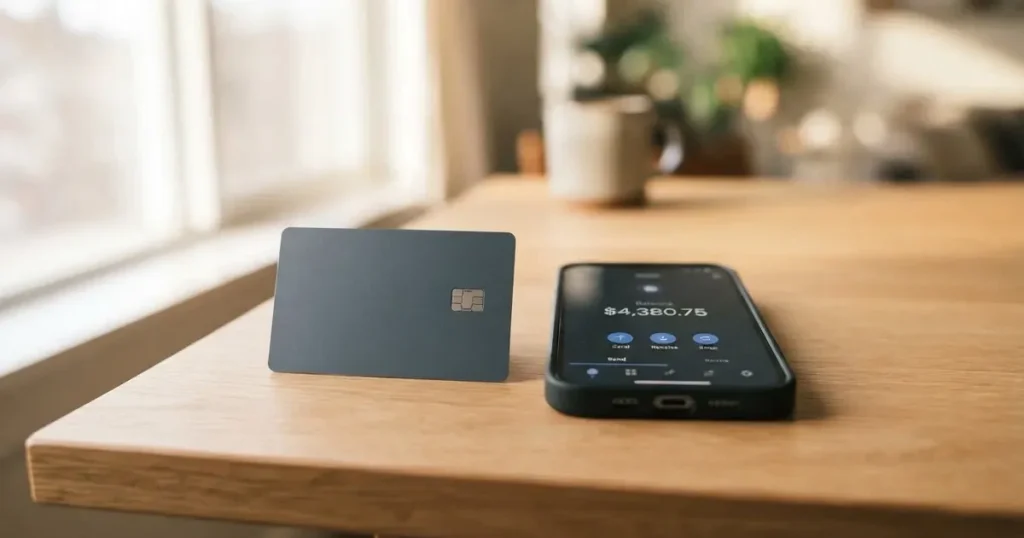
SafePal is best known as a self-custody crypto wallet, and in recent years it has bolted on a card that spends straight from that crypto balance. That part is genuinely nice: no annual fee, no management fee, a 0% standard top-up fee, and a list of supported networks in the dozens. But the card arrives wrapped in a lot of things the marketing pages do not put up front — a Swiss IBAN run through a partner called Fiat24, an unnamed card issuer, a 1% fee every time the Mastercard settles in a currency other than USD, a licence requirement for KYC that runs through the same partner, and a 2026 data breach at the wallet level that leaked order information on roughly 39,798 customers. Add a Trustpilot score of 3.1 out of 5 from 394 reviews, and you get a picture of a product that is cheaper than most and less settled than most.
I scored it 6.2 out of 10. That is not a rounding error either side — it is a card that does the basics without charging you for them, wrapped in a service with real reliability marks against it and one fee that quietly follows you around every time you pay somewhere that is not America.
Who it suits: you already hold SafePal’s own token and want a Swiss IBAN alongside your wallet, or you spend in one of the currencies the account can hold natively so the 1% never bites. Who it does not suit: anyone who needs a physical card in the post, anyone who wants a card for spending while travelling across many currencies, and anyone for whom a partner handles the KYC and holds the balance rather than their own bank.
The conditions described on this page are current as of October 28, 2026.
| Criterion | Mark | Why |
|---|---|---|
| Who can get it | 5 / 10 | Citizens of supported regions who live in supported areas — and the regions page listed no names when I checked |
| Cost | 8 / 10 | No creation or management fee, 0% standard top-up, but 1% on Mastercard settlement outside USD |
| Top-up options | 9 / 10 | Crypto from 40+ blockchains, converted to USDC by default; activation costs 10 USDC on Arbitrum |
| Reliability and complaints | 4 / 10 | Swiss IBAN via Fiat24 with no named issuer; a 2026 data breach; Trustpilot 3.1 from 394 reviews |
| Everyday use | 5 / 10 | Virtual Mastercard with Apple Pay, Google Pay, Samsung Pay and PayPal; no physical card described |
| Total | 6.2 / 10 | Cheap on paper, unsettled underneath |
Will they give you the card?
Here is the first thing to check, and for most readers it is the thing that ends the enquiry. SafePal’s own wording is that the card is for “citizens of supported regions who live in supported areas”. That is the whole eligibility statement. When I fetched the supported-regions page, the headline “Supported regions for SafePal Fiat gateway” listed no names, and the list at the address the help section points to came back empty. The same page still carried limits, though — $100,000 per month with Mastercard, $1,000 per month without — which tells you the gate exists even when the contents do not load.
So the honest answer to “will they give me the card?” is: citizens of supported regions, living in supported areas, and nobody can tell you from the public pages which those are right now. If you are outside the regions they serve, your enquiry goes nowhere useful. If you are inside them, the KYC process below decides it.
Note the citizenship half of that sentence. Residence and nationality are screened separately in this industry, because sanctions screening and issuer risk policy are applied to citizenship and country of birth as well as to country of address. A residence-based list alone would not tell the whole story.
One more practical limit on the same point: the account limits are $100,000 per month with Mastercard and $1,000 per month without. If you are one of the readers who wants to move real money through this, the $1,000 figure is the one to notice.
How to get it
There is no credit check and no staking requirement — that much is stated plainly. What you cannot skip is KYC, which is required by licence and regulator, and which SafePal hands to Fiat24 rather than running itself. That distinction matters more than it sounds, because the moment you are verified by a partner, a partner holds the account.
What the KYC actually involves, as described in the KYC FAQ:
- Email and phone verification
- An address check requiring a residential address within 2 km of your current location, with location access enabled on your device
- A passport scan taken in the ReadID Ready app
- Passport is the only identity document named
- SafePal app 4.5.0 or newer
- At least 0.0001 ETH on Arbitrum
Three things the public pages do not state, and you should not assume: processing time, minimum age, and the reasons an application can be rejected. Where a regulator expects age to be assessed, cards in this category generally go to adults of 18 and over, some issuers with higher limits — but SafePal does not publish its own figure, so treat that as background rather than as a SafePal rule.
The card itself is a virtual Mastercard debit. Spending limits are given in EUR because the underlying account is a Swiss Fiat24 account. Nothing on the public pages describes a physical card, and there is no physical card article in the Banking Gateway help section. Third-party listings agree with that: cryptocardhub.com reported a virtual-only card on 11 August 2026, and the DefiLlama card form lists it as Virtual. Treat both as unofficial — they are not confirmed by the card — but they are consistent with what SafePal’s own pages describe, which is that this is a card you add to your phone.
Fees
The headline numbers are genuinely good, and the fee that will actually cost you money is not the one the headline advertises. Here is everything I could find, and I want to flag one gap explicitly rather than paper over it: the card issuance fee is not stated. If a virtual card costs something to set up, SafePal has not published it.
| Fee or limit | Value |
|---|---|
| Account creation | No charge |
| Account management | No charge |
| Card issuance | Not stated |
| Standard top-up | 0% |
| Crypto top-up, top tier | From 0.4% on the bank page |
| Deposit rate cited in the tier article | Standard 1% |
| Mastercard settlement outside USD | 1% FX fee |
| Refund processing | 1 USD / 1 EUR / 1 CHF / 7 CNH per refund |
| Swaps | Include a spread, not quantified |
| Payments in an enabled currency | No exchange fee |
| Enabled currencies with zero FX fee | EUR, CHF, USD, CNY |
| ATM withdrawals | Not stated |
| Contactless limit | 1,600 EUR/day |
| Other payment methods | 5,000 EUR/day |
| Monthly limit | Equals the transaction limit |
| Regions page monthly limits | $100,000 with Mastercard, $1,000 without |
Two of those rows contradict each other on the surface — a 0% standard top-up in one article, a standard 1% deposit rate in the tier article, and 0.4% on the top tier on the bank page. The reconciliation is the tier system, which I come back to below. Third-party sources tell the same story from outside: cryptocardhub.com and the DefiLlama card page (verified 28 September 2026) both report no opening, management or virtual-card fee, with the main cost being the 1% FX fee. Unofficial, but aligned with the card’s own material.
Now the three everyday payments, because that is where the fees stop being abstract.
Coffee abroad. You tap for a coffee in a country that is not the United States. The Mastercard settles in a non-USD currency and takes 1%. If the account holds EUR as an enabled currency, no exchange fee applies on top — but the 1% is a settlement fee, not an exchange fee, and it is separate. This is the line item that decides whether the card is worth carrying.
An online subscription billed in dollars. No 1%, because settlement is in USD. The catch is that the payment is funded from a stablecoin balance, so a swap may be involved, and swaps carry a spread that is disclosed but never quantified.
A refund. You cancel something and the money comes back less 1 USD, 1 EUR, 1 CHF or 7 CNH in processing. On a €3 refund you are paying a meaningful share of it.
There is a currency layer worth understanding before you transfer any money. The Swiss IBAN accounts hold fiat, and you enable the currencies you actually use. A payment in an enabled currency carries no exchange fee; otherwise the default currency is used. Zero FX fees apply for EUR, CHF, USD and CNY. What you cannot do from the public pages is find out how to fix the default currency, or what happens when the currency you need is one you have not enabled.
ATM withdrawals: SafePal does not state a fee or a limit. DefiLlama’s card page says “ATM withdrawals: Yes” with nothing else — dated 28 September 2026, and unofficial. cryptocardhub.com says there is no physical card at all, virtual only. The sources conflict, which is what I would expect from a virtual card, and I would not plan around cash withdrawals with this card.
The tier system, and where the 0% goes
Account tiers run on points, and this is the piece that explains the fee figures above. The tier is set on the 1st of each month from the points accumulated over the previous three months. Opening the IBAN account gives 1,500 points. Higher tiers earn a rebate on top-up fees — the worked example in the docs is Silver, which pays a standard 1% deposit and gets 0.1% back — and reduced fees when buying USDC with the Mastercard. Staking $SFP raises the level, with a 90-day lock and no early redemption. Referral commission depends on tier as well.
Read that carefully before you plan around a 0% top-up: it is the standard rate that is 0%, and the 0.4% figure is a top-tier figure. Staking $SFP for 90 days with no early exit is a real commitment, not a setting.
Top up
This is the strongest part of the product and it earned 9 out of 10. Crypto arrives from 40+ blockchains and is converted to USDC by default, or to fiat if you prefer; the transactions run on Arbitrum. For someone already holding a spread of assets across chains, that is the reason to look at this card at all.
Activating the Mastercard is the one catch. It requires a deposit of 10 USDC on Arbitrum, plus ETH to pay the gas — from a help article dated 25 July 2026. The sender pays the blockchain gas, which is the network’s cost, not SafePal’s.
What the top-up fee structure looks like across the sources:
| Route | Fee | Source |
|---|---|---|
| Standard top-up | 0% | Fee article |
| Crypto top-up, top tier | From 0.4% | Bank page |
| Deposit rate in the tier article | Standard 1% | Tier article |
| On-ramp / deposit waiver | Zero-fee waiver while SafePal’s program runs; terms can change | Fee article |
| Ethereum network gas | Paid by the sender in ETH | Network, not the provider |
The zero-fee waiver deserves a flag rather than a plan. A waiver that runs “while SafePal’s program runs” is not a fee schedule; it is a promotion with no end date written on it.
Getting money back out is thinner on paper than getting it in. Transfers between accounts inside the IBAN are free. Transfers to external banks carry no SafePal or Fiat24 fee, though other banks may charge their own. There are help articles on payout transfers. What is not stated: the steps for withdrawing back to crypto, and what happens to the balance if you close the account. If you are considering closing an account, ask both questions before you do.
Paying with it every day
Day to day, this behaves like a normal card in the ways that matter and like something else in the ways that do not.
It works with Apple Pay, Google Pay, Samsung Pay and PayPal. Apple Pay is the tidiest route: the card number is replaced by a device-specific Device Account Number held in the Secure Element rather than on Apple’s servers, and each payment carries a one-time dynamic code — so there is no card number to photograph and no magnetic stripe to worry about. The issuer can also restrict a tokenised number, blocking it on particular channels, which is a feature when something goes wrong and a puzzle when nothing does.
There is no cashback. What stands in its place is a rewards structure built on referral commissions of up to 40% of referred top-up fees, plus tier privileges tied to deposits, referrals and $SFP staking. Read that as a scheme that pays you for bringing other people in, not as a rebate on your own spending.
The app is the part you will actually touch. The iPhone and iPad app requires iOS 15.0 or newer and was at version 4.11.12 on 12 October, with an App Store rating of 4.7 out of 5 from 17K ratings — though that is the wallet’s rating, not the card’s, and the Google Play rating was not read. The interface includes Russian alongside English and thirteen other languages, which is worth knowing if support ever becomes your route out of a problem.
Two things the card pages leave unsaid. Which merchants are blocked is not stated, so you will find out at the till rather than in advance. And the card control itself is good: you can freeze and unfreeze the card and view transactions in the app, and set a custom spending limit — the standard safeguards, along with app-based 2FA and 3-D Secure on online payments.
One category to expect trouble with, in the industry rather than on this card specifically: gambling. MCC 7995 covers casinos, betting and lotteries, and many issuers block it on specific cards by policy rather than by law, with the blocked list differing between issuers. SafePal does not publish its block list, so treat gambling as out of scope.
Refunds cost 1 USD, 1 EUR, 1 CHF or 7 CNH each. Failed registrations and banned accounts are routed to Fiat24’s support rather than SafePal’s.
What can go wrong
This is the section where SafePal loses most of its points, and it is worth reading even if you have already decided.
The 2026 data breach. SafePal disclosed a breach exposing order information of approximately 39,798 customers. Per SafePal, no seed phrases, keys, card numbers or identity documents were exposed. Order information is still customer information. Ahead of the statement, users reported phishing using accurate personal data in early July — that is, weeks before anyone was told.
The IBAN and the missing issuer. The Swiss IBAN and fiat gateway run with Fiat24, which handles compliance and licensing. The card issuer is not named. For a card, that is a real gap: the issuer is the institution you would approach in a dispute, and SafePal’s pages do not tell you who that is.
What users actually report. Trustpilot for safepal.com reads 3.1 out of 5 from 394 reviews — 57% five-star and 37% one-star, with the company answering 93% of negative reviews. That answering rate is genuinely decent, and the complaints are still specific:
- Between February and September 2026, swaps and withdrawals shown as completed in the app but not arriving
- May 2026, a Fiat24 refund received with roughly 20% missing, with the user told to contact Fiat24
- July to September 2026, phishing and scam calls using order details
- June to July 2026, email-only support with copy-paste replies
One review claims crypto was removed without consent. Reddit threads raise delayed transactions and slow support. An important qualifier: none of the reviews mentions the card or the IBAN directly — this is wallet-level feedback, and the same 3.1–3.5 band appears across two different review counts, so treat the number as a range of sentiment rather than a precise reading.
Who holds the money. This is the part I would want a non-technical reader to hold onto. Control of crypto belongs to whoever holds the private key. With a custodial wallet the provider holds the credentials and you must trust them completely; with a self-custody-linked card the funds stay in your own wallet until the moment of payment, and you alone carry the risk of key loss, phishing, and clipboard-hijacking malware that swaps a copied address. SafePal says its own wallet is non-custodial — that is their position in Trustpilot replies — while Fiat24, the Swiss partner, runs the KYC and the account. That split is not a contradiction, but it does mean two parties stand between you and your balance, and blockchain transfers are irreversible either way: the network cannot freeze or return funds.
The licence side. Fiat24 is an electronic money institution in the Swiss sense of the model. EU EMI rules are the useful analogy: an EMI may issue e-money, payment cards and wallets but cannot lend, and must safeguard customer funds by segregating them in dedicated accounts or insuring them. Those funds are not bank deposits and may not sit inside a deposit guarantee scheme. Nobody has told me SafePal’s card funds are insured — insurance is simply not stated — so do not assume a bank-level protection you have not seen written down.
The sector’s own history is the caution here. Card programmes do close. WaveCrest, a Visa issuer that supplied crypto card brands, was suspended by Visa in Europe in 2018, closing every WaveCrest-issued Visa programme. In November 2022 Visa said it had “terminated our global agreements with FTX” and the FTX US debit card was wound down by its issuer. Programme closures typically give a notice period, then stop spending and loading, then ask you to withdraw. And Visa and Mastercard do not issue crypto cards to consumers themselves — they license issuers, and they can suspend a programme.
Support and access. Email support and a request form through a Zendesk help centre; Fiat24 account problems go to a Telegram bot at t.me/fiat24bot. Hours are not stated. The support channel includes a specific anti-impersonation measure, which tells you impersonation is happening — and the phishing calls reported last summer used real order details.
A live operational note. In March 2026 SafePal’s own blog said the fiat on-ramp was disabled until further notice, though the crypto on-ramp through third parties like MoonPay still worked. That is the kind of one-line announcement that matters enormously to anyone planning to fund by bank transfer, and it is exactly the reason I would not treat any of the fee figures above as permanent.
The background behind all of it
A few things worth knowing about this whole category, because they explain the shape of the card.
The card number starts with a six or eight digit issuer identification number, and merchants can look it up to see which institution and country issued the card — and apply extra scrutiny if the issuer country differs from the billing address. This is why a card issued in one country looks “foreign” in another, and why some shops decline prepaid or foreign BINs. Address verification, which compares the numeric parts of the billing address a buyer types with issuer records, is mainly offered in the US, Canada and the UK and is generally unavailable for foreign-issued cards, which can cause declines.
Most crypto cards behave like prepaid cards drawing on a stored balance: you convert or top up a fiat or stablecoin balance first, and the card cannot overdraw. That is a genuine comfort. It also means a declined authorisation can leave a hold on your funds for several days, typically up to seven.
On regulation, the EU’s markets-in-crypto-assets regulation (MiCA, Regulation (EU) 2023/1114) took legal effect in June 2023; its rules on stablecoins applied from 30 June 2024 and the remaining provisions, including crypto-asset service provider rules, from 30 December 2024. The transitional period lets providers already operating under national law continue only until 1 July 2026 or until they receive or are refused a MiCA authorisation, whichever comes first — which is precisely why a Swiss partner sits in this arrangement. ESMA keeps an interim register of authorised providers, white papers and non-compliant entities, and it is worth a look before you commit. A card is a payment service regulated separately from the crypto side, so a product like this often rests on two licences. In the US, FinCEN guidance treats administrators and exchangers of convertible virtual currency as money transmitters, while ordinary users buying goods are not.
Stablecoins are the fuel here, and they are not what the name suggests. The BIS in July 2025 put about 90% of stablecoin market capitalisation in Tether’s USDT and Circle’s USDC. Circle says USDC is redeemable 1:1 for USD and fully backed by cash and cash equivalents with monthly reserve attestations by a Big Four firm, and lists it as natively supported on 38 networks as of 16 September 2026. But stablecoins can depeg — TerraUSD collapsed in May 2022 and USDC temporarily lost its peg in March 2023 — and Tether says it disables tokens in wallets on the OFAC sanctions list and has frozen funds tied to illicit activity. They are not censorship-proof.
One network detail that catches people: gas on Ethereum-based chains is paid only in ETH, so a wallet with USDT but no ETH cannot send. Tron prices fees through bandwidth and energy, often burning TRX, and Circle stopped supporting USDC on Tron in February 2024, so “USDC over TRC20” is not a native option. And a deposit sent on a network the provider does not support, or to an address belonging to a different network, can be lost or need manual recovery with no guarantee.
On tax, one thing only, because it is not advice and I am not qualified to give it: the IRS treats digital assets as property, so exchanging them for goods, services or dollars generally produces a taxable gain or loss, measured in local fiat currency at fair market value on the date of the transaction. Each card payment funded from crypto may therefore be a separate disposal. Please take that to someone who can advise on your situation.
What to take instead
None of these are unambiguously better. They are differently shaped, and if your reason for wanting a card is “no ordinary bank card for me”, the right comparison is usually not card to card but cost against the fee you were quoting yourself.
| Card | Score | Card type | Standout costs | Notable |
|---|---|---|---|---|
| SafePal | 6.2 / 10 | Virtual Mastercard, Swiss IBAN via Fiat24 | 1% Mastercard FX outside USD; top-up from 0% standard to 0.4% top tier | 40+ chains; Apple Pay, Google Pay, Samsung Pay, PayPal |
| TokenPocket | 5.8 / 10 | Visa/Mastercard debit, Arbitrum, Fiat24 cards virtual | 1% on crypto deposit, refunded later via rewards; NFT creation fee partly covered | No cashback stated; balances in EUR24 and USD24 |
| MetaMask | 7.1 / 10 | Mastercard, virtual instant then optional metal | Virtual free, no annual or maintenance fee; metal $199/year | 1% cashback in mUSD on Virtual, up to 3% on Metal within stated caps; Linea, Base, Monad, Solana |
| KAST | 6.1 / 10 | Virtual and physical, Visa, up to 10 cards | Standard 0 USD/year; Premium 1,000 USD/year; Private 10,000 USD/year; non-USD FX 0.5%–1.75% | 1.5%–3% USD cashback by tier; USDT, USDC, PYUSD, RLUSD |
TokenPocket is the closest structural comparison — also on Arbitrum, also Fiat24 virtual cards — which means the same issuer questions follow it. Its eligibility is clearer than SafePal’s: Visa debit for a list of European countries and territories including Germany, France, Spain and Switzerland; Mastercard debit for Australia, Canada, Hong Kong, Japan, Taiwan, New Zealand, Singapore, South Korea and the UK among others; the Americas described as planned for Q2 2025. It charges 1% on crypto deposits into the card, refunded later through rewards and reduced transaction fees, plus an NFT creation fee partly covered by TokenPocket where you pay “a small portion” — amount not stated. It scores lower than SafePal, 5.8 against 6.2, largely on cost.
MetaMask scores highest at 7.1 and is the one I would point at if you want a plain, well-expressed card. Sign-up is open in 45 listed countries and territories with proof of residency, while other regions join a waitlist; citizenship rules are not stated, and US and UK sign-ups were temporarily closed per its FAQ. Ineligible regions limit sign-ups, not spending. The virtual card is free with no annual or maintenance fee; metal is $199/year, one card per user, issuer Monovate and card provider Crypto Life, card currency not stated. It spends directly from the connected wallet across Linea, Base, Monad and Solana, with mUSD, wETH, EURe, GBPe, USDC and USDT named — though Solana-only wallets cannot withdraw credit. Fees are described as “minimal” per transaction with no additional MetaMask fees and no foreign transaction fee, though the amount is not stated on the pages read. The cashback is real: 1% in mUSD on Virtual, a Metal headline of 3% limited by footnote to the first $10,000 spent then 1%, plus a $FLY bonus of 5X or 7X via a dining app.
KAST is the one to consider if you want a physical card and a published cashback figure. Residence-based eligibility is shown at KYC, the country list is not published, and the citizenship rule is explicit in a way SafePal’s is not: living in a supported country with only an ID from a restricted region may still fail KYC, dual citizens with a supported-country ID may pass, only the account holder’s own ID is accepted, and a VPN does not bypass it. You can create an account in an unsupported country but KYC stays locked. Cards run from Visa Platinum to Visa Infinite metal, with up to ten per user. Pricing is tiered and steep above Standard: 0 USD/year, then Premium at 1,000 USD/year and Private at 10,000 USD/year billed annually upfront, with a 2 USD extra virtual card in some regions, 40 USD delivery on the Standard physical card, and a 1 USD monthly inactivity fee after twelve months. Fees are otherwise unusually clean — stablecoin top-up 0%, USD spend 0%, Apple and Google Pay 0% — with non-USD FX at 0.5%–1.75% depending on where you live, where you spend and which card programme, and cashback of 1.5% on the first 2,000 USD/month at Standard, rising to 3% on the first 40,000 USD/month at Private. It scores 6.1.
If you want the Swiss IBAN specifically and already hold SafePal’s token, none of these beats SafePal. If you want the cleanest everyday card, MetaMask’s 1% cashback and free virtual card are harder to argue with. If you want cash in hand, KAST is the only one here that describes a physical card.
Who I would recommend it to
Three groups, in order.
You already hold SafePal’s own token and want a Swiss IBAN attached to your wallet, with crypto arriving from 40+ chains and a plan to spend in EUR, CHF, USD or CNY so the 1% settlement fee never applies. For you the tier system is not overhead — staking $SFP for 90 days with no early exit is a reasonable trade for 0.1% back on a 1% deposit and reduced fees on USDC purchases.
You already hold crypto across several networks and want a card that spends it directly without a conversion step in a browser tab. The top-up story is the best in this comparison and the Arbitrum activation is a one-off 10 USDC.
You are comparing this against a mainstream bank card and have decided the fees here are better. On cost alone, SafePal scores 8 out of 10 and that is deserved: no creation fee, no management fee, 0% standard top-up, and no ATM or issuance fee disclosed. What you are accepting is an unnamed card issuer, a Swiss partner running your KYC, and a 1% that follows every non-dollar payment.
And the group I would not recommend it to, plainly: anyone who needs a physical card in the post, since no physical card is described anywhere on the public pages. Anyone planning to withdraw cash, since the ATM position is not stated by SafePal and third-party sources contradict each other. Anyone who spends across many currencies, since the 1% Mastercard fee is exactly the case it was built for. Anyone who takes a 3.1 out of 5 from 394 reviews as disqualifying — that is a fair position, not a foolish one. And anyone who wants to know who the issuer is before signing up, because SafePal does not say.
My own verdict is this: the product is priced well and the infrastructure around it is unsettled. Before you commit, three questions are worth more than any fee table. Which regions are actually supported right now, given that the page listing them was empty when I checked. Whether Fiat24, not SafePal, is the institution holding your balance and running your account. And what happens to the balance if you close it, which the pages do not address.
Frequently asked questions
What is the SafePal card?
It is a virtual Mastercard debit card that spends from your SafePal crypto balance, sitting on a Swiss IBAN account run with a partner called Fiat24. You add it to Apple Pay, Google Pay, Samsung Pay or PayPal. SafePal itself describes only a virtual card — no physical card appears on its public pages — and it does not name the card issuer.
How does the SafePal card work?
You transfer crypto from any of 40+ supported blockchains, it is converted to USDC by default or to fiat, and the balance sits behind the card. Activating the Mastercard requires a deposit of 10 USDC on Arbitrum plus ETH for gas. Spending limits are published in EUR because the underlying account is a Swiss Fiat24 account.
Is SafePal a bank?
No. SafePal is a crypto wallet company. The IBAN and the fiat gateway come through Fiat24, which handles compliance and licensing, and SafePal does not name the card issuer. That distinction matters: funds held through an electronic money institution are not the same as bank deposits, and no insurance is stated for this card.
Who owns SafePal?
SafePal is a self-custody wallet company that has expanded into card and fiat services. Its own pages position the wallet as non-custodial, meaning you hold the keys, while the card account and KYC are operated by Fiat24. If you are asking who stands behind your card balance specifically, the published answer is Fiat24, with the card issuer unnamed.
Does the SafePal card require KYC?
Yes, and the regulator and licence require it. SafePal hands the process to Fiat24: email and phone verification, an address check needing a residential address within 2 km of your location, and a passport scan in the ReadID Ready app. No credit check and no staking are required. Processing time, minimum age and rejection reasons are not stated on the public pages.
What countries is the SafePal card available in?
SafePal says citizens of supported regions who live in supported areas. When I checked, the supported-regions page carried no country names and the list it points to came back empty, while still showing limits of $100,000 per month with Mastercard and $1,000 without. Check the regions page yourself immediately before applying, because that is the gate and it is not currently readable.
How much does the SafePal card cost?
There is no account creation or management fee and the standard top-up is 0%, with crypto top-up from 0.4% on the top tier and a rebate at higher tiers. The cost that bites is a 1% fee when the Mastercard settles outside USD, and 1 USD, 1 EUR, 1 CHF or 7 CNH to process a refund. ATM fees and the card issuance fee are not stated.
Is the SafePal card safe?
It carries the ordinary safeguards — freeze and unfreeze in the app, custom spending limits, 3-D Secure and tokenised mobile wallets — but it also carries the category’s risks. SafePal disclosed a 2026 breach exposing order information on roughly 39,798 customers, phishing using accurate personal data was reported ahead of that statement, and the card issuer is not named. No insurance is stated, so do not assume bank-level protection.
Can I use the SafePal card in my country?
Wherever Mastercard is accepted, in principle — the card is a normal Mastercard. The practical limits are elsewhere: the 1% fee on non-USD settlement, foreign BINs sometimes declined because a shop can look up the issuing country, and which merchants are blocked is not stated, with gambling commonly blocked at issuer level. Check eligibility first, because that list was empty when I looked.
Is the SafePal card worth it?
For someone who already holds SafePal’s token, wants a Swiss IBAN, and spends in EUR, CHF, USD or CNY, I think yes — the fee structure is the strongest in this comparison. For anyone who needs a physical card, plans to use ATMs, or travels across many currencies, no. With a Trustpilot score of 3.1 from 394 reviews and a 2026 data breach in the record, weigh the service risk before the fee table.
Choosing a wallet card – cryptocardadvisor
Content created by the «cryptocardadvisor» team