
A wide-network crypto card with a quiet fee line and a noisy complaint file
 Available in US

Kolo is a crypto card in the pre-loaded-balance mould: you send crypto to it, it converts what it can, and you spend the resulting balance through a virtual card number that behaves like an ordinary Visa card in the places that accept one. The top-up side is genuinely broad — any crypto, several networks drawn as logos on the site, an in-app swap — and that is where the card earns its strongest mark. The spending side is where the caution lives. The conversion and foreign-exchange costs are not stated in the terms in a way you can price before you pay, and the public card pages do not reconcile the official line with the numbers third-party reviewers measured. Add an operator that has changed hands three times in a year and a complaint file centred on blocked withdrawals and unexplained closures, and you get a service I would call promising on paper and rough at the edges.
This review is written for a person who wants an everyday payment card and finds ordinary bank cards hard to get — in a country with weak banking access, a poor credit history, a residence or documentation problem, or simply no appetite for a traditional account. If that is you, Kolo is genuinely one of the more interesting options in this category, and I will tell you exactly where it works and where it does not. If instead you already have a normal debit card with a normal interchange rate, the numbers below will make it obvious that this is not a way to save money on ordinary spending.
The conditions described here are current as of October 28, 2026. Where a fact comes from the card’s own terms or site I have said so; where it comes from a third-party site I have marked it unofficial and unconfirmed, because the card’s public pages do not state it.
The score, and who I think it suits
Kolo scores 6.4 out of 10. That is a middling number, and it is worth being precise about where the middle sits: the card is good at one job — getting crypto onto something you can tap — and unremarkable or shaky at everything around it.
| Criterion | Mark | Why |
|---|---|---|
| Who can get it | 7 / 10 | Service in 170+ countries, card works in 60+; only embargoed and sanctioned countries are excluded |
| Cost | 7 / 10 | Officially 1% exchange plus network costs; unofficially free issuance, $0 monthly, 1% conversion on payments, ATM $1 + 0.65% |
| Top-up options | 9 / 10 | Any crypto; BTC, ETH, LTC, USDT, USDC and others; seven networks shown as logos, including Tron, Solana and Base; in-app swap |
| Reliability and complaints | 4 / 10 | Operator changed three times in a year, issuer not named (Signify/Rain partner), complaints about blocked withdrawals and closed accounts (Trustpilot 3.7) |
| Everyday use | 5 / 10 | Apple Pay and Google Pay present; unofficially virtual only, plastic announced with no dates, no ATM on the virtual card |
The audience this card is built for is narrow and specific: someone who wants a virtual card funded with any crypto across many networks, and who treats the card as a bridge rather than as a main account. For that person the top-up breadth is worth a lot. For someone who wants a card they can leave in a shop for nine years, the changing operator and the unnamed issuer are reasons to keep only a small balance on it.
Will they give you the card?
Yes, in most countries — with a list of exclusions that is written broadly and applies to nationality as well as residence, which is the detail worth reading twice.
The official terms bar anyone who is in, controlled from, or a national or resident of Cuba, Iran, North Korea, Sudan or Syria, or any other country under US embargo, UN, EU or HM Treasury sanctions, as well as listed sanctioned persons. The rule explicitly covers both nationality and residence, so it is not only where you live but what passport you hold. The site says the service runs in “170+” countries and the card works in “60+”, with the country list at kolo.xyz/countries; the terms text I read does not mention the third-party US restriction that had been reported elsewhere, so I would not rely on US availability either way.
Two things the public pages do not tell you: proof of address and age requirements are not stated, and there are no named verification tiers, per-tier limits, processing times or published rejection reasons. What the terms do say is that limits depend on “verification steps you have completed”, that enhanced due diligence may be required to raise them, that Kolo may refuse or later lower limits, and that a suspicion of fraud can trigger enhanced verification.
> One unofficial detail worth knowing: for the EUR card, additional verification including proof of address may be required (reported by SpendNode, October 2026). The card’s own terms do not say this.
How to get it
Full identity verification is required, through Sumsub — the flow is described as taking about a minute — plus two-factor authentication. Extra documents may be required if you want higher limits.
The card is provided in collaboration with Signify Holdings Inc (Wilmington, Delaware; Rain cards, raincards.xyz), according to the terms. What form the card takes, which network runs it and what currency it settles in are not stated in the official material I could find; the site’s FAQ only says it works wherever Google Pay, Apple Pay, or Visa and Mastercard are accepted. Unofficially, it is a Visa network card, virtual only — USD, and EUR as Visa Platinum — and a physical card is advertised for Q3 2026 with no ordering schedule (CryptoCardHub, September 2026; SpendNode, October 2026, which describes the product as Visa Platinum, virtual only).
Delivery is likewise not stated officially. Unofficially, virtual cards are issued inside the app or the Telegram mini-app and added to Apple Pay or Google Pay, with physical delivery unscheduled. Neither of those third-party sources is the card speaking, and the card has changed its own product shape before, so I would treat the plastic as a rumour with a quarter attached.
What it really costs: Fees
The short version: the exchange fee is official and clear, the card-spending fee is not. That asymmetry is the single most important thing in this review.
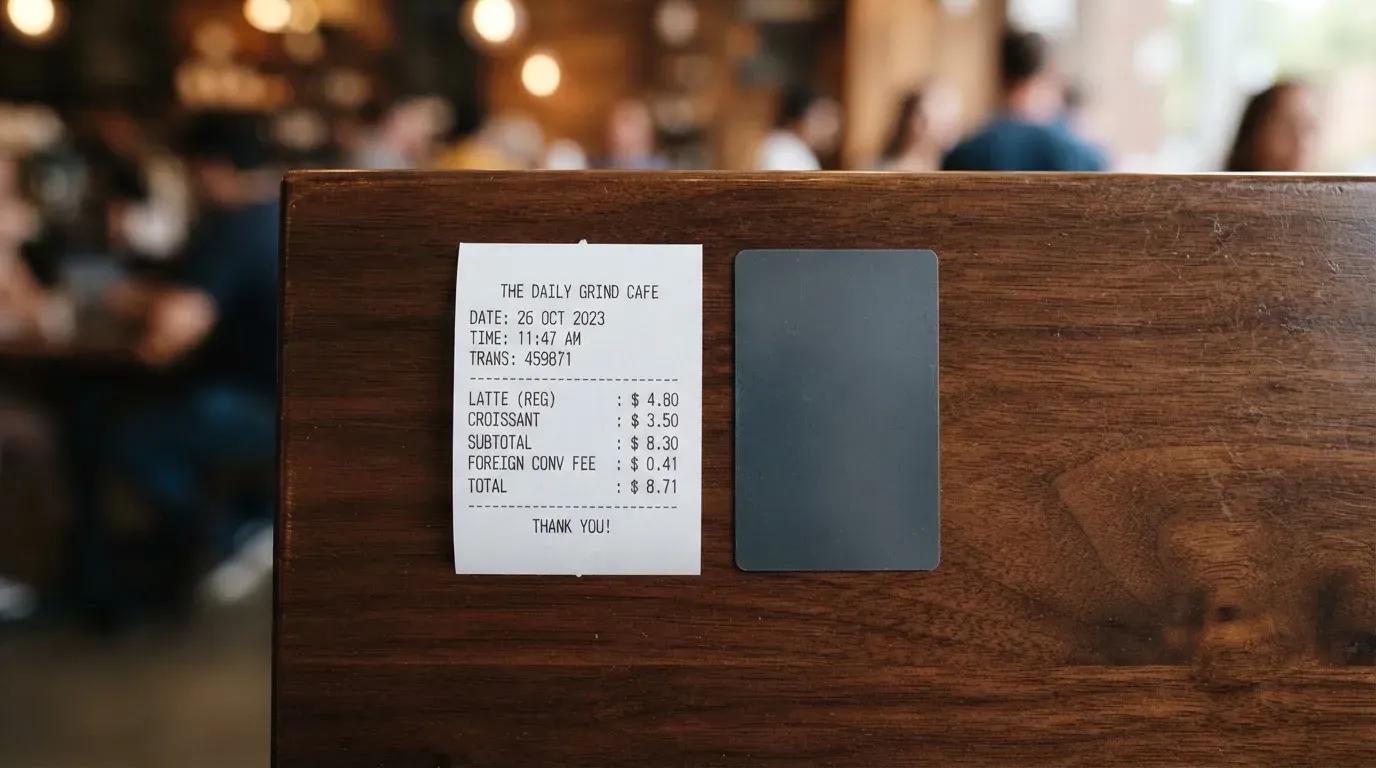
The official terms put the base fee for exchange orders — the buy, sell or swap of digital assets — at 1% of the order plus network and bank costs, shown before you confirm. The site adds that there are “0% mark-ups on USDT, USDC, EURC” and that crypto top-ups are converted “for no extra fee”. Card foreign-exchange fees and card-payment fees are not stated in the official material, and the site and the terms do not reconcile on the stablecoin case.
| Fee or limit | Officially stated | Unofficial, not confirmed by the card |
|---|---|---|
| Issuance | Not stated | Virtual issuance free |
| Monthly fee | Not stated | $0 per month, $0 annual |
| Activation | Not stated | Needs $10 / EUR 10 balance, which stays on the card balance |
| Crypto exchange order | 1% of the order plus network/bank costs | — |
| Stablecoin mark-up | “0% mark-ups on USDT, USDC, EURC” on the site | Sources disagree on whether stablecoin-funded payments pay the 1% |
| Card payment conversion | Not stated | 1% Kolo conversion fee on all card payments, including stablecoin-funded ones |
| Foreign exchange on a USD card | Not stated | Visa rate plus 1% |
| Purchase at a non-US merchant on a USD card | Not stated | Extra 1% issuer fee |
| Foreign exchange on a EUR card | Not stated | Visa rate plus 0.55% / 0.65% / 1.35% by currency |
| Measured all-in FX cost | Not stated | About 1.40% against mid-market (SpendNode, October 2026) |
| ATM withdrawal | Not stated; site and terms do not mention ATM | $1 + 0.65% per withdrawal |
| ATM limits | Not stated | $500 per withdrawal, 3 per rolling 24 hours (CryptoCardHub); $250 per withdrawal, 3 per 24 hours (Bleap, 2026) |
| ATM balance inquiry or declined attempt | Not stated | $0.60 |
| ATM availability | Not stated | Not available on the virtual card; planned for the physical card |
| Daily and monthly limits | Volume limits per period vary by payment method and verification level; shown after login; no numbers published; raises on request to [email protected] | — |
| Card tiers or plans | None — no tiers, plans or metal card on the site or in the terms | — |
| Card currency and balances | Not stated; the site only says payments convert to local currency at the point of sale | Settles in USD or EUR subject to country eligibility; spendable assets listed as USDT, USDC, DAI, EURC, EURI, BTC, ETH, SOL, BNB, LTC, DOGE, TRX |
Now, three everyday payments, and which of those lines actually touches them.
Coffee in your own currency, funded from a stablecoin. Unofficially this is the case the sources disagree about. CryptoCardHub reports a 1% Kolo conversion fee on all card payments including stablecoin-funded ones; the site’s own claim of 0% mark-ups on USDT and USDC points the other way. SpendNode repeated the 0% claim and separately measured all-in foreign exchange at about 1.40% against mid-market. If the site is right, a stablecoin-funded purchase in your own currency costs roughly nothing beyond the Visa rate; if the third-party fee table is right, add 1%. Nobody has published a reconciled figure, and that is exactly why I would not budget from either.
A purchase from a non-US merchant with the USD card. Here the unofficial numbers stack: the Visa rate, plus 1% conversion, plus a further 1% issuer fee for a USD purchase at a non-US merchant. That is the shape of a purchase that quietly costs more than the sticker price.
Withdrawing cash from an ATM. You cannot do this on the virtual card, which is the version most people would actually get. Unofficial figures for the physical card are $1 plus 0.65% per withdrawal, with a $500 cap per withdrawal and three in any rolling 24 hours, and $0.60 for a balance inquiry or a declined attempt. One 2026 review puts the per-withdrawal cap at $250 instead of $500 — the sources disagree on a number that matters if you ever need cash in an emergency.
The minimum top-up, who pays the on-chain network fee, and the fees on any bank-transfer or card top-up route are not stated. Unofficially the floor is the $10 / EUR 10 activation balance, no top-up fee is published, and on-chain gas may apply. One structural point worth holding onto: the network fee for your deposit is charged by the blockchain, not by the card provider, so you cannot expect the card’s 1% to cover it.
How to Top up the card
This is the part I like most, and the part where the card is genuinely better than most of its category. Any crypto will do — BTC, ETH, LTC, USDT and USDC are named, there is a swap inside the app, and seven networks are shown as logos that appear to include BNB Chain, Ethereum, Sui, Tron, Base and Solana, with one unlabelled. If your money is sitting on Tron or Solana or Base, this card will probably take it directly rather than making you bridge it somewhere first.
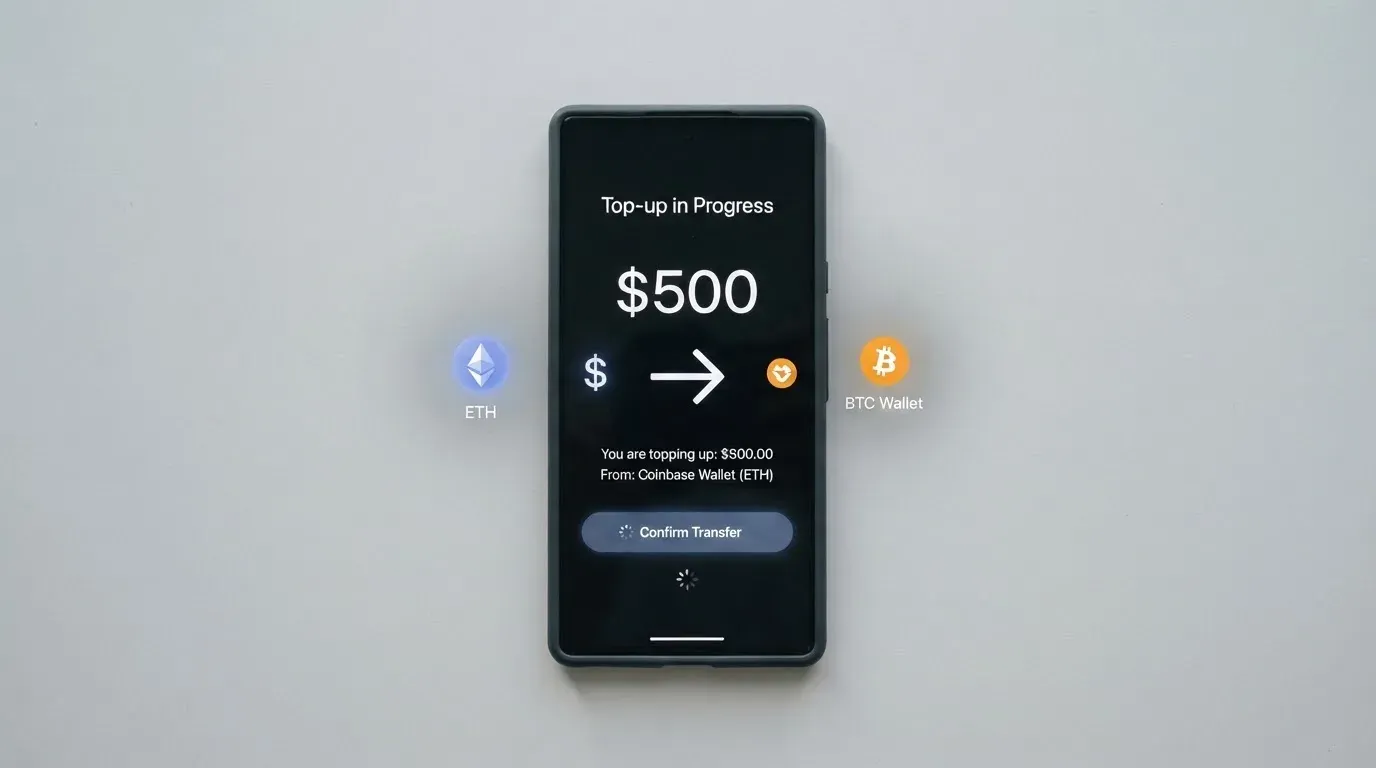
The official line is that crypto is converted during payment “for no extra fee” and that mark-ups on USDT, USDC and EURC are 0%. Terms add the 1% order fee on fiat-side services and the per-period volume limits described above.
Cashback is worth reading properly, because the two numbers do not match. The site says 2% BTC for the first 30 days then 1%, and the site also says 2% — the caps are $2 then $1 per purchase and $100 per month. The terms, meanwhile, describe the Cashback Program as voluntary and discretionary, paid in digital assets, and changeable or terminable at any time without notice. So the cashback is a promotion, not a feature you can rely on.
Sending crypto out works too: the site says crypto can be sent to Revolut, Wise, N26 or any SEPA account, with no fees or limits given, though withdrawal-fee figures are not stated. This is where the July 2026 model change matters. Under terms in force from 1 July 2026 the wallet is non-custodial: Kolo cannot unilaterally transfer, seize or recall your assets, and on suspension or closure your ability to recover your own key share and assets is preserved. But you remain liable for amounts due before closure. Withdrawal fees are not stated.
Unofficially, the $10 / EUR 10 activation balance is the minimum, no top-up fee is published, and on-chain gas may apply.
Paying with it every day
Apple Pay and Google Pay are supported, which is how most people will actually use this card — you add the number to your phone and tap. In practice, that makes the absence of a plastic card much less of a problem for daily spending than it first sounds.
The app runs on iOS, Android and a Telegram Mini App, with the download link at get.kolo.xyz. I could not reach or read the store pages, so I cannot tell you what current ratings look like — worth checking yourself before you commit. Blocked merchant categories are not stated anywhere I could find, which is a real gap: some issuers block gambling (MCC 7995) by policy rather than by law, and this card does not tell you where its line sits.
Two things about paying deserve more care than they usually get. First, a card like this sits on a foreign BIN, and merchants can look up the issuing institution and country and apply extra scrutiny when it does not match the billing address — that alone causes declines. Address verification is mainly offered in the US, Canada and the UK and is generally unavailable for foreign-issued cards, which is another way a payment gets refused at the till. Second, a declined authorisation can leave a hold on your funds for several days, typically up to seven.
On disputes, the terms are firm and mostly unfavourable. If a transaction is disputed or charged back, related cashback is cancelled or deducted. Kolo may pursue losses from your chargeback with your bank, including acquirer and card-scheme administrative fees and the value of the assets. Orders for digital assets are final, non-cancellable and non-refundable. There is a 14-calendar-day right of withdrawal from the agreement after account acceptance, by email to [email protected]. The card-payment dispute process itself and its time frames are not stated.
What can go wrong
The most concrete risk in this file is not a fee. It is who you are contracting with.
Since 1 July 2026 all services are provided by Hardline Holding Limited, Kazakhstan, company number 221240900259. Before that: BURVIX SP. Z O.O. from January to June 2026, and Cryppo UAB before that. Card services are provided in collaboration with Signify Holdings Inc (Wilmington, Delaware; Rain cards). The card issuer, BIN sponsor and licences are not named. Licences and fines are not stated. The site claims MiCA compliance and 10 million users, both self-reported.
MiCA is the EU’s markets-in-crypto-assets regulation; ESMA states it took legal effect in June 2023, with the token rules applying from 30 June 2024 and the remaining provisions, including crypto-asset service provider rules, from 30 December 2024. Its transitional period lets providers operating under national law continue only until 1 July 2026 or until they are authorised or refused. A card itself is a payment service regulated separately under e-money and payment-services law, so a crypto card often depends on two licences; the site says it aligns with MiCA and the Travel Rule, but the licence numbers are not on the pages I read.
The complaint record is the other half of the picture, and it is a user report, not a finding. Two summaries of Trustpilot differ slightly: one puts it at 3.9/5 from 52 reviews, another at 3.7/5 from 54 reviews with 16 in the last 12 months, 79% five-star and 17% one-star, and notes that Kolo does not reply to negative reviews. The recurring themes in the second, read on 20 October 2026, are withdrawals blocked or not completed with support silent (November and December 2025, February, May and September 2026); accounts or wallets closed without explanation (January, May and June 2026, one report from Zimbabwe); verification problems including one lasting 3 weeks with repeats in November 2025 and an Indonesian ID not accepted in September 2026; and a card that could not be added to a phone wallet in December 2025. On the positive side, some reviewers mention fast Telegram support. Some reviewers allege fake positive reviews — unverified, and worth treating as unverified.
The reliability mark of 4 out of 10 comes from exactly that combination: an operator that changed three times in a year, an unnamed issuer, and a pattern of funds-access complaints.
Security is better than the complaint file implies, and the July 2026 change is genuinely material. From 1 July 2026 the wallet is non-custodial and secured by MPC key shares: you hold one share, required for every transaction; Kolo holds another and may decline to co-sign for legal or risk reasons; and the recovery process is preserved. Kolo does not charge storage fees. On the site: 2FA for login and withdrawals, real-time AML and risk checks under the name “Fraud Shield”, Sumsub KYC. In-app card freeze, spending controls and insurance are not stated.
The structural risk sits underneath all of this. A card like this is a prepaid balance, not a deposit, so the money sits with providers rather than behind a deposit guarantee scheme; crypto transfers are irreversible, which is why a deposit on an unsupported network or to an address belonging to another network can be lost or need manual recovery with no guarantee. And in many jurisdictions, spending digital assets produces a taxable disposal at the local-currency value on the date of the transaction — I am not going to advise you on your own position here, but I will say that each card payment funded from crypto may be a separate disposal worth checking with someone qualified in your country.
What to take instead
If you want to compare rather than take my word, these are the three closest alternatives in this category, with their own marks.
| Alternative | Score | Card | Annual or setup cost | Fees that are stated |
|---|---|---|---|---|
| Kolo | 6.4 / 10 | Visa, virtual (EUR card reported as Visa Platinum) | Not stated; unofficially $0, $10 / EUR 10 activation balance | 1% exchange order plus network costs; unofficially 1% on card payments |
| TokenPocket | 5.8 / 10 | Mastercard / Visa debit, virtual | NFT creation fee partly covered, user pays “a small portion”; no other fees | 1% on depositing crypto into the card |
| MetaMask | 7.1 / 10 | Mastercard, virtual then optional metal | Virtual free; metal $199/year | “Minimal fee for each transaction”; no MetaMask fee; no foreign transaction fee, Mastercard rate used |
| KAST | 6.1 / 10 | Visa Platinum, Visa Infinite metal or gold plated; virtual and physical | Standard $0, Premium $1,000/year, Private $10,000/year; extra virtual card $2; Standard physical $0 plus $40 delivery; $1/month inactivity after 12 months | Stablecoin top-up 0%, USD spend 0%, Apple/Google Pay 0%; FX 0.5%–1.75% by country; $0.10 non-USD under $25; $0.50 declined |
MetaMask (7.1 / 10) is the highest-scoring of the four, and the reason is mostly transparency. Sign-up is open in 45 listed countries and territories with proof of residency; ineligible regions limit sign-ups but not spending. Costs are stated plainly: virtual free with no annual or maintenance fee, metal $199 a year, “minimal fee for each transaction”, no MetaMask fees, no foreign transaction fee. Issuer Monovate, card provider Crypto Life, one card per user, Mastercard. It spends directly from the connected wallet across Linea, Base, Monad and Solana, and cashback is paid in mUSD — 1% on Virtual, 3% on Metal up to the first $10,000 then 1%, plus a FLY bonus via the Blackbird dining app. The catch is scope: 45 countries, US and UK sign-ups temporarily closed, and card currency not stated.
KAST (6.1 / 10) is the most transparent about its tier structure and the most expensive if you climb it. Standard is $0 a year, Premium $1,000, Private $10,000, billed annually upfront. Fees are unusually clear: stablecoin top-up 0%, card spend in USD 0%, Apple and Google Pay 0%, non-USD foreign exchange 0.5%–1.75% depending on your country, the transaction country and the card programme, $0.10 on non-USD transactions under $25, $0.50 for a decline. Funding is USDT, USDC, PYUSD and RLUSD on Ethereum, Solana, Polygon, Arbitrum and Tron, and balances are converted 1:1 with 0% spread — though the terms say acceptable tokens are “currently USDT and USDC”, which conflicts with the app listing. Eligibility is residence-based, shown at KYC, and citizenship matters too: living in a supported country with only an ID from a restricted region can still fail; a VPN does not bypass it. Cashback runs 1.5% to 3% by tier on capped monthly spend, paid in USD when the transaction is authorised.
TokenPocket (5.8 / 10) is the weakest of the three on the information available. Visa debit for a list of European countries and territories, Mastercard debit for Australia, Canada, Hong Kong, Japan, Taiwan, New Zealand, Singapore, South Korea and the UK, with the Americas “planned for Q2 2025”. It runs on Arbitrum, the cards are virtual, balances are EUR24 and USD24. The one clear fee is 1% on depositing crypto into the card, which is “refunded to users through rewards, reduced transaction fees, etc.” — which is not the same as not charging it. Coins and networks are not listed, FX fees are not stated, and no cashback is stated.
Against Kolo specifically: if you want one card, many networks and no annual fee, Kolo and KAST are the pair to weigh. KAST is far clearer about what it charges and publishes a country list at KYC; Kolo accepts a wider range of networks for the deposit and changes hands more often. If you have your own self-custody wallet and want to spend straight from it, MetaMask is the one that names its issuer, its card provider and its annual cost.
Who I would recommend it to
I would recommend Kolo to a person who has crypto on a chain the card supports — Tron, Solana or Base especially — and wants a tap-to-pay balance without bridging, sitting through a KYC queue at a bank, or building a credit history. I would recommend it to someone who needs a virtual card number this week and is content to have only a virtual card for the foreseeable future. I would recommend it, cautiously, to someone whose banking access is genuinely poor and who has accepted that this is a bridge, not a main account.
I would not recommend it to someone planning to hold a meaningful balance on it, because the complaint record is specifically about funds access and that is the one thing you cannot check in advance. I would not recommend it as a first card for someone who needs an ATM, a plastic card, or a stable published exchange rate on spending. And I would not recommend it to anyone hoping for a fee-free card: even on the most favourable reading of the sources, a foreign-currency purchase carries roughly 1% somewhere in the chain.
If you do open one, the sensible posture is small and transactional. Top up what you intend to spend, read the fee line on the confirmation screen each time rather than assuming the 0% mark-up applies, keep an eye on the Telegram channel, and set aside the small possibility that the operator changes again.
Frequently asked questions
What is the Kolo card?
Kolo is a crypto payment card that behaves like a prepaid Visa card. You send crypto to it, it converts what it can into a spendable balance, and you pay with a virtual card number through Apple Pay or Google Pay. It is not a bank account and it does not lend. The card services are provided in collaboration with Signify Holdings Inc, and since 1 July 2026 all services come from Hardline Holding Limited in Kazakhstan.
How does the Kolo card work in practice?
You open the app, complete identity verification through Sumsub, and enable two-factor authentication. A virtual card appears in the app or the Telegram mini-app, which you add to your phone wallet. From then on you send crypto to the card’s address, and each payment draws down the converted balance. The wallet has been non-custodial since 1 July 2026, secured by MPC key shares where you hold one share needed for every transaction.
Is Kolo a bank?
No. It is a payment service built on top of crypto, and the card itself is provided in collaboration with Signify Holdings Inc, a Rain card partner in Wilmington, Delaware. The issuer, BIN sponsor and licences are not named on the pages I could read. Deposits are not bank deposits and should not be assumed to be covered by a deposit guarantee scheme. Treat the balance as money held with a payment provider, not with a bank.
Who owns Kolo?
The operating company has changed three times in about a year. Services were provided by Cryppo UAB until 2025, then BURVIX SP. Z O.O. from January to June 2026, and now by Hardline Holding Limited in Kazakhstan, company number 221240900259, since 1 July 2026. That handover also brought the switch to a non-custodial MPC wallet model.
Does Kolo require KYC, and what documents?
Yes — full identity verification through Sumsub, described as a flow of about a minute, plus two-factor authentication. Extra documents may be required for higher limits, and proof of address is not stated in the official material. Unofficially, the EUR card may require proof of address. Limits depend on the verification steps you have completed, and no per-tier limits are published.
Is the Kolo card free?
Unofficially, yes at the level of issuing: virtual issuance free, $0 monthly, $0 annual. Activation needs a $10 or EUR 10 balance, which stays on the card balance. Official pages state no issuance or monthly figure at all. Spending is not free: unofficially 1% conversion on card payments and around 1.40% all-in foreign exchange measured by one reviewer.
Can I use the Kolo card in my country?
Probably, if you are not from a sanctioned country. The service is said to run in 170+ countries and the card works in 60+, with a list at kolo.xyz/countries. Excluded are nationals and residents of Cuba, Iran, North Korea, Sudan and Syria, and other countries under US, UN, EU or HM Treasury sanctions, plus listed sanctioned persons. Both citizenship and residence count.
How do I top up the Kolo card?
Send crypto to the card’s address — BTC, ETH, LTC, USDT, USDC and others are named, and the site shows seven networks as logos that appear to include BNB Chain, Ethereum, Sui, Tron, Base and Solana, one unlabelled. There is also an in-app swap. The site says conversion happens “for no extra fee” and that mark-ups on USDT, USDC and EURC are 0%, though third-party sources disagree on the stablecoin-funded payment case. On-chain network fees are charged by the blockchain, not the card.
Is the Kolo card safe to use?
The security design is stronger than the complaints suggest: MPC key shares with one share yours and required for every transaction, 2FA on login and withdrawals, real-time risk checks, and a preserved recovery process. The practical risk is different — Trustpilot summaries show 3.7 or 3.9 out of 5, with recurring reports of blocked withdrawals, accounts closed without explanation and long verification delays. Keep a small balance and do not treat it as savings.
Is the Kolo card worth it?
Worth it if your crypto already sits on a supported network and you need a tap-to-pay card without a traditional bank account. Not worth it if you need cash, a plastic card, or a clearly published exchange rate — and not as a way to reduce what you pay elsewhere, since even the friendliest reading puts a foreign-currency purchase at roughly 1% above mid-market. Judge it as a payment bridge with a small balance, not as an account.
Choosing a wallet card – cryptocardadvisor
Content created by the «cryptocardadvisor» team