
A crypto card for people who already hold USDe — and who can live inside its narrow list of countries
 Available in US
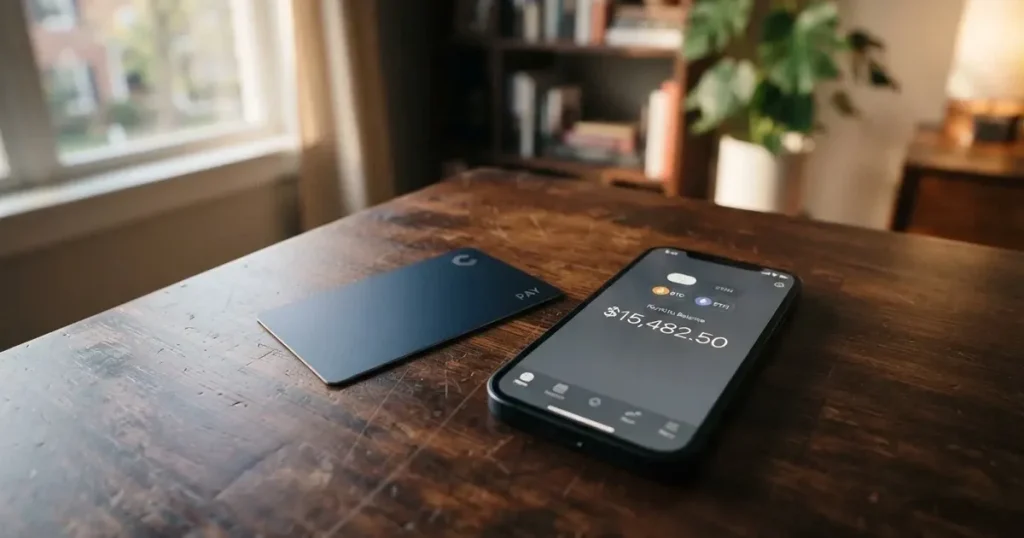
The Ethena Pay card is a Visa payment card that spends directly from a self-custody wallet holding USDe and other crypto collateral, targeting holders who live in 48 countries across Latin America, the Caribbean, Asia and the Middle East, Africa, and Oceania. I spent time going through its terms, the company’s own pages, and the third-party reports that exist about it, and this review walks through what I found, what it means for you if you’re considering the card, and where the gaps are. The short version: it is a real product with a clear audience, but it is still invite-only, unlicensed, and lightly documented outside its own marketing.
The conditions described here are current as of October 28, 2026.
Verdict
Ethena Pay earns 6.7 out of 10 in my scoring, and that number reflects what the card is rather than what it isn’t. It is not a bank-grade product with full regulatory cover, and it doesn’t pretend to be. What it offers is a Visa card tied to your own self-custody wallet, free to issue, and operating in a band of countries where ordinary banking cards are hard to get. The breakdown of the score explains how I got there.
| Criterion | Mark | Why |
|---|---|---|
| Who can get it | 7 / 10 | Invite-only beta in 48 countries across Latin America, the Caribbean, Asia and the Middle East, Africa, and Oceania; U.S. persons are excluded. |
| Cost | 8 / 10 | Virtual card, account opening, and monthly maintenance are free; FX on non-USD is “typically around 1.0%” passed through at network rate; ATM withdrawal is $1.00 plus 0.65%. |
| Top-up options | 5 / 10 | Self-custody wallet with USDe and other supported assets as collateral, spending debits USDe; funding partners MoonPay and Iron are mentioned but coins and networks are not listed. |
| Reliability and complaints | 5 / 10 | Ethena Pay Ltd. is a Maltese company (number C114576) that states it is not licensed by financial regulators; the issuer is not named in the Terms; unofficial reports point to Third National and Signify (Rain); the beta launched with around 400 users and I could not find sustained complaint threads. |
| Everyday use | 8 / 10 | Virtual card in about a minute, works with Apple Pay, physical cards in Standard, Pro, and VIP tiers, ATM access, Google Pay “available soon”; unofficial reports say the card is virtual-only. |
| Total | 6.7 / 10 |
The headline takeaway is that this card is built for a specific reader: someone who already holds USDe or other crypto collateral, lives in one of the 48 covered countries, and wants to spend that balance through Visa without first converting it on an exchange. If that is you, the card does what it says. If you are looking for a regulated everyday debit card with a clear bank behind it, you will want a different product.
Who they will give you the card
The card is offered in 48 countries, and the list is a deliberate one. It covers most of Latin America, the Caribbean, Asia and the Middle East, and Africa, plus Australia and New Zealand. The full list runs to Latin America’s 17 countries (Argentina, Belize, Bolivia, Brazil, Colombia, Costa Rica, Ecuador, El Salvador, Guatemala, Guyana, Honduras, Mexico, Panama, Paraguay, Peru, Suriname, and Uruguay), 12 in the Caribbean, 8 in Asia and the Middle East (Hong Kong, Japan, Malaysia, Pakistan, the Philippines, Singapore, Thailand, and the UAE), 9 in Africa (Côte d’Ivoire, Egypt, Ghana, Kenya, Morocco, Senegal, South Africa, Uganda, and Zambia), and 2 in Oceania (Australia and New Zealand).
Two restrictions matter as much as the country list. The card is not offered to U.S. persons, which is broader than just “U.S. residents”: it covers U.S. citizens wherever they live. And the Terms apply a separate set of restricted jurisdictions under clause 4.6, which include Belarus and Russia. The wording is that access is restricted for anyone “located in, ordinarily resident in, established in, or accessing the Services from” those countries, so what counts is residence and location, not citizenship. If you are a citizen of a restricted country but live elsewhere, the residence test applies; if you are inside a restricted country, you are not eligible. Because the Terms name a list of restricted jurisdictions without giving the full text of that list here, and because it can change, the practical step is to read the current version of the Terms before you assume you are eligible.
The card is also gated by an invite. At the time of writing it was in beta, launched on 1 September 2026 in what one third-party source described as 49 countries, with around 400 early users. The page you are reading is current as of October 28, 2026, and the company has signalled that the U.S., the EU, the UK, Canada, Switzerland, Taiwan, and South Korea are “coming soon.” That signal is not a date. It is a roadmap hint, and I would treat it as such.
What this means for you in practice: if you are in one of the listed countries, you can be considered for the beta. If you are not, you cannot use the card today, and you should not sign up speculatively on the promise of a future rollout. The Terms state that passing checks does not guarantee approval, so the application process is discretionary even for people in eligible countries.
How to get it
Getting the card is a three-step process: register, pass verification, and generate a virtual card. The virtual card is issued in about a minute and you can add it to Apple Pay immediately. The Terms describe the verification as carried out by Ethena Pay or third parties including Sumsub, and the documents they may ask for include a government-issued photo ID, proof of address, source of funds information, tax details, and biometric or liveness data. The minimum age is 18, and you are limited to one account per person.
A few practical things stand out. The first is that this is a fairly standard KYC stack for a crypto card, and the company reserves the right to ask for more documents later, including proof of where your funds came from. The second is that “passing checks does not guarantee approval” appears in third-party reporting, which means Ethena Pay retains discretion to refuse you even after a successful Sumsub verification. Third-party reporting from September 2026 also discusses whether physical cards are available; I treat the official product page as authoritative, noting that physical cards are part of the offering, but I was not able to confirm the delivery countries, lead times, or shipping cost.
If you are at the point of opening the app, the order is: download the iOS app (it is in beta), register an account, work through the verification screens, and once approved generate the virtual card. Apple Pay provisioning is built in. Google Pay is described on the official site as “available soon.” There is no published minimum balance to open, no setup fee, and no separate activation step beyond provisioning into a wallet or using the card details directly.
Fees
The cost story is one of the card’s strengths. The virtual card is free to issue, free to replace, and free to activate. Opening an account and the monthly maintenance are both free. There is no minimum balance and no inactivity fee. The fees you actually pay depend on how you use the card.

| Fee or limit | What it is | Value |
|---|---|---|
| Virtual card issuance | Creating the card | Free |
| Virtual card replacement | Replacing a lost or compromised card | Free |
| Virtual card activation | Activating the card | Free |
| Account opening | Setting up the account | Free |
| Monthly maintenance | Keeping the account open | Free |
| Minimum balance | Required balance to hold the account | None |
| Inactivity fee | Charged for not using the card | None |
| FX on non-USD | Currency conversion on non-USD spending | Typically around 1.0% (network rate) |
| Cross-border fee | Charged on spending in another country | None |
| USD domestic purchase | Spending in USD | Free |
| Interest on purchases | Charged on outstanding balances | 0.00% |
| Late payment fee | If you miss a payment | Up to $40 |
| Returned payment fee | If a payment bounces | Up to $29 |
| Cash withdrawal (ATM) | At an ATM | $1.00 + 0.65% of amount |
| ATM operator surcharge | Added by the ATM owner | Separate, not capped |
| Crypto conversion fee | When converting crypto to spend | Not stated |
| Third-party funding fee | Charged by MoonPay, Iron, gas | Separate, charged at cost |
The “typically around 1.0%” line for FX is worth pausing on. It is described in the official material as passed through from the card network at cost, not as a cap or a guarantee. On the days when the network spread is wider, you pay more; on the days when it is tighter, you pay less. There is no published conversion fee for the crypto side of the transaction, and that is a gap in the documentation rather than a feature — you don’t know what slice the spread takes when you spend.
A worked example makes this more concrete. Imagine you spend the equivalent of $100 at a café in a country that uses a non-USD currency. The card converts the local amount to USD at the network rate and adds around 1.0%, so the dollar cost is roughly $101. The merchant sees a Visa transaction in USD; you see a single line on your statement. The crypto leg of the transaction, the conversion from USDe to USD, has its own economics, but the card does not break that out for you.
A second example: you take $200 out of an ATM abroad. The card charges $1.00 plus 0.65% of the amount, and the ATM operator may add its own surcharge. The total cost depends on that surcharge, which is the kind of detail that matters if you plan to rely on the card for cash.
A third example, the one to watch: you carry a balance and the card sends you a chargeback, a refund, or flags a transaction as ineligible. The Terms allow the platform to deduct chargebacks from your balance, and if your balance goes negative you remain liable for the amount. The fees for that situation are not the FX line or the ATM line; they are the late and returned payment fees of up to $40 and $29 respectively, plus the underlying dispute.
Top up
Topping up the card starts with the wallet, not the card. The card is linked to a self-custody wallet that holds USDe and other supported digital assets as collateral; when you spend, the card debits the USDe balance. The funding partners named in the official material are MoonPay and Iron, which suggests you can buy USDe through a fiat on-ramp inside the app, but the specific coins and networks supported are not listed on the public page. One third-party headline at launch said the app rolled out on Avalanche, which is a hint, not a confirmation.
This is the part of the offering that I found least documented. With most crypto cards, the supported assets and chains are listed up front because the wrong network is the most common way to lose money on a deposit. With Ethena Pay, the public material is silent on that detail, and the practical advice is to send a test amount first and to check inside the app which assets and networks the wallet will accept. Sending the wrong coin to the wrong address is irreversible, and the Terms do not give you a recovery path.
There is no published deposit fee for moving USDe into the wallet, and transfers between Ethena Pay users are free. Third-party fees, including the gas paid to the network and any fee charged by MoonPay or Iron, are billed separately by those providers and are not part of the card’s fee schedule. The minimum top-up is not stated, which is a small but real gap if you want to plan your funding precisely.
The withdrawal story is symmetrical but equally thin. Keys and funds stay with you in the self-custody model, and sending to other Ethena Pay users is free. The Terms do not describe a withdrawal process to an external wallet, and the practical interpretation is that you control the wallet, so you can move assets out whenever you like, with the cost being whatever the network charges for that transfer.
Paying with it every day
The day-to-day use case is built around a virtual card that lives in your phone. You add it to Apple Pay, and you can pay anywhere contactless Visa is accepted. The official material describes physical cards in Standard, Pro, and VIP tiers, with Google Pay “available soon.” The app is iOS-first, in beta, with an Android version planned according to a third-party report.
Cashback is paid in AVAX, the Avalanche token, and lands in your account daily after each transaction settles. The bands differ by tier. Standard gives you 4% on the first $2,500 of monthly spend, 1% on the next $1,500 (the $2,500 to $4,000 band), and 0% above that. Pro gives you 4.5% to $8,000, then 2%, 1%, and 0.5% on the bands above. VIP gives you 5% to $20,000, then 2%, 1%, and 0.5% on the bands above. Transactions under $1.00 earn nothing, and refunds reverse the cashback they generated. A second mechanism, called Daily Boost, pays Standard 5% per year on balances up to $5,000, and Pro and VIP 6% per year on balances up to $100,000 and $1,000,000 respectively, provided you make at least one card transaction in the month. Pro tier is reached by subscription or by referrals.
The category exclusions are the kind of thing that often gets glossed over and then bites later. Cashback does not apply to cash advances, ATM withdrawals, crypto, stablecoin, NFT, or securities purchases, gambling, gift cards, peer-to-peer transfers, or account funding. If your spending profile leans on any of those, the headline rate is not the rate you actually earn.
There are no published spending limits on the card. The closest the official material comes is the Daily Boost cap on balances and a clause that says transaction limits may be imposed and changed without notice. There are unofficial reports that the spending limit is dynamic, tied to the value of your collateral, and can be reduced even to zero. That description is unconfirmed, but it fits with a self-custody model where the spendable amount tracks the value of the assets backing it.
The disputed-transaction process runs by email. The card issuer acknowledges complaints within five business days and targets a final response within fifteen. There are no published time frames for raising a chargeback, and the Terms allow chargebacks to be deducted from your balance. If your balance goes negative, you remain liable for the amount.
What can go wrong
The risk profile of this card is dominated by three things: the company is unlicensed, the issuer is unnamed in the Terms, and the underlying assets are your own crypto collateral.
The company is Ethena Pay Ltd., a Maltese limited company with registration number C114576, registered in Ta’ Xbiex, Malta. The Terms state that the company is “not licensed, registered, authorized, or otherwise approved” by financial regulators and that it works through third-party providers. That is a material disclosure: the entity that markets and runs the card is not a regulated payments business, and the entity that actually issues the card sits behind a third party. Unofficial reports suggest the Visa card is issued by Third National, a Puerto Rico-chartered bank, and managed by Signify Holdings (Rain). These names are unconfirmed and I have not seen them on Ethena Pay’s own pages, so I would treat them as plausible but unconfirmed. Either way, the practical point is the same: when you read the Terms, you are not reading a card-issuer agreement, and the protections that come with a regulated card product (clear recourse, deposit insurance, a regulator to complain to) do not necessarily apply.
The self-custody model is a feature and a risk. Ethena Pay says it does not hold your funds, keys, or seed phrases, and that lost keys cannot be recovered. It provides no custodial or safeguarding services. That means the typical crypto risks sit with you: phishing, clipboard malware that swaps a copied address, a device that fails without a backup of the seed phrase, and the irreversibility of blockchain transactions. Two-factor authentication and a card-freeze option are not described on the public pages, and the app is English-only according to a third-party report.
The dispute process has another layer. If a transaction is refunded, charged back, or later found to be ineligible, the cashback is reversed and the transaction drops out of your monthly spend total. If a chargeback is processed against your balance, the amount is deducted, and if your balance goes negative you still owe the platform. There is no published timeframe for raising a chargeback, which is a small but real gap.
On the complaints side, I looked for the usual surfaces. There is no Trustpilot page that I could find, no Reddit thread that surfaced in one search, and no published incidents on the company’s own side. The third-party editorial reviews I saw were light: SpendNode gave it 3.9 out of 5 in September 2026, and the only user report I found was a Philippines-based user who said the app quoted a $10 charge for a first card, which I would treat as an isolated data point rather than a pattern. The picture is one of a product too new to have a complaints history, rather than one with a clean record.
A few other risks worth naming. The Terms include a clause that lets the company change transaction limits without notice, and unofficial reporting says the spending limit is collateral-dependent and can drop to zero. The card is invite-only and in beta, which means the experience is still being shaped. The “coming soon” list of countries (U.S., EU, UK, Canada, Switzerland, Taiwan, South Korea) is a roadmap hint rather than a date, and the regulator or issuer landscape in those jurisdictions is more demanding than the beta’s current footprint. And because the public material does not list the supported networks or coins for funding, sending the wrong asset to the wrong address is a non-trivial risk until the documentation catches up.
What to take instead
The alternatives below offer different trade-offs, and reading them side by side with Ethena Pay makes the differences clearer.
Sponge
Sponge is a virtual Visa card issued by Rain, a Visa Principal Member, with USDC collateral moved from the Sponge wallet via a card fund command. The platform’s homepage describes it as a credit card, and the example chain shown in the SDK is Base, with Solana listed as an optional chain. The score is 4.9 out of 10, the country list is not stated, and the cost, fees, and rewards are not stated on the card pages. The shape of the product is close to Ethena Pay’s self-custody model, but the documentation gap is wider: less of the basic information is published, and there is no published monthly or annual fee schedule to anchor a cost comparison.
Nexo
Nexo’s card is a Mastercard (the trademark appears on the page; the network is not stated explicitly) issued by DiPocket UAB, available as virtual and physical, and accepted wherever Mastercard is taken. It is offered to residents and citizens of “selected European countries, including the EEA and the United Kingdom,” with the precise list not on the page and the excluded jurisdictions described only as “not available in certain jurisdictions.” The score is 6.3 out of 10. There is no monthly, annual, or inactivity fee. The virtual card needs at least $50 in the account to activate; the physical card is free to ship but requires more than $5,000 in digital assets and at least Gold tier. FX is 0.2% on weekdays in the EEA, UK, and Switzerland, and 2% in the rest of the world; on weekends, 0.7% and 2.5%. The card spends from the Nexo account across more than 100 digital assets, with Debit Mode using stablecoins, crypto, and FiatX assets. Cashback is paid in NEXO tokens or Bitcoin and only applies in Credit Mode with more than $5,000 in digital assets, with rates by loyalty tier. Compared to Ethena Pay, Nexo is a regulated product with a stated issuer and a published fee schedule, and it concentrates its coverage in Europe rather than the global footprint Ethena Pay targets.
Xplace
Xplace is a Visa card on the Solana network, available in Basic (free), Silver ($99/year), Gold ($249/year), and Platinum ($999/year), with virtual cards instant and physical cards in 7 to 14 business days at the Silver tier (Gold and Platinum physical cards were marked as coming soon at the time of writing). The score is 7.7 out of 10. The country list is not stated and acceptance is described as 160-plus countries. Platinum offers “0% FX,” and other tiers’ FX and the conversion fee are not stated. The card supports BTC (cbBTC), ETH (wETH), SOL, JitoSOL, USDC, USDT, and xStocks, all on Solana. Cashback in Credit Mode runs from 0.5% at Basic to 2% at Platinum, paid in USDC at settlement. Compared to Ethena Pay, Xplace is more expensive at the top end (Platinum at $999/year versus a free Ethena Pay tier) but it is also more clearly priced and operates on a single network with a published asset list. Cash mode spending is stablecoin balance; credit mode borrows against holdings.
Reading the three alternatives together, the pattern is that each one gives up something Ethena Pay offers. Sponge gives up documentation; Nexo gives up the global country list; Xplace gives up the free tier at the high end and the self-custody model. None of them replicate Ethena Pay’s exact mix of self-custody, USDe collateral, and free issuance across 48 countries, which is part of why the card exists.
Who I would recommend it to
If you already hold USDe, live in one of the 48 listed countries, and want a Visa card that draws on that balance without going through a centralized exchange, Ethena Pay is one of the few products that does what it says at this price. The card is free, the FX is competitive, the cashback bands are honest about their tiers, and the self-custody design means the funds never sit on a platform balance you don’t control. The Daily Boost, which pays interest on your USDe balance, is a useful sweetener if you make at least one card transaction a month.
If you are outside the country list, the picture is different. The roadmap hints that the U.S., EU, UK, Canada, Switzerland, Taiwan, and South Korea are coming, but those are hints, and the Terms restrict access by residence and location, not by citizenship, which matters if you are a citizen of a restricted country living elsewhere. The Terms name Belarus and Russia as restricted jurisdictions and the list can change; if you are in a country that might be on a future restricted list, you should read the current Terms before relying on the card.
If you want a regulated everyday debit card with a clear bank behind it and a published fee schedule, this is not it. The Terms state that the company is unlicensed, the issuer is not named in the official material, and the dispute process runs by email with no published time frame for raising a chargeback. Those are not dealbreakers for everyone, but they are the kind of details that bite the first time something goes wrong. For that reader, Nexo or Xplace — both of which name an issuer and publish a fee schedule — are the closer fit.
For most people reading this, the practical question is whether the trade-offs match your situation. If you are in a covered country, hold USDe, and want a no-fee Visa that spends from your own wallet, the card earns its score. If any of those three conditions is missing, the alternatives above are worth the look.
Frequently asked questions
What is the Ethena Pay card?
The Ethena Pay card is a Visa payment card linked to a self-custody wallet that holds USDe and other supported digital assets as collateral. When you spend, the card debits the USDe balance, and the company is Ethena Pay Ltd., a Maltese limited company (number C114576) that describes itself as not licensed by financial regulators.
How does the Ethena Pay card work?
You register, complete verification (which may include photo ID, proof of address, source of funds, and biometric data through Sumsub or another third party), and generate a virtual card in about a minute. The card is added to Apple Pay and works wherever Visa contactless is accepted; non-USD spending is converted at the network rate with around 1.0% passed through, and cash withdrawals cost $1.00 plus 0.65%.
Is Ethena Pay a bank?
No. Ethena Pay Ltd. is a Maltese limited company that states in its Terms that it is “not licensed, registered, authorized, or otherwise approved” by financial regulators and works through third-party providers. The Terms do not name a card issuer, and a third-party report from September 2026 names Third National (a Puerto Rico-chartered bank) and Signify Holdings (Rain) as the issuer and programme manager, though that naming is unofficial and unconfirmed.
Who owns Ethena Pay?
The Terms identify the operator as Ethena Pay Ltd., registered in Ta’ Xbiex, Malta, with company number C114576. Ownership beyond that is not described in the public material I read.
Is the Ethena Pay card available in my country?
The card is offered in 48 countries across Latin America, the Caribbean, Asia and the Middle East, Africa, and Oceania (Australia and New Zealand). The U.S. is excluded for U.S. persons, and the Terms’ restricted jurisdictions clause names Belarus and Russia among others; the test is residence and location, not citizenship. The U.S., EU, UK, Canada, Switzerland, Taiwan, and South Korea are described as “coming soon,” which is a roadmap hint rather than a confirmed date.
How do I get the Ethena Pay card?
You download the iOS beta app, register an account, complete the verification flow, and once approved generate a virtual card in about a minute. Physical cards in Standard, Pro, and VIP tiers are part of the offering on the official page. The card is currently invite-only.
Does the Ethena Pay card require KYC?
Yes. The verification is run by Ethena Pay or third parties including Sumsub, and may include government-issued photo ID, proof of address, source of funds information, tax details, and biometric or liveness data. The minimum age is 18 and you can hold only one account. The Terms note that passing checks does not guarantee approval.
How do I top up the Ethena Pay card?
The card is funded through a self-custody wallet that holds USDe and other supported digital assets; spending debits the USDe balance. The official material names MoonPay and Iron as funding partners but does not list the supported coins or networks, so send a test amount first. Transfers between Ethena Pay users are free; third-party funding fees and gas are charged separately.
Is the Ethena Pay card safe?
The self-custody model means Ethena Pay does not hold your funds, keys, or seed phrases, and lost keys cannot be recovered, which puts the usual crypto key-management risks (phishing, clipboard malware, device loss without backup) on you. The company is unlicensed, the issuer is unnamed in the official Terms, and the dispute process runs by email with no published chargeback time frames. No Trustpilot or Reddit complaint thread surfaced in my search.
Is the Ethena Pay card worth it?
If you hold USDe, live in one of the 48 covered countries, and want a no-fee Visa that spends from your own wallet, the card is a reasonable fit and the 6.7/10 score reflects that. If you are outside the country list, want a regulated card with a named issuer and a published fee schedule, or care more about clear dispute and chargeback protections than about free issuance, the alternatives in this review (Nexo for a regulated Mastercard in Europe, Xplace for a published Solana-based fee schedule, Sponge for a similar self-custody model with less documentation) are worth comparing side by side.
Choosing a credit or cashback card – cryptocardadvisor
Content created by the «cryptocardadvisor» team