
KOSH Global card, reviewed: cheap to issue, quiet on jurisdictions
 Available in US
KOSH Global pitches itself as a payment card you load from a crypto balance, spend like any other Visa, and reach for when an ordinary bank card is not an option. The pitch is simple, the price is low, and the everyday mechanics are straightforward. What is harder to pin down is where the card actually works, who stands behind the program, and what happens if something goes wrong. This review walks through the card as it stands today: eligibility, sign-up, costs, top-up options, daily use, and the risks that come with a young, lightly documented product.
Conditions in this review are current as of October 28, 2026.
Verdict
I would give the KOSH Global card 6.5 out of 10. The everyday mechanics are the strongest part of the package: a USD Visa, virtual and physical, with Apple Pay and Google Pay, no monthly fee, and a low $8 annual price for the virtual card. The cost structure for paying in USD is clean. What pulls the score down is the uncertainty around where the card is available, the absence of any published list of supported countries, the lack of a named card issuer, and the fact that the product is new enough that I could not find independent user reviews or complaints to lean on. If you are in a region where the card option appears in your KOSH app, and you mainly want a cheap virtual Visa funded with stablecoins, the card does what it says. If you need clarity on jurisdiction, issuer, or a long public track record, you have to keep looking.
| Criterion | Mark | Why it scores this way |
|---|---|---|
| Who can get it | 5 / 10 | Availability depends on country of residence; KOSH has not published a list, and the card only appears in-app if your region is supported. Countries under comprehensive sanctions are excluded. |
| Cost | 7 / 10 | Virtual card $8 a year, physical $80 a year, no monthly fee, USD spending 0%. FX is quoted as 0.5% in the help centre and 1.5% on the marketing page; ATM withdrawals cost $1 plus 1%. |
| Top-up options | 6 / 10 | USDT and USDC only, deposited to a KOSH wallet, with no published minimum or maximum. The blockchain networks are not named in the article I read, which leaves a practical gap. |
| Reliability and complaints | 6 / 10 | The operator is Piers Technology Inc, which describes itself as a financial technology company, not a bank. The issuer is not named, no licences are listed, and I found no Trustpilot page or Reddit threads for KOSH Money. The product reportedly launched in June 2026. |
| Everyday use | 9 / 10 | Both virtual and physical Visa, Apple Pay and Google Pay, ATM access with the physical card. No concierge or lounge benefits, but the basics are covered. |
| Total | 6.5 / 10 | A useful, low-cost stablecoin-to-Visa card, held back by opaque eligibility and an early-stage company profile. |
If you are the kind of person who wants a cheap virtual Visa funded from USDT or USDC and you live somewhere the app confirms the card is available, KOSH Global is worth a serious look. If you are an EU resident looking for a regulated CASP, an investor who wants a published licence, or anyone who needs a card that works in a specific high-risk country, the picture is too thin to commit to.
Who will they give you the card
Eligibility for the KOSH Global card is the first thing I would check, and it is also the part of the product that is hardest to evaluate from the outside. KOSH says availability depends on your country of residence. The card option appears in the Cards section of the app only if the card is available in your region, and KOSH has not published a list of supported countries. The marketing page uses the phrase “available in select jurisdictions”. If the app does not show the card for you, you can join an early-access list through in-app chat, and KOSH adds that a physical card can be shipped to some regions where the card itself is not supported, with India given as an example of that exception.
The rules on sanctioned jurisdictions are clearer, even though no specific country is named in the terms. Users located in, or transacting with, countries under “comprehensive sanctions or embargoes” are barred. The card is otherwise positioned for global use: the marketing page says Visa merchants in 180-plus countries will accept it, which is true of any Visa network card, but it is not the same as KOSH itself being licensed in those places.
A practical takeaway: do not assume your country is supported because the marketing page is in your language or because the app lets you sign up. The real test is whether the card option appears under Cards after you complete KYC. If it does not, you are looking at a waitlist, not a guaranteed route in.
A few other constraints to be aware of:
- The card is for individuals, with a separate KYB flow for businesses; the help article I read does not list company requirements.
- The terms require you to be at least 18.
- If you completed KYC in 2025 or earlier, you will need to resubmit; the single personal KYC tier is ID plus a selfie or liveness check, and the verification partner is Sumsub.
The single biggest gap in this section is the missing country list. Most card programmes publish at least the regions they support, even if the legal entity behind the card varies. KOSH Global does not, and that is a meaningful transparency issue for anyone who cannot just open the app and see the card option first-hand.
How to get it
The sign-up flow is the kind of straight line you would expect from a fintech app: create a KOSH account, pass KYC, order a virtual card from the Cards section, and, if you want a physical card, order it from the same place. There is no separate application form to fill in beyond identity verification.
KYC is the central step. You submit a government-issued ID and a selfie or liveness check. The marketing page also references a recent bank statement, though the help article on KYC does not list proof of address among the requirements. I would keep a bank statement or utility bill handy in case it is requested, since the rule on proof of address is not consistent between the marketing and help-centre pages. Sumsub handles verification. Approval is usually quick: the help-centre says five to ten minutes for the personal-card tier, although it can take longer if documents need review. If your KYC was done in 2025 or earlier, you will be asked to resubmit.
Once KYC is approved, you order the virtual card in the app. The physical card is an optional add-on. Both are Visa-branded and priced in USD, which matters for FX: every non-USD purchase will be converted to USD and trigger the FX fee.
The physical card is shipped by express delivery, with up to 10 business days and tracking, and costs $80. KOSH does not list which countries it ships to. The card activates in the Cards section once it arrives. There is no published replacement cost, so I would treat the $80 as a one-time cost rather than a recurring one unless you hear otherwise from support.
What is not stated in the help article is the names of the card-issuing bank and the regulator that licenses the programme. The terms refer to “the regulated financial institution selected for the Card Program”, and KOSH describes itself, through parent Piers Technology Inc, as a financial technology company, not a bank or money services business. Services are delivered “via licensed partners”. For a low-cost virtual card funded with stablecoins, that is not unusual, but it does mean a customer has to trust the partner layer without seeing it named.
Fees
This is the section where the KOSH Global card is at its strongest, with one footnote worth flagging. The KOSH Everyday Card comes in two forms: virtual, at $8 per year, and physical, at $80 per year. There is no monthly fee. Express shipping for the physical card is $80. That is the entire annual cost if you stick to the virtual card and pay in USD.
For day-to-day spending, the published fees are: card authorisation free; USD transactions 0%; USDC and USDT deposit or settlement free. The foreign-exchange fee is where the two official pages disagree. The help-centre fee article lists 0.5% as the added FX, while the marketing page says 1.5% per foreign-currency transaction. I would treat the lower number as the floor and the higher one as the ceiling until KOSH reconciles the two; in practice the figure you pay is whatever the app shows at the time of the transaction.
ATM use is restricted to the physical card: virtual cards cannot be used at ATMs. The withdrawal fee is $1 plus 1% plus the applicable FX fee, and the ATM operator may add its own surcharge. Balance inquiry and a declined ATM transaction each cost $1. The single transaction limit is $250, with up to three withdrawals a day, and no weekly or monthly cap is published.
There is no free ATM allowance, and KOSH does not list merchant-category or spend caps. Spend limits are user-set inside the app, which is the right tool to keep the card from going further than you intend.
| Fee or limit | Amount |
|---|---|
| Virtual card, annual | $8 |
| Physical card, annual | $80 |
| Monthly maintenance | None |
| Express shipping (physical) | $80 |
| Card authorisation | Free |
| USD spending | 0% |
| FX (help-centre article) | 0.5% |
| FX (marketing page) | 1.5% |
| USDC/USDT deposit or settlement | Free |
| ATM withdrawal | $1 + 1% (+ FX, + operator fee) |
| ATM balance inquiry | $1 |
| Declined ATM transaction | $1 |
| ATM per-transaction limit | $250 |
| ATM daily limit | 3 transactions |
| Spend limits | User-set in app |
| Top-up | No strict minimum or maximum |
| Dispute fee | $30 per request |
A few everyday examples to put the cost in context. If you buy a $50 coffee in New York and pay in USD, the only cost is whatever the merchant charges: there is no KOSH fee on top, and no monthly fee eating into the balance. If you buy a €45 dinner in Paris, your USD card will convert the amount at the Visa rate plus either 0.5% or 1.5% depending on which figure KOSH is applying that day, so the all-in cost is the FX margin. If you take $200 out of an ATM in Bangkok, you pay $1 plus 1% of the withdrawal (about $2 in this case), the FX fee on the converted amount, and whatever surcharge the local ATM operator adds, which can easily be another $5. The dispute fee is $30, refundable if the dispute is resolved in your favour, but it is paid up front.
How to top up KOSH Global
Top-up starts with the KOSH wallet. The card is loaded from the wallet balance, and the wallet is funded with USDT or USDC. KOSH does not list the supported blockchain networks in the article I read, which is a real gap: if you send USDT on a chain the wallet does not accept, the transfer can be lost or stuck in manual support, and crypto transfers are not reversible. I would confirm the network in the deposit screen of the app before sending anything, and I would send a small test amount first if the amount is meaningful.
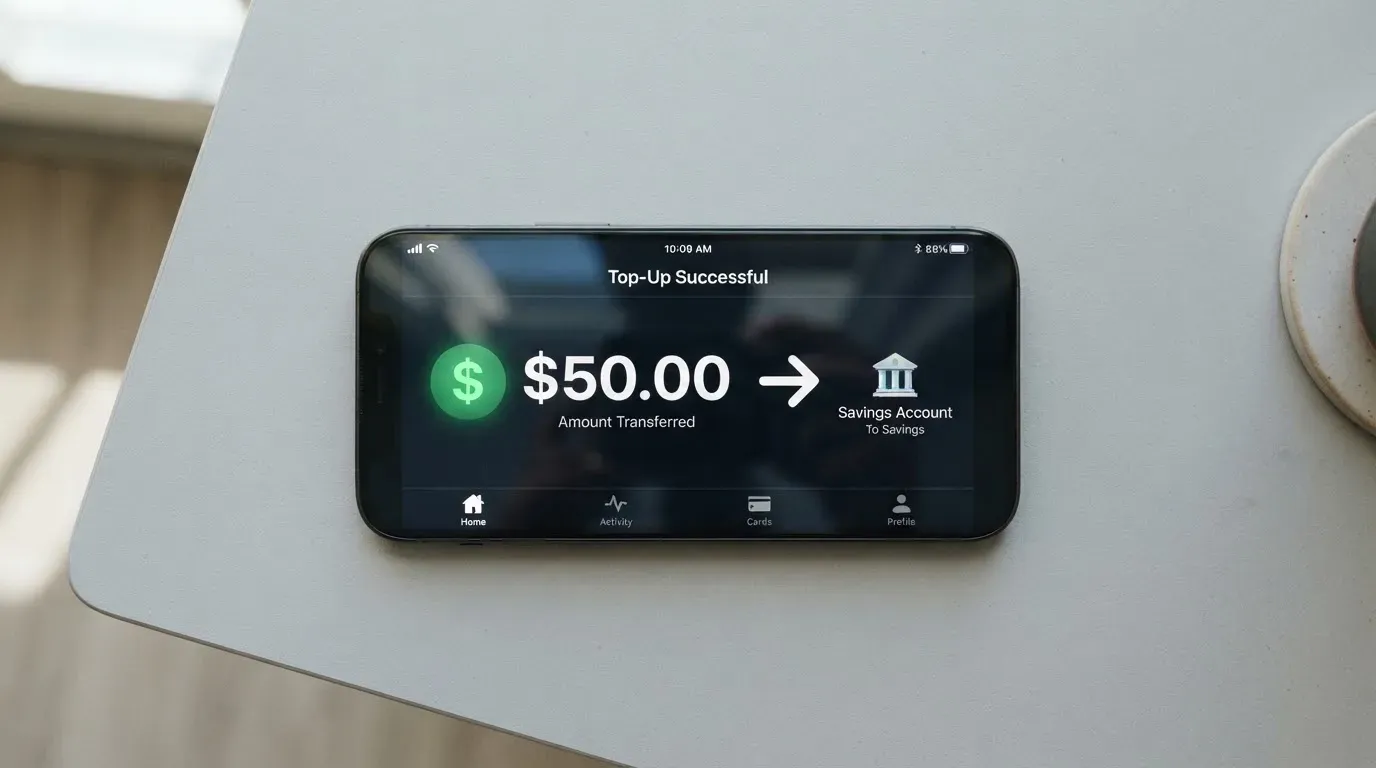
Deposits of USDC and USDT are free on the KOSH side. The wallet does not publish a minimum or a maximum, and the help-centre says there is “no strict minimum or maximum” for top-up. Who pays the on-chain network fee is not stated in the help article. In practice, the network fee is paid by the sender, so it is the wallet or exchange you are sending from that deducts it, not KOSH. The balance typically updates five to ten minutes after on-chain confirmation.
There is also a fiat route. KOSH operates a virtual USD account you can fund by ACH or wire transfer. When the fiat settles, it is converted to a stablecoin inside the wallet and then becomes card balance. The fee for this conversion is not stated in the help-centre article, so the cost of the fiat on-ramp is something to confirm with support before wiring any amount that matters.
You can move card balance back to the KOSH wallet in the same stablecoin you used to top up, and only user-added funds are eligible; welcome bonuses, referral rewards and cashback are excluded. The fee for the reverse transfer is not stated. The account can be closed from the dashboard or by contacting support, and the help article does not describe how the remaining balance is handled on closure, which is a small but real gap.
Two practical points that often decide whether a stablecoin card is usable day to day:
- Keep a small amount of the network’s native token in the wallet you send from, since on some networks the gas fee is paid in a token that is not the stablecoin itself. Sending USDT on Ethereum without any ETH in the sending wallet is a frequent reason for failed transfers.
- Send a test amount before sending a meaningful sum, especially the first time, because the network mismatch failure mode is silent: the address looks right, the transfer confirms on-chain, and the funds do not appear on the other side.
Paying with it every day
The KOSH Everyday Card is built for routine spending. Both the virtual and physical cards are Visa, in USD, and work anywhere Visa is taken. Apple Pay is supported in countries where Apple Pay itself is available; Google Pay is supported per the marketing page, described as a two-tap setup, although the help-centre article I read does not cover it. The physical card is metal and is shipped worldwide per the marketing page, with the same caveat as before: the list of countries it actually ships to is not published.
ATM access is restricted to the physical card, and the $250 per-transaction limit makes it more useful for small cash needs than for large cash pickups. Blocked merchant categories are not stated in the help article, and the app lets you lock the card to specific categories or merchants, which is the more useful control. A help article on whether to pay in USD or in the local currency exists, but I did not read it; in general, choosing USD at the terminal lets the card do the conversion at the Visa rate plus the FX fee, which is usually the better deal on a foreign-issued card.
The reward structure is the part that feels least settled. The marketing page describes 10% reward points on eligible purchases, 5% cashback on hotel bookings, and a $5 referral bonus, all of which “may vary and are subject to program terms”. The help-centre fee article lists 10% reward points as “coming soon”. I would not budget around the headline rates until the app shows them live on your account. The absence of a Visa Concierge tier or lounge access is consistent with the rest of the product: this is a single-tier card positioned as a low-cost utility, not a premium travel card.
Disputes follow a fixed path. You contact the merchant first, then send evidence to KOSH through in-app chat or by email. KOSH files through its card partner via the Visa network. The fee is $30 per dispute request, refunded if the dispute is resolved in your favour, and investigations typically take 30 to 90 days.
What can go wrong
There are three layers of risk to think about with a card like this, and KOSH Global has more open questions than most established programmes.
The first layer is the company. Piers Technology Inc describes itself as a financial technology company, not a bank or a money services business. Services are delivered “via licensed partners”. The card issuer is “the regulated financial institution selected for the Card Program”, and KOSH does not name that institution in the public materials I read. No licences are listed. Terms are governed by Delaware law, with arbitration in New York. A third-party listing notes that the product launched on 12 June 2026, and another profile suggests signups have at times routed through a partner platform ahead of a planned relaunch under the KOSH brand; the product was previously known as CopperX. None of that is a problem on its own, but it does mean a customer is trusting an early-stage operator, an unnamed issuer, and a partner stack that is not all visible from the outside.
The second layer is the user base. I could not find a Trustpilot page for KOSH Money, no Reddit threads specific to the brand, and no major incident in the news. That is consistent with a product that is new rather than with one that has a clean record, and a low number of complaints is not the same as a public track record. The comparison sites I checked did not have KOSH reviews either.
The third layer is the operational risk that comes with any card programme. Card programmes have been wound down before. In November 2022, Visa said it had terminated its global agreements with FTX and the FTX US debit card was wound down by its issuer. In 2018, Visa suspended WaveCrest in Europe, closing every WaveCrest-issued Visa programme. More recently, a 2026 closure reported by a single secondary source said new loads ended 8 July 2026 and spending stopped 8 August 2026; that report is not confirmed and is not about KOSH, but the pattern matters: when a programme closes, users typically get a notice period, then loading stops, then spending stops, and remaining balances have to be withdrawn.
There are also some category-level risks that travel with any stablecoin-funded card:
- Stablecoins are not necessarily stable. USDT and USDC are the two largest, and both have depegged in the past: USDC briefly lost its peg in March 2023 during the US banking crisis, and TerraUSD collapsed in May 2022.
- Stablecoin issuers can freeze funds. Tether has disabled tokens in wallets on the OFAC sanctions list and has frozen funds tied to illicit activity. This is the opposite of censorship-proof.
- Crypto transfers are irreversible. A deposit on the wrong network, or to an address on a different chain, can be lost or stuck in manual support with no guarantee of recovery.
- Custodial platforms have failed before: Mt. Gox (about US$350 million reported stolen 2011–2014), Coincheck (about US$400 million in 2018), Ronin Network (US$625 million in 2022). Holding the underlying balance with a custodian carries counterparty and hack risk.
On the safety controls that are within KOSH’s reach, the help-centre covers the basics: instant freeze and unfreeze inside the app, user-set spending limits, the ability to lock a card to specific categories or merchants, and dedicated articles on lost or stolen cards and on suspicious activity. Two-factor authentication is not described in the help article I read, and the safeguarding arrangements for the underlying stablecoin balance are not described either. Treat any meaningful balance on the card the way you would treat cash in a wallet you might lose.
A separate note on chargebacks and disputes: KOSH’s dispute fee is $30, and the resolution window is 30 to 90 days. US debit card reversal rights come from Regulation E and credit card rights from Regulation Z, but prepaid-card coverage is not the same and should not be assumed. If you need a card with strong statutory protections, look at cards that sit clearly inside the debit-card framework with a named bank issuer.
What to take instead
If KOSH Global does not fit, the comparison set is thin because few cards in this niche are both cheap and broadly available. Three alternatives appear in my notes: International Visa Card, UNi Card, and Whop Cards. They are not the same product, and the score for each is from a separate review, not a direct comparison.
International Visa Card (6.7/10) is a US-issued Platinum Visa, currently virtual only, with a $5 one-time issuance fee, no maintenance fee, and three monthly plans (Classic free, Pro $9, Max $19). USD spending is free on every plan; foreign-currency transactions carry the Visa exchange rate plus 2% FX. Deposits are free, in USDC, USDT, USD, EUR, SEPA, SWIFT and FedNow. The exclusion list is explicit and longer than KOSH’s: residents or legal registrants of Belarus, mainland China, North Korea, Cuba, India, Iraq, Iran, Israel, Myanmar, Nepal, Nicaragua, Russia, Syria, Turkey, Ukraine, Venezuela, and Vietnam are not served; FATF grey-list countries are reviewed case by case. Purchases are blocked in North Korea, Cuba, Iran, Russia, Syria, Ukraine, and Venezuela. If your country is on that list, this card is not an option; if it is not, the explicit list is a transparency advantage.
UNi Card (6.1/10) is a multicurrency Mastercard on the UNi.Global account balance, with no annual fee and no foreign transaction fee, and assets converted at live OTC rates. Spend-to-Earn rewards go up to 3%. The product is less well documented in my notes: residency rules, virtual or physical form, and funding options are not stated, so I would treat it as a “check the country list first” option.
Whop Cards (5.2/10) is a Visa product that spends from a Whop balance. For consumers it is available in 31 US states (Alabama, Alaska, Arkansas, California, Colorado, Connecticut, Florida, Hawaii, Illinois, Indiana, Iowa, Kansas, Kentucky, Maine, Massachusetts, Michigan, Minnesota, Montana, Nebraska, New Hampshire, New Jersey, New York, North Carolina, Oklahoma, Pennsylvania, South Carolina, Texas, Utah, Virginia, West Virginia, Wyoming) and 41 states for businesses, with a long list of unsupported countries that includes Russia, Belarus, China (mainland), Cuba, Hong Kong, India, Iran, Iraq, Israel, Myanmar, Nepal, Nicaragua, North Korea, Syria, Turkey, Ukraine, Venezuela, and Vietnam. Cashback is 5% at select merchants, currently Uber, with more planned. The card spends from a Whop balance, and the underlying collateral is stablecoin; the page says “no extra fees” but does not list conversion or FX amounts.
A simple way to compare:
| Card | Score | Annual fee (virtual) | FX fee | Best for |
|---|---|---|---|---|
| KOSH Global | 6.5 / 10 | $8 | 0.5%–1.5% | A cheap, USD-denominated virtual Visa funded with stablecoins |
| International Visa Card | 6.7 / 10 | $5 one-time | 2% | A US-issued virtual card with a published exclusion list |
| UNi Card | 6.1 / 10 | Not stated | None stated | Multicurrency spending on Mastercard |
| Whop Cards | 5.2 / 10 | Not stated | Not stated | A US-state-restricted card with merchant cashback |
Who I would recommend it to
I would recommend KOSH Global to a person who already has a KOSH account, sees the card option in their app, and wants a low-cost virtual Visa they can top up with USDT or USDC for routine online and in-store spending. The combination of a $8 annual virtual card, no monthly fee, free USD spending, and support for Apple Pay and Google Pay is a credible utility card for that use case. The physical card at $80 a year is a reasonable upgrade if you also need ATM access and you are comfortable with the $1 + 1% per withdrawal.
I would not recommend it as a primary card. There is no named issuer, no published licence, no public track record, and the country list is not published. If you are in a country where the card option does not appear, joining the early-access list is a wait, not a guarantee. If you need a card that works in a high-risk jurisdiction, the marketing page and the app are not detailed enough to rely on. If you need a premium travel card with concierge or lounge access, this is a single-tier utility product and will not meet that bar.
The honest summary is this. KOSH Global is a young, low-cost, stablecoin-funded Visa with a clean everyday cost structure and a genuinely unclear eligibility and issuer picture. If the app shows the card to you, the cost makes it worth trying for small daily spending. If it does not, or if you need the issuer, the regulator, and the country list to be on the public record before you commit, the right move is to wait for those to appear.
Frequently asked questions
What is the KOSH Global card?
KOSH Global is a Visa payment card, available in virtual and physical form, that spends from a KOSH wallet balance funded with USDT or USDC. The card is operated by Piers Technology Inc and issued through a regulated financial institution that KOSH does not name publicly.
How does the KOSH Global card work?
You fund your KOSH wallet with USDT or USDC, then load the card from that balance. At payment time the card draws on the USD balance, so USD purchases carry no fee from KOSH, and non-USD purchases are converted at the Visa rate plus a foreign-exchange fee that the help-centre puts at 0.5% and the marketing page puts at 1.5%.
Is KOSH Global a bank?
No. Piers Technology Inc describes itself as a financial technology company, not a bank or money services business. The card programme is delivered through licensed partners, and the card issuer is the regulated financial institution selected for the programme; KOSH does not name that institution in its public materials.
Who owns KOSH Global?
KOSH Global is operated by Piers Technology Inc. A third-party listing notes the product was previously known as CopperX and that the relaunch under the KOSH brand was planned; that history is unconfirmed by the card itself.
Is the KOSH Global card available in my country?
Availability depends on your country of residence and the card option appears in the Cards section of the KOSH app only if your region is supported. KOSH has not published a list of supported countries. If the card option does not appear, you can join an early-access list through in-app chat, and a physical card can sometimes be shipped to a region where the card is otherwise not supported.
Does the KOSH Global card require KYC?
Yes. The personal-card flow uses a government-issued ID plus a selfie or liveness check, run by verification partner Sumsub. Approval is usually five to ten minutes. The marketing page also mentions a recent bank statement as a possible requirement, and the terms require you to be at least 18.
How do I top up the KOSH Global card?
You deposit USDT or USDC into your KOSH wallet, then load the card from the wallet balance. The help-centre does not name the supported blockchain networks, and a wrong-network deposit can be lost. There is also a virtual USD account that accepts ACH and wire transfers, which settles as stablecoin in the wallet.
Can I withdraw cash from the KOSH Global card?
Yes, with the physical card only. The fee is $1 plus 1% plus the applicable FX fee, with up to $250 per transaction and three transactions a day, and the ATM operator may add its own surcharge. Virtual cards cannot be used at ATMs.
Is the KOSH Global card safe?
The card offers standard controls: instant freeze and unfreeze in the app, user-set spending limits, category and merchant locks, and dedicated help articles on lost or stolen cards and suspicious activity. Two-factor authentication is not described in the help-centre article I read, and the safeguarding arrangements for the underlying stablecoin balance are not described either. Treat the card balance the way you would treat cash in a wallet.
Is the KOSH Global card worth it?
For a person who already has a KOSH account, sees the card option in their app, and wants a low-cost virtual Visa funded with stablecoins, the cost structure is genuinely competitive. For anyone who needs a named issuer, a published country list, a longer public track record, or premium travel benefits, the product is too early to lean on as a primary card.
Choosing an app or neobank card – cryptocardadvisor
Content created by the «cryptocardadvisor» team