
A USD- and stablecoin-loaded Visa or Mastercard for people ordinary banks keep turning away
 Available in US
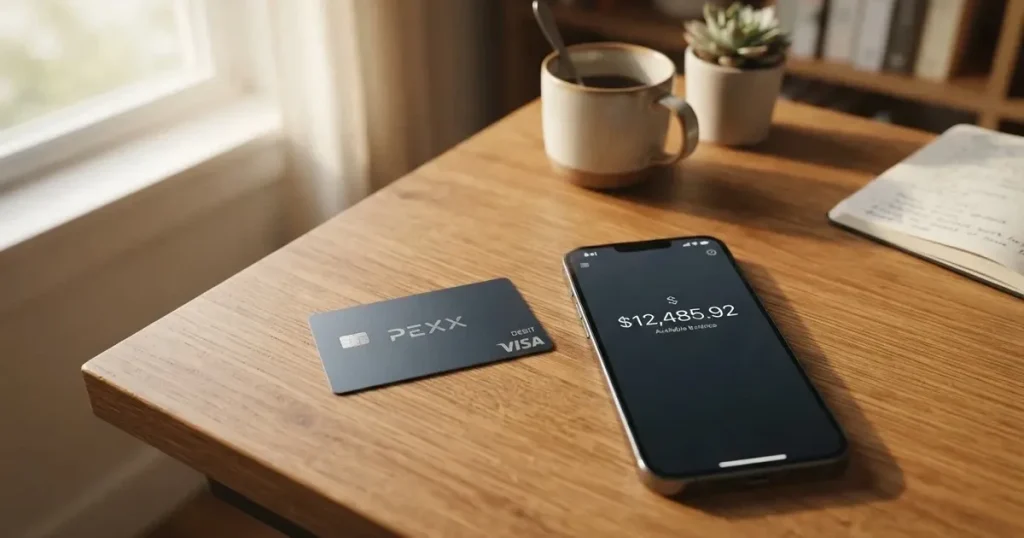
The PEXX card is one of those products built for a specific kind of reader: someone who already holds US dollars or stablecoins and wants to spend them in the ordinary world, at shops, online and at ATMs, without first wiring the money to a local bank. PEXX runs as a payment card linked to a balance you top up in USD, USDT or USDC, and it sells itself on two things — the card has no stated spending limits, and it reaches countries most other crypto cards skip past. That reach is its biggest selling point, and the fee structure is its biggest caveat, and both come out clearly once you look at the numbers and the country list. Conditions are current as of October 28, 2026.
Verdict
PEXX earns 6.8 out of 10 in my scoring. That is a respectable middle-of-the-pack score for a card that is not really competing on cashback, fancy tiered rewards or low FX. It is competing on access. If you live in a place where Visa or Mastercard debit cards from ordinary banks are hard to get, or you simply want a card funded directly from your crypto balance without first selling to a bank, PEXX is one of the few options that actually ships a card to your address.
| Criterion | Mark | Why |
|---|---|---|
| Who can get it | 7 / 10 | Wide country list across Europe, Asia-Pacific, Latin America, Africa, the Gulf and CIS, but eligibility and exclusions are not spelled out in detail |
| Cost | 6 / 10 | 0.6% platform fee on every transaction, 1.2% on non-USD purchases; issuance and monthly fees are not published |
| Top-up options | 6 / 10 | USD, USDT and USDC; networks are not specified; USD balance fed by ACH, Fedwire and SWIFT |
| Reliability and complaints | 7 / 10 | Registered with AUSTRAC and FinCEN; bank partner not named; only 3 Trustpilot reviews, with users complaining of fees higher than advertised |
| Everyday use | 8 / 10 | Physical and virtual cards available; Apple Wallet and Google Pay supported; ATM fee not disclosed |
Where PEXX fits best, in plain terms, is the dollar and stablecoin holder who needs high spending limits, who is comfortable managing identity checks, and who lives in a country most other cards will not serve. Where it does not fit is the reader who wants a clearly priced, no-surprises card, or anyone who needs rich cashback and reward programs.

Who will they give you the card to
PEXX’s country list is the headline. The card is available, by country of residence, across roughly 35 European countries and territories, including the UK, France, Germany, Italy, Spain and Switzerland, plus Australia, Japan, Macao, Malaysia, the Philippines, South Korea, Taiwan and Thailand. In Latin America: Argentina, Brazil, Chile, Colombia, Ecuador, El Salvador, Mexico, Panama and Peru. In the Middle East and Africa: Bahrain, Ghana, Kenya, Nigeria, South Africa, Uganda and the UAE. In the broader post-Soviet space and Caucasus: Azerbaijan, Georgia, Guernsey, the Isle of Man, Jersey, Kazakhstan, Moldova, Ukraine and Uzbekistan.
The crucial thing to notice is that the eligibility and exclusions are not actually itemised. The card page does not list excluded countries or any specific eligibility rules — instead it lists where the card is available, and leaves the negative side implied. If your country is not on that long list, treat that as a strong signal it is not currently served, rather than an oversight. The reader who asked “is PEXX card available in my country” should look for their country first; if it is missing, the rest of this review matters less than the country list. The unsupported countries (Belarus, mainland China, North Korea, Cuba and the rest) you see on some competitor pages are not stated on PEXX’s own materials, so any answer beyond “not on the supported list” is not confirmed by the card.
Beyond country of residence, the application asks for a valid ID and a phone number. A US virtual bank account is an extra step: it requires “level 1 KYC” on top of the standard sign-up. Proof of address, age limits and any other exclusions are not stated.
How to get it
Sign-up is a standard identity-checked flow rather than an open sign-up. You create an account, hand over a valid ID and a phone number, and PEXX reviews the application. The review usually takes 1 to 2 business days, and the FAQ title suggests there is an extra identity check to activate the card once the account is approved. PEXX does not publish the rejection reasons, so if your application is refused you may not get a clean explanation.
A practical point worth flagging: if you intend to use a US virtual bank account as your funding balance, complete the level 1 KYC step before you start funding. The card itself is issued about a minute after your deposit confirms for the virtual card; the physical card delivery time, cost and replacement cost are not stated.
The two products on offer are the PEXX Physical card, which is loaded with USD and stablecoins, and the PEXX Virtual card, which is instant and intended for online use. Both card products appear under page titles that mention Visa and Mastercard, so the brand on the plastic depends on the network assigned at issuance. The card currency is USD by implication rather than by explicit statement.
What it really costs
PEXX’s pricing is straightforward in shape but slightly thin on the small print. There is a 0.6% platform fee on every card transaction, a 1.2% FX markup on purchases that are not in USD, and “true mid-market pricing” for the underlying conversion. Issuance and monthly fees are not stated, the ATM fee is not stated, and there is no published tier structure — there are two products, Physical and Virtual, rather than Classic, Pro and Max plans.
| Fee or limit | Amount |
|---|---|
| Issuance fee | Not stated |
| Monthly fee | Not stated |
| Platform fee on every transaction | 0.6% |
| FX markup on non-USD purchases | 1.2% |
| ATM fee | Not stated |
| Spending limits | “There are currently no spending limits” (unofficial third-party data: US$30,000 per day, US$30,000 per transaction, US$70,000 per month) |
| Multi-currency balance | Not stated |
| Cashback | None stated |
A few everyday scenarios make the cost concrete.
Paying in USD with a USD balance is the cheapest path. The platform fee is 0.6% on top of the spend, so a US$100 purchase costs you US$100.60 in total — and the card is not adding an FX layer because the merchant settles in dollars. Paying in euros or any non-USD currency with a USD balance adds the 1.2% FX markup on top, so a €100 purchase, at a notional 1.08 rate, lands at around €100 plus 1.2% in FX plus 0.6% in platform fee. The exact figure depends on the day’s mid-market rate, but the markup is set.
Paying from a stablecoin balance works similarly: the platform converts the stablecoin to USD at mid-market, then charges the 0.6% platform fee. If the merchant is in euros, the 1.2% FX markup applies on top of the platform fee. There is no published network fee for the on-chain side at the card level — that cost is paid when you send the stablecoin in.
The limits deserve a closer look. PEXX’s own pages say “There are currently no spending limits.” Unofficial third-party data, on the other hand, gives a US$30,000 per day, US$30,000 per transaction and US$70,000 per month cap. The two statements are not in obvious conflict — “no spending limits” can be read as a marketing line about not capping ordinary cardholders, and the third-party figures as the actual ceiling — but they are not the same thing. Treat the official line as PEXX’s promise and the third-party figures as the practical ceiling until PEXX confirms one or the other in writing.
How to top up PEXX card
The top-up side is two-track: a crypto top-up in stablecoins and a fiat top-up in US dollars. The crypto side accepts USDT and USDC, and the fiat side accepts USD, but the specific blockchain networks are not specified on the page. That matters more than it sounds, because sending USDT on a network PEXX does not support is a one-way ticket to a manual support recovery with no guarantee of a refund.
USD balance top-ups go through three rails: ACH (1 to 3 US business days), Fedwire (a few hours to 1 business day) and SWIFT (1 to 5 US business days). ACH is free for the sender in the US; Fedwire and SWIFT are interbank wires that the sending bank will usually charge for. PEXX does not publish a deposit fee, and PEXX Earn has no minimum balance, so a small first top-up is workable. Card minimum top-up is not stated.
A practical checklist before you send your first transfer: confirm the network PEXX expects in the app or the support chat (do not assume); keep a small amount of native gas token in the wallet you are sending from if the network charges fees in a separate token; and send a test amount first, especially the first time you use a new chain.
Earn balance withdrawals are described as available “anytime”; the card-balance withdrawal and account closure treatment are not stated, beyond the existence of a Withdrawal collection in the FAQ. If getting your money out matters to you, raise that point in the support chat before you load a large balance.
Paying with it every day
The PEXX card is built for ordinary cardholder behaviour. You get both a physical and a virtual card, and you can add the card to Apple Wallet or Google Pay from the Cards tab in the app, with a one-time password sent by email or SMS. The app rating on the Australian App Store is 5.0 out of 5 from 3 ratings on iOS 16.0 and above, version 3.6.2, with English as the language. The Google Play listing exists, but the rating was not read for this review.
There is no cashback program, and the rewards story is PEXX Earn: a daily-interest product tied to US T-bill rates, with the important caveat that the balance is not FDIC-insured. So instead of points or cashback, the value proposition is “your idle balance earns treasury-rate interest” — a different model that suits a reader who parks funds on the card for a while rather than spending them down weekly.
The dispute process is more concrete than the cost page. Disputes are filed through PEXX support and submitted through the card network, only for transactions that actually went through, within 120 days of the transaction; the process itself takes 60 to 90 days; and a US$25 administration fee may apply if the dispute fails. A couple of practical notes from the broader card landscape: unauthorised claims on 3-D Secure transactions can have limited chargeback rights, and authorisation holds can stay on your balance for several days even if the merchant cancels the payment. Blocked merchant category codes (MCCs) are not stated, so you should not assume gambling or other sensitive categories are blocked.
What can go wrong
The complaint picture is small but instructive. Official channels do not surface any complaints, and on Trustpilot the brand page holds 3.5 out of 5 from 3 reviews at the time of writing. The substantive user reports cluster around fees higher than advertised — including a reported US$0.50 per-transaction charge and unexplained deductions — plus a failed crypto deposit with only a partial refund, against one positive December 2025 review praising fees and speed. Three reviews is a thin sample, and it is not enough to call the card unsafe, but it is enough to call the fee structure a place where surprises happen.
The corporate picture is reasonably solid for a small player. PEXX Technology Pty Ltd is an Australian company; it is registered with AUSTRAC as a Digital Currency Exchange (DCE100851583-001) and a remittance dealer (IND100851583-001), and with FinCEN as a money services business (MSB 31000288010318). The card is issued by a “partner bank” or “licensed partners”, and that partner is not named in the public materials. PEXX also says it follows AUSTRAC guidelines and runs an AML/CTF programme with enhanced due diligence. The missing name of the issuing bank is a real gap if you care about the financial strength behind the card.
Security is described as “bank-grade encryption” with real-time alerts and an in-app payment approval step, but card-freeze, card-insurance and FDIC insurance on the USD balance are not stated. The USD deposits are held with licensed partners, not at an insured bank, so the balance is exposed to the partner’s solvency in a way an ordinary US bank account is not. Help is available in the app, by email, through a Telegram channel, on X, on Instagram and on Medium, and the FAQ lives at faq.pexx.com — but support hours and a Russian-language option are not stated, so if you need 24/7 phone support or a non-English helpdesk, raise that with the team before you commit a large balance.
There are no dated events, no news-driven risks and no public programme-closure notices to report. The general card landscape has had its share — Visa terminated FTX’s global agreements on 13 November 2022 and wound down the FTX US debit card; WaveCrest was suspended by Visa in Europe in 2018, closing all WaveCrest-issued Visa programmes — so the question is not whether a programme can be suspended, only whether your card’s issuer is in good standing with the network. PEXX does not publicly name its issuer, so you cannot answer that question from the public materials alone.
What to take instead
PEXX is not the only option, and three alternatives are worth weighing depending on what you need.
| Card | Score | Best for | Headline cost |
|---|---|---|---|
| PEXX | 6.8 / 10 | Wide country reach, USD and stablecoin funding, no published spending cap | 0.6% platform fee + 1.2% FX |
| International Visa Card | 6.7 / 10 | US dollar-funded virtual card with explicit country rules | Virtual card US$5; plans from free to US$19/month; Visa rate + 2% FX |
| UNi Card | 6.1 / 10 | Multicurrency Mastercard with up to 3% spend-to-earn rewards | No annual or FX fees; live OTC rates |
| Whop Cards | 5.2 / 10 | 5% cashback at select merchants, with US state restrictions | No extra fees; cashback conditions and payout currency not stated |
The International Visa Card is the closest competitor in spirit, with USDC and USDT funded into a USD account at 1:1 and free deposits. It spells out its country exclusions — residents or legal registrants of Belarus, mainland China, North Korea, Cuba, India, Iraq, Iran, Israel, Myanmar, Nepal, Nicaragua, Russia, Syria, Turkey, Ukraine, Venezuela and Vietnam are not served, with FATF grey-list countries reviewed case by case — and that explicit list is itself a feature. Its cost is virtual card issuance at US$5, three plans (Classic free, Pro US$9/month, Max US$19/month), USD card use free and a “Visa exchange rate + 2% FX fee” for foreign currency. If you want the country and fee rules in writing, this card is more transparent.
UNi Card is a multicurrency Mastercard that spends from a UNi.Global account balance, has no annual fee and no foreign transaction fee, and offers “spend-to-earn rewards” up to 3%. The cost structure is “live OTC rates” with “no hidden exchange fees” — a different promise from PEXX’s 0.6% platform fee, but the conversion margin is paid through the OTC rate rather than a published line item. If you want rewards rather than just access, this is the more rewarding card; if you want published fees, PEXX is.
Whop Cards is the cashback play, offering 5% back at select merchants (currently Uber, with more planned). The consumer version is available in 31 US states, with a different and longer list for businesses, and an unsupported-consumer list that includes Belarus, mainland China, Cuba, Hong Kong, India, Iran, Iraq, Israel, Myanmar, Nepal, Nicaragua, North Korea, Russia, Syria, Turkey, Ukraine, Venezuela and Vietnam. Funding is a Whop balance backed by stablecoin collateral from a linked wallet, but the coins and networks are not stated. The 5% cashback makes Whop the most rewarding of the four, but the US-state footprint makes it useless outside the United States.
Who I would recommend it to
I would recommend PEXX to a specific reader. You live in a country on the supported list — most of Europe, Australia, Japan, much of Latin America, much of Africa, the UAE, Georgia, Kazakhstan — and you cannot get a sensible Visa or Mastercard from a local bank. You hold USD, USDT or USDC and you want to spend that balance directly, without first selling to a bank account. You are comfortable with a 0.6% platform fee on every payment, a 1.2% FX markup on non-USD purchases, and a fee structure that is not exhaustively published. You do not need rich cashback, and you do not need a US-state-restricted card.
I would not recommend PEXX to a reader who needs a fully transparent fee schedule, who values cashback or rewards over access, who lives in a country not on the supported list, or who needs a named, well-capitalised bank behind the card. For that reader, the International Visa Card is a more transparent alternative, UNi Card is a more rewarding one, and Whop Cards is the right pick if you live in a supported US state and care about cashback.
A small closing note on safety: any crypto-funded card carries counterparty risk on the platform, the issuer and the underlying custodian. The PEXX card’s balance is not FDIC-insured, the issuer is not named, and the published fee structure is thinner than the marketing language. None of that makes PEXX unsafe, but it does mean you should keep a smaller balance on the card than you would on a named-bank debit card, treat it as a spending tool rather than a savings account, and pull any balance you do not need back out to a wallet you control.
Frequently asked questions
What is the PEXX card?
The PEXX card is a Visa or Mastercard payment card issued by PEXX Technology Pty Ltd, an Australian company registered with AUSTRAC and FinCEN. It is funded by a USD, USDT or USDC balance, comes as a physical and a virtual card, and is sold on the basis of country reach and uncapped spending rather than on cashback.
How does the PEXX card work?
You create an account, complete identity verification, and load the card’s balance in USD via ACH, Fedwire or SWIFT, or in USDT or USDC from a crypto wallet. At payment time the platform converts the balance at mid-market, applies a 0.6% platform fee, and a 1.2% FX markup if the merchant is not in USD.
Is PEXX a bank?
No. PEXX is a payments and digital currency company, not a bank. The card is issued by an unnamed “partner bank” or “licensed partners”, and the USD balance held with licensed partners is not FDIC-insured.
Who owns PEXX?
PEXX is owned by PEXX Technology Pty Ltd, an Australian private company. The card-issuing partner bank is not named on PEXX’s public pages, and the underlying corporate ownership of the technology company is not published in the materials used for this review.
Is the PEXX card available in my country?
The card is available, by country of residence, in roughly 35 European countries, Australia, Japan, several Asia-Pacific economies, much of Latin America, several African countries, the UAE and a handful of CIS and Caucasus states. If your country is not on the supported list, PEXX does not publish an exclusion list, but the omission is itself the answer.
How do I get a PEXX card?
Sign up in the app, complete the standard identity check with a valid ID and phone number, complete level 1 KYC if you also want a US virtual bank account, and load a balance. The virtual card issues about a minute after the deposit confirms; the physical card delivery time is not stated.
Does the PEXX card require KYC?
Yes. The standard sign-up requires a valid ID and phone number, with the application usually reviewed within 1 to 2 business days. A US virtual bank account needs an additional level 1 KYC step, and the card itself requires an extra identity check to activate.
How do I top up the PEXX card?
Top up with USD via ACH, Fedwire or SWIFT, or with USDT or USDC from a crypto wallet. The blockchain networks for the stablecoin top-up are not specified on PEXX’s public page, so confirm the supported network in the app before sending, and consider a small test transfer first.
Is the PEXX card free?
PEXX does not publish an issuance fee or a monthly fee. The published costs are a 0.6% platform fee on every transaction and a 1.2% FX markup on non-USD purchases. User reviews on Trustpilot report fees higher than these published numbers, including a US$0.50 per-transaction charge in some cases.
Is the PEXX card safe?
PEXX is registered with AUSTRAC as a Digital Currency Exchange and a remittance dealer, and with FinCEN as a money services business. The USD balance is held with licensed partners and is not FDIC-insured, the issuing bank is not named, and the card relies on the same network-level security as any other Visa or Mastercard. Treat the card as a spending tool rather than a long-term store of value, and keep only the balance you intend to spend on it.
Choosing an app or neobank card – cryptocardadvisor
Content created by the «cryptocardadvisor» team