
CasherCard, step by step: an independent read of a virtual card that advertises zero KYC
 Available in US
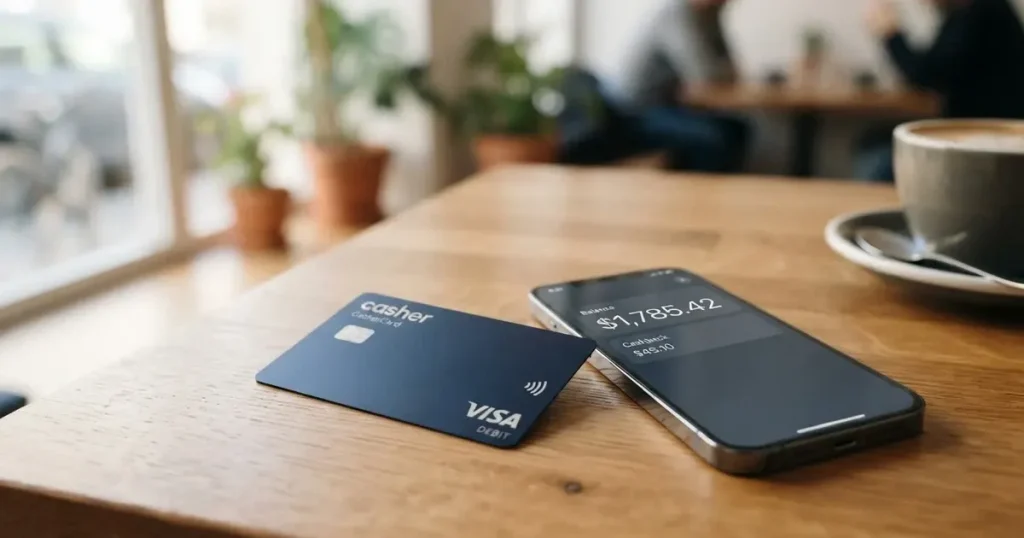
CasherCard is a virtual-only Visa-style card that you fund with crypto and spend at any merchant that takes the network. Signup is an email, the marketing line is “Zero KYC”, and the wallet accepts Bitcoin, Ethereum, Solana, USDT, BNB, TRON, Polygon, Litecoin, Avalanche and Arbitrum. The score from this review is 5.5 out of 10, and the reason that figure sits in the middle rather than higher is the amount of detail the company does not publish: no legal entity, no issuer name, no fee schedule for crypto conversion or foreign exchange, no dispute process, and no information about which networks are supported beyond a short list. If you want a virtual card you can load with crypto in minutes, the product is in front of you. If you want to know who you are sending money to, the page runs out of answers quickly.
The conditions described here are current as of October 28, 2026.
Verdict
CasherCard scores 5.5 out of 10. The product itself does what it says in broad terms: a virtual card number, funded from a crypto wallet, usable online or in a mobile wallet, with no subscription and a $4 issuance fee. What drags the score down is the disclosure gap. There is no list of supported countries, no legal entity name on the public pages, no published FX or crypto-conversion fee, no written dispute process, and no information about which stablecoin networks the wallet actually accepts (the FAQ names ERC20, BEP20 and TRC20, while the wallet list adds Solana, Polygon, Avalanche, Arbitrum, Litecoin and BNB without saying which token standards those imply). For a reader who is choosing a card, the safe interpretation is that this is a small operator with a thin public footprint, and that the 5% top-up fee is the only number you can plan a budget around.
| Criterion | Mark | Why it lands there |
|---|---|---|
| Who can get it | 6 / 10 | Countries and citizenship are not stated; payment methods “may vary by location” |
| Cost | 4 / 10 | $4 per card issued, no subscription, but 5% to fund the wallet |
| Top-up options | 9 / 10 | Ten assets listed across Bitcoin, Ethereum, Solana, USDT, BNB, TRON, Polygon, Litecoin, Avalanche and Arbitrum |
| Reliability and complaints | 5 / 10 | Issuer and legal entity unnamed; Trustpilot 4.1 from 10 reviews, with a fraud allegation and a “balance not viewable for weeks” report |
| Everyday use | 4 / 10 | Virtual only; Google Pay listed, Apple Pay not mentioned, no ATM |
| Total | 5.5 / 10 |
The card suits a crypto holder who wants an instant virtual number, accepts a 5% loading cost, and is comfortable with a small operator that does not publish the standard card-programme detail. It is not suited to a reader who needs a physical card, an ATM, Apple Pay, a published fee schedule, a clear dispute path, or a regulated issuer name on the public page.
Who will they give you the card
The site does not list supported countries and does not list excluded ones either. The terms say only that payment methods “may vary over time and by location”, and the eligibility rule in the terms is that you confirm you are at least 13 years old. There is no mention of which citizenships can apply, which residences are accepted, or which sanctions lists are screened against. In practice that means you will only know whether the card works for you when you sign up, fund the wallet and try to spend.
The signup block runs through this in a moment, but the short version is that the sign-up form is an email, and the marketing line is “Zero KYC”. That is unusual among card programmes, and it is worth sitting with for a second before you take it at face value. Zero KYC, on a card product, usually means the issuer or programme manager has decided to live with the regulatory ceiling of low-balance prepaid cards in the jurisdiction they operate in, or has chosen a jurisdiction with a higher ceiling. The card is described as virtual-only and prepaid-style, so the most likely fit is a low-balance prepaid product, but the company does not say which jurisdiction it sits in, so the ceiling itself is not visible to the reader. If you need a card for larger balances, for business expenses, or for a regulated employer to expense against, this is not the right product.
A second caveat is that the 13-year minimum age is also unusual. Most card programmes set 18 as the minimum, and regulated issuers in the EU, the UK and the US tend to be in the 16 to 18 range with parental consent rules. A 13-year minimum is consistent with a product that is not registered as a payment institution in a major financial centre, and that is something to weigh in your own decision.
If you are in a country that the card programme does not serve, the natural fallback is to use a card from a regulated issuer in your own country. The alternative section below looks at three options, and the background section on crypto cards more generally explains the difference between an issuer, a programme manager and a network brand.
How to get it
The signup path the site describes is short. You register with an email, you fund the wallet with crypto, and you issue a card in the dashboard. There is no mobile app, so the dashboard is a web page. The product page markets “Instant Crypto Funded Virtual Cards”, which means you do not wait for a physical card to be printed and posted. The card graphic on the site shows a Visa logo; Mastercard is not mentioned anywhere I could find on the public pages, so I am treating this as a Visa-only product unless the company updates that.
There is no KYC step on the signup form itself. The site markets the product as “Zero KYC”, and the only personal data you enter at signup is your email. There is no request for a phone number, no proof of address, no identity document, and no selfie. There is also no mention of a tiered verification system where the limits rise once you upload documents; the limits section below is the only number the company publishes on size.
A few things follow from this that are worth being explicit about. First, because there is no identity check, the card cannot be issued in your name in the way a regulated bank card can. If a merchant or a regulator asks who holds the card, the answer is essentially the company that issued the number, not you. Second, because there is no proof of address, you cannot use this card where a merchant requires AVS (Address Verification Service) to match a billing address against the card issuer’s records. Third, if the programme is suspended by Visa or by the issuer, the recovery path is whatever the company writes into its terms, and as the disputes section below sets out, those terms are thin.
The dashboard does offer some controls that partly substitute for a formal verification step. You can set per-card daily, weekly and total spending limits, you can create sub-accounts, and you can issue more than one card. None of that is the same thing as KYC, but it is the set of dials the company gives you to manage exposure.
Fees: what it really costs
The honest answer to “what does it cost” is that only the issuance fee and the top-up fee are published. The rest of the cost stack — crypto-to-fiat conversion, foreign exchange, network fees inside the wallet, and what the card charges for declined authorisations — is not stated. The fee page acknowledges this directly, saying that fees and limits vary by “card program, provider availability, payment network, and account eligibility”. That is a long way of saying “we will tell you when you try to use it”.

| Fee or limit | Amount |
|---|---|
| Card issuance | $4 per card |
| Monthly subscription | None |
| Tiers | None (single tier) |
| Funding the wallet | 5% |
| Decline fee | 0% |
| Crypto-to-fiat conversion fee | Not stated |
| Foreign exchange fee | Not stated |
| ATM withdrawal | Not stated (virtual only) |
| Maximum per transaction | $5,000 |
| Maximum per month | $50,000 |
The numbers a reader can plan around are the $4 issuance, the 5% loading fee, the 0% decline fee, and the $5,000 / $50,000 limits. Everything else is “not stated” on the public pages.
It is worth thinking through three everyday payments to see what that means in practice.
A $50 online subscription paid in your local currency from a USDT balance. The 5% loading fee is the only cost you can be sure of in advance. If the card converts USDT to USD at the moment of payment, the conversion fee (if any) and any FX fee from USD to your local currency both apply, and the company does not publish either. A reasonable mental model is that the 5% is your floor and the real cost is somewhere above 5% once a typical crypto-to-fiat markup and an FX margin are layered on, but treat that as an estimate of the range, not as a published number.
A $100 in-store contactless payment in a foreign currency. The 5% loading fee is already paid. At the terminal, the card routes through Visa’s exchange rate, and the company can apply an FX markup on top, which it does not publish. Many crypto cards in this corner of the market charge an FX fee on the FX leg; the company neither confirms nor denies that.
A $5 micro-transaction or a refused authorisation. The decline fee is published as 0%, so a declined transaction does not add a charge. That is a small but useful number for a reader who worries about failed subscriptions eating into a balance.
The general point is that the cost story is “5% on the way in, and then we will see on the way out”. If you want a card with a published FX fee, a published conversion fee, and a fee schedule you can read end to end, the alternative section points to other products, and the broader background section explains why published fee schedules are the norm in this category.
How to top it up
Topping up starts with a transfer to the wallet. The company lists ten assets on the funding page: Bitcoin, Ethereum, Solana, USDT, BNB, TRON, Polygon, Litecoin, Avalanche and Arbitrum. The FAQ narrows the supported networks to Bitcoin, Ethereum (ERC20), BNB Smart Chain (BEP20) and Tron (TRC20), and the supported assets to BTC, ETH, USDT and USDC. That is a meaningful gap to be aware of. Polygon, Avalanche, Arbitrum, Solana and Litecoin appear on the wallet list but are not mentioned in the FAQ network list; the safe interpretation is that the FAQ is the conservative answer and the wallet list is the broader marketing list, but the company does not reconcile the two on the public pages. Send to the network the company tells you to in the dashboard for the specific asset you are sending, not the first network you see on the marketing page.
A few mechanics are worth being clear about. The wallet holds the funds after the transfer, and the card draws on that wallet balance. The 5% fee is taken at funding, not at spend, so by the time the card is used, the balance already reflects the fee. The minimum top-up is not stated, which means there is no published floor below which the system refuses a transfer. Who pays the on-chain network fee (gas, bandwidth, energy) is also not stated; in most setups the sender pays it from the same wallet, and that is the most likely arrangement here, but treat it as a question to confirm in the dashboard rather than a published rule.
Fiat top-up is not stated. The supported funding path is crypto, and there is no mention of a bank transfer, a card top-up, or a third-party on-ramp. If your only access to crypto is through a centralised exchange, the cost of moving from the exchange to the wallet includes the exchange’s withdrawal fee, the on-chain network fee, and then the 5% CasherCard fee on top.
Unloading is the other half of the picture. The site says “unused balance is refundable”, but it does not name the method, the fee, or what happens to the balance when the account is closed. A reasonable read is that crypto is returned to a wallet address you provide, and that the 5% is not refunded (the fee was for the load, not for the spend), but the company does not confirm any of this on the public page. If you plan to keep a meaningful balance in the wallet, the absence of a written withdrawal process is a real consideration.
Paying with it every day
The card is virtual, so there is no plastic. The site lists Google Pay as a supported wallet; Apple Pay is not mentioned. The practical effect is that on Android you can add the card to Google Pay and pay contactless in store, while on iPhone there is no published path. That matters more than it sounds, because in markets where Apple Pay dominates in-store contactless, a virtual card without Apple Pay support is effectively an online card.
There is no ATM access. The card has no physical form, and even if it did, ATM access is not mentioned on the public pages, so the card is for online checkout and for in-store contactless via Google Pay. There is no published list of blocked merchant categories, so it is not stated whether gambling, dating, crypto exchanges or other commonly-restricted MCCs are declined at the issuer level.
There is no cashback, points or rewards programme mentioned on the public pages, and no referral bonus is described either. A /referral path is referenced in the company material, but its terms are not in the public pages I could read. Treat the card as cashback-free unless and until the company publishes otherwise.
There is no mobile app. The dashboard is a web page, and a REST API is mentioned for developers. That means there are no app store ratings to consult, and that the controls you have over the card (freezing, limits, sub-accounts) live in the browser, not in a phone. For a reader who keeps a balance on a payment card, the absence of an app is a usability gap, particularly for an instant freeze.
The disputes path is where the everyday-use picture gets thin. The terms do not describe a general chargeback or dispute process. The company says remedies relating to a vendor’s products or services must generally be pursued with the vendor directly, that delivered gift cards and codes are non-refundable, and that a defective item may be replaced or refunded after verification. Chargebacks are not mentioned. In practice this means the protections you get on a regulated debit card (a written dispute process, a chargeback code, a liability shift under 3-D Secure) are not documented for this product, and the terms push you back to the merchant. If a merchant refuses to help, the published recourse is the company’s support email, with a stated reply time of “usually within 24 hours”.
What can go wrong
The first risk is structural. The company describes itself as “a registered technology company” and explicitly says it is “not a bank or financial institution”. Card issuing and wallets come from unnamed “regulated third-party providers” and from “authorized Visa/Mastercard partners which may change”. No legal entity name, no registered address, no company number, and no regulator name is given on the public pages. The background section on crypto cards more generally explains the role of an issuer versus a programme manager; the practical point here is that the entity whose name is on the card, and the entity that actually issues the card number, are not visible to you from the public site.
The second risk is operational. Trustpilot shows a 4.1 out of 5 from 10 reviews, all within the last 12 months as of October 2026, which is a small sample. The two complaints that stand out are a 1-star review from August 2026 alleging that the company “advertised no kyc cards and cheated customers”, and a 4-star review from September 2026 reporting that prices are high and the balance could not be viewed for weeks. The first is an allegation, not a finding, and the second is a usability report. They are not a pattern, but they are the only independent signal available, and they line up with the disclosure gaps on the company side.
The third risk is the custody model. The site does not state how funds in the wallet are held. The most likely arrangement is that funds sit in a custodial wallet operated by the company or by a third-party custodian, and that the company controls the private keys. That is the standard model for a “load crypto, spend fiat” card, but the company does not say so, does not name a custodian, does not say whether funds are segregated, and does not say what safeguarding (if any) applies. The background section explains why this matters: with a custodial wallet the user trusts the provider completely, and crypto transfers are irreversible, so a custodian failure or a hack is unrecoverable from the user’s side.
The fourth risk is regulatory. The company is not a bank or financial institution by its own description, and the public pages do not name a regulator. In the EU, MiCA (the markets-in-crypto-assets regulation) sets out a CASP authorisation regime that took effect in stages through 2024 and that is now in force; the background section summarises the main dates. In the US, FinCEN guidance treats administrators and exchangers of convertible virtual currency as money services businesses. A reader in either jurisdiction can check the relevant register (ESMA’s interim register in the EU, FinCEN’s MSB registrations in the US) for the entity that actually holds the licence. The company does not give you a name to search for, so the check is not possible from the public page.
The fifth risk is support reach. The terms list [email protected] and the contact page lists [email protected], plus a Telegram channel (@CasherCard), a WhatsApp link, and a contact form. Reply time is “usually within 24 hours”. A gmail address on a contact page, alongside a corporate domain, is a small but real signal of operational thinness, and the absence of a phone line or a ticketing system is worth factoring in if you are moving meaningful balances.
The sixth risk is the network-and-token confusion. Because the wallet list and the FAQ network list do not line up perfectly, a reader who sends USDT on Polygon (because Polygon is on the wallet list) when the FAQ only confirms ERC20, BEP20 and TRC20 is at risk of a deposit that arrives on a network the system does not credit automatically. The background section explains why this matters in general: blockchain transfers are irreversible, and manual support recovery for a wrong-network deposit is not guaranteed.
What to take instead
Three alternatives appear in the comparison set for this review. They are not endorsements, and each comes with its own gaps.
Cardex, score 5.6 out of 10, markets “one crypto card, 200+ countries” and accepts USDT, USDC and BTC into a wallet that converts to fiat at the moment of payment. The site describes an “AI-Powered Conversion Rate” that scans global exchanges at the moment of spend. The card is available on Verve, Visa, Mastercard and UnionPay, and both virtual and physical cards are offered, with the App Store listing pointing to a Naira-focused product. The cost is not stated on the public pages I could read, and no fee percentage is given for the conversion. The strength relative to CasherCard is country coverage and the network mix; the weakness is that the published fee schedule is similarly thin.
CardFlow, score 4.9 out of 10, is positioned as “Nigeria’s smartest fintech card platform” with global users. The product is a virtual USD Mastercard created in about 3 minutes, with creation listed as free in the site FAQ. Funding is Bitcoin, USDT, ETH, or a Naira bank transfer, which is a more useful fiat rail than CasherCard’s crypto-only path. Cost and fees are not stated. The strength is the Naira on-ramp and the free creation; the weakness is the narrow geographic focus and the absence of a published fee schedule.
HyperCard, score 4.7 out of 10, is a prepaid card with USD or EUR balances, funded by depositing USDT, BTC or ETH in the app and converting to fiat on the card. The App Store page says the card works in more than 176 countries, which is an acceptance claim rather than an eligibility list, and the public pages I could read do not state cost or fees. The strength is the dual-currency balance and the broad acceptance claim; the weakness is the same fee-schedule gap and a country list that is implicit rather than published.
A simple way to read this comparison is to look at the gaps rather than the scores. None of the three alternatives publish a full fee schedule, none name their issuer in the public materials I could read, and all three sit in the same “thin disclosure” category as CasherCard. If the disclosure gap is the deciding factor for you, the realistic move is to a card issued by a named bank or e-money institution in your own jurisdiction, where the fee schedule, the regulator and the dispute process are public and checkable. The background section on crypto cards explains how to tell the difference.
Who I would recommend it to
I would recommend CasherCard to a crypto holder who already keeps funds on a self-custody or exchange wallet, who wants a virtual card number in minutes, who is comfortable paying a 5% load fee plus an unknown conversion and FX margin on top, who does not need Apple Pay, an ATM, a physical card, or a written dispute process, and who treats the wallet balance as small and replaceable. The product does the basic job in that profile.
I would not recommend it to a reader who needs a physical card, an ATM, Apple Pay, a published fee schedule, an issuer name on the public page, a country list, or a regulated dispute path. The 5% load fee is also high enough that any reader making more than a few hundred dollars of purchases a month will pay more in loading fees than they would on a card with a published FX margin. And the disclosure gap is wide enough that a reader who plans to keep a meaningful balance should treat the balance as money held by an unknown custodian, and size it accordingly.
The most useful single check before you commit is to ask the company, in writing, four questions: which legal entity issues the card, which regulator oversees that entity, what the crypto-to-fiat conversion fee is in basis points, and what the FX margin is on a non-USD purchase. If the answers come back in writing, you can compare the product on a like-for-like basis. If they do not, the disclosure gap on the public pages is the answer in itself.
Frequently asked questions
What is CasherCard?
CasherCard is a virtual payment card you fund with crypto and spend wherever the network is accepted. The site markets it as “Zero KYC” and as a Visa-style card. Card issuance is $4, the wallet is funded with crypto only, and there is no monthly subscription. The site does not name the card issuer or the legal entity behind the product.
How does CasherCard card work?
You sign up with an email, send crypto to the wallet, and issue a virtual card in the dashboard. The card draws on the wallet balance at the moment of spend, and the 5% funding fee is taken at the load step. There is no mobile app; the dashboard is a web page.
Is CasherCard a bank?
No. The company describes itself as “a registered technology company” and explicitly says it is “not a bank or financial institution”. Card issuing and wallets come from unnamed third-party providers. The legal entity behind the product is not named on the public pages.
Who owns CasherCard?
The public pages do not give a legal entity name, a registered address, or a company number. The site describes itself as a technology company, but does not name the parent, the jurisdiction of incorporation, or the regulator. Independent verification of ownership is not possible from the public material.
How do I get a CasherCard card?
Register with an email on the site, fund the wallet with one of the listed crypto assets and networks, and issue a virtual card from the dashboard. The card is virtual, so there is no delivery step. The site markets signup as taking a few minutes.
Does CasherCard require KYC?
The marketing line is “Zero KYC” and the signup form is an email. No phone number, identity document, or proof of address is requested at signup. There is no mention of a tiered verification system where limits rise with documents. The published limits are $5,000 per transaction and $50,000 per month.
How do I top up CasherCard?
Send crypto to the wallet address shown in the dashboard. The site lists Bitcoin, Ethereum, Solana, USDT, BNB, TRON, Polygon, Litecoin, Avalanche and Arbitrum, and the FAQ narrows the supported networks to Bitcoin, ERC20, BEP20 and TRC20. The 5% funding fee is taken at the load step, and the on-chain network fee is paid by the sender.
Can I add the CasherCard card to Apple Wallet?
The site does not mention Apple Pay. Google Pay is listed. If you need Apple Pay support specifically, the public pages do not document a path for it, and this is one of the practical limits of a virtual-only product without a published tokenisation programme.
Where can I use the CasherCard card?
The card is virtual, with no ATM access, and is accepted anywhere the network is taken. Google Pay is listed for in-store contactless on Android, and the card number can be used for online checkout. There is no published list of blocked merchant categories, so gambling, dating, crypto exchanges and other commonly-restricted MCCs are not stated one way or the other.
Is CasherCard safe?
The wallet is custodial, and the company does not publish how funds are held, who the custodian is, or what safeguarding applies. Trustpilot shows 4.1 out of 5 from 10 reviews, with one fraud allegation and one report of a balance that could not be viewed for weeks. Treat the balance as money held by an unknown custodian and size it accordingly.
Choosing a virtual card – cryptocardadvisor
Content created by the «cryptocardadvisor» team