
A self-custody Visa Platinum that loads through seven blockchains and pays 2.5% back, but charges a mystery price for the card itself
 Available in US

Rizon is a self-custody Visa Platinum that converts stablecoins held in your own wallet into a spending balance across seven blockchains, then pays 2.5% back on every purchase. If you already keep crypto in your own wallet and want a card that doesn’t ask you to deposit first, Rizon is one of the few options that does it. The catch is that several of the most basic numbers on the official site are either missing or contradictory: the card’s price, the ATM fee, and even whether the card is available by residence or by passport. This review walks through what Rizon actually does, what it costs in practice, and where it falls short, so you can decide whether the 2.5% cashback and the multi-chain top-up are worth the unknowns.
The conditions described here are current as of October 28, 2026.
Verdict
Rizon earns 6.7 out of 10 in my scoring. The card does the things it promises, but the gaps in the public documentation keep it from ranking higher.

| Criterion | Mark | Why |
|---|---|---|
| Who can get it | 6/10 | The help center lists 44 nationalities, but the card’s main page says 122+ countries by residence; the two pages contradict each other, and US passport holders are on the supported list while the physical card ships to only 31 US states |
| Cost | 6/10 | Spending in USD is free, account maintenance is free, and on-chain deposits are free, but the card price, ATM fee, and Emerald subscription price differ between the card page and third-party sources |
| Top-up options | 9/10 | On-chain deposits work on Arbitrum, Solana, Base, Polygon, Optimism, Avalanche, and BSC with no platform fee, which is wider than most rivals |
| Reliability and complaints | 5/10 | Only 8 reviews on Trustpilot, mostly one star, with user reports of card fees charged before KYC and slow manual reviews |
| Everyday use | 9/10 | Virtual and physical Visa Platinum, Apple Pay, Google Pay, ATM withdrawals up to $250, and 2.5% cashback on every purchase |
The card suits you if you hold a Latin American or Asian passport, keep stablecoins across multiple chains, and want a Visa you can fund directly from your own wallet. It does not suit you if you need a US-only card, a metal card today, or a clear answer on the upfront price before you sign up.
Who will give you the card
The most confusing part of Rizon is its availability rule, because the card’s own pages disagree with each other.
The main card page says the product is “intended for people who live in and are domiciled in” the United States or Latin American countries, and may be restricted elsewhere, while at the same time claiming 122+ countries are supported. That is a residence-based rule, but the help center tells a different story: availability is based on citizenship (your passport), not where you live, and the supported list runs to 44 nationalities. Russia and Belarus are not on it. The full list covers Antigua and Barbuda, Argentina, Australia, Bahamas, Barbados, Bangladesh, Belize, Brazil, Cayman Islands, Colombia, Costa Rica, Dominica, Dominican Republic, Ecuador, Egypt, El Salvador, Ghana, Grenada, Guatemala, Guyana, Honduras, Japan, Malaysia, Mexico, Morocco, New Zealand, Pakistan, Panama, Paraguay, Peru, Philippines, Saint Kitts and Nevis, Saint Lucia, Saint Vincent and the Grenadines, Senegal, Singapore, Suriname, Thailand, Turks and Caicos Islands, Uganda, UAE, United States, Uruguay, and Zambia.
In practice, the citizenship rule is the one that decides whether KYC passes. If your passport is on the list, you can usually complete verification. The 122+ countries on the card page refers to where the physical card can be shipped, not who can sign up.
For the physical card specifically, help articles narrow the picture: it is available in 49 countries and territories, and inside the United States only 31 states are covered. If you live in a state the help center does not name, you can sign up and use a virtual card, but the plastic will not arrive.
The application also enforces an 18+ age rule, which is standard for prepaid and debit cards in most jurisdictions.
How to get it
Rizon offers three card types: a virtual card, a physical Visa Platinum, and a metal card that is listed as “Coming Soon” on the official page. The product sits on USD and EUR account balances, though the card’s own settlement currency is not explicitly stated anywhere on the public pages.
Sign-up runs through the iOS or Android app. You create an account, complete KYC, and the virtual card provisions once verification passes. KYC is required, and the public pages do not describe exactly which documents are accepted; the help center refers to two outcomes in the app. “KYC Declined” is final, set by the card’s KYC/AML provider, and Rizon cannot override it. “Verification Incomplete” means a typo, an unclear document photo, or a poor selfie; you can retry.
Third-party sources describe the KYC flow as passport plus selfie, with the reviewer’s test clearing in two minutes, though other users report manual review running beyond 24 to 48 hours. Treat that two-minute figure as unofficial: it is one reviewer’s experience, not a guarantee from Rizon.
Once KYC passes, the virtual card appears in the app and can be added to Apple Pay or Google Pay immediately. The physical card is shipped globally per the card page, with an average delivery time of three days, though the exact shipping cost and replacement cost are not stated; the card page just says “Check app for the price.” If you live outside the 31 US states that receive physical cards, or outside the 49 countries the help center names, the plastic will not arrive even after approval.
What it really costs
The headline numbers look good: account maintenance is free, on-chain deposits are free, spending in USD is free. The detail is where the pricing gets murky, because the card’s own page, the help center, and third-party reviewers do not agree.
| Fee or limit | Amount |
|---|---|
| Virtual card issuance | Not stated (“Check app for the price”) |
| Physical card | Not stated (“Check app for the price”) |
| Replacement card | Not stated |
| Account maintenance | Free |
| On-chain deposit | Free |
| Card spend in USD | Free |
| Card spend in non-USD | 1.7% + $0.10 |
| Trading fee | 1.7% |
| ATM withdrawal | $1 + 0.65% |
| ATM withdrawals per 24h | Up to 3 |
| Max per ATM withdrawal | $250 |
| Emerald subscription | From $5.59/month |
| Emerald FX/trading discount | 50% off (so ~0.85% trading, ~1.02% non-USD spend per the page, though this figure looks garbled) |
| Deposit, card spend, and send limits | No limit |
| Metal card | Coming soon |
Two non-USD examples make the fee structure concrete. If you spend €100 at a Paris café, Rizon converts USD to EUR at the 1.7% + $0.10 rate, so the cost on a $108 equivalent would be about $1.84 plus the $0.10 fixed fee. If you spend the same €100 from an Emerald subscription, the discount should halve the variable rate, though the published Emerald number reads as 1.02% and is hard to verify against the standard 1.7% baseline.
A second example: you withdraw $200 from an ATM in Bangkok. The fee is $1 plus 0.65% of $200, so $2.30 total. That is a third withdrawal in a 24-hour period, so any further withdrawal that day would be declined. At a $250-per-withdrawal cap, taking out $1,000 in cash from Rizon in one day means four trips to the ATM, with a combined fee of $11.50.
Unofficial third-party sources give more detail that is worth knowing even if Rizon’s own page does not confirm it: a Standard virtual card reportedly costs $10 one-time, a Gold virtual card and Emerald virtual card are reportedly free, a Standard physical card reportedly costs $49.99, a Gold physical card reportedly costs $24.99, and the Emerald physical card is reportedly included in the subscription. Plans on that source are Standard free, Gold $3.99/month, and Emerald $6.99/month, with a three-month minimum. The card page’s “$5.59/month from” Emerald price contradicts that figure. Treat all of this as unofficial until the in-app price matches.
The fee table also hides a less obvious cost: the network fee. Rizon does not charge a platform fee on deposits, but every blockchain charges its own gas or bandwidth fee for the transfer. On Ethereum mainnet, that can easily be several dollars per deposit; on Solana or Polygon, it is usually a fraction of a cent.
Top up
Rizon’s strongest feature is the breadth of its on-chain top-up, which is wider than most crypto cards I have looked at. The official page lists seven networks for deposits with no platform fee: Arbitrum, Solana, Base, Polygon, Optimism, Avalanche, and BSC. The help center adds that both Solana and EVM-compatible chains are supported.
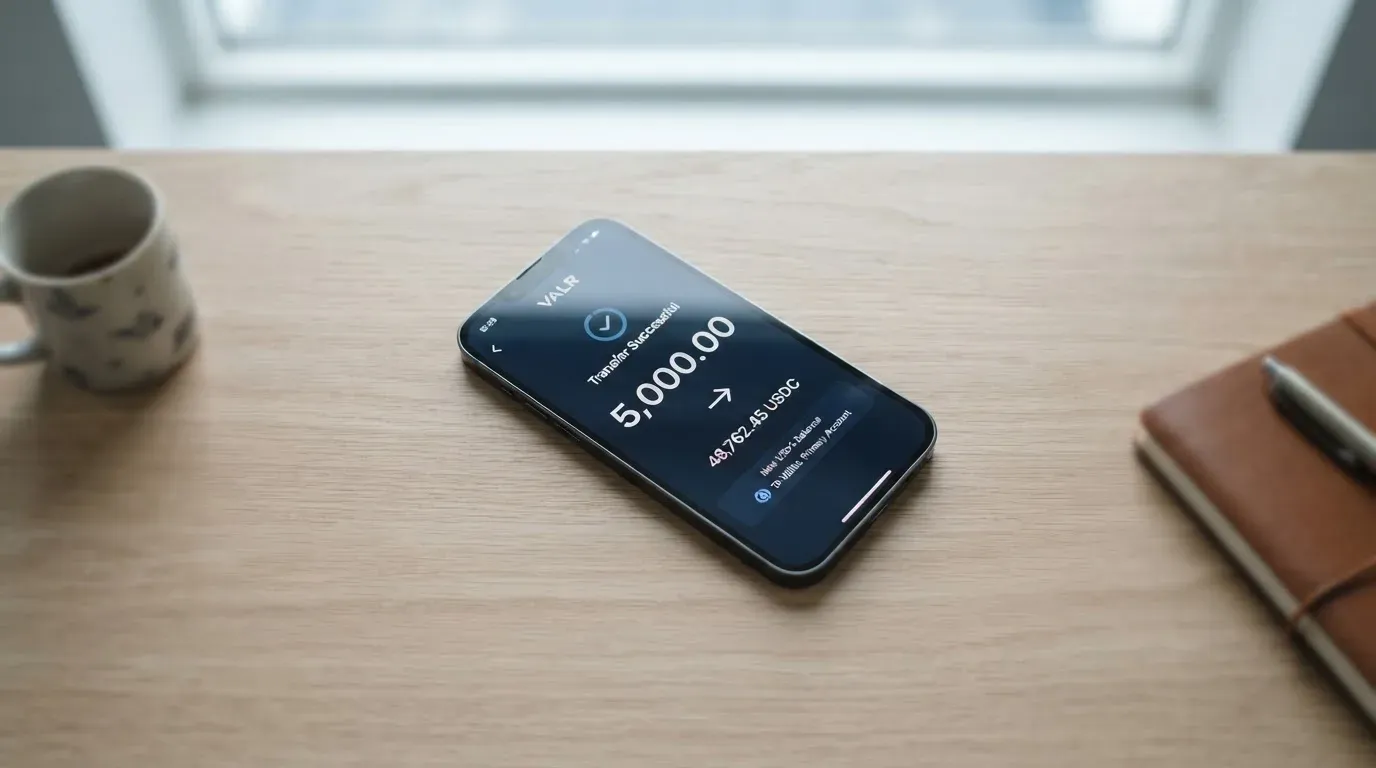
The specific coins accepted are not listed on the public pages I read, and an “extended fees” page referenced elsewhere was not available. Unofficial sources name USDC and USDT on Polygon, Optimism, or Arbitrum, plus a US bank transfer and a credit card option. Rizon’s own pages do not confirm which tokens or fiat rails are live, so check the app before sending anything.
The mechanics of a top-up look like this. You open the app, choose a network from the list, copy the deposit address, and send the token from your self-custody wallet. The on-chain transfer is irreversible: if you send on a chain Rizon does not support, or to the address of a different network, the funds can be lost or require manual support recovery with no guarantee. Background context worth keeping in mind: Circle, the issuer of USDC, has listed 38 networks it natively supports as of September 2026, including the seven Rizon uses, but Circle stopped supporting USDC on Tron in February 2024, so a USDC TRC-20 deposit is not a native option. Tether’s USDT is similarly issued on multiple networks, including Ethereum, Tron, Solana, Polygon, and Avalanche.
Sending from a wallet that holds only stablecoins and no native gas token is a common pitfall. On Ethereum and EVM chains, gas is paid in ETH; on Solana, fees are tiny but still paid in SOL; on Polygon, the native token is MATIC; on BSC, it is BNB. A small balance of the gas token keeps deposits from failing.
For off-ramps, on-chain withdrawals cost a network fee plus 0.1%. International sends cost the same. Sending to another Rizon user is free. The balance on account closure is not stated in the public materials.
Paying with it every day
Once funded, the Rizon card behaves like a prepaid Visa. Spending in USD is free; spending in any other currency takes the 1.7% + $0.10 fee. The virtual card can be added to Apple Pay and Google Pay, so contactless payments at a coffee shop or supermarket go through the phone without ever showing the plastic.
The 2.5% cashback applies to online, in-store, and ATM purchases, and lands in a cashback balance you can redeem. The official card page says 2.5% across the board; one third-party source claims 1% capped at the plan fee on the Gold tier. The card’s own wording is the safer read, but if the cashback you actually see in the app is lower than 2.5%, that is the unofficial conflict playing out. The payout currency is not stated.
RizPoints also accrue on spending, which sit alongside the cashback as a separate loyalty layer. The exact relationship between the two is not explained on the public page.
For ATM use, the physical card works worldwide, capped at $250 per withdrawal and three withdrawals per 24 hours. Some merchants and online sites decline prepaid or foreign-issued cards, partly because the BIN (the first six or eight digits of a card number) reveals the issuer country. Address Verification Service, which many US and UK merchants use, is often unavailable for foreign-issued cards, which can lead to declines even when the balance and the card are valid. Rizon does not publish a list of blocked merchant categories, so there is no public way to know in advance whether a given subscription or gambling site will accept the card.
The mobile app is the only interface for managing the card. Unofficial app store data puts the Android app (“RIZON: Stablecoin Finance”) at around 4.3 out of 5 from about 3,500 ratings, and the iOS app at 4.0 from 144 ratings; those are from a third-party aggregator of unknown date and should be taken as unofficial.
What Rizon does not state is a chargeback or dispute process. The help center has articles on card limits and on card use, but nothing titled to cover a refund or a fraud claim. As a cardholder that means the safety net for a disputed transaction is not described, and you should keep your own records.
What can go wrong
The reliability score is the lowest of the five criteria, and it is the area where Rizon is hardest to evaluate. The card has a thin public footprint: no Trustpilot page under the Rizon card name (the search results collide with an unrelated IRC network, which makes any Trustpilot score for “Rizon” unreliable), and no dated public statements on licences, issuer changes, or fines in 2025 or 2026.
The card programme is issued by Signify Holdings Inc. and its subsidiary Nimbus LLC, which is also known as Rain, a known crypto card issuer. A Medium article and some aggregators also name Third National as the issuing bank, but that is unverified and not on the official Rizon page. Rizon Technologies, UAB is the entity that makes the product available to users.
User reports collected from aggregators and secondhand reviews cluster around the following themes, none of which I can confirm by opening the original Reddit or app store threads:
- Card issuance fees being charged before KYC is finished, so a user who is later declined has to chase a refund.
- Manual KYC review running beyond 24 to 48 hours, even though the advertised experience is closer to two minutes.
- Wrong-network deposits taking slow manual recovery.
- Refund requests ending up in chatbot loops rather than reaching a human.
The aggregator that compiled these themes says Rizon acknowledged the onboarding flaw and planned to add a country-selection step, but no date is given.
Security controls lean on the self-custody model: biometric login, a “smart fraud protection” label, and the ability to lock and unlock the physical card in the app. Two-factor authentication and any form of insurance are not mentioned on the public pages. Because Rizon is non-custodial, you keep full control of the recovery phrase; if you lose it, Rizon cannot help you recover funds, and a stolen seed phrase gives the thief everything.
Support runs through the help center at intercom.help/rizon and a contact email that is obfuscated on the page. Phone and live chat are not offered, and response hours are not stated. For a card that bills itself as global, the absence of phone support is a practical limit.
The metal card is still “Coming Soon” with no shipping date, and the standard “higher tiers” the card page mentions as unlocking premium benefits are not named or priced.
What to take instead
Rizon’s mix of self-custody, multi-chain top-up, and Visa acceptance is unusual, but several other cards cover parts of the same ground with more published detail. Here is how three of them compare.
| Feature | Rizon | MetaMask Card | KAST | TokenPocket (TP Card) |
|---|---|---|---|---|
| Score | 6.7/10 | 7.1/10 | 6.1/10 | 5.8/10 |
| Network | Visa Platinum | Mastercard | Visa Platinum/Infinite | Visa or Mastercard debit |
| Availability | 44 nationalities, residence rules unclear | 45 listed countries, waitlist elsewhere | Residence-based, list not published | EU/EEA, plus APAC, Americas “planned” |
| Card cost | Not stated | Virtual free, Metal $199/year | Standard $0, Premium $1,000/yr, Private $10,000/yr | Not stated; only NFT fee named |
| Top-up | 7 chains, no platform fee | Linea, Base, Monad, Solana, from connected wallet | Stablecoins on multiple chains, 0% fee | From TokenPocket wallet, 1% deposit fee |
| Cashback | 2.5% | 1% (Virtual), 3% (Metal, first $10,000) | 1.5%-3% depending on tier | None, 1% deposit fee refunded as rewards |
MetaMask Card is the closest spiritual sibling: it spends directly from the connected self-custody wallet, supports USDC and USDT, and runs on Linea, Base, Monad, and Solana. Its published sign-up rules cover 45 countries with proof of residency; US and UK sign-ups have been temporarily closed. The Metal tier is $199 a year, the virtual tier is free, and cashback runs 1% to 3% depending on card and spend bracket. The published numbers are clearer than Rizon’s, and the score reflects that.
KAST takes a different angle: stablecoin balances convert 1:1 into USD, top-up is 0%, and FX fees range from 0.5% to 1.75% depending on residence and card tier. The trade-off is the annual membership: Premium costs $1,000 a year, Private $10,000, billed annually upfront, which is a different proposition from Rizon’s free maintenance. KAST’s country list is not public, and the help text makes clear that KYC depends on both residence and the ID on file.
TokenPocket’s TP Card is debit-only, runs on Arbitrum, and is available across European and Asia-Pacific countries. The main published cost is a 1% deposit fee, which the project says is later refunded through rewards. The card does not charge additional fees, and the score reflects a narrower feature set and missing details rather than a bad product.
If you need a card that spends directly from your own wallet and you hold USDC or USDT on chains Rizon supports, Rizon is competitive. If published prices, a clear dispute process, or a known support channel matter more to you than the 2.5% cashback headline, MetaMask Card is the more documented option.
Who I would recommend it to
I would recommend Rizon to a self-custody user who already keeps USDC or USDT on Arbitrum, Solana, Base, Polygon, Optimism, Avalanche, or BSC, holds a passport from one of the 44 supported nationalities, and is comfortable checking the actual price in the app before paying for a card. The 2.5% cashback is a real perk for someone spending in USD; the seven-chain top-up is genuinely wider than most rivals; and the fact that the account lives in your own wallet until the moment of payment means you are not leaving a fiat balance sitting on a platform you have to trust.
I would steer you elsewhere if you need a metal card today (it is still “Coming Soon”), if you live in a US state that does not receive the physical card, if your passport is not on the supported list, if a clear dispute or chargeback process matters to you, or if the upfront price of the card is a deciding factor and the in-app price is not transparent. Rizon’s self-custody model also means the loss of a seed phrase is a total loss, and on-chain deposits are irreversible; if you would rather rely on phone support, a published dispute policy, and a clearly priced card, MetaMask Card or KAST is the safer first choice.
Frequently asked questions
What is the Rizon card?
The Rizon card is a Visa Platinum that spends from a balance funded by stablecoins sent from your own self-custody wallet. Rizon Technologies, UAB makes the product available, and the card is issued by Signify Holdings Inc. and its subsidiary Nimbus LLC. A virtual, physical, and metal (coming soon) version are offered.
How does the Rizon card work?
You complete KYC in the Rizon app, get a virtual card, fund the account by sending stablecoins to a deposit address on one of seven supported blockchains, and the card spends the converted balance wherever Visa is accepted. Spending in USD is free, non-USD spend carries a 1.7% plus $0.10 fee, and 2.5% cashback is paid on every purchase.
Is Rizon a bank?
No. Rizon is not a bank and does not take deposits in the banking sense. The card programme is run by Signify Holdings Inc. and Nimbus LLC under Visa’s licence, and the front-end product is operated by Rizon Technologies, UAB, a Lithuanian entity. Funds in the Rizon account are safeguarded as e-money rather than held as bank deposits, so deposit guarantee schemes do not apply.
Who owns Rizon?
Rizon Technologies, UAB operates the product. Card issuance is by Signify Holdings Inc. and its subsidiary Nimbus LLC, which is also known as Rain. The Rizon brand does not publish ownership, leadership, or investor information on its public pages, so I cannot confirm who ultimately owns the company.
In which countries is the Rizon card available?
The help center lists 44 supported nationalities, including the United States, Japan, Singapore, the UAE, Brazil, and Mexico. The card’s main page claims 122+ countries supported, referring to where the physical card can ship, but KYC is decided by passport, not residence. Russia and Belarus are not on the list, and inside the US, the physical card ships to only 31 states.
How do I get a Rizon card?
Download the Rizon app for iOS or Android, create an account, complete KYC with a passport and a selfie, and the virtual card provisions in the app. The physical card is shipped globally per the card page with an average delivery of three days, but only to 49 countries and territories and to 31 US states.
Does the Rizon card require KYC?
Yes. KYC is required to use the card, and the app reports two outcomes: “KYC Declined” (final, set by the KYC/AML provider, Rizon cannot override) and “Verification Incomplete” (retriable, usually a photo or selfie issue). One third-party reviewer reports clearance in two minutes; other users report manual review beyond 24 to 48 hours.
How do I top up the Rizon card?
In the app, pick a deposit network from Arbitrum, Solana, Base, Polygon, Optimism, Avalanche, or BSC, copy the deposit address, and send the supported stablecoin from your self-custody wallet. On-chain deposits have no platform fee, but the network charges its own gas or bandwidth fee. The official page does not list which tokens are accepted, so check the in-app list before sending.
How do I add the Rizon card to Apple Wallet or Google Pay?
Once the virtual card is provisioned in the Rizon app, open Apple Wallet or Google Pay, choose to add a card, and follow the prompts. The card provisions immediately for mobile wallet use, and the physical card can be ordered separately from inside the app.
Is the Rizon card safe?
The card uses biometric login, “smart fraud protection,” and a lock and unlock toggle in the app. Because Rizon is non-custodial, you keep the recovery phrase and bear sole responsibility for its loss; a stolen seed phrase gives the thief everything. Rizon does not publish a chargeback or dispute policy on its public pages, and support runs through email and a help center rather than phone or live chat, so plan for slow resolution of any issue.
Choosing a wallet card – cryptocardadvisor
Content created by the «cryptocardadvisor» team