
KAST looks cheap and handy, but nobody will tell you who issues the card
 Available in US
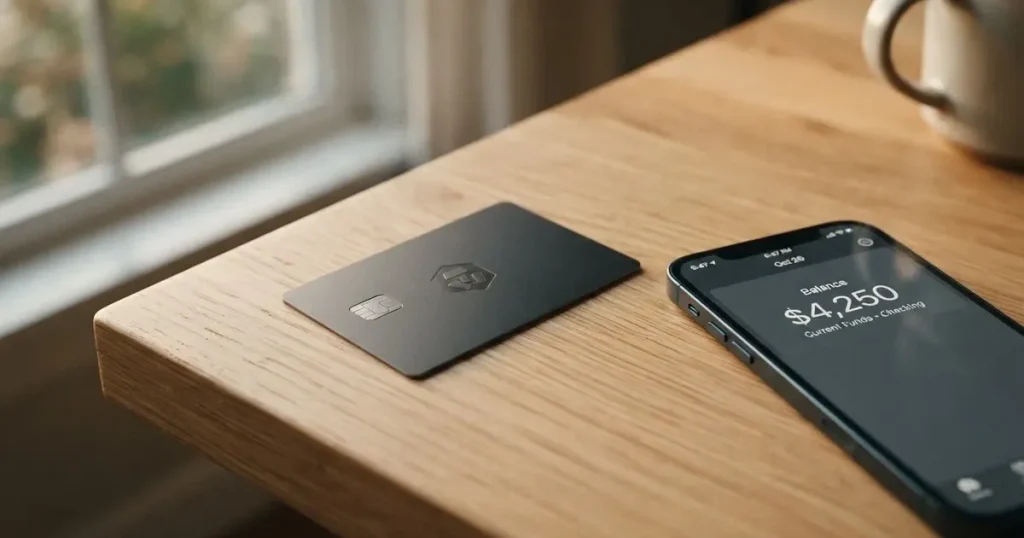
The KAST card is one of those crypto cards that behaves like an ordinary payment card while the money behind it sits in stablecoins rather than in a current account. On paper it is unusually generous: the entry tier is free, spending your own USD balance costs nothing at all, and you can load it with four different stablecoins across five networks at no fee. The problems start where the card’s own marketing stops, because the company behind it does not name its issuing bank, publishes no licence numbers, and keeps its card-programme country list off the page. I gave it 6.1 out of 10. That is a working score for one specific kind of user — someone who already holds stablecoins, wants to spend USD across many chains, and treats the card as a tool rather than as a bank. It is a poor fit if what you need is a card that behaves predictably, because the weakest part of the picture is precisely the part you cannot check.
Conditions described here are current as of October 28, 2026.
The score at a glance
Here is how the six criteria I applied break down, with the marks unchanged.
| Criterion | Mark | Why |
|---|---|---|
| Who can get it | 5 / 10 | The supported-country list only appears during KYC and is not published; Visa is said to be accepted in 170+ countries (a service claim, not a KAST guarantee) |
| Cost | 6 / 10 | Standard tier 0 USD a year; physical card 0 USD plus 40 USD delivery, extra virtual card 2 USD; stablecoin top-up 0%, USD spending 0%, FX 0.5%–1.75%, ATM 3 USD + 2% |
| Top-up options | 9 / 10 | USDT, USDC, PYUSD, RLUSD; USDT and USDC on Ethereum, Solana, Polygon, Arbitrum, TRON, top-up fee 0% |
| Reliability and complaints | 3 / 10 | Issuer not named, no licences shown, KAST Tech registered in Anjouan (Comoros); Trustpilot 2.5–2.7, with reports of frozen accounts and repeated document requests |
| Everyday use | 9 / 10 | Virtual and physical cards, Apple Pay and Google Pay, ATMs across the Visa network |
| Total | 6.1 / 10 | Cheap and easy to load, structurally hard to verify |
The three highest marks are all about things you can do with the card. The three lowest are all about things you cannot check: who issues it, where it is licensed, and what happens when something goes wrong.
Will they give you the card
Short answer: maybe. Eligibility is decided during the identity check, not on a public list, and the answer also depends on what passport you hold rather than only where you sleep.
KAST shows a residence-based country list at the KYC stage and nothing before it. Its own wording is that if your country is not listed, the service is not available there. The Restricted Locations list is referenced in the terms but no countries are named on the pages I could read, so I cannot tell you which countries are excluded. Three further wrinkles matter more than the country list itself:
- Living in a supported country is not enough. The terms say that if you live in a supported country but hold an ID from a restricted region, you may still fail KYC.
- Holding two citizenships can help. Dual citizens with an ID from a supported country may pass, and only your own ID is accepted — you cannot upload a document that belongs to somebody else.
- You can register in an unsupported country, but the account stays locked. The app opens, the KYC does not clear, and nothing further happens.
So the honest answer to “is KAST available in my country” is: ask inside the app and see. Which is exactly what makes this hard to plan around if you need certainty before committing.
How to get it
The application runs in three verification levels, and this is the part worth reading twice, because what you get at each stage differs more than the marketing suggests.
- Level 1 — account creation. Phone number with a one-time code, PIN, email, country of residence. This gives you app access only. No cards.
- Level 2 — a valid government ID (passport, national ID card or driving licence) plus a selfie with liveness check. This unlocks sending and receiving funds, and cards.
- Level 3 — proof of address plus enhanced checks, with citizenship documentation requested. This unlocks USD and EUR accounts and global payouts.
Alongside that, the app can ask for source-of-funds documents at any point, and US residents are asked for an SSN. The minimum age is the legal age where you live, 18 in most countries. The sequence itself is short: download the app, clear KYC, then order a virtual or physical card.
One thing the company does not state: how long verification takes, or on what grounds an application is refused, beyond expired documents and unsupported or restricted countries. If you are in a hurry, plan for an unknown wait.
After approval you can hold up to 10 cards. The card ranges are Visa Platinum on Standard, Visa Infinite metal on Premium, and gold-plated Visa Infinite on Private, plus designs themed around Pengu, Solana and Bitcoin. Your balance is shown in USD, and stablecoin deposits convert into it at a 1:1 rate with a 0% spread. Physical delivery runs 7–10 business days. On Standard you pay 40 USD for delivery, and which countries ship to, or what a replacement costs, is not stated.
Fees and limits: what it really costs
Standard costs nothing to hold. The interesting number is what happens when money moves.

| Item | Fee or limit |
|---|---|
| Standard annual membership | 0 USD |
| Standard physical card | 0 USD card fee + 40 USD delivery |
| Extra virtual card | 2 USD |
| Stablecoin top-up | 0% |
| Card spend in USD | 0% |
| Transaction fee | 0% |
| Apple Pay / Google Pay | 0% |
| Non-USD FX fee | 0.5%–1.75% |
| Non-USD transaction under 25 USD | 0.10 USD |
| Declined transaction (insufficient balance) | 0.50 USD |
| ATM withdrawal | 3 USD flat + 2% of the amount |
| Inactivity fee | 1 USD/month after 12 months |
Three everyday payments show how this plays out.
A coffee in New York. You pay in USD from your own balance. The card charges nothing. This is the model the card is built for.
A taxi in Tokyo. The transaction is not in USD, so the FX fee of 0.5%–1.75% applies — depending on your country of residence, the country of the transaction and your card programme — plus 0.10 USD if the amount is under 25 USD. On a small fare the flat 0.10 USD is the larger half of the cost.
A card declined because the balance ran out at the till. That costs 0.50 USD, and it comes straight off the balance. If you pay at a supermarket with a card that is exactly short, you can pay twice: once at the till, once in fees. This is the fee users complain about most often.
Cash behaves differently again. ATMs work across the Visa network at 3 USD plus 2%, with the FX fee on top for non-USD withdrawals. On limits, the two official pages contradict each other: the concierge page says up to 500 USD per withdrawal, up to three withdrawals or 1,500 USD per 24 hours; the card marketing page says 250 USD per withdrawal including fees and three per rolling 24 hours, 750 USD a day. Take the lower figure as the realistic one and check in the app. Card transaction, deposit and balance limits are advertised as “Unlimited”, with the caveat that large transactions may be flagged for compliance and that you can set lower limits yourself. The terms say limits are set by the company and shown on the platform, without figures. KAST Tag transfers are free, capped at 10,000 USD a day and five a day.
Above the free tier, Premium costs 1,000 USD a year and Private 10,000 USD, both billed annually upfront with no monthly option. What the extra money buys is worth knowing before you consider it:
| Standard (0 USD) | Premium (1,000 USD/yr) | Private (10,000 USD/yr) | |
|---|---|---|---|
| Card | Visa Platinum | Visa Infinite metal | Gold plated Visa Infinite |
| Cards included | 2 free, virtual or physical | 1 plated plus 2 from other tiers (on Private) | 1 plated plus 2 from other tiers |
| Physical shipping | 40 USD | Included | Included |
| Cashback | 1.5% | 2% | 3% |
| Reserve rate | 8% | 10% | 12% |
| Points | None | +1% | +2% |
| Extras | — | Visa Infinite benefits | VIP Concierge |
The Reserve offer on balances ends 1 July 2027. SOL staking pays in Points: 0.25 per 1 SOL roughly every two days on Standard, 0.5 on Premium and Private. Visa Infinite benefits — travel, purchase protection, lounge, eSIM — have to be registered on the Visa Benefits portal.
Top up: the part that works best
This is the strongest part of the card. Stablecoin deposits are free, unlimited, and network fees are the only cost, charged by the blockchain rather than by KAST.
Accepted tokens are USDT, USDC, PYUSD and RLUSD, on Ethereum, Solana, Polygon, Arbitrum and TRON for USDT and USDC, with the app listing the networks currently live. No bank account is needed. One internal inconsistency to note: the terms say the acceptable tokens are “currently USDT and USDC”, which conflicts with the app listing PYUSD and RLUSD.
Spending draws on your own balance, with each purchase deducted immediately. This is not credit.
Bank transfers cost more, and the spread is wide: USD ACH 2 USD, FedWire 15 USD, SWIFT 30 USD, EUR SEPA 0.5%. The minimum top-up is not stated.
Getting money back out is where the network choice bites hardest:
| Network and token | Withdrawal fee |
|---|---|
| Solana (USDT, USDC) | 1 USD + 0.1% |
| Arbitrum (USDC) | 0.20 USD + 0.1% |
| Tron (USDT) | 5 USD + 0.1% |
| Ethereum (USDT, USDC) | 6 USD + 0.1% |
The minimum withdrawal is 5 USD. What happens to any remaining balance at closure is not stated — which matters if you are the kind of person who closes accounts.
Paying with it every day
In practice the card behaves like a prepaid card. You load a balance, the balance gets spent, and it cannot go negative through a purchase. That is the whole design, and it is why there is no credit line and no overdraft.
Apple Pay and Google Pay both work with the virtual and physical cards at 0%. Samsung Pay is not mentioned. Visa acceptance is claimed at 150M+ merchants in 170+ countries — a marketing claim, not something the card itself guarantees.
Rewards are where the tiers actually differentiate. Cashback is in USD, paid when a transaction is authorised: 1.5% on the first 2,000 USD a month on Standard, 2% on the first 10,000 USD on Premium, 3% on the first 40,000 USD on Private. KAST Points work separately — none on Standard, +1% on Premium, +2% on Private of eligible spend.
The app is “KAST: Global USD Account” from Troia Limited on the iOS App Store, rated 3.97 from 276 ratings, updated 2026-10-08. The Google Play rating was not read.
What the card will not do: the terms prohibit weapons, controlled substances, Ponzi, pyramid and MLM schemes, counterfeit goods, Darknet or Tor purchases, adult content, and pseudo-pharmaceuticals. Gambling (merchant category 7995) is not mentioned either way, so do not assume it works. Merchants may also place pre-authorisation holds that sit on your balance for days.
If something goes wrong with a purchase, the terms say to contact the company within 90 days, and the company’s liability is capped at 500 USD. The chargeback process itself is not described.
What can go wrong
This is where I have to be blunt, because the score here is 3 out of 10 and the reasons are structural rather than anecdotal.
The issuing bank is not named. KAST describes itself as a financial technology company, not a bank, and says cards, custody and on/off-ramp are “provided by licensed partners”. The terms name Tazapay and BitGo as partners. The issuing institution is referred to only as “one of our Partner”. The homepage carries logos including Stripe, Privy, Fireblocks, Visa, Sardine and Elliptic. Logos are not licences.
No licence numbers appear anywhere on the pages I read. No regulator is named. Availability is stated as “subject to regulatory approval”. The term entity is “KAST Tech” (Reg No. 16223), incorporated in Anjouan, Comoros, with governing law in Seychelles and SIAC arbitration in Singapore. The App Store developer is Troia Limited. That is a workable legal structure for a crypto company; it is not the structure of a regulated European payments firm, and it does not tell you where your money is licensed.
User complaints cluster around frozen money. On Trustpilot, roughly 170 reviews sit at about 2.5 on regional pages and 2.7 on the main page. Reported themes: accounts frozen or restricted soon after depositing, repeated 0.50 USD declined-transaction fees that pushed a balance negative in April 2026, failed ATM cash dispensation with the money still debited, repeated document requests on self-transfers, and slow support. KAST replies to most negative reviews saying accounts can be restricted by security and compliance systems. Official incidents are not stated. Positive reviews praise the low fees and stablecoin spending, which is fair.
Safeguards are thin on the public pages. Users can set lower spend limits in the app. Two-factor authentication, instant card freeze and any insurance are not stated on the pages I could read, except the Visa Infinite benefits that come with Premium and Private. That absence is not proof the features do not exist; it is proof you cannot verify them.
Support exists but is thin. There is a KAST Concierge help centre, 24/7 at every tier, with a VIP Concierge on Private, and [email protected] appears in company replies. The membership page offers English only — Russian is not offered there.
One piece of context helps you read all this. Freezes and document requests are not always a sign of wrongdoing. Anti-money-laundering rules require ongoing monitoring, and where due diligence cannot be completed, institutions are expected to hold off and sometimes to close relationships. On top of that, nationality is screened separately from residence, because sanctions rules apply to citizenship and country of birth as well as address. So a request for papers in April 2026 may be routine. It is still your money out of reach in the meantime, and the 500 USD liability cap is not much comfort.
What to take instead
If the reason you are reading about KAST is that an ordinary bank card is hard to get, you have other options, and two of them score better. Here is how they compare.
| KAST | MetaMask | Zeal | TokenPocket | |
|---|---|---|---|---|
| Score | 6.1 / 10 | 7.1 / 10 | 6.1 / 10 | 5.8 / 10 |
| Card | Visa Platinum / Infinite | Mastercard | Visa | Visa and Mastercard debit |
| Who can get it | Residence list shown only at KYC | 45 listed countries, waitlist elsewhere, US and UK temporarily closed | 150+ countries for spending, issuance depends on eligibility | European list for Visa; wider list for Mastercard |
| Entry cost | 0 USD | Virtual free, metal 199 USD/year | Not stated | Not stated |
| Cashback | 1.5%–3% | 1% virtual, up to 3% metal (1% above 10,000 USD) | Up to 4% in GNO | None stated |
| Funding | Stablecoins on five networks | Direct from connected wallet on Linea, Base, Monad, Solana | Balances in card Safe (Gnosis Pay) | Crypto from the wallet |
| Notable catch | No named issuer, no licences shown | One card per user, geography limited | No published fee schedule | 1% fee on crypto deposits, refunded later via rewards |
MetaMask Card is the one I would look at first if you already live in a supported country. It is a Mastercard, the virtual card is free with no annual or maintenance fee, metal costs 199 USD a year, and there is no foreign transaction fee — Mastercard’s own rate is used. Cashback of 1% on the virtual card and a headline 3% on metal, with a footnote limiting 3% to the first 10,000 USD spent, is paid in mUSD. It spends directly from a connected wallet on Linea, Base, Monad and Solana. The limits are real: sign-up is open in 45 listed countries and territories, other regions go to a waitlist, US and UK sign-ups are temporarily closed, and there is one card per user.
Zeal runs on Gnosis Pay. It spends in 150+ countries, holds accounts in EUR, USD and GBP, adds a virtual card to Apple Pay, and adds no FX fee of its own — conversion happens at Visa’s wholesale rate, though Gnosis Pay fees such as ATM withdrawals can still apply. Cashback runs up to 4%, paid in GNO on Gnosis Chain, and you must hold GNO in the card Safe to qualify; rates can change. What I could not find is any published fee schedule for Zeal itself.
TokenPocket is the weakest of the four. It charges 1% on crypto deposits, refunded later through rewards or reduced transaction fees, and the app advertises virtual Fiat24 cards rather than physical ones.
For context on why structure matters: a card number begins with a 6- or 8-digit BIN that tells any merchant which institution and country issued it. Merchants can look that up and apply extra scrutiny when the issuer country differs from the billing address, and some decline prepaid or foreign BINs outright. Address verification is mostly a US, Canada and UK system and is generally unavailable for foreign-issued cards, which is another source of declines. Visa and Mastercard do not issue these cards themselves — they license issuers and can suspend a programme. Visa terminated its global agreements with FTX on 13 November 2022, and WaveCrest, a Visa issuer that supplied crypto card brands, was suspended in Europe in 2018, closing all its programmes. A crypto card can therefore disappear while your balance is still on it.
Who I would recommend it to
I would recommend KAST to someone in this specific position: you already hold stablecoins, most of them USDT or USDC, spread across several chains, and you want to spend that money directly without routing it through an exchange account or a bank. For that person the card does its job well. Top-up is free, spending in USD is free, Apple Pay works, and there is no bank account to open.
I would not recommend it as your primary or only card, for four reasons that all point the same way: no named issuer, no licence numbers on display, unresolved reports of frozen accounts, and a 500 USD liability cap on disputes. If your balance is large relative to what you can afford to have locked for weeks, those facts should decide it.
I would also pause before applying if you are outside Europe or North America, because the country list is not published and the answer only arrives inside the KYC flow.
And if you are simply looking for the cheapest way to spend dollars, note the tier structure honestly: Standard is genuinely free, and the 1.5% cashback on the first 2,000 USD a month is real money. But Premium at 1,000 USD a year only makes sense if you spend well past 10,000 USD a month. Below that, the standard tier is the sensible choice, and the extra cards are something to buy individually at 2 USD rather than by upgrading.
Frequently asked questions
What is the KAST card?
KAST is a crypto payment card that spends a stablecoin balance converted into USD. You top up with USDT, USDC, PYUSD or RLUSD and the app converts them 1:1 into a USD balance with a 0% spread. The card then behaves like a prepaid card: it draws on that stored balance, Visa Platinum on the free tier, and works in Apple Pay and Google Pay at no extra fee.
How does KAST card work?
It works on the pre-loaded balance model. You convert or top up first, and the card can only spend what is already there, so it cannot overdraw through a purchase. Each payment is deducted immediately from your balance. There is no credit line, no borrowing, and no bank current account behind it — the company describes itself as a financial technology company, not a bank.
Is KAST a bank?
No. KAST states plainly that it is a financial technology company, not a bank, and that cards, custody and on/off-ramp services come from licensed partners. The issuing bank is not named on the pages I could read — only “one of our Partner”. Terms name Tazapay and BitGo, and the site displays logos including Stripe, Privy, Fireblocks, Visa, Sardine and Elliptic.
Who owns KAST?
The terms name “KAST Tech” (Reg No. 16223), incorporated in Anjouan, Comoros, with governing law in Seychelles and arbitration through SIAC in Singapore. The iOS app is published by Troia Limited. No licence numbers or regulator appear on the pages I read, and availability is stated as subject to regulatory approval.
Is KAST card available in my country?
The supported-country list appears only during KYC and is not published; the terms reference a Restricted Locations list without naming countries. Eligibility also depends on your document, not just your address: living in a supported country with an ID from a restricted region may still fail, while dual citizens with a supported ID may pass. You can register in an unsupported country, but KYC stays locked.
Can I use KAST card in my country?
Spending depends on Visa acceptance, which KAST claims at 150M+ merchants in 170+ countries. That is the card’s claim, not a guarantee for your country. Cards issued in one country can look foreign to merchants elsewhere, and address verification is generally unavailable for foreign-issued cards, so some declines are normal for any card like this.
How do I get the KAST card?
Download the app and create an account with a phone number, PIN, email and country of residence — that is Level 1 and gives app access only. Level 2 needs a valid passport, national ID or driving licence plus a selfie, which unlocks cards and transfers. Level 3 adds proof of address and unlocks USD and EUR accounts. Then order a virtual or physical card; delivery takes 7–10 business days.
How do I top up the KAST card?
Send USDT, USDC, PYUSD or RLUSD from your own wallet to the address the app shows, on a supported network — Ethereum, Solana, Polygon, Arbitrum or TRON for USDT and USDC. The stablecoin deposit fee is 0% and there is no stated minimum; only network fees apply, charged by the blockchain. Bank transfers cost 2 USD for USD ACH, 15 USD for FedWire, 30 USD for SWIFT and 0.5% for EUR SEPA.
Is KAST card free?
The Standard tier is free: 0 USD a year, Visa Platinum, two free cards, 1.5% cashback on the first 2,000 USD a month. Costs appear elsewhere — physical delivery is 40 USD, an extra virtual card is 2 USD, non-USD FX runs 0.5%–1.75%, ATM withdrawals are 3 USD plus 2%, and there is 1 USD a month after 12 months of inactivity. Premium costs 1,000 USD a year and Private 10,000 USD.
Is KAST card safe?
Treat the balance like money held with a counterparty, not like a bank deposit. Custodial platforms have a failure history — Mt. Gox, Coincheck and Ronin Network among them — and KAST’s own pages name no issuer, show no licence numbers, and carry a 500 USD liability cap on disputes. Trustpilot reviews sit around 2.5–2.7 with repeated reports of frozen accounts. Two-factor authentication and card freeze are not stated on the pages I read, so ask before you load anything large.
Choosing a wallet card – cryptocardadvisor
Content created by the «cryptocardadvisor» team