
A USDC payment card with self-custody promise and few disclosed numbers
 Available in US
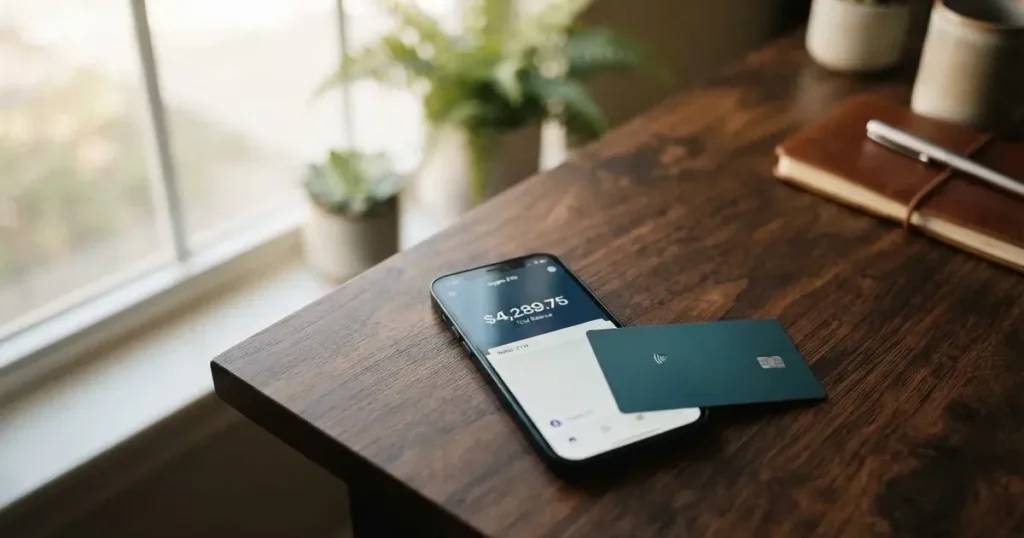
Kontigo describes its product as the first international credit and debit card in USDC that earns yield, with assets held in the user’s own custody. The idea is to bridge a stablecoin balance and a payment card without handing custody to a bank or exchange. The execution, however, is thin on disclosed numbers: the public pages do not state the card’s network, whether it comes as a physical or virtual card, what it costs to issue or maintain, which wallets it works with, or which company actually issues the card. The page walks through what is known, what is not, and what that means if you are considering signing up.
Conditions are current as of October 28, 2026.
Verdict
Kontigo lands at 4.7 out of 10. The score reflects four issues: a card that is barely described on the public site, fees and spreads that only show in the app, no named card issuer or licences, and one third-party report of a hack with refunds promised. It is not a card you can evaluate line by line from the website; it is one you only really see once you have already created an account and verified your identity.
The card fits a narrow reader: someone in Latin America (the site lists Argentina, Bolivia, Brazil, Chile, Colombia, El Salvador, Mexico, Peru, plus Spain and the United States in its footer) who is comfortable holding their balance in USDC, self-custodying it, and discovering the real cost of a coffee inside the app after the fact. It is not a fit for someone who needs to see fees, supported networks and a card-network logo before downloading the app, or who wants a named issuer behind a regulated card programme.
| Criterion | Score | Why |
|---|---|---|
| Who can get it | 5 / 10 | Card-issuing countries are not stated; the footer lists ten countries under “Países” without linking them to the card. Terms say availability depends on country of residence and that sanctioned or high-risk jurisdictions are not permitted. |
| Cost | 5 / 10 | No card fees are disclosed. The home page says send, receive and top up in USDC “without commissions”; spreads and any conversion or FX mark-up only appear inside the app. |
| Top-up options | 4 / 10 | Card purchases are spent directly from the user’s USDC balance, and a Kontigo article says the app runs on Base. Other coins, networks and the exact deposit path are not stated. |
| Reliability and complaints | 4 / 10 | Kontigo, Inc. is a Delaware corporation; the card issuer, BIN sponsor and licences are not named. Assets sit in self-custody. One unofficial report describes a hack that drained USDC from over a thousand accounts, with the company stating refunds were processed. |
| Everyday use | 5 / 10 | The card form (physical/virtual/hybrid), supported mobile wallets, ATM access and merchant category restrictions are not stated. The site markets a hybrid, credit and debit family of cards, and a card that “earns yield” with no rate disclosed. |
| Total | 4.7 / 10 |
Who can get the Kontigo card
The card-issuing countries are not stated. The site footer lists Argentina, Bolivia, Brasil, Chile, Colombia, El Salvador, España, Estados Unidos, México and Perú under a “Países” heading, but that list is not tied to the card programme and should be read as a regional signal rather than a list of countries where the card is confirmed available.
The terms are more cautious than the footer. They state that availability depends on the country of residence, that sanctioned and high-risk jurisdictions are not permitted, and that the company may refuse service where local rules make it impossible to operate. That phrasing is standard for crypto platforms with shifting geographic coverage; in practice it means the same product may be available in one country and blocked in a neighbour, and the only way to know is to start the sign-up flow.
Because Kontigo, Inc. is incorporated in Delaware, the company is subject to US rules for its own entity, but the card programme itself is not stated to be regulated by a US bank or e-money licence. A reader in the European Union should note that the footer lists Spain but the card programme’s MiCA status (EU’s main crypto regulation) is not described, and a CASP (crypto-asset service provider) register entry is not referenced. A reader in the United Kingdom should expect the same gap: the card’s FCA (Financial Conduct Authority) status is not stated.
What this means for you: do not assume the footer list equals availability. The list tells you which countries the company is interested in, not which ones the card programme has been opened in. If you live in a country not on the list, treat availability as uncertain rather than excluded.
How to get it
The terms require identity verification before you can use any service: name, date of birth, address, nationality, identity documents, and potentially financial information, plus sanctions and credit checks. The terms also state one account per user. The developer documentation goes a little further, mentioning that deposit methods depend on KYC level, but the levels themselves and the deposit amounts that unlock them are not described.
The card-specific steps are not stated. The public pages do not walk you through “download the app, verify, order card, activate.” The site markets a family of cards — hybrid, credit and debit — without saying which one a new sign-up is offered first, what the eligibility differences are, or whether the card arrives as a physical piece of plastic, a virtual card number, or both. The network logo (Visa or Mastercard) is not displayed on the landing page, and an issuer name is not given, which means the BIN (the first six or eight digits of the card number that identify the issuing bank) is unknown until you have the card in your hand. Delivery time, whether a virtual card is issued instantly, and the rejection reasons the company applies are also not stated.
One unofficial Spanish-language article describes users receiving “a stablecoin card with Bitcoin cashback” and a 10% USDC yield. That wording is promotional and unverified. Treat it as marketing copy from a third party, not as a feature you can rely on from the card’s own terms.
What this means for you: the sign-up flow is essentially the app. If you are someone who reads terms, fees and an issuer name before downloading, you cannot do that here; you have to install the app, register, verify identity, and only then see what card you are being offered. If the BIN turns out to be one that merchants in your country routinely decline (a real risk for any card issued abroad), the discovery happens at the checkout screen.
What it really costs: Fees
This is the section with the most disclosed on the home page, and also the section with the largest gap between marketing and specifics.

The home page says you can send, receive and top up and save in USDC “without commissions.” That is a marketing line, not a fee schedule: it tells you there is no explicit commission on a USDC transfer, but it does not tell you what spread, exchange rate mark-up, or network fee is applied when USDC is converted to the currency a merchant charges in. The terms put it more carefully: fees, commissions and spreads are shown in the app and may change. That phrasing is honest but it also means there is no public schedule to compare against.
The card-level costs are not stated. The public pages do not give an issuance fee, a monthly maintenance fee, a foreign-exchange fee, an ATM withdrawal fee, a daily or monthly spending limit, or a KYC threshold that unlocks higher limits. The terms reserve the right to disclose these inside the app, which is where most crypto card programmes put the real numbers.
| Fee or limit | Disclosed value |
|---|---|
| Issuance fee | Not stated |
| Monthly / annual fee | Not stated |
| Conversion spread (USDC to fiat at payment) | Not stated (shown in app) |
| Foreign-exchange fee | Not stated |
| ATM withdrawal fee | Not stated |
| Daily spending limit | Not stated |
| Monthly spending limit | Not stated |
| Currency accepted at payment | Not stated for the card; terms mention USD and “other local currencies shown in the platform” |
What this means for you: a card payment in a café is a conversion from USDC to whatever currency the merchant’s acquirer (the bank that processes payments on the merchant’s behalf) settles in. The cost of that conversion is a spread between the mid-market rate (the midpoint between the buy and sell price in the open market) and the rate the app shows you, plus any explicit fee. If neither number is published before you sign up, you have to test the card with a small payment, read the receipt in the app, and work backwards. Until you do that, the marketing line “without commissions” is not a cost guarantee — it is a category claim about transfers, not about card payments.
Three everyday scenarios to think about:
A coffee paid in your home currency. The card converts USDC to local fiat at the app’s rate. If the spread is around 1%, a US$5 coffee costs you about five cents. If the spread is closer to 3%, the same coffee costs fifteen cents. The difference is invisible at the till and visible in the monthly statement.
A subscription in US dollars to a foreign service. The card converts USDC to USD (or charges in USDC and the merchant converts). If the card’s currency and the merchant’s currency match, you avoid a foreign-exchange mark-up; if not, you pay it.
An ATM withdrawal in cash. The cost of an ATM withdrawal is the network fee (charged by the ATM operator, not the card), plus any fee the card programme charges, plus the conversion spread. The card’s fee is not stated, the spread is not stated, and the ATM network access is not stated.
How to top it up: Top up
Topping up starts with a transfer. A Kontigo article says the app runs on Base, the Ethereum layer-2 network run by Coinbase, which sets the default network for any USDC the user moves in. Card purchases are then paid directly from the USDC balance, rather than from a pre-loaded fiat balance, which is the structural choice the card rests on.
The home page repeats that topping up in USDC is “without commissions.” The terms, again, are more measured: they say digital assets can be transferred to external wallets “when that feature is available,” and that after account closure a user has a reasonable period (the example given is 30 days) to instruct a withdrawal. If no instruction is given, Kontigo may sell the assets and hold the proceeds in a fiat currency of its choice, with no interest paid. Closing an account needs no pending obligations and either a zero balance or a withdrawal instruction already in place.
Several practical questions are not answered on the public pages. Are coins other than USDC accepted, and if so which ones? Are networks other than Base supported, and if so is the user asked to confirm the network before sending, or is the app opinionated? What happens to a deposit sent on the wrong network, or in a token the card does not support — is it lost, or recoverable? Are there minimum and maximum top-up amounts, and is there a hold period before the funds become spendable? The terms do not state any of these, and developer documentation only notes that deposit methods depend on KYC level, without listing the levels or the amounts.
What this means for you: treat the first top-up as a small test. Send a small amount of USDC on Base from a wallet you control, watch the balance arrive in the app, then attempt a small card payment. Only after that round trip succeeds cleanly should you move a larger balance. If your usual funding source is an exchange that withdraws USDC on Tron or Solana by default, double-check the network before sending — the wrong network for USDC means the funds will not arrive and recovery, if it is even possible, is a manual support process with no guarantee.
Paying with it every day
The everyday-use picture is mostly blank. The card is described as a hybrid, credit and debit family; the marketing line is that it “earns yield” — that is, the USDC sitting on the card continues to generate a return rather than sitting idle — without disclosing the rate, the form of the return, or whether it is paid in USDC, in a partner token, or as a cashback credited after a statement period. There is no published cashback figure.
The mobile wallet story is not told. Whether the card can be added to Apple Pay or Google Pay, whether it supports tokenisation (where the real card number is replaced with a one-time number stored on the device), and whether the card can be frozen instantly from the app are all questions the public pages do not answer. The app is available on Google Play and the App Store; the site cites “over 10,000” user reviews, but the actual star rating on each store is not stated. Without that, the “10,000 reviews” line is a count, not a quality signal.
ATM access is not stated. The card’s behaviour for online subscriptions, recurring billing, or merchants that use AVS (Address Verification Service, a check that compares the billing address you type with what the card issuer has on file, mostly used in the US, Canada and the UK) is also not stated. AVS in particular matters: a foreign-issued card (the BIN is in Delaware, even if the user is in Bogotá or Buenos Aires) can be declined by US merchants that rely on AVS, not because the card is bad but because the issuer country does not match the billing country.
If something goes wrong with a payment, the terms describe a dispute process that starts with a good-faith negotiation period of up to 15 business days after written notice, and only then moves to the courts of Delaware. Local consumer protection authorities remain available, the terms note, but chargebacks (bank-initiated refunds for disputed transactions) are not mentioned. The advice the terms give — to report unrecognised transactions as soon as possible — is good general practice and not a substitute for a chargeback right.
What this means for you: before relying on the card for rent, a subscription or a large purchase, run it through the patterns you actually use. Pay at a chain café. Pay for an online subscription. Try Apple Pay or Google Pay if those matter to you. Try an ATM if cash matters. Read the receipts inside the app to see what the conversion spread was, whether a foreign-exchange mark-up was applied, and whether the merchant was categorised in a way the card handles. The everyday-use picture is built up by trying, not by reading.
What can go wrong
The company behind the card is Kontigo, Inc., a Delaware corporation. The footer says the company does not provide financial services and does not take deposits, and that assets are held in user custody. The terms go further: assets may be in a self-custodied wallet (a wallet where the user holds the private key themselves, with no third party able to move the funds) or with third-party custodians, Kontigo cannot access or recover private keys, the user is solely responsible for credentials, and transactions are generally final. The card issuer, the BIN sponsor, and the licences that govern the card programme are not stated.
The self-custody framing is a meaningful choice, and it cuts both ways. On the plus side, the user is not exposed to the kind of custodial failure that has hit other crypto platforms (Mt. Gox, Coincheck, the Ronin Network hack, and the FTX collapse all involved a custodian losing control of user funds). On the minus side, the user is solely responsible for their seed phrase (the 12 or 24 words that act as the master key to a wallet), for keeping their device clean of clipboard-hijacking malware (software that silently rewrites a copied crypto address to one controlled by an attacker), and for recognising phishing attempts. A lost seed phrase is a lost balance; there is no support number to call.
Two other risks are worth flagging.
The first is a third-party report of a hack. Unofficial sources describe a drain of USDC from 1,005 user accounts totalling US$340,905.28, with the company stating that refunds were processed. The dates and the refund claim have not been independently verified, and the figure is not stated on Kontigo’s own pages, but it is the most specific reliability data point available. The lesson is the one self-custody already implies: a card that spends from your own wallet is only as safe as the device and the wallet you use to authorise the spend.
The second is the support channel. The help centre has a FAQ, and there is a WhatsApp contact; the terms describe communication via in-app messages, push notifications, email, SMS and messaging apps. A direct phone number, live chat or dedicated support email are not listed. Help-centre content is in Spanish; English article pages exist at an /en/article path. If you do not read Spanish, the self-serve content is thinner than it looks.
What this means for you: the safety story here is closer to a self-custody wallet than to a bank card. Keep your seed phrase offline, keep your device clean, prefer the in-app payment authorisation over copy-pasting addresses, and treat the card as a way to spend from a balance you are prepared to lose, not as a bank account with a guarantee behind it. If you want a card with a named issuer, a chargeback right, and a customer-support phone number, the Kontigo structure is not designed to give you that.
What to take instead
Kontigo is not the only crypto-linked card with thin public information; the category is full of programmes that disclose more in the app than on the website. Three alternatives from different angles, each with its own profile, are worth weighing before committing.
International Visa Card, 6.7 out of 10. The most clearly disclosed of the three. A US-issued Platinum Visa card, virtual, paying in USD, with a US$5 one-time issuance and no maintenance fee. Plans are Classic (free), Pro at US$9.00 a month, and Max at US$19.00 a month. Card use in USD is free on every plan; foreign-currency use is “Visa exchange rate + 2% FX fee.” Deposits of any kind are free, and the account can be funded in USDC or USDT at 1:1, alongside USD, EUR, SEPA (the eurozone’s single payments area for bank transfers), SWIFT (the global bank-to-bank transfer network) and FedNow (the US Federal Reserve’s instant payment system). The country list is clearer too: the card is not available to residents or legal registrants of Belarus, mainland China, North Korea, Cuba, India, Iraq, Iran, Israel, Myanmar, Nepal, Nicaragua, Russia, Syria, Turkey, Ukraine, Venezuela or Vietnam, with FATF (the Financial Action Task Force, the global money-laundering watchdog) grey-list countries reviewed case by case. The trade-off is the 2% foreign-currency mark-up, which Kontigo’s undisclosed spread may or may not beat.
UNi Card, 6.1 out of 10. A multicurrency Mastercard spending from the UNi.Global account balance, with “no annual fee” and “no foreign transaction fee” stated outright, and assets converted at “live OTC (Over-the-Counter) rates” — meaning the wholesale rate a large desk would quote, rather than a retail mark-up. Spend-to-Earn rewards go up to 3% with the card. The country list and the funding path are not stated, so eligibility and how to get money in are the open questions. Compared with Kontigo, the fee language is plainer, the network is named, and the cashback rate is concrete; what you give up is the self-custody framing.
Whop Cards, 5.2 out of 10. Visa cards that spend from a Whop balance, with pending balance usable as soon as a payment arrives. The consumer footprint is 31 US states (Alabama through Wyoming, with notable gaps), and unsupported consumer countries include Belarus, mainland China, Cuba, Hong Kong, India, Iran, Iraq, Israel, Myanmar, Nepal, Nicaragua, North Korea, Russia, Syria, Turkey, Ukraine, Venezuela and Vietnam. Rewards are 5% cashback at select merchants (currently Uber, with more planned); the reward currency and conditions are not stated. The page says “no extra fees” without listing issuance or monthly amounts. Compared with Kontigo, the geographic restrictions are spelled out, the network is named, and the cashback is concrete; what you give up is the LATAM focus and the self-custody framing.
Across the three alternatives, the pattern is the same: Visa or Mastercard, fees that are stated (or at least a fee language that names a percentage), and a country list that you can read before downloading the app. Kontigo’s selling point is the self-custody USDC balance and the LATAM regional focus; its cost is the absence of those disclosures.
Who I would recommend it to
Kontigo fits a reader who already lives in USDC and is looking for a way to spend that balance without giving up custody, who is comfortable reading fee and rate information inside an app rather than on a website, and who is not relying on the card for chargebacks, a customer-support phone line, or a regulated bank behind the BIN. The geographic signal in the footer points to Latin America, and the yield language suggests the card is most useful where holding USDC already pays better than holding local fiat.
It does not fit a reader who wants to compare the card line by line with a competitor before signing up. It does not fit a reader in a country not on the footer list, who should treat availability as uncertain. It does not fit a reader who plans to put rent or a large subscription on the card without first running the patterns they actually use. And it does not fit a reader for whom “card” implies a named issuer, a deposit guarantee or a chargeback right — because the self-custody structure, the Delaware-only issuer entity, and the 15-business-day negotiation clause in the terms point somewhere else.
The honest summary: this is a card worth a small test if you already self-custody USDC, and not worth a salary if you do not.
Frequently asked questions
What is the Kontigo card?
The Kontigo card is a payment card that the company describes as the first international credit and debit card in USDC that earns yield, with assets held in the user’s own custody. The card-issuing countries, the network, the card form and the issuer are not stated on the public pages; the specifics become visible inside the app.
How does the Kontigo card work?
Card purchases are paid directly from a USDC balance held by the user. A Kontigo article says the app runs on Base, an Ethereum layer-2 network, which sets the default network for incoming USDC. The yield is the return generated by the USDC balance while it sits in the wallet; the rate and form of the return are not disclosed.
Is Kontigo a bank?
No. The footer states that Kontigo does not provide financial services and does not take deposits, and the terms describe assets as held in user custody. Kontigo, Inc. is a Delaware corporation, but the card issuer, the BIN sponsor and the licences that govern the card programme are not named.
Who owns Kontigo?
Kontigo, Inc., a Delaware corporation. The ownership structure, the investors and a third-party-reported US$20M seed round from December 2025 are not confirmed by the company on its public pages.
Is the Kontigo card available in my country?
The footer lists Argentina, Bolivia, Brazil, Chile, Colombia, El Salvador, Spain, the United States, Mexico and Peru under “Países,” but that list is not tied to the card. The terms say availability depends on country of residence and that sanctioned and high-risk jurisdictions are not permitted. The only reliable test is to start the sign-up flow.
Does the Kontigo card require KYC?
Yes. The terms require identity verification before any service can be used: name, date of birth, address, nationality, identity documents and potentially financial information, plus sanctions and credit checks. One account per user. The developer documentation mentions KYC levels affecting deposit methods, but the levels and amounts are not described.
How do I top up the Kontigo card?
The terms describe a transfer into a USDC balance, with a Kontigo article pointing to Base as the app’s network. Other coins and other networks are not stated on the public pages. The home page says topping up in USDC is “without commissions,” while the terms note that spreads are shown in the app and may change.
Can I use the Kontigo card with Apple Pay or Google Pay?
The public pages do not state whether the card supports either wallet. Tokenisation, instant freeze and mobile-wallet enrolment are not described. The app is on Google Play and the App Store, but a star rating is not stated.
Is the Kontigo card safe?
The card is built around self-custody, so the security story is closer to that of a personal wallet than to that of a bank account. A lost seed phrase means a lost balance, and Kontigo cannot recover it. One unofficial third-party report describes a hack that drained USDC from 1,005 user accounts totalling US$340,905.28, with the company stating refunds were processed; the dates and the refund claim have not been independently verified. Treat the card as a way to spend from a balance you are prepared to lose, not as a regulated bank product.
How do I close my Kontigo account?
The terms describe account closure as needing no pending obligations and either a zero balance or a withdrawal instruction already in place. After closure, a user has a reasonable period (the example given is 30 days) to instruct a withdrawal of any remaining digital assets. If no instruction is given, Kontigo may sell the assets and hold the proceeds in a fiat currency of its choice, with no interest paid.
Choosing an app or neobank card – cryptocardadvisor
Content created by the «cryptocardadvisor» team