
Exodus card review — a self-custody debit card built on a crypto wallet you already use
 Available in US
The Exodus card sits in an unusual corner of the crypto card market. It is a debit card, not a credit card, and it spends directly from a self-custody Exodus wallet rather than from a balance you have to pre-load onto a separate account. That design choice shapes everything about it: how you get it, what it costs, and what happens if something goes wrong. If you already keep crypto in the Exodus wallet and you want a card that draws on it without first moving funds to a third party, this is one of the few products that does exactly that. If you are looking for a low-friction prepaid card with no crypto involvement, or a credit-building product, this is not it.
Conditions are current as of October 28, 2026.
Verdict
I gave the Exodus card a 6.8 out of 10. That is a middling score, and the middling comes from a specific tension: the funding model is genuinely good, but everything around it is a little rougher than the marketing suggests. The card is a real product you can hold in your hand, it works in a long list of countries, and the top-up flow is one of the smoothest in the category. Against that, the issuer has had a bumpy year, the company has gone through layoffs, and new US card issuance is not currently open.
| Criterion | Mark | Why |
|---|---|---|
| Who can get it | 7 / 10 | Works in 42 countries across Europe, Canada, the US (excluding Vermont), Mexico, Brazil, Argentina, Colombia and others |
| Cost | 7 / 10 | Free tier costs $0 a year; cross-border use on Free costs 1%; ATM withdrawals cost 2%; non-cardholder-currency stablecoin deposits cost 0.5% |
| Top-up options | 9 / 10 | USDT and USDC across multiple networks (Solana, Ethereum, Arbitrum One, Base, BNB Smart Chain, Polygon) plus bank card and Apple Pay |
| Reliability and complaints | 5 / 10 | Issuer Monavate Ltd (FCA-authorised) and operator Baanx were both acquired by Exodus in May 2026; reports that Monavate cannot issue cards to new European clients; 25% workforce cut |
| Everyday use | 6 / 10 | Virtual and physical Metal card available; ATM at 2%; Apple Pay works for top-ups; supported wallets for spending are not fully disclosed; card does not currently support a PIN |
| Total | 6.8 / 10 |
The audience that gets the most out of this card is the one Exodus is clearly built for: people who already use the Exodus wallet in Europe or Latin America, hold stablecoins there, and want to spend that balance at a card terminal without going through a separate exchange or a custodial card account. If you fall into that group, the card is worth a serious look. If you are outside that group — you do not use the wallet, you want a credit card, or you need a card that works everywhere with zero friction — there are better options.
Who can actually get the card
Exodus Pay, the broader product, works in most jurisdictions. The card itself is supported in 42 countries. The list is long but worth reading through, because it is not “everywhere except a few places” — there are real gaps.
The supported countries are: Andorra, Argentina, Austria, Belgium, Bosnia and Herzegovina, Brazil, Bulgaria, Canada, Colombia, Croatia, Cyprus, Denmark, Finland, France, Germany, Gibraltar, Greece, Guatemala, Hungary, Iceland, Ireland, Isle of Man, Italy, Jersey, Liechtenstein, Lithuania, Luxembourg, Malta, Mexico, Netherlands, Niger, Norway, Poland, Portugal, Romania, Slovakia, Slovenia, Spain, Sweden, Switzerland, United States (excluding Vermont), and Uruguay.
A few things stand out. Vermont is excluded from the US, which is unusual and probably tied to state-level money transmitter rules. The list is heavy on Europe, which makes sense given the issuer. Latin America is well covered — Argentina, Brazil, Mexico, Colombia, Uruguay and Guatemala are all there. The United Kingdom is conspicuously not in the list as a separate entry, though the Crown Dependencies (Isle of Man, Jersey) and Gibraltar are.
If you are in a country that is not on this list, you cannot get the card. Exodus Pay itself may still work for wallet functions, but the card is geographically restricted to the 42 above, and the rules of the card programme come from where you live, not where you hold citizenship. That matters for people who live in one country and hold a passport from another.
How to sign up
The signup process is straightforward on paper and a little opaque in practice, because the public help pages do not spell out every step. What is confirmed: identity verification is required before you can use the card, make cash deposits, or redeem rewards points. The account setup needs a phone number that receives a one-time code by WhatsApp or SMS, followed by email verification and an ID check inside the Exodus app. If you were a former Spend Card user, your account migrates over without re-verification.
Beyond that, several details are not stated on the public pages. The processing time for verification, the documents accepted, and the reasons an application might be rejected are not published. This is common in the category but worth flagging: you may need to wait without a clear timeline, and if something goes wrong, you may not get a detailed reason.
What the card actually is, in concrete terms: a debit card, not a credit card. Usable wherever Mastercard is accepted. Available as a virtual card and as a physical Metal card. The issuer is Monavate Ltd, an FCA-authorised e-money institution in Cambridge, UK. The program manager is Baanx Group Ltd. Both were acquired by Exodus Movement on 1 May 2026.
The Metal card sits behind a waitlist and takes 6 to 8 weeks to arrive after purchase. Replacement of a lost or damaged Metal card costs $99. There is no replacement fee listed for the Free tier card, though the public pages do not give a current replacement price.
Fees and limits — what the Exodus card really costs
The cost section is where most card reviews either get sloppy or get useful. I want to walk through the actual numbers, because the difference between the Free tier and the Metal tier is large enough that it changes who the card is for.

| Fee or limit | Free tier | Metal tier |
|---|---|---|
| Annual fee | $0 | $199/year (auto-renews; refund if cancelled within 14 days) |
| Card replacement | not stated | $99 |
| Cross-border transaction (using outside your home country) | 1% | none (fair usage) |
| Stablecoin deposit in a currency other than cardholder’s | 0.5% | 0.5% |
| DeFi or yield-token deposit | 0% up to $1,200/month, then 0.5% | 0% up to $1,200/month, then 0.5% |
| Other cryptocurrency deposit (e.g. wrapped ETH) | 0.875% | 0.875% |
| ATM withdrawal fee | 2% (operator may charge extra) | 0% up to $1,200/month, then 2% |
| Per-transaction purchase limit | $10,000 | $20,000 |
| Daily purchase limit | $15,000 | $30,000 |
| ATM withdrawal limit per transaction | $1,000 | $1,000 |
| ATM withdrawal limit per day | $1,000 | $5,000 |
A few things to notice. First, the headline annual fee is not the only cost. On the Free tier, a holiday in another country costs you 1% on every swipe. On the Metal tier, that fee goes away within fair-use limits, but the $199 annual fee is a real fixed cost you have to spend enough to amortise. For someone spending $5,000 a year abroad, the 1% cross-border fee on Free is $50 — a quarter of the Metal subscription.
Second, the ATM story is genuinely useful on Metal if you travel. The first $1,200 a month in ATM withdrawals is free, which is more than most people take out in cash on a trip. Beyond that, the 2% rate kicks in.
Third, the conversion and FX wording is a little confusing because there are two sources. The newer Exodus Pay help article says purchases in other currencies are converted from USD at the Mastercard and payment-processor rate at the time of purchase, and does not list a separate FX fee. The older EU/UK terms say the card is denominated in local currency or in USD for US cardholders, and that “neither Baanx nor Exodus will charge an additional currency conversion fee.” Both say the same thing in different words: you pay the Mastercard wholesale rate, not a stacked-on margin. That is better than many cards in the category, which add 1% to 3% on top.
Three everyday payments and what they cost
To make the table less abstract, here are three concrete scenarios. I am using the Free tier because that is what most people will start with.
- Coffee at a local café, paid in your home currency, card topped up with USDC on Solana. No conversion needed, no cross-border fee, no deposit fee on USDC. Cost: $0 in card fees, plus a tiny amount of network gas (typically around $0.01).
- Dinner in another country, paid in a foreign currency, card topped up with USDC. The transaction is cross-border (1% on Free), and the foreign currency is converted from USD at the Mastercard rate. On a $50 dinner, that is $0.50 in card fees.
- ATM withdrawal of $200 while travelling, card topped up with USDT. The 2% ATM fee applies (Free tier), and the ATM operator may add their own surcharge. On $200, the card-side fee is $4, before any operator fee.
None of these are large in isolation. The fees add up over a month of spending, which is the more realistic way to think about it.
Top up — how to add money to the card
The top-up flow is one of the strongest parts of the product. The card draws from the Exodus Pay balance on Solana in this priority order: USDT, then USDC, then XO Cash. A single purchase must be covered by a single asset — you cannot split a payment across two tokens — but the wallet will use whichever of those three you have, in that order.
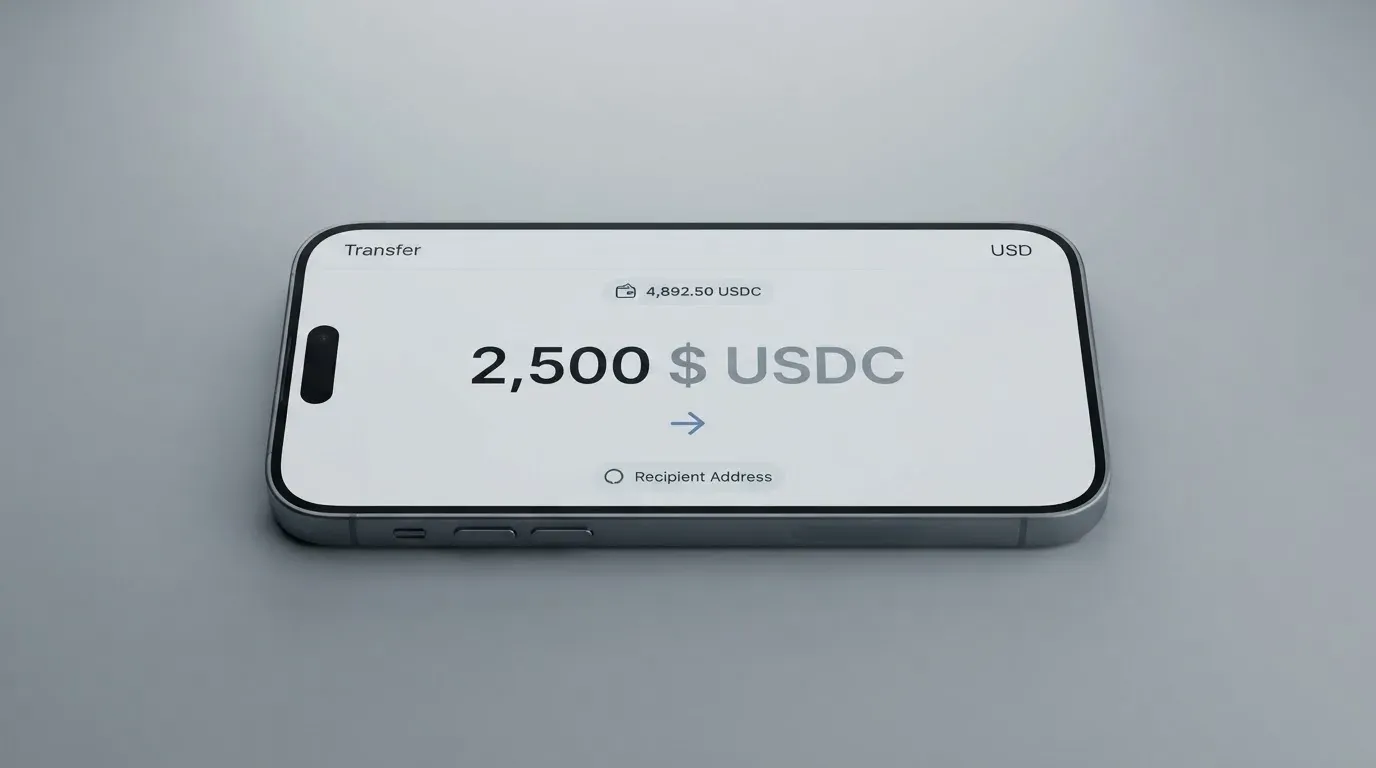
Deposits are accepted in:
- USDC on Solana, Ethereum, Arbitrum One, Base, BNB Smart Chain, and Polygon.
- USDT on Arbitrum One, Solana, Ethereum, BNB Smart Chain, and Polygon.
- Debit card and Apple Pay on iOS (for buying crypto to deposit).
The breadth of networks is notable. Many crypto cards support one or two networks, sometimes only Ethereum, and Ethereum gas fees can make small deposits uneconomic. Supporting Solana, Base and Arbitrum alongside Ethereum gives you real options for cheap transfers. Network gas is described as “small variable, typically $0.01,” which lines up with Solana and L2 fees in 2026.
A few deposit scenarios to think through:
- If you deposit USDC on Solana, the deposit fee is 0% (it is the cardholder’s currency and a supported stablecoin).
- If you deposit USDT on a network where you do not normally hold it, the deposit fee is 0% as long as USDT is in the local currency of the cardholder.
- If you deposit a DeFi or yield token, you pay 0% up to $1,200 a month and 0.5% beyond that.
- If you deposit something like wrapped ETH, the fee is 0.875%.
- If you buy crypto with a debit card or Apple Pay to deposit, the fees on that purchase are not stated in the public materials.
A small but important point: there is no minimum balance. The terms describe the deposit as “no fee (no min. balance),” which matters for people who want to keep their working capital in their own wallet and only top up the card as needed.
Because the card draws from a self-custody wallet, there is no separate “withdraw from card” step. The funds stay in your wallet. The only thing that moves is the value at the moment of payment. Refunds from merchants are credited back to the Card Account, and may be unavailable for up to five days. If you close the Card Account, you can ask for a check of the remaining balance, for a fee that is not stated in the public pages.
Paying with the card day to day
The card is a Mastercard debit card, so it works at any merchant that accepts Mastercard, online and in person. The virtual card is available alongside the physical Metal card, which is useful for online subscriptions or one-off purchases where you do not want to hand over the physical card details.
There are some specific behaviours worth knowing about.
- Apple Pay can be used to add money to the card on iOS. The public help pages do not currently describe Apple Pay for spending with the card at a terminal. The same is true for Google Pay: it is not described for spending in the materials I read.
- The card does not currently support a PIN. At a terminal that asks for a PIN, the user may be able to confirm the transaction without one. This can be a friction point at unattended terminals (ticket machines, fuel pumps, parking) that require a PIN.
- Cashback is only on Metal, and only on spending. The Metal tier pays 3% cashback on the first $10,000 spent in a year, then 1% beyond that. The cashback applies to spending, not to deposits, and the rewards programme can be paused or terminated under the terms (Schedule C). For Free tier, there is no general cashback rate; the one promotional offer I found was a 25% cashback for new customers in Argentina, Brazil, Mexico, Colombia, and Uruguay who paid for DGO or SKY+ subscriptions from 1 July 2026.
- The Exodus app on iOS is rated 4.6 out of 5 from 38,000 ratings as of 20 October 2026. The Google Play rating was not read in the materials I have. The app is the main interface for managing the card, freezing it, and adjusting spending limits.
Two limitations are worth flagging up front. The wallets and tokens that can be used to fund a specific purchase are described at a high level, but the detailed rules of which wallet can be linked are not fully disclosed. And the lack of PIN support is unusual in 2026 and can cause real-world failures at certain terminals.
What can go wrong
The risk section is, frankly, the reason the score is not higher. None of the issues below are dealbreakers, and none of them are unique to this card. But taken together, they lower my confidence in recommending it unreservedly.
The issuer and the program manager changed hands. Exodus Movement completed the acquisition of Monavate Holdings (whose operating company Monavate Ltd is the FCA-authorised issuer) and Baanx on 1 May 2026. The shares were acquired from receivers after the W3C loan default; the deal was announced in November 2025 at $175 million. The Q2 2026 results mentioned a 25% workforce cut at Exodus. The CEO has reportedly said that Monavate cannot issue cards for new European clients, following a late-2025 inspection by the Bank of Lithuania of Monavate UAB. New US card issuance is also not currently open.
What that means in plain terms: the company that issues the card is going through a transition, the European pipeline for new cardholders is bottlenecked, and US readers who want a card today may not be able to get one. If you are already a cardholder, the card should continue to work. If you are not yet a cardholder, your experience of signing up depends on which side of these changes you land on.
Trustpilot scores are decent but not exceptional. Exodus as a company sits at around 4 out of 5 from roughly 4,380 reviews, and the company replies to 93% of negative reviews. Card-specific complaint threads are hard to find, which can mean either that cardholders are happy, or that the card user base is small enough that complaints have not clustered. The themes that do appear in wallet-related reviews (rather than card-specific) are blocked transactions, high fees, and unresponsive support.
Security is a mixed picture. The terms describe a self-custody model: the card spends value from a self-custody Exodus wallet that you link to the card. You set a spending limit, you can freeze the card in the card dashboard, and you can add or remove wallets. You are asked to report a lost or stolen card immediately. Insurance coverage is not stated in the public materials, which is worth knowing if you keep a large balance in the linked wallet.
The newer Exodus Pay balance sits on Solana, but the custody wording on the newer help pages is not as detailed as in the older terms. For someone whose mental model is “the card spends from my own wallet,” that ambiguity is worth pressure-testing with customer support before you put a meaningful amount on the card.
Support channels include a card-specific email ([email protected] for Metal and replacement issues), the issuer’s email ([email protected]), and a toll-free number printed on the back of the card. For the wallet itself, support goes through the in-app flow.
The legal framework around disputes is worth understanding. The terms say that disputes with the program manager go to arbitration under Delaware law, with a class-action waiver. The cardholder’s liability for unauthorised transactions is limited to the face amount of the transaction plus any fees, which is the standard prepaid-card position. Chargeback time frames are not stated in the public materials.
What to use instead
The Exodus card is one option in a market with several. Here is how the alternatives stack up, with the caveat that the alternatives have their own country restrictions and onboarding flows.
TokenPocket
Score: 5.8 / 10. TokenPocket offers a Visa debit card for a list of European countries (Germany, France, Spain, Switzerland among them) and a Mastercard debit card for Australia, Canada, Hong Kong, Japan, Taiwan, New Zealand, Singapore, South Korea, and the UK, among others. The cards run on Arbitrum, and the Fiat24 versions are virtual only — no physical card. Balances are held in EUR24 and USD24. NFT creation fees are partly covered by TokenPocket, and the user pays a small portion (the exact amount is not stated). The card itself does not charge additional fees beyond a 1% fee on cryptocurrency deposits, which is later refunded through rewards or reduced transaction fees. FX fees are not stated; extra fees can come from inter-institution settlement. There is no general cashback.
MetaMask
Score: 7.1 / 10. Sign-up is open in 45 listed countries and territories, including Andorra, Argentina, Brazil, Canada, Mexico, Germany, France, Spain, and Uruguay. Other regions join a waitlist. Proof of residency is required, and the rule is that ineligible regions limit sign-ups rather than spending. US and UK sign-ups are temporarily closed per the FAQ. Citizenship rules are not stated. The card is a Mastercard, virtual first and instant, with a Metal card available for pre-order in the app after virtual approval. One card per user. The issuer is Monovate and the card provider is Crypto Life. The card currency is not stated in the public materials. The virtual card is free, with no annual or maintenance fee. Metal is $199 a year. There is a “minimal fee for each transaction” (the amount is not on the pages I read), no additional MetaMask fees, and no foreign transaction fee — Mastercard’s rate is used. The card spends directly from the connected wallet, on Linea, Base, Monad, or Solana. Tokens named include mUSD, wETH, EURe, GBPe, USDC, and USDT (the page says nine total). Cashback is paid in mUSD into the Money Account: 1% on Virtual, headline 3% on Metal with a footnote that limits 3% to the first $10,000 spent then 1%. A $FLY bonus of 5x on Virtual and 7x on Metal is available through the Blackbird dining app.
KAST
Score: 6.1 / 10. KAST shows a residence-based country list at KYC (“If your country isn’t listed, it means KAST is not available there”), and the full list is not published. There is a Restricted Locations list, but the countries are not named. The rules around ID are strict: only the account holder’s own ID is accepted, VPN does not bypass the restriction, and dual citizens with an ID from a supported country may pass. You can create an account in an unsupported country, but KYC stays locked. The card lineup is wide: up to 10 cards per user, virtual and physical, in Visa Platinum (Standard), Visa Infinite metal (Premium), and Visa Infinite gold plated (Private) tiers, plus themed designs (Pengu, Solana, Bitcoin). Account balance is in USD, with stablecoin deposits converted 1:1 at 0% spread. Annual membership is $0 for Standard, $1,000 for Premium, and $10,000 for Private, all billed annually upfront. Standard physical card costs $0 plus $40 delivery; Premium and Private physical cards are included. There is an inactivity fee of $1 a month after 12 months. Stablecoin top-up is 0%, card spend in USD is 0%, transaction fee is 0%, and Apple/Google Pay is 0%. Non-USD FX is 0.5% to 1.75% depending on residence, transaction country, and card programme. Non-USD transactions under $25 cost $0.10. A declined transaction for insufficient balance costs $0.50. Cashback is in USD: 1.5% on Standard up to $2,000 a month, 2% on Premium up to $10,000 a month, 3% on Private up to $40,000 a month. KAST Points add 1% (Premium) or 2% (Private) on top.
If the self-custody design is what matters to you, MetaMask is the closest comparable — it also spends from a connected wallet, and it has a wider cashback structure on Metal. If you want a low-friction USD-denominated card with no FX markup on US-dollar spending, KAST is the strongest option. If you are in the specific European and Asia-Pacific countries where TokenPocket operates and you do not need a physical card, it is a reasonable free option, though the deposit fee (refunded later) is awkward.
Who I would recommend the Exodus card to
The card is at its best for a specific kind of user: someone who already holds crypto, particularly stablecoins, in the Exodus wallet, lives in one of the 42 supported countries, and wants to spend that balance at Mastercard merchants without first transferring to a custodial account. For that person, the card removes a real friction — the extra step of converting and moving funds to a separate card account — and the top-up options across Solana, Base, Arbitrum, Polygon, BNB Smart Chain, and Ethereum make it cheap to fund.
It is less compelling for several other groups. If you do not use the Exodus wallet, the card is a worse deal than MetaMask, which has a similar self-custody model and a more developed cashback structure. If you travel heavily and want a card with no cross-border fee and free ATM withdrawals, the Metal tier’s $199 annual fee has to be weighed against what you would pay on Free tier’s 1% cross-border and 2% ATM. If you are in the US, new card issuance is currently not open, so the card may not be available to you at all. If you are in Europe and not already a cardholder, the reported bottleneck at the issuer means your application may take longer than expected.
The honest summary is this. The funding model is the best part. The fees are competitive. The country list is long. The issuer is in transition, and that is the part to watch.
Frequently asked questions
What is the Exodus card?
The Exodus card is a debit card that spends directly from a self-custody Exodus wallet rather than from a pre-loaded custodial account. It is issued by Monavate Ltd, an FCA-authorised e-money institution, with Baanx as program manager. It is available as a virtual card and as a physical Metal card, and works wherever Mastercard is accepted.
How does the Exodus card work?
When you make a purchase, the card draws value from your linked Exodus wallet. The wallet holds USDT, USDC, or XO Cash, and a single purchase is covered by a single asset. The wallet converts the chosen asset to fiat at the Mastercard wholesale rate at the time of purchase, with no additional Exodus or Baanx conversion fee on top.
Is Exodus a bank?
No. Exodus is a software company that makes a crypto wallet. The card itself is issued by Monavate Ltd, an FCA-authorised electronic money institution in the UK. As an e-money institution, Monavate can issue cards and safeguard customer funds, but it is not a bank and its products are not covered by deposit guarantee schemes.
Who owns Exodus?
Exodus Movement, the parent company, is publicly traded. On 1 May 2026 Exodus Movement completed the acquisition of Monavate Holdings (the issuer) and Baanx (the program manager) from receivers after the W3C loan default. The deal was announced in November 2025 at $175 million.
Is the Exodus card available in my country?
The card is supported in 42 countries: most of the EU plus Switzerland, Norway, Iceland, the UK Crown Dependencies and Gibraltar, Canada, the US (excluding Vermont), Mexico, Brazil, Argentina, Colombia, Uruguay, Guatemala, and a few others. The full list is in the “Who can actually get the card” section above. If your country is not on the list, the card is not available there.
How do I get the Exodus card?
You need to download the Exodus app, create an account, verify your phone number by WhatsApp or SMS, verify your email, and complete an ID check in the app. Once verified, you can request the virtual card immediately and join the Metal waitlist for the physical card. Former Spend Card users migrate over without re-verification.
Does the Exodus card require KYC?
Yes. Identity verification is required for the card, for cash deposits, and for redeeming rewards points. The newer help article describes phone verification by WhatsApp or SMS, then email verification, then an ID check in the app. The full list of accepted documents, processing times, and rejection reasons is not stated on the public pages.
How do I top up the Exodus card?
You do not top it up in the traditional sense. The card draws from your linked Exodus wallet. You add funds to the wallet by depositing USDC on Solana, Ethereum, Arbitrum One, Base, BNB Smart Chain, or Polygon, or USDT on Arbitrum One, Solana, Ethereum, BNB Smart Chain, or Polygon. You can also buy crypto with a debit card or Apple Pay on iOS to deposit. There is no minimum balance.
Can I add the Exodus card to Apple Wallet?
The public help pages describe Apple Pay as a way to add money to the card on iOS. The materials I read do not describe Apple Pay for spending with the card at a terminal, so this is one to confirm with support before relying on it for in-person payments. Google Pay is not described in the same materials.
Is the Exodus card worth it?
For existing Exodus wallet users in Europe or Latin America who hold stablecoins, yes — the self-custody model and the breadth of supported networks are hard to match. For users who do not use the Exodus wallet, want a credit card, need PIN support at unattended terminals, or are based in the US where new issuance is paused, the value is much less clear. The Metal tier’s $199 annual fee only makes sense if you would otherwise pay more in cross-border and ATM fees.
Choosing a wallet card – cryptocardadvisor
Content created by the «cryptocardadvisor» team