
A virtual dollar VISA card from a Nigerian app, with most of the numbers missing
 Available in US
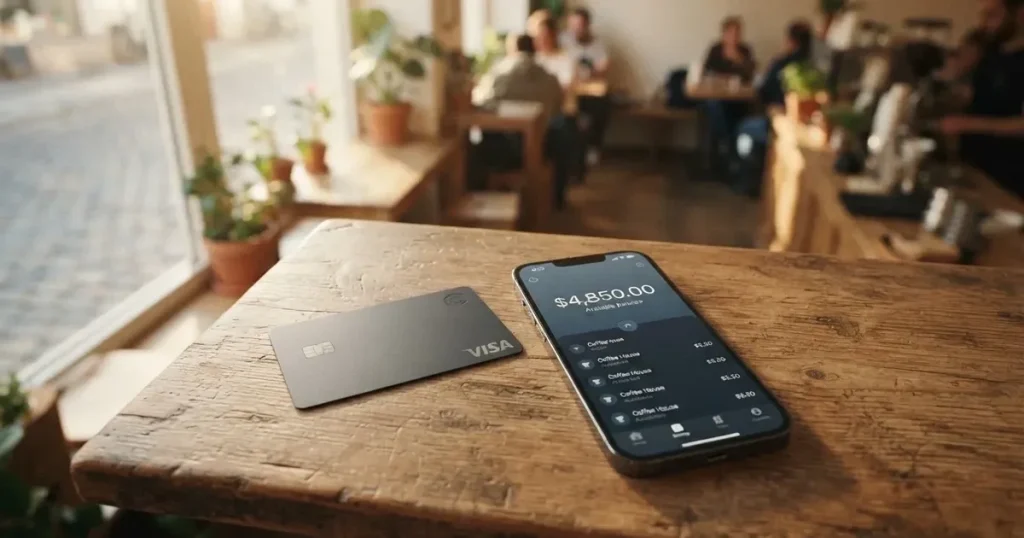
The Ecstasy card is a virtual VISA card in dollars, issued through an app that converts crypto — USDT on TRC20, among the routes named — into naira and then into a dollar wallet you spend from online. That is the whole product, as far as the card’s own published material goes. There is no physical card, no card for cash machines, no Apple Pay or Google Pay mentioned, and no fee schedule, no limits table, no withdrawal route and no stated identity-checking procedure. If you are Nigerian and you want to pay for subscriptions or online services in dollars out of crypto, that is exactly the job this card describes itself as doing. If you are anywhere else, or you want a card you can hand over in a shop, the picture is thinner than the marketing suggests.
The conditions described below are current as of October 28, 2026.
My score for the card is 3.6 out of 10. That is not a verdict on whether the app works — it never crashed while I was reading it — but on how much of what you need in order to decide is actually published. A card that says nothing about what it charges and nothing about who can hold one makes every decision the reader’s problem, and that is what the number reflects.
| Criterion | Mark | Why |
|---|---|---|
| Who can get it | 2 / 10 | Nigeria only, by the issuer’s name and the app’s naira conversion; no country list published |
| Cost | 5 / 10 | Issuance and top-up fees are not disclosed |
| Top-up options | 4 / 10 | USDT TRC20 converts to naira in the app, then a dollar wallet is funded |
| Reliability and complaints | 4 / 10 | Issuer named, licences not; App Store rating 2.7 out of 5, reviews cite freezes and login trouble |
| Everyday use | 3 / 10 | Virtual dollar VISA for online and subscriptions only; no wallets named, no cash machines |
The audience the card actually fits is narrow and worth saying plainly: Nigerian users paying for subscriptions in dollars from crypto. That is a real job with real obstacles — dollar-priced services are hard to reach from a naira account without a dollar balance — and a virtual dollar card is a reasonable shape of answer to it. The problem is that the card’s public pages describe the shape of the answer and very little of its terms.
Will they give you the card?
The starting data points to Nigeria and only Nigeria: the developer name in the App Store listing is Ecstasy Data Nigeria Limited, and the app’s central mechanic is converting crypto to naira. There is no published country list, no citizenship or residence rule, and nothing in the card’s published information says how it treats users whose documents come from elsewhere — including Russian or Belarusian users, whose situation differs sharply from a Nigerian address. You likely need Nigerian grounds to open this, as the card does not state other options.
What that means practically is that “is Ecstasy available in my country” has no answer on the record for most countries. If you are not Nigerian, treat the app’s own sign-up as the only test, and expect to fail it. If you are Nigerian, you are in the intended lane, but you still do not have a published list of acceptable documents or a stated age rule. Prepaid and debit cards generally go to adults aged 18 and over, and some issuers set higher limits, but that is the category norm, not a promise from this issuer.
The one thing you can weigh is the company behind it. Ecstasy Data Nigeria Limited is a Nigerian company named as the app developer. The issuing bank or partner is not stated, and no licences or registration numbers are published in what I could read. That is not an accusation — plenty of small issuers operate legally without splashing their paperwork around — but it means you cannot check a register, and I would not have a way to if I wanted to.
One practical note about the app itself: it exists for iPhone and iPad in the App Store and on Google Play. That tells you the app ships; it says nothing about whether the card issuing behind it is available in your country.
How to get it
The card is virtual — a dollar VISA card number created in the app, per the app description. No physical or metal card is mentioned anywhere, and delivery is not applicable because there is nothing to deliver. It is a dollar card: the card currency is USD, while the naira side of the world is handled inside the app.
On the identity question, the card’s public pages say nothing. Not “light KYC”, not “no KYC” — nothing. What the App Store privacy section does say is that the app collects payment information, name, email address, phone number, and photos or videos. That is a data-collection statement, not an onboarding policy: it tells you what the app may gather, not what it demands before opening an account, and not whether it screens against sanctions lists or asks for proof of address. If your decision depends on how many documents you will be asked for, you will have to find out inside the app.
There is no published activation procedure either — no “tap here to activate” instruction, no first-transaction rule, no 3-D Secure enrolment step. Practically, the sequence looks like this: install the app, get through whatever checks it applies, convert crypto to naira, fund the dollar wallet, and issue the virtual card from it. Every step after the install is my reconstruction from how the wallet and card are described to fit together, not a published walkthrough.
Fees: what it really costs
Here is the honest part: the card publishes no numbers. Issuance cost: not stated. Monthly fee: not stated. Conversion fee: not stated. FX fee: not stated. ATM fees: not stated, and there is no ATM to use anyway. Daily limits: not stated. Monthly limits: not stated. Tiers: none described. I am not going to fill those gaps with estimates or with what similar products tend to charge, because a number I invented would be worse than a blank — you would plan around it.
| Fee or limit | What the card says |
|---|---|
| Card issuance | Not stated |
| Monthly fee | Not stated |
| Crypto-to-fiat conversion | Not stated |
| Foreign exchange | Not stated |
| ATM / cash withdrawal | Not stated (virtual card, online use) |
| Daily limit | Not stated |
| Monthly limit | Not stated |
| Tiers | Not stated |
So what does a payment actually cost? Three everyday examples, and what I can and cannot say about each.
Paying for a streaming subscription in dollars — the card’s core use case. What is published: you convert USDT TRC20 to naira in the app, then a dollar wallet funds the virtual VISA. What is not published: the conversion rate, any spread on it, and whether the app charges a fee on top. So your real cost on a $10 subscription could be materially above $10 and I could not tell you by how much.
Paying a small online invoice or a merchant that declines prepaid cards. Two things can bite here, and neither is Ecstasy-specific. First, the merchant may look at your BIN and see a prepaid card issued in Nigeria, and some merchants decline prepaid or foreign BINs on that basis. Second, address verification is mainly offered in the US, Canada and the UK and is generally unavailable for foreign-issued cards, which causes declines. Neither is a rule against you; both are reasons a payment that should work does not, and neither is disclosed anywhere on the card’s pages.
Adding money to the wallet itself. The card says nothing about a top-up fee. What you will also pay, and this is a fact about blockchains rather than about this card, is the on-chain network fee for your deposit — gas on Ethereum, bandwidth and energy on Tron, often burning TRX. Those are charged by the network, not by the card provider, and they are outside anything the card could quote you.
The practical advice is blunt: before you commit real money, work out the conversion spread from the app’s own displayed numbers on a small amount, and price it per subscription. If the app does not show you its rate and fee, that silence is itself information.
Top up
The funding route the card describes is two-step and runs through naira. You convert crypto to naira inside the app — the conversion named is USDT on TRC20 to naira — and that naira then funds a dollar wallet, and the dollar wallet is what claims and uses the virtual dollar card. The dollar wallet shows a top-up function, transfers and a transaction history.
What is not there: fees for the top-up itself, minimum amounts, and which fiat options are available. So the size of a practical top-up, and what it costs you, is something you would have to discover in the app rather than read anywhere.
Two things to be careful about with a TRC20 route. First, network choice is not cosmetic: blockchain transfers are irreversible, so a deposit sent on a network the card provider does not support, or to an address belonging to another network, can be lost or need manual support recovery with no guarantee. Second, USDT on Tron is a specific thing and USDC on Tron is not — Circle stopped supporting USDC on Tron in February 2024, so if you are used to thinking of “USDC over TRC20” as one unit, it is not, and that habit is how people lose money.
And the general point about stablecoins: they aim to hold a steady value, but despite the name, stablecoins are not necessarily stable. TerraUSD collapsed in May 2022; USDC temporarily lost its peg in March 2023 during the US banking crisis. Tether describes USDT as backed one-to-one, but Tether also says it disables tokens in wallets on the OFAC sanctions list and has frozen funds tied to illicit activity — so stablecoins are not censorship-proof either. A dollar balance fed by USDT inherits all of that.
Withdrawal from the wallet is not stated. If you cannot get money back out, “top up” is a one-way door, and that is a question to have answered before you fund it.
Paying with it every day
Everyday use here means online and subscriptions. That is the design: a virtual dollar VISA for services that charge in dollars. There is no physical card, no card for a shop, and no ATM.
Apple Pay and Google Pay are not indicated. That is a real daily-use cost, because Apple Pay replaces the card number with a device-specific number stored in the Secure Element and each payment carries a one-time dynamic security code — a layer of tokenisation you simply do not get here, typing a card number into a merchant site instead. If you are used to tapping to pay, the ergonomics of this card are a step backwards.
Wallets are not stated. So I cannot tell you whether your crypto stays in a wallet you control until the moment of payment, or whether a provider holds it. That distinction is not technical trivia. Control of crypto belongs to whoever holds the private key or seed phrase; with a custodial wallet the provider holds the credentials, so you must trust the provider completely, and a seed phrase — typically 12 to 24 words — is the unencrypted form of that key, meaning anyone who obtains it can restore the wallet and spend its funds. Transfers are typically irreversible and a stolen key has no built-in recovery, because the network cannot freeze or return funds. Custodial platforms have a record of it: Mt. Gox (about US$350 million reported stolen, 2011-2014), Coincheck (about US$400 million, 2018), Ronin Network (US$625 million, 2022). I do not know which model this card uses, and that is the single thing I would most want answered.
There are referral rewards in the app. No cashback rate is stated, so treat “rewards” as a word, not a number.
The app’s own reception is worth weighing, and I would read it carefully because the two sources disagree. In the App Store the rating is 2.7 out of 5 from 9 ratings, read 2026-10-21, on version 2.8.2 of 24 September. Nine ratings is a very small sample — a single angry week moves it — but it is the figure the store itself shows. Unofficial, from an older snapshot on mwm.ai with no date shown and version 2.7.7, the rating reads 3.5 out of 5 from 54 ratings; treat that as third-party and unconfirmed by the card. Either way the picture is of an app that has not settled. Two recent App Store reviews cite freezes after updates and login problems.
Dispute handling is not stated. That is the quiet risk in daily use: a chargeback is a refund ordered by the issuer, with reason codes for fraud, duplicate billing or goods not received, and prepaid-card coverage varies and should not be assumed. Nobody has told you this card has any process here.
What can go wrong
Let me take the risk items in order of how likely they are to cost you something.
Compliance and sanctions. KYC rules require regulated businesses to verify customers and assess risk as part of anti-money-laundering law, including ongoing transaction monitoring. In the EU that due diligence covers name, address, date of birth, nationality, identity documents, a sanctions check and a politically-exposed-person check; if it cannot be completed, rules require the institution to decline or end the relationship, which is why accounts get closed or frozen pending documents. In the US the customer identification programme requires name, date of birth, address and an identification number. Nationality is screened separately from residence because sanctions screening and issuer policy often apply to citizenship and country of birth, not just address. This card states no KYC level at all, so you cannot know which of these applies to you. That matters especially if your citizenship is not Nigerian: an account can work fine and then stop.
Funds on the wrong network, or stuck. Irreversibility cuts both ways. Send on the wrong network or to another network’s address and the money can be gone, with no guarantee of manual recovery. And the dollar wallet has no stated withdrawal route, so I cannot tell you that you can get out.
The app breaking when you need it. The two App Store reviews describe exactly that: update freezes and login problems. On a card whose entire use is paying for things online, a login failure at renewal time is not a nuisance — it is a failed subscription.
The provider disappearing. This is the category’s history, and it is not hypothetical background colour. Visa terminated its global agreements with FTX on 13 November 2022 and the FTX US debit card was wound down. WaveCrest, a Visa issuer that supplied crypto card brands, was suspended by Visa in Europe in 2018, closing all WaveCrest-issued Visa programmes. Closures tend to follow a pattern: a notice period, then spending and loading stop, then users are asked to withdraw remaining balances. One 2026 closure reported by a secondary source ended new loads on 8 July 2026 and stopped spending on 8 August 2026 — single source, unconfirmed, and included because it shows the shape rather than because it is verified. Also worth knowing: Visa and Mastercard do not issue crypto cards to consumers themselves; they license issuers and can suspend a programme, which is exactly how those two closures happened.
Licensing you cannot verify. Ecstasy Data Nigeria Limited is named; the issuing bank or partner, licences and registration are not stated. There is no Trustpilot page for Ecstasy, and one search turned up no Ecstasy-specific complaint threads. No official incidents found either — but the absence of complaints from a service with nine App Store ratings and no Trustpilot presence is weak evidence, not reassurance. Security arrangements are not stated: no mention of two-factor authentication, instant card freeze, spending limits or 3-D Secure confirmation, all of which are typical safeguards in this category. Under 3-D Secure, liability for a fraudulent online payment can shift from the merchant to your bank — or, per its critics, to you.
And one structural point that outlasts any single provider: EU rules on markets in crypto assets, MiCA, took legal effect in June 2023, with the rules on asset-referenced and e-money tokens applying from 30 June 2024 and the remaining provisions, including crypto-asset service provider rules, from 30 December 2024. Under MiCA, e-money tokens may be issued only by a credit institution or an electronic money institution. The transitional period lets providers operating under national law continue only until 1 July 2026 or until they are authorised or refused authorisation, whichever comes first, and ESMA keeps an interim register of authorised CASPs that you can check. None of that tells you anything about this card directly — it tells you that checking a register is a thing you can do, and this card gives you nothing to check.
What to take instead
The other options here are also thin, which is worth saying before the table. Each scores higher because each publishes more of what you need to decide.
| Ecstasy | Cardex | CardFlow | HyperCard | |
|---|---|---|---|---|
| Score | 3.6 / 10 | 5.6 / 10 | 4.9 / 10 | 4.7 / 10 |
| Who | Nigeria only, per issuer name; no country list | “One crypto card, 200+ countries”; no exclusions stated | Aimed at Nigeria and “Nigerians and global users” | No country list; app says works in “more than 176 countries” (acceptance, not eligibility) |
| Card | Virtual dollar VISA | Virtual and physical, on VERVE, VISA, Mastercard, UnionPay; Naira per listing | Virtual USD Mastercard, created in about 3 minutes | Prepaid “HyperCard”; balance in USD or EUR |
| Cost | Not stated | Not stated | Creating a virtual card is free; monthly fee not stated | Not stated |
| Fees | Not stated | Real-time crypto-to-fiat conversion at payment; no percentage stated | Not stated | Not stated |
| Top-up | Crypto to naira, then dollar wallet | USDT, USDC, BTC wallets; networks not stated | Bitcoin, USDT, ETH or Naira bank transfer; networks not stated | Crypto such as USDT, BTC, ETH; networks not stated |
Read that table for what it shows. Cardex is the one to look at if physical presence matters: virtual and physical cards, on four networks including VISA and Mastercard, and a stated breadth of countries. Its cost and fee detail is no better than Ecstasy’s — it does sell a conversion story, real-time crypto-to-fiat at the moment of payment with an “AI-Powered Conversion Rate” that scans global exchange rates and picks the best one, but no percentage is published, and a mechanism without a number is still a number you have to go and find.
CardFlow is the most specific on eligibility, describing itself as Nigeria’s fintech card platform for Nigerians and global users, and the only one here that states a price: creating a virtual card is completely free, per its own site FAQ. The monthly fee is not stated.
HyperCard is the quietest option: a prepaid card with a balance in USD or EUR, deposits of USDT, BTC or ETH in the app, no country list, no fees. Its app says the card works in more than 176 countries — that is acceptance, not eligibility, and the distinction matters if you are outside Nigeria and wondering whether you can open one.
Every one of these has the same gap Ecstasy has: networks not stated for deposits. That is the thing to check first wherever you go, because sending on the wrong network is the one error with no undo.
Who I would recommend it to
I would recommend Ecstasy to a Nigerian user who already holds crypto, wants a dollar balance for recurring online subscriptions, and is willing to treat the card’s missing disclosures as something to verify in the app before committing money. For that person the product shape is right: convert USDT, hold dollars, pay a dollar subscription. The friction is entirely in the unknowns, and the unknowns are discoverable — you can see the conversion rate and any fees in the app before you commit, and you can see whether KYC is asked for before you upload anything.
I would not recommend it to anyone outside Nigeria who is reading the country question as still open. I would not recommend it to anyone who needs a physical card, a shop, a restaurant, or cash from a machine. I would not recommend it to anyone who needs money back out of the wallet, because no withdrawal route is stated. And I would not recommend it to anyone whose citizenship or country of birth is not Nigerian, because nationality is screened separately from residence in this industry and this card tells you nothing about how it screens.
If you fall between those, the sensible next step is not another card — it is the same three questions, asked of whichever option you are looking at: what does the conversion actually cost me, what identity document do I need and what happens if the review fails, and how do I get the balance back. A card that will not answer those three is not cheaper for being quiet about them.
Frequently asked questions
What is the Ecstasy card?
Ecstasy is a virtual dollar VISA card issued through an app from Ecstasy Data Nigeria Limited. You convert crypto to naira in the app, that naira funds a dollar wallet, and the dollar wallet pays for online purchases and subscriptions. There is no physical card, no metal card, and nothing for cash machines — everything the card does is online, in dollars.
How does the Ecstasy card work?
In two steps. First you convert crypto to naira inside the app; the conversion the card names is USDT on TRC20 to naira. Then the dollar wallet is topped up from that, and the wallet is what claims and uses the virtual dollar card. The wallet shows top-up, transfers and a transaction history. Fees, minimums and available fiat options are not stated anywhere.
Is Ecstasy a bank?
Not on the evidence published. The app developer is named as Ecstasy Data Nigeria Limited, a Nigerian company, but the issuing bank or partner is not stated, and no licences or registration numbers appear in what I could read. That means you cannot look the issuer up in a register. Treat it as an app company rather than a bank until the card names its issuer.
Who can get the Ecstasy card?
Almost certainly people with Nigerian grounds. The issuer is Nigerian and the app’s core mechanic is converting crypto to naira, but there is no published country list, no citizenship or residence rule, and no statement about users with Russian or Belarusian documents. If you are not Nigerian, the app’s own sign-up is your only test — and expect it to fail.
How do I get the Ecstasy card?
Install the app from the App Store or Google Play, register, and create the virtual dollar VISA card in the app. Beyond that, the sequence is not published: there is no stated identity-checking procedure, no documented activation step and no guide to the documents required. What the App Store privacy section does say is that the app collects payment information, name, email, phone number and photos or videos.
Does the Ecstasy card require KYC?
The card does not say. There is no published KYC level, no list of required documents and no statement either way. In this industry KYC normally covers name, address, date of birth, nationality, identity documents, a sanctions check and a politically-exposed-person check, and if it cannot be completed the institution is expected to decline or close the relationship. You will find out only by trying.
What does the Ecstasy card cost?
Nothing is published. No issuance fee, no monthly fee, no conversion percentage, no foreign-exchange fee, no daily or monthly limits, no tiers. Separately, you will pay the blockchain’s own network fee for a deposit — gas on Ethereum, or bandwidth and energy on Tron. Work out the conversion spread from the app’s displayed numbers on a small amount first.
Is the Ecstasy card safe?
I can’t tell you, and neither can the card. Security arrangements are not stated: no mention of two-factor authentication, card freeze, spending limits or 3-D Secure. No Trustpilot page exists and no complaint threads surfaced, but with only nine App Store ratings that is weak evidence. What is documented is two recent reviews citing update freezes and login problems — a real risk for a card whose only job is online payments.
How do I top up the Ecstasy card?
Convert crypto to naira in the app — USDT on TRC20 is the named route — then fund the dollar wallet, which is what the card spends. Check the network carefully before sending: blockchain transfers are irreversible, so funds sent on a network the provider does not support, or to another network’s address, can be lost. No withdrawal route is stated.
Is the Ecstasy card worth it?
For a Nigerian user who already holds crypto and pays dollar subscriptions, the shape is right and the price is unknown — the deciding factor is whether the app shows you an acceptable conversion rate. For anyone needing a physical card, cash, a way to withdraw, or living outside Nigeria, the published material is too thin to justify it. Verify the rate, the KYC level and the exit route in the app before committing money.
Choosing a virtual card – cryptocardadvisor
Content created by the «cryptocardadvisor» team