
Karta card review — fees, top-up, who it suits, who it does not
 Available in US
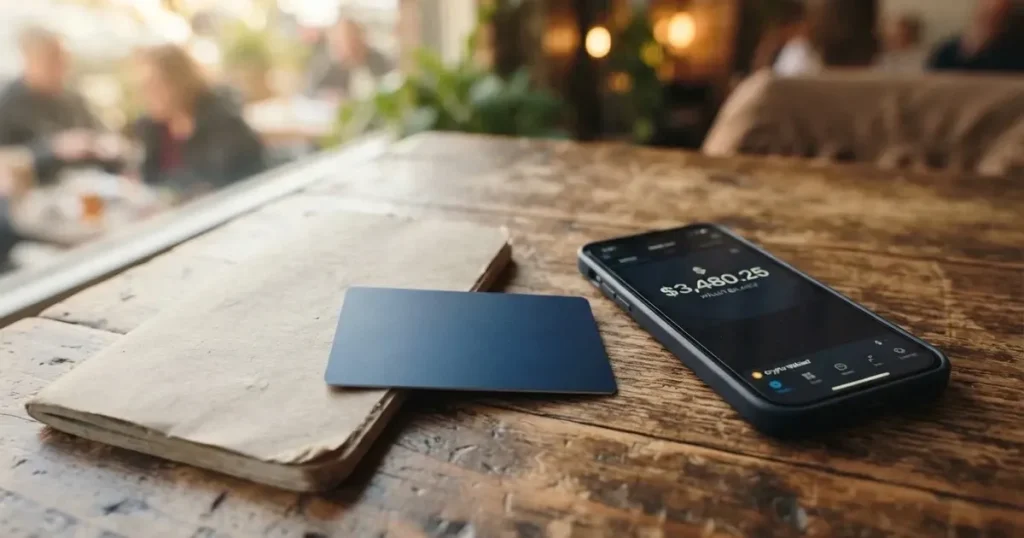
The Karta card sits at a strange intersection. It is a Visa Signature — virtual or physical — that you set up and load from inside a Telegram bot. There is no bank account, no mobile app in the usual sense, and no customer support phone line. For the right person, that simplicity is the point. For anyone who needs a familiar bank behind the card, the same simplicity is the problem.
I went through the card’s own pages, the third-party review sites and the public record to see how it actually works, what it costs in real life, and where it tends to disappoint. The conditions below are current as of October 28, 2026.
Verdict
Karta earns 7.9 out of 10 in my scoring, with the marks spread across the criteria that mattered most to me.
| Criterion | Mark | Why I gave that mark |
|---|---|---|
| Who can get it | 9 / 10 | Works “in 200+ countries and territories where Visa is accepted”; availability depends on local regulations and partner coverage |
| Cost | 7 / 10 | Virtual Visa activation 5.00 USDT, physical from 100.00 USDT; crypto top-up free; card payments 1.5%; ATM 1.5% + 1 USDT |
| Top-up options | 10 / 10 | USDT or USDC on Tron (TRC-20), Ethereum, BNB Smart Chain, Polygon, Arbitrum, Optimism, Base, Solana; plus fiat via ACH, SWIFT, SEPA, PIX, SPEI |
| Reliability and complaints | 5 / 10 | Karta Finance Inc., not a bank, issuer not named; Trustpilot 3.9 from 25 reviews, complaints about high fees; unofficial sources flag the “0% commission” and “25% cashback” claims as misleading |
| Everyday use | 9 / 10 | Visa Signature virtual and physical, Apple Pay and Google Pay, ATM cash access worldwide |
| Total | 7.9 / 10 |
The card suits a particular kind of user: someone already living in Telegram, comfortable sending USDT across multiple chains, and unbothered by a 1.5% spend fee. The Telegram-first design is the reason someone like a freelancer paid in stablecoins from clients across several networks would look at Karta first — that audience gets a 10/10 on top-up options, a working virtual card in minutes, and Apple Pay support from day one. It is not the right card for someone who wants a bank behind them, a published fee schedule, or a regulator’s name on the issuer. Read the costs section, then the risks, before deciding.
Will they give you the card
Karta’s own page says the card works “in 200+ countries and territories where Visa is accepted.” That is the headline figure, and it sounds generous. The honest version of that sentence, the part the marketing copy does not foreground, is the second clause: availability “depends on local regulations and partner coverage.” In other words, “200+” is what Visa’s network gives you at the till, and Karta is being careful about promising that you can sign up in any of those places.
The pages do not separate citizenship from residence, so it is not stated whether the check looks at your passport, where you live, or both. I would expect the usual pattern for this kind of card — the check looks at both, because sanctions screening and issuer risk policy are often applied to citizenship and country of birth as well as to the country of address — but I am not going to tell you Karta has confirmed that, because the card’s own site has not.
The bigger limit is the issuer. Karta Finance Inc. is a Delaware company at 221 W 10th St, 4th Floor, Wilmington, DE 19801, USA, and the company explicitly says it is “not a bank.” Card-issuing is done through “regulated financial and card-issuing partners,” but the partner is not named on the public page. If you are someone who wants to know exactly which licensed institution holds your card programme, that absence is itself an answer: the card is not for you.
In short: if you live somewhere Visa is taken, you can probably get Karta, but two questions — what you are a citizen of, and which rules the unnamed issuing partner applies — sit underneath that “probably.”
How to get it
Sign-up lives inside Telegram. There is no web application form, no App Store or Google Play listing referenced from the main page, and no separate onboarding portal. You start the Karta Telegram bot, run a “quick verification (it takes up to 5 minutes)” inside the app, then top up to activate the virtual card. That is the entire path, in three steps.
What “quick verification” actually involves is not stated on the card’s public pages. The closest a third-party site (Crypto Cards, no date shown) gets is “ID Verification”: email, phone and identity document required; proof of address and selfie not required. Treat that as unofficial. The official line is just the five-minute promise. A single verification level is offered, so there is no tiered KYC where bigger limits unlock after more documents — there is one level, and what it covers is the five-minute check.
There is no age statement on the public pages either, but prepaid and debit cards in this category are almost always 18+ by issuer policy, and the underlying Visa programme typically requires an adult cardholder. If you are under 18, plan on being told no.
For the physical card, the page says activation “from 100.00 USDT” — meaning a minimum load of 100 USDT in stablecoin, not a fee. The physical card’s country list, delivery time, delivery cost and replacement cost are all not stated on the site. The official site lists the virtual Visa activation as 5.00 USDT, while the FAQ on the same site shows “30 USDT 5 USDT” with what looks like an old price struck through. I have used 5.00 USDT as the current figure, because that is what the headline page says.
Fees: what it really costs
This is the section to read twice, because the headline number is 1.5% per card payment, and that is not the only number. The costs table is the fastest way to see the full picture.
| Fee or limit | Amount |
|---|---|
| Virtual Visa activation | 5.00 USDT |
| Physical Visa activation | from 100.00 USDT (minimum load) |
| Virtual account | free |
| Monthly fee | none listed |
| Card payment | 1.5% |
| FX fee on foreign-currency payments | not stated |
| ATM withdrawal | 1.5% + 1 USDT |
| ATM free allowance | not stated |
| Crypto top-up | free |
| SEPA (EUR) deposit | 1.5% + EUR 2 |
| SWIFT (USD) deposit | 1.4% + $2 |
| Send to external crypto wallet | network fee only |
| Daily spend limit | not stated on official page; unofficial source cites “unlimited” for the virtual card and $25,000/day for the physical — see below |
| Monthly spend limit | not stated on official page; unofficial source cites “unlimited” for the virtual card |
Now let me walk the same numbers through a few everyday situations, because the table does not show you how the fees stack up.
A $50 grocery shop paid with the virtual card. The 1.5% spend fee is 0.75 USDT. Nothing else, if the merchant charges in the card’s currency and you are topped up in USDT. The total drag on your crypto is the 1.5% plus whatever your own wallet paid to send the USDT to Karta — and that second part is the network fee (gas on Ethereum, bandwidth on Tron), charged by the blockchain, not by Karta. On a $50 load, Ethereum gas will eat the whole point. On Tron, it usually will not.
A €100 dinner in a country that does not use the card’s currency. Spend fee 1.5% on the converted amount. FX fee on top: not stated. That gap is a real risk. If the card settles in USD, you take the card scheme’s exchange rate into USD, then whatever rate the scheme applies from USD to EUR, and Karta’s 1.5% sits on top. The official pages do not publish a separate FX percentage, so I cannot tell you the total drag here. I can tell you the 1.5% spend fee is the floor, not the ceiling.
A $200 ATM withdrawal. ATM fee is 1.5% + 1 USDT. On $200 that is $3 + $1 USDT = about $4. There is no free-allowance figure published, so treat every ATM withdrawal as paid. Daily and monthly ATM limits are not stated on the official page.
A note on what the official page does not say, because it is the same set of gaps in every review I have done of this kind of card. There is no published fee schedule for: FX on non-card-currency payments, card-currency choice, multi-currency balances, monthly fee, replacement-card fee, declined-transaction fee, inactivity fee, or closure fee. If a fee matters to you, assume it is not free until you have seen it in writing.
There is also a third-party claim to be careful with. The same Crypto Cards page (no date) says the ATM fee is “free” and withdrawals are “unlimited,” and that the virtual card has unlimited daily and monthly spend while the physical has a $25,000/day cap. That contradicts the official page, which lists 1.5% + 1 USDT for ATM. Unofficial sources, undated, and at odds with the card’s own numbers — I would not plan a budget around them.
Top up
Top-up is where Karta is genuinely different, and where the 10/10 mark comes from. You can fund the card with USDT or USDC across nine networks: Tron (TRC-20), Ethereum, BNB Smart Chain, Polygon, Arbitrum, Optimism, Base and Solana. The same page also lists fiat rails: ACH and domestic wire (USD), SWIFT, SEPA (EUR), PIX (BRL), bank transfer in COP and SPEI (MXN), with availability varying by country. Withdrawals go the other way — to external crypto wallets, paying only the network fee. Bank withdrawals are listed as “coming soon.”
The minimum top-up amount is not stated on the official page. In practice the constraint is the network fee you pay to send stablecoins in. On Ethereum, you need ETH in the sending wallet to pay gas; a wallet holding only USDT cannot send, because ERC-20 transfers pay gas in ETH. Tron’s network uses bandwidth and energy as internal resource pricing, and TRX gets burned to pay for those resources — which is why most people use TRC-20 USDT for cheap moves. If you choose Ethereum, the network fee can easily exceed the 1.5% spend fee on small purchases.
Two stablecoin details that bit the category in the past and that are worth knowing before you pick a network. Circle stopped supporting USDC on Tron in February 2024, so “USDC over TRC20” is no longer a native option — Karta’s list of USDC on Tron (TRC-20) is something I would treat with care and confirm inside the app before sending. Tether says it disables tokens in wallets on the OFAC sanctions list and has frozen funds tied to illicit activity, which means stablecoins are not censorship-proof and a frozen-address deposit is a real risk.
A transfer sent on a network Karta does not support, or to an address belonging to a different network, can be lost or need manual support recovery with no guarantee. The single biggest avoidable loss in this category is the wrong-network deposit, and Karta’s nine-network menu makes that mistake easier to make. Read the deposit screen twice before sending.
Paying with it every day
The card is Visa Signature in both virtual and physical form, which means it is accepted wherever Visa is taken, in any of the 200+ countries Karta cites. Apple Pay and Google Pay are supported, so you can load the virtual card onto a phone and tap to pay. The card works at any ATM on the Visa network for cash.
What the public pages do not tell you is just as informative. Restricted merchant categories are not stated. The closest I can get is the general background: many issuers block MCC 7995 (gambling — casinos, betting, lotteries) on specific cards by policy, and the blocked list varies by issuer. If gambling or a particular category matters to you, you will not find Karta’s policy spelled out — assume the default and ask support before you rely on it.
Cashback is mentioned on the card’s pages (“the more they spend, the more you earn”), but the rate and the currency it is paid in are not stated. There is a separate referral programme in KARAT points, with 1 KARAT = 0.01 USDT. Unofficial coverage describes a “25% cashback” headline elsewhere on the site, and the third-party review I read says that claim and the “0% commission” claim are widely seen as misleading, with cashback paid in a token that is not liquid. Treat the cashback number as marketing and read the small print if you intend to rely on it.
For online payments, 3-D Secure is part of the security page. Address Verification Service (AVS), which compares numeric parts of the billing address to issuer records, is generally unavailable for foreign-issued cards and can cause declines at US/Canada/UK merchants. Some merchants also decline prepaid or foreign BINs outright, because the BIN lookup reveals the card type and issuer country. None of that is unique to Karta, but it is the kind of friction that someone planning to use the card abroad should know about before their first online checkout.
A practical tip: tokenising the card into Apple Pay or Google Pay replaces the card number with a device-specific Device Account Number stored in the Secure Element, never on Apple or Google’s servers, and each payment uses a one-time dynamic security code. That is the safest everyday setup, and the card supports it.
What can go wrong
I split the risks into three: what other users have said, what the company structure looks like, and what the security story actually is.
User feedback. Trustpilot, read 2026-10-20, shows 3.9/5 from 25 reviews — a small sample but a mixed one. Themes that come up repeatedly: the fees are higher than users expected, and there is not enough information before registration. A third-party aggregator (cryptocards.so) scores Karta Virtual Visa 4.0/10, calls the “0% commission” marketing deceptive, and gives the Android app 3.0 stars. None of that is a deal-breaker on its own, but it is consistent: this is a card where the headline numbers look better than the small print.
Company structure. Karta Finance Inc., Delaware, is the marketing entity. The page is explicit: “not a bank,” not FDIC insured. The card-issuing partner is “regulated” but is not named on the public page, and the licences behind the programme are not stated. If the issuer were to wind the programme down — Visa terminated its global agreements with FTX in November 2022 and the FTX US debit card was wound down by its issuer; WaveCrest was suspended by Visa in Europe in 2018 — you would be reading the closure notice from a partner you did not know you had. Visa itself does not issue crypto cards to consumers; it licenses issuers and can suspend a programme, which is why the issuer’s identity matters.
Security. The pages list self-custody wallet, 3-D Secure, encrypted transactions and PIN protection. Two-factor authentication and instant card freeze are not mentioned on the security page. Insurance or safeguarding of customer funds is not stated. “Not a bank, not FDIC insured” appears in the same breath as those features, and that combination is the honest summary: there are technical safeguards, but the deposit-style protections of a bank are not part of the deal.
A note on the controls that aren’t there. If you lose your phone, an instant card freeze in the app is the single most useful safety net for a payment card, and Karta does not say it has one. If you cannot reach the Telegram bot, that is also your support channel gone, because the support path is in-app chat, email at [email protected], the Help Center, and Telegram. There is no phone line.
For the broad context, the category has had real failures: Mt. Gox (about US$350 million reported stolen 2011-2014), Coincheck (about US$400 million in 2018), Ronin Network (US$625 million in 2022). A self-custody-linked card like Karta, where the funds stay in your own wallet until the moment of payment, removes some of that counterparty risk — but the card still depends on a card-issuing partner you do not name, on a network (Visa) that can terminate programmes, and on a marketing entity (Karta Finance Inc.) that is not a bank. None of that is a reason to reject the card; it is a reason to keep balances modest and not treat the card as a long-term store of value.
What to take instead
Three alternatives came up in my research, and I scored them on the same rough scale. None of them is a perfect swap — they are different products with different constraints — but if Karta’s gaps put you off, the comparison is useful.
| Card | Score | Best for | Top-up | Card | Not for you if |
|---|---|---|---|---|---|
| Karta | 7.9 / 10 | Multi-chain USDT users in Telegram | USDT/USDC on 9 networks, plus fiat | Visa Signature (virtual + physical) | You want a named issuer or a published fee schedule |
| Azul Card | 5.3 / 10 | People who want a virtual Mastercard worldwide | Crypto to the card in Telegram (networks not named on the pages I read) | Virtual only, USD balance, Mastercard | You need a physical card, you are in a restricted jurisdiction (Russia, Belarus, North Korea, Iran, Syria, Cuba, Sudan, Venezuela, Ukraine and the Crimea, Donetsk, Luhansk, Zaporizhzhia and Kherson regions), or you want cashback |
| Telecard | 6.1 / 10 | People who want a free basic virtual card | USDT on Tron or Ethereum, USDC on Ethereum, plus ETH/TRX on the main page | Virtual only, USD, Mastercard | You want a physical card, a metal card, or Polygon support |
| OnCards | 4.6 / 10 | People who want a simple Telegram card | USDT BEP20 only; no bank transfers | Virtual only, network not fixed | You want clarity on costs, a physical card, or a published fee schedule |
Reading across the table, the trade-offs are sharp. Karta is the only one of the four with a physical card, a Visa network, and a multi-chain top-up menu that is genuinely long. Azul is the only one that publishes a clear country block-list, and that list is part of its score. Telecard’s free basic plan is genuinely free on signup, but the $99 minimum deposit and the “up to 3% each” FX/cross-border disclosure explain why its cost mark is what it is. OnCards’ “Simple and clear fees — no hidden charges” comes with no amounts at all, which is its own kind of warning.
Who I would recommend it to
I would recommend Karta to a fairly specific reader. You live in Telegram already and you are comfortable that the support channel is the same app. Your income arrives in USDT or USDC, possibly on different chains, and you do not want to bridge manually before spending. You are happy with a 1.5% spend fee because your alternative is a manual off-ramp. You can use Apple Pay or Google Pay, which means a phone-based card is enough and you do not need a physical card in your wallet. You are not relying on a bank-style guarantee if the card-issuing partner or the network pulls the programme. You live somewhere Visa is taken and the local rules and the unnamed partner do not block you.
I would not recommend it to: someone who needs a named bank or e-money issuer on the front of the card; someone who needs a published FX percentage on non-card-currency payments; someone who plans to use it heavily for cash, because the 1.5% + 1 USDT ATM fee adds up; someone whose main concern is regulatory recourse in a dispute; and someone who has never sent a stablecoin cross-chain and is not ready to learn, because the wrong-network mistake on this card is unrecoverable in most cases.
If you are somewhere in between — Karta is interesting but not quite right — start with the alternatives. Azul is the closest “virtual Mastercard in Telegram” competitor and it is more honest about its restricted-country list. Telecard is the cheapest on paper if your volumes are small. OnCards is the simplest to explain to a friend, but it is also the one with the least disclosed.
Either way, the practical advice is the same: read the deposit screen twice, keep balances modest, tokenise the card into Apple Pay or Google Pay before your first online checkout, and do not assume any fee not on the official page is free.
Frequently asked questions
What is the Karta card?
Karta is a Visa Signature — available as a virtual or physical card — that you set up and load from inside a Telegram bot. It is run by Karta Finance Inc., a Delaware company that is explicit about not being a bank, and the card is issued by a regulated partner that is not named on the public page.
How does the Karta card work?
You start the Karta Telegram bot, run a quick verification inside the app, then top up the card with USDT or USDC across several networks, or with fiat via ACH, SWIFT, SEPA, PIX, SPEI and similar rails. The card spends a pre-loaded balance, so it cannot overdraw, and every card payment carries a 1.5% fee.
Is Karta a bank?
No. Karta Finance Inc. says so on its own page. The card is issued by a “regulated financial and card-issuing partner,” but the partner’s name is not published. Customer funds are not FDIC insured.
Who owns Karta?
The card is operated by Karta Finance Inc., registered at 221 W 10th St, 4th Floor, Wilmington, DE 19801, USA. The ownership beyond the Delaware company is not stated on the public pages.
Is Karta available in my country?
The card works “in 200+ countries and territories where Visa is accepted,” with availability depending on local regulations and partner coverage. The public page does not list supported or excluded countries, so the only way to know for sure is to start the Telegram bot from your usual device and see what the verification step allows.
How do I get the Karta card?
Open the Karta Telegram bot, run the in-app verification, then top up the card to activate the virtual Visa. The virtual card activation is 5.00 USDT and the physical card activates from a 100.00 USDT minimum load.
Does Karta require KYC?
Yes. The public page describes a single “quick verification (it takes up to 5 minutes)” inside the Telegram app. The official pages do not list which documents are required; a third-party source (Crypto Cards, no date) says email, phone and an identity document, with no proof of address or selfie. That is unofficial.
How do I top up the Karta card?
Send USDT or USDC to the deposit address shown in the app on one of nine networks — Tron (TRC-20), Ethereum, BNB Smart Chain, Polygon, Arbitrum, Optimism, Base or Solana — or use a fiat rail like ACH, SWIFT, SEPA, PIX or SPEI. Crypto top-ups are free on Karta’s side; you pay only the network fee to the blockchain.
Is the Karta card free?
There is no monthly fee listed, and the virtual account is free. The virtual card activation is 5.00 USDT, the physical card activates from 100.00 USDT, card payments cost 1.5% and ATM withdrawals cost 1.5% + 1 USDT. The “0% commission” line elsewhere on the site is flagged by third-party reviewers as misleading.
How do I add the Karta card to Apple Wallet?
The card is listed as compatible with Apple Pay and Google Pay. The public pages do not walk through the steps; in practice you open the card detail in the Telegram app and follow the prompt to add it to your phone’s wallet, after which it appears in Apple Pay for tap-to-pay and online checkout.
Choosing a virtual card – cryptocardadvisor
Content created by the «cryptocardadvisor» team