
A Visa Infinite card that spends your own USDC, kept in your own wallet
 Available in US
Banqa is a Visa Infinite card programme built around an unusual idea: the USDC you spend stays in a wallet you control until the moment of payment. There is no annual fee on the Standard tier, the physical card costs $39.00 including shipping, and the only recurring bite is the 1.99% FX fee on purchases that are not in US dollars. If you already hold USDC and you trust yourself to look after a seed phrase, Banqa is one of the cleaner self-custody cards on the market. If you do not, the same design starts to feel less like a feature and more like a risk.
This review is written from the published terms and help-centre pages, checked on October 28, 2026, with Trustpilot data read on 2026-10-21. Conditions are current as of 2026-10-20.
Verdict
Banqa earns 7.1 out of 10 in my scoring. That score is the average of five criteria I weigh for every crypto card: who can get it, what it costs, how it is funded, how reliable the company is, and how it works day to day. The breakdown is below.
| Criterion | Mark | Why |
|---|---|---|
| Who can get it | 6/10 | No country list is published. Eligibility is confirmed during application and KYC, and the rules depend on residence and applicable regulations. |
| Cost | 7/10 | No annual fee on Standard. Physical card $39.00 with shipping, no fee to deposit USDC, 1.99% on non-USD spending, $1.50 fixed per ATM withdrawal. |
| Top-up options | 7/10 | USDC only, into a self-custody smart-contract wallet on Base, Arbitrum or Ethereum. USDC top-ups are free; other assets and networks from 0 to 1% by route. |
| Reliability and complaints | 7/10 | Brand of Codego Group, cards issued by a Visa Principal Member under a Visa licence. Banqa says it is not a bank; the issuer is not named publicly. SOC 2 and penetration tests are claimed. Trustpilot shows 3.7 from a single review. |
| Everyday use | 9/10 | Virtual and physical Visa Infinite, Apple Pay and Google Pay, ATM withdrawals at 1% + $1. |
| Total | 7.1/10 |
The card is a good fit for someone who already holds USDC in a self-custody wallet, lives outside the comfortable overlap of European and US banking, and does not need a long list of supported countries to be checked in advance. It is a poor fit for someone who wants a card from a named bank, who needs cashback or a rewards programme beyond a referral scheme, or who would rather not take responsibility for a recovery phrase.
Will they give you the card
Banqa does not publish a list of supported countries. The official wording is that “eligibility depends on residence and applicable rules”, and the check happens when you apply and complete KYC. A supported-countries page is linked from the help centre, but the contents are not made public; the decision is made on a per-application basis.
This is a meaningful difference from cards that publish their country lists up front. With MetaMask Card, for example, you can see at a glance that sign-up is open in 45 named countries. With Banqa, you have to start the application to find out, and you may only learn the answer after submitting identity documents.
The other eligibility points to know:
- KYC needs a government ID (passport, national ID, or driver’s licence) plus a proof of address dated within the last 3 months. Higher tiers may ask for source-of-funds documents.
- Automated checks usually finish in minutes; manual reviews take 24 to 48 hours. If a check fails, you can retry from the dashboard.
- The minimum age is not stated on the public pages.
- Limits (daily, weekly, monthly) depend on which verification tier you reach. The tier names and the actual amounts are not published.
- The supported-countries page is not the same as a list of card-acceptance countries. Once you have the card, the question of where you can spend it is the question of where Visa Infinite is accepted, not where Banqa is licensed.
If your situation is unusual (a sanctioned country on your ID, a residence in a country with a less common passport, a recently changed address), the lack of a published list makes the card harder to evaluate before you start.
How to get it
The signup path is a standard one for a regulated card: account, KYC, virtual card, then a physical card if you want one.
- Create an account through the web or app and start KYC. You will be asked for a government ID and a recent proof of address.
- Pass the checks. Most applications clear in minutes through automated checks; if the system flags anything, the manual review takes 24 to 48 hours.
- Receive a virtual Visa Infinite card as soon as KYC passes. Business accounts can also get a virtual card at this stage.
- Order the physical card for $39.00 (issuance and shipping combined). The list of countries it ships to and the typical delivery time are not published, so this is one of the things to confirm in the help centre before paying for shipping.
- Top up the card by sending USDC to your self-custody wallet, then add the card to Apple Pay or Google Pay if you want contactless payments on the phone.
The card itself is a Visa Infinite, in both virtual and physical form. The card currency is US dollars, which is why non-USD transactions carry an FX fee. If you do business in USD already, this is a clean setup; if your everyday life is in euros or pounds, every tap will have the 1.99% spread on top.
There is no cashback programme and no sign-up bonus. The only incentive is a referral programme: 0.15% of friends’ spend, plus a $10 bonus per friend who reaches $500 of spending.
Fees: what it really costs
The fee structure is short and easy to read. There is no annual fee on the Standard tier, no fee to deposit USDC, and a clear spread of small one-off charges. The two recurring costs to watch are the 1.99% FX fee on non-USD purchases and the ATM fee.
| Fee or limit | Amount |
|---|---|
| Annual fee (Standard tier) | $0 |
| Physical card issuance and shipping | $39.00 |
| Account residency (Visa Corporate) | $3.00 |
| Corporate card issuing | $5.00 |
| Account closure | $10.00 (one-time) |
| FX fee on non-USD transactions | 1.99% |
| USDC top-up fee | $0 |
| Other assets / networks top-up fee | 0–1% by route |
| ATM withdrawal — fixed fee | $1.50 |
| ATM withdrawal — end-user rate | 1% of amount + $1 |
| ATM balance / decline / authorisation check | $0.60 |
| Crypto-to-fiat conversion | None (“no manual conversion”; USDC spent against collateral) |
| Daily / weekly / monthly limits | Per verification tier; amounts not published |
| Per-transaction limits | Set by the user |
Now let me walk through three everyday payments so the fees show up in context, because the table alone does not say what you will actually pay.
A coffee in a Paris café with a euro-priced terminal. You tap the card for €4.50. Because the card settles in US dollars and the merchant charges in euros, the 1.99% FX fee applies: roughly €0.09 on that coffee. The card balance drops by about $4.93. The conversion is automatic; there is no manual “convert USDC to USD” step on the app.
A monthly supermarket shop in London, £180. Again, non-USD, so the 1.99% FX fee applies: £3.58. Compared to a UK debit card with no FX fee, that is £3.58 a month the supermarket shop is paying for the convenience of using USDC.
A €200 cash withdrawal from an ATM in Berlin. The end-user ATM rate is 1% + $1, so the percentage part is €2.00 and the fixed part is roughly $1.00 (about €0.92 at current rates). Total ATM cost: about €2.92. In addition, the merchant’s ATM operator may add its own surcharge, which is independent of Banqa. If you are travelling and need cash often, ATM use is the most expensive part of the card.
The two cases that look expensive on the table — non-USD spend and ATM withdrawals — are also the cases where everyday cards without FX or ATM fees will look cheaper. The case where Banqa looks cheap is USD-denominated spending, where the FX fee is 0%.
There is no “free ATM allowance” published, no monthly fee, and no inactivity fee. The minimum top-up amount is not stated, and a chargeback handling fee is mentioned in the schedule without the amount.
Top up: how to fund the card
The funding model is what makes Banqa different from most crypto cards. You do not send USDC to a Banqa account. You send it to a self-custody smart-contract wallet that Banqa generates for you, and the card spends against that wallet. You hold the keys; the card programme does not custody your crypto.
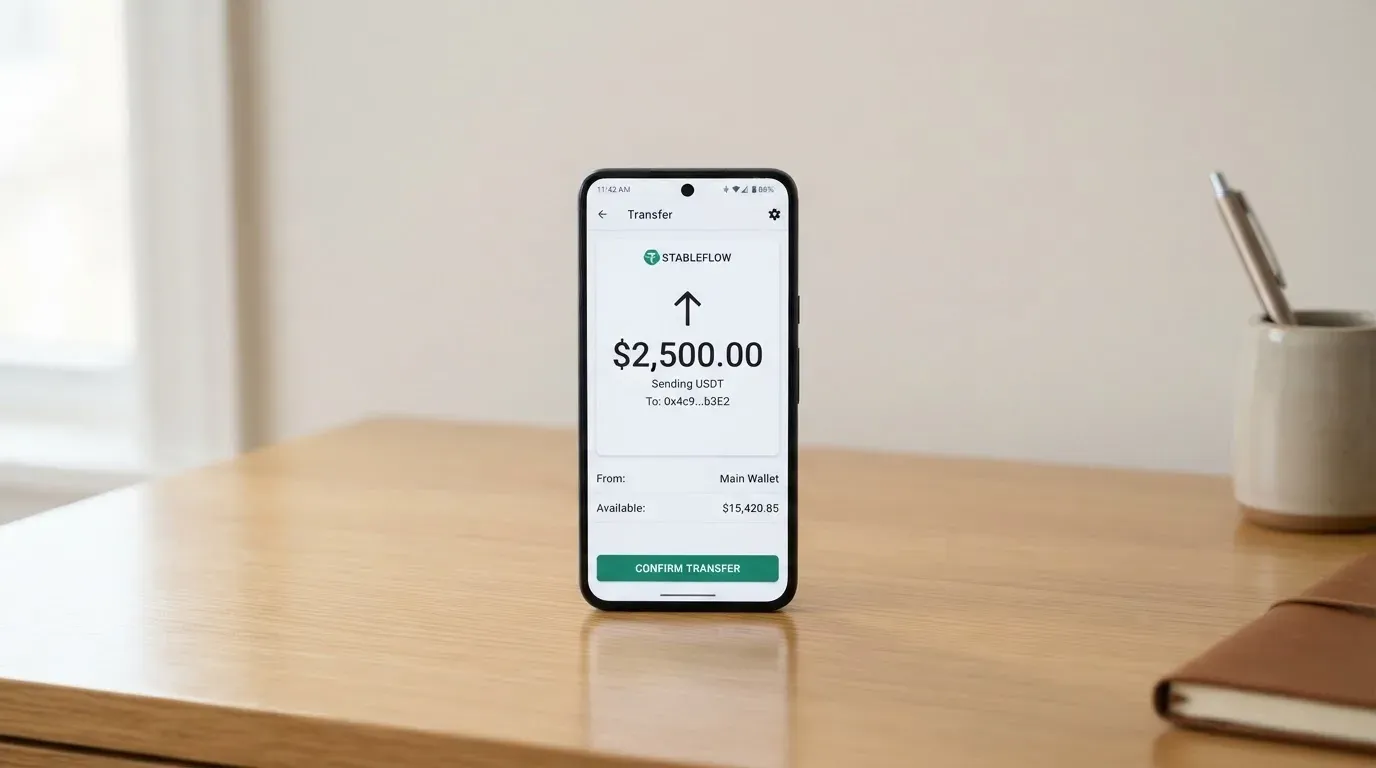
Three networks are supported for USDC: Base, Arbitrum, and Ethereum. The help-centre wording is “Hold USDC on Base and Arbitrum” and “Send only USDC on Base”, which suggests Base is the default and safest choice for new users. USDC top-ups are free; other assets and other networks are accepted on some routes with a fee of 0 to 1% depending on the route shown on the fee page.
There is a withdraw direction as well. The withdraw page moves USDC from the card collateral back to your self-custody wallet through an on-chain authorisation, and the home page gives a worked example: an “offramp” fee of 1% + $3.00. There is also a $10.00 account closure fee if you decide to close the account.
Practically, top-up looks like this: open the app, copy the USDC deposit address (the Base one if you want the free route), send USDC from your exchange or wallet to that address, wait for the on-chain confirmation, and the card balance updates. The minimum top-up amount is not stated on the public pages.
The trade-off is straightforward. The self-custody model means Banqa cannot freeze or lose your USDC, because it does not hold it. It also means you can lose it. If you lose the recovery phrase, no one at Banqa can help you get it back, because no one at Banqa ever saw it. The phrase is shown once, and the company explicitly says it cannot recover it for you.
Paying with it every day
The card is a Visa Infinite, which is the top of the Visa consumer range. It works in contactless terminals, online, and in mobile wallets. Apple Pay and Google Pay are both supported, so you can add the card to a phone and pay with a tap without ever taking the physical card out of your wallet. ATM withdrawals are available, at the cost structure described in the fees section.
Other everyday-use notes:
- The blocked merchant category list is not stated publicly. Some issuers block gambling (MCC 7995), adult content, or crypto purchases by policy, but the merchant categories Banqa blocks are not in the public help centre.
- The card is Visa Infinite, which in the broader Visa product line usually comes with travel and concierge benefits. Whether those are activated for the Banqa programme is not stated on the public pages.
- The dashboard is a web/app interface; specific platforms (iOS, Android, web only) and app store ratings are not stated.
- The dispute and chargeback process is mentioned in the fee schedule (a chargeback handling fee is disclosed), but the steps and time frames are not described in the help centre. This is something to clarify before you rely on the card for a large purchase from an unfamiliar merchant.
- There is no cashback programme on spending. The only incentive is the referral programme: 0.15% of friends’ spending and a $10 bonus per friend who reaches $500 of spend.
The combination of Visa Infinite acceptance, mobile wallet support, and instant issuance of a virtual card is the strongest part of the product, and it is why the everyday-use score is 9/10. The weakness is the lack of published detail on reward restrictions, blocked categories, and dispute time frames, which a heavier spender would want to know before relying on the card.
What can go wrong
Three risks are worth thinking about before you apply.
Issuer and regulatory risk. Banqa is a brand of Codego Group. The card programme is run by a Visa Principal Member under a Visa licence, but the issuer’s name is not published on the help centre pages I read. The company says it is not a bank. If you want to know which regulator supervises the issuer, which deposit guarantee (if any) protects the funds loaded onto the card, and what happens if the issuer fails, those answers are not on the public pages. By contrast, an EMI that issues a card in the EU is required to safeguard customer funds in segregated accounts or insurance, and those funds are not the same as bank deposits and are not covered by deposit guarantee schemes. The same general principle applies here, but without a named issuer and a named regulator, the consumer has to do extra checking.
Self-custody risk. The card’s design means the USDC sits in a wallet whose keys you hold. If you lose the recovery phrase, you lose access to the USDC. The help centre is explicit that the phrase is shown once and is not recoverable by Banqa. Crypto transfers are irreversible, and on-chain transactions cannot be reversed by the network. Sending USDC on the wrong network, or to an address on the wrong network, can mean lost funds with no guarantee of support recovery.
Programme and operational risk. Trustpilot has 1 review for Banqa, dated July 2026, scored 3.7. The platform notes that the company has not invited reviews, and there are no complaint themes to read. That is too small a sample to say anything meaningful about real-world reliability: there is no track record of complaints, but also no track record at all. SOC 2 controls and penetration tests are claimed by Codego Group. There is no published news on closures, regulatory action, or product changes. The 2026 closure of a different crypto card programme is a reminder that programmes can be shut down by their network (Visa or Mastercard) or by their issuer with relatively short notice, and a small programme with one named brand and no published issuer is more exposed to that kind of event than a programme run by a large bank.
There is also a soft risk worth naming. The card is USDC-only at the published zero-fee tier. If you hold USDT, DAI, or another stablecoin, you either pay the 0–1% route fee or you convert to USDC before sending. If you hold volatile crypto, you cannot load it directly; you would need to convert to USDC first, on whatever venue you use, and that conversion is outside Banqa’s fee schedule.
What to take instead
Banqa is not the only self-custody-friendly card on the market. The three I look at when comparing it are TokenPocket, MetaMask, and KAST. They are different products aimed at different readers, and the table below makes the differences easier to see at a glance.
| Card | Score | Card type | Where it works | Annual fee | Top-up model | Cashback |
|---|---|---|---|---|---|---|
| Banqa | 7.1/10 | Visa Infinite, virtual + physical | Not published | $0 (Standard) | USDC into self-custody wallet on Base, Arbitrum, Ethereum | None (referral only) |
| MetaMask Card | 7.1/10 | Mastercard, virtual first; Metal pre-order | 45 listed countries for sign-up; others waitlist | $0 Virtual; $199/year Metal | Spends from connected wallet on Linea, Base, Monad, Solana | 1% Virtual; 3% on first $10,000 then 1% on Metal; mUSD; + $FLY bonus via Blackbird |
| KAST | 6.1/10 | Visa Platinum / Visa Infinite metal, up to 10 cards per user | Residence-based list confirmed at KYC | $0 Standard; $1,000 Premium; $10,000 Private | USDT, USDC, PYUSD, RLUSD on Ethereum, Solana, Polygon, Arbitrum, TRON | 1.5% / 2% / 3% depending on tier; up to a monthly cap |
| TokenPocket / TP Card | 5.8/10 | Mastercard or Visa debit (Fiat24), virtual | Country-specific (EU for Visa, APAC for Mastercard) | $0 (“no additional fees”) | Crypto from TokenPocket wallet on Arbitrum | 1% deposit fee, later refunded via rewards |
A few notes on the comparison:
- MetaMask Card scores the same overall, but for a different reader. The country list is published, the issuer is named (Monovate, with Crypto Life as card provider), and there is a real cashback programme in mUSD. The trade-off is that MetaMask Card spends from the connected wallet, and the supported tokens and networks are a specific list (mUSD, wETH, EURe, GBPe, USDC, USDT on Linea, Base, Monad, Solana). If your everyday stablecoin is USDC and you are on Base, both cards work; if you want cashback, MetaMask Card is the better pick.
- KAST is the most feature-rich of the three. The card programme publishes a tiered cashback structure (1.5% / 2% / 3%) with a monthly cap that scales with the membership tier, and the funding model accepts USDT and USDC across several networks. The price of that is the membership fee on Premium and Private tiers ($1,000 and $10,000 a year, billed upfront). KAST is the right card if you spend heavily and want the highest cashback; it is the wrong card if a $1,000 annual fee is a stretch.
- TokenPocket / TP Card is the weakest of the four in my scoring. The 1% deposit fee is refundable later through rewards, but that requires waiting. The card runs on Arbitrum, is virtual only (no physical card mentioned), and the supported geography is split by card network: a list of European countries for Visa, a list of APAC countries for Mastercard.
If you do not need self-custody at all, the broader crypto-card market also has custodial cards that hold your balance for you. Those are easier to use but expose you to the risk that the custodian fails, which has happened repeatedly in the past (Mt. Gox in 2011–2014, Coincheck in 2018, Ronin in 2022, and most recently the FTX US debit card programme, which Visa wound down in November 2022). That history is part of why Banqa’s design is interesting, and part of why the self-custody responsibility sits with you.
Who I would recommend it to
Banqa is a good card for a specific kind of reader. I would recommend it to:
- Someone who already holds USDC in a self-custody wallet, on Base, Arbitrum, or Ethereum, and would prefer to keep holding the keys rather than deposit the funds with a custodian.
- Someone whose everyday spending is in US dollars or in a currency they can easily budget against USD, and who is comfortable paying 1.99% on non-USD transactions.
- Someone who values the referral programme, or who is happy with no cashback at all.
- Someone outside the typical European and US banking footprint, who is comfortable with a per-application eligibility check rather than a published country list.
I would not recommend it to:
- Someone who wants a card from a named, regulated bank or e-money institution with a clearly identified regulator. Banqa does not name its issuer on the public pages I read.
- Someone who needs a cashback programme as a meaningful part of their card choice. The lack of cashback and the small referral programme are real gaps next to MetaMask Card or KAST.
- Someone who is not comfortable with self-custody. The 12- or 24-word recovery phrase is shown once, is not recoverable by Banqa, and crypto transfers are irreversible. If that sounds stressful, a custodial card is the safer pick.
- Someone who needs a known ATM allowance. There is no published free ATM allowance, and the per-withdrawal cost adds up quickly for someone who takes cash out often.
- Someone who needs a published country list to plan around. The supported countries are confirmed at application, which means you cannot fully plan a trip or a move around Banqa until you have an account.
If you fall in the first group, the card is a clean, low-fee way to spend USDC, and the 7.1/10 score reflects that. If you fall in the second group, one of the alternatives in the previous section will fit you better.
Frequently asked questions
What is Banqa card?
Banqa is a Visa Infinite card programme that lets you spend USDC directly from a self-custody smart-contract wallet. The card is a brand of Codego Group; cards are issued by a Visa Principal Member under a Visa licence. Banqa states it is not a bank.
How does Banqa card work?
You complete KYC, receive a virtual Visa Infinite, and (optionally) order a physical card. To fund the card, you send USDC to a self-custody wallet address on Base, Arbitrum, or Ethereum. At payment time, USDC is spent against the card’s collateral; there is no manual conversion step, but non-USD transactions carry a 1.99% FX fee.
Is Banqa a bank?
No. Banqa states on its public pages that it is not a bank. Cards are issued by a Visa Principal Member pursuant to a Visa licence. The issuer’s name is not published on the help-centre pages I read.
Who owns Banqa?
Banqa is a brand of Codego Group (CODEGO GROUP LTD). The starting data the company provided lists the corporate name as CODEGO GROUP LTD. Codego runs SOC 2 controls and penetration tests.
Is Banqa card available in my country?
The card does not publish a list of supported countries. Eligibility is confirmed at application and KYC, and depends on residence and applicable rules. A supported-countries page is linked from the help centre, but its contents are not made public.
How do I apply for a Banqa card?
You create an account, complete KYC (government ID plus proof of address within the last 3 months), receive a virtual Visa Infinite, and (optionally) order the physical card for $39.00 with shipping. Automated checks usually finish in minutes; manual reviews take 24 to 48 hours.
What is the Banqa card KYC process?
You submit a government ID (passport, national ID, or driver’s licence) and a proof of address dated within 3 months. Higher tiers may ask for source-of-funds documents. Failed checks can be retried from the dashboard.
How do I top up the Banqa card?
You send USDC to your self-custody smart-contract wallet address on Base, Arbitrum, or Ethereum. USDC top-ups are free. Other assets and other networks are accepted on some routes for 0–1% depending on the route shown on the fee page. The minimum top-up amount is not stated.
How do I add the Banqa card to Apple Wallet or Google Pay?
Apple Pay and Google Pay are both supported. Add the card through the Apple Wallet or Google Wallet app using the card details shown in the Banqa dashboard; the card details are displayed for 60 seconds for security. Tokenised mobile wallet payments do not transmit the real card number; each payment uses a one-time dynamic security code.
Is Banqa card safe?
The card is built around self-custody, so the USDC you load stays in your own wallet until the moment of payment. Banqa supports email OTP and Google 2FA, with passkeys rolling out; the card can be frozen instantly in the app; and Codego runs penetration tests and operates under SOC 2 controls. The trade-off is that you carry the risk of losing the recovery phrase, and on-chain transfers cannot be reversed.
Choosing a wallet card – cryptocardadvisor
Content created by the «cryptocardadvisor» team