
A self-custody crypto card that pays up to 10% back in USDT, with pricing you will have to check for yourself
 Available in US
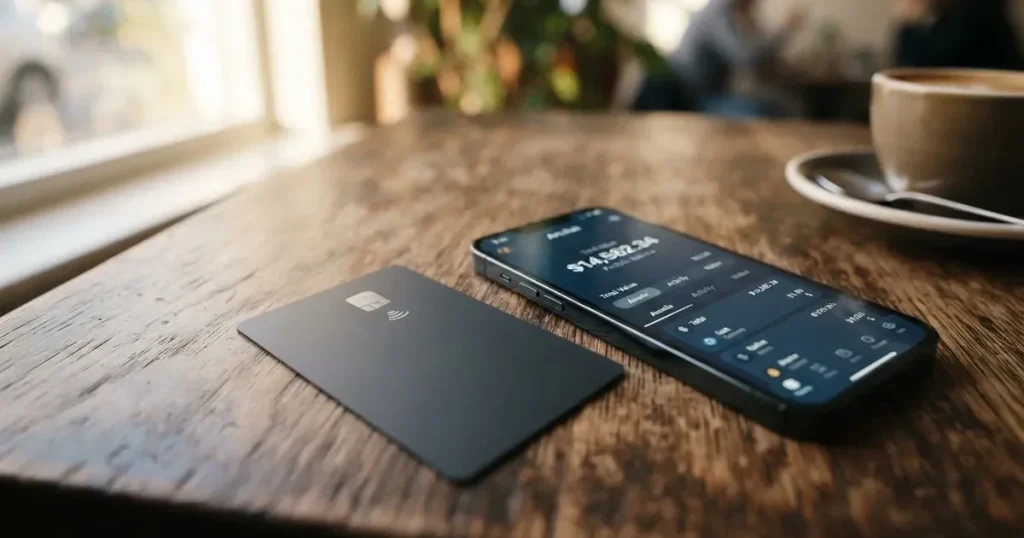
The PayitFast card is a Visa you load from a crypto wallet you already control, and the pitch that makes it interesting is simple: up to 10% of what you spend comes back as USDT, paid to your wallet straight away. That is a genuinely generous headline for a category where the norm is a percentage here and a fee there. But here is the tension running through everything I checked: the card’s own public pages, as far as I could read them, do not publish the numbers you would need to judge it. No fee schedule, no spending limits, no card currency, no list of countries. Third parties fill some of those gaps, and where they do I say so plainly rather than passing their figures off as the card’s own.
My score is 6.9 out of 10. That is not a rejection. It is a card with a good structure and an unusually quiet public price list, and those two things pull in opposite directions.
Who this suits: you already keep your crypto in a self-custody wallet, you are comfortable sending a stablecoin transfer to a network you have chosen yourself, you spend more than a token’s worth every month, and you are comfortable with a young programme whose fee page you will have to read yourself. Who it does not suit: anyone who needs the card’s cost before signing up, anyone who wants to be sure where the money is safeguarded in plain language, anyone who needs a physical card next week, and anyone who plans to withdraw the cashback.
The conditions described here are current as of October 28, 2026.
| Criterion | Mark | Why |
|---|---|---|
| Who can get it | 8 / 10 | Officially “varies by jurisdiction and is subject to regulatory approval”; no country list published. Unofficial figures say 189 countries. |
| Cost | 4 / 10 | Not disclosed officially. Unofficial: 3% annual fee, and 2.2% on transactions not in USD. |
| Top-up options | 8 / 10 | Your own wallets — MetaMask, Trust Wallet, Binance Wallet or any — with stablecoins, USDT, Bitcoin and Ethereum accepted. Networks not named. |
| Reliability and complaints | 8 / 10 | Silverleaf E-Money Services Ltd., FINTRAC MSB registration M23026009, supervised by the Bank of Canada under the RPAA. No user complaints found. |
| Everyday use | 7 / 10 | Virtual Visa, Apple Pay and Google Wallet; ATMs mentioned without conditions; physical card only by waitlist. |
| Total | 6.9 / 10 | Strong on access and rewards, weak on published pricing. |
Will they give you the card?
Short answer: probably, if your country is on their verification list — but the card itself will not tell you which countries those are.
Here is the official wording: availability “varies by jurisdiction and is subject to regulatory approval.” Certain countries may be temporarily unavailable, and if your country is missing from the verification list, onboarding is unavailable there. That is the whole of it. There is no published country list, no supported-nations table, nothing you can read before installing the app to find out whether you qualify. Unofficial figures — and I want to be careful with these, because they are not confirmed by the card — put availability at 189 countries, which is close to universal. Take that as a hint rather than a promise.
What that means in practice is that the question “is PayitFast available in my country?” has a bad answer. The honest answer is: install the app, start verification, and the app will tell you. That is a reasonable design if the alternative is a static list that goes stale, and an irritating one if you are trying to decide between cards before downloading anything.
Worth knowing about the company’s standing, because it is stronger than a typical new crypto brand. The operator is Silverleaf E-Money Services Ltd., trading as PayitFast, incorporated in British Columbia, Canada. It holds FINTRAC money services business registration M23026009 and is supervised by the Bank of Canada under the RPAA, Canada’s regime for payment service providers. Unofficial reporting names Third National Bank as the Visa issuer; the card does not state its issuing bank officially, which is a gap worth noticing given how many people look for exactly that.
For background: a card like this is usually not issued by the brand you have downloaded. The card network — Visa or Mastercard — routes the payments and sets the rules; the issuer is the bank or licensed e-money institution holding the programme; the crypto brand is frequently only the programme manager and the front end. Knowing which of the three you are dealing with tells you who to contact when something goes wrong.
How to get it
The honest answer is that getting it is easy; getting a physical one may not be.
Identity verification happens inside the app. Documents are rejected if they are expired, damaged, unclear, if the details on them do not match, or if the country is unsupported. Here is the part that catches people out: support cannot manually approve or override a rejection. There is no appeal, no manual review, no “send us a better photo and a human will look at it.” The same list is given for rejection reasons — expired or damaged or unclear document, a details mismatch, an unsupported country. What the card does not state is which document types qualify, whether proof of address is needed, or what age threshold applies.
That combination — a modest list of rejection reasons, no override — is where most of the friction will be. In this category generally, customer due diligence is not a formality. Regulated firms must verify identity, assess risk, keep monitoring transactions and report suspicious activity. In the EU the standard covers name, address, date of birth, nationality, identity documents, a sanctions check, the purpose of the relationship, and whether you are a politically exposed person. In the US the customer identification programme requires name, date of birth, address and an identification number, with electronic systems also checking proof-of-address documents. If due diligence cannot be completed, rules require the institution to withhold the transaction or the relationship, and where necessary close an existing one. That is why accounts freeze pending documents — it is the system working, not a punishment.
One thing specific to people in a hurry: nationality is recorded and screened separately from residence, because sanctions screening and issuer risk policy often apply to citizenship and country of birth, not only to your address. So a supported residence with an ID from a restricted region is a different case from a supported residence with a supported ID.
The card itself: Visa, virtual by default, with a physical card on a waitlist only. Delivery times and physical card details are not stated. Card currency is not stated either — which matters more than it sounds, and I will come back to it in the cost section.
The apps: iOS (App Store ID 6764277245) and Android (co.payitfast.app), plus a web app at app.payitfast.com. When I checked on 2026-10-21 the store pages would not load, so store ratings were not retrievable — meaning I cannot tell you what users say about the apps, and you should treat any rating you see as something to look at for yourself.
Fees: what this card really costs you
Here I have to be blunt, because this is the section you care about and the card is the thinnest. The cost of this card is not stated on the pages I read. No annual fee, no monthly fee, no conversion fee, no foreign-exchange fee, no ATM fee, no limits. If you are deciding between PayitFast and something else, you cannot do it on the card’s own numbers, because they are not published there.
What third parties report — unofficial, and not confirmed by the card:
| Item | What the card says | What third parties report (unofficial) |
|---|---|---|
| Annual fee | not stated | 3% annual fee (DefiLlama, Oct 2026) |
| Monthly fee | not stated | not stated |
| Crypto conversion fee | not stated | 0.75% per transaction (card.md, earlier check) |
| Non-USD transaction fee | not stated | 2.2% (DefiLlama, Oct 2026) |
| ATM withdrawal fee | “withdraw at any contactless ATM” — conditions not stated | not stated |
| Spending limits | not stated (described as collateral-based in card.md) | not stated |
| ATM allowance | not stated | not stated |
| Card currency | not stated | not stated |
| Tiers | Master Terms and Elite Terms exist; contents not retrieved | not stated |
DefiLlama itself notes that the pricing page differs from the card agreement. That is a warning worth taking seriously: the two official-looking documents on the site do not agree with each other. If a number ever conflicts, the card agreement is the document that binds you.
Let me put the unofficial numbers side by side and let you judge. A 3% annual fee on a card with no monthly component, plus 0.75% per conversion, plus 2.2% on anything not in USD. If you buy something priced in euros with a card that converts, you could be paying well over 2.2% once conversion is counted — or, if the 0.75% and the 2.2% do not stack, rather less. The card does not say. That ambiguity is the whole problem.
Now three everyday payments, because percentages only mean something against actual spending.
A coffee at 4 USD, paid from a USDT balance, no conversion needed beyond the top-up. Whatever the annual fee works out to per purchase on a monthly volume is yours, plus any conversion the card does. The conversion question is the one that stays unanswered.
A meal at 40 EUR on a card funded in dollars. This is the case the 2.2% non-USD fee, if it exists, would hit. On 40 EUR that is roughly 0.90 in fees before any conversion cost is added. It is not catastrophic. It is also the kind of cost that a person who shops abroad pays every single time without noticing until they look at a statement.
A 300 USD monthly online subscription. Here the annual fee matters most, because if the 3% figure is real, a 3,600 USD annual spend would carry around 108 in annual charges, and if any of that spend is in another currency, more on top. Whether that is acceptable depends entirely on how much you would otherwise pay for the cashback.
Which brings me to the cashback, because it is the reason to stay in the maths at all. Up to 10% back on eligible transactions, paid in USDT to the PayitFast wallet, “immediately.” Two things you need to know before counting on it: which transactions are eligible is undefined on the pages I read, and the amount depends on which eligible asset you spend. And the cashback is non-withdrawable — it is usable on eligible card transactions only. So it is not money you can take out; it is a discount on the next thing you buy. If you spend outside the eligible set, “up to 10%” can be zero.
Top up: where the money comes from
Top-ups come from your own wallet, not from a bank. MetaMask, Trust Wallet, Binance Wallet, or any wallet you like — plus stablecoins, USDT, Bitcoin and Ethereum. That breadth of sources is the genuine strength here, and it is why I marked top-up options so high. You are not waiting for a transfer from an exchange; you are sending from a wallet you already control.
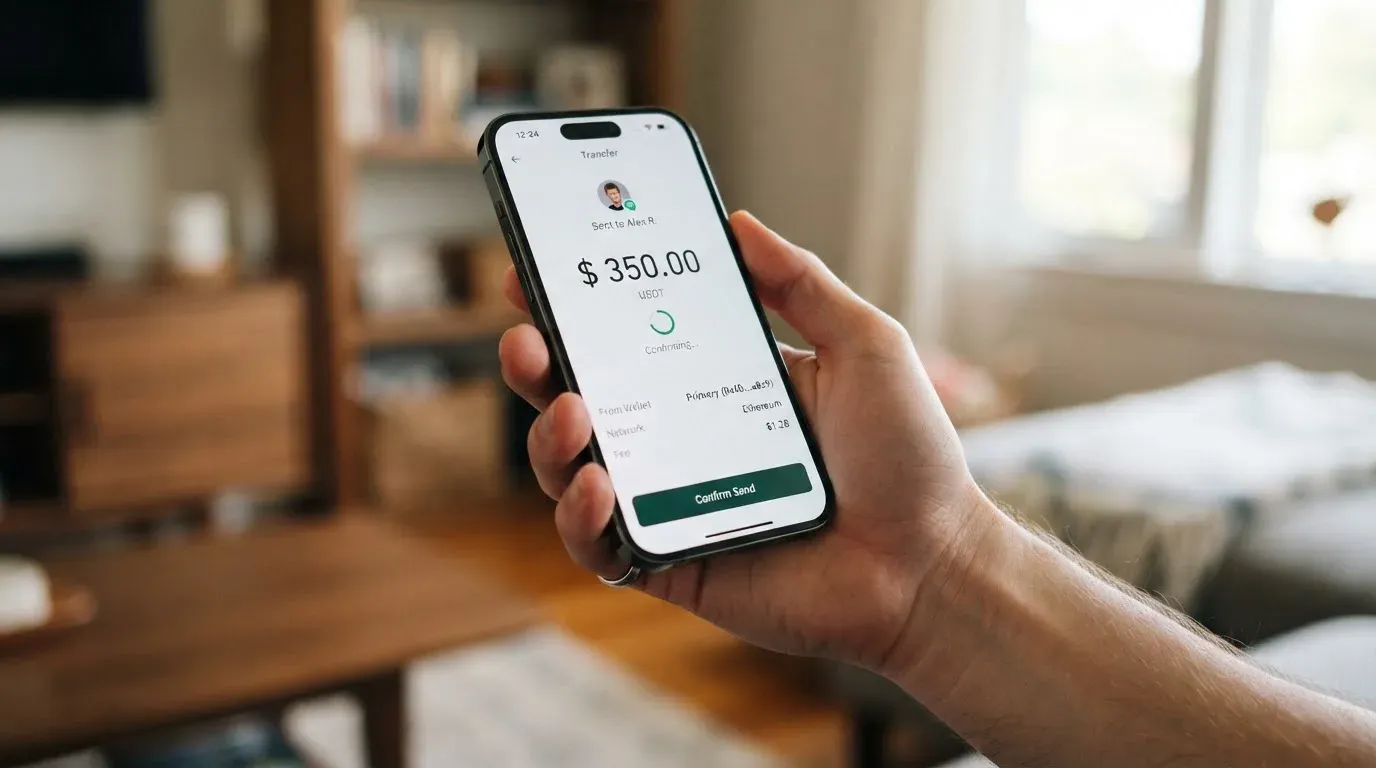
What the card does not state is the networks. This is the single most consequential omission on the whole page, so let me explain why it matters.
Sending USDT is not one action but many, depending on which chain it travels on. Ethereum, Tron, Solana, Polygon, Avalanche, Arbitrum and others all carry a version of it, and the addresses are not interchangeable. Send on the wrong network, or to an address belonging to a different network, and the transfer can simply be lost — or need manual support recovery with no guarantee. Blockchain transfers are irreversible; the network cannot reverse them. On Ethereum, fees are paid in ETH, so a wallet holding USDT and no ETH cannot send at all. Tron prices fees with bandwidth and energy and often burns TRX. Circle stopped supporting USDC on Tron in February 2024, so USDC over TRC20 is not a native option. And on-chain network fees for your deposit are charged by the blockchain, not by the card provider — so they are real money you pay on top of everything else.
In practice: read the deposit instructions inside the app, and confirm the network and address before you send. That is not a workaround for anything; it is the ordinary care the technology requires. If a deposit does not appear, support handles it via the transaction ID — pass your TXID — so keep it.
Two more funding details worth knowing. Withdrawals can be held pending for compliance, Travel Rule checks, network congestion, or large-amount review. And promotional credits, referral rewards, cashback and bonus funds cannot be withdrawn at all. Withdrawal fees are not stated.
A note on the stablecoins themselves, since these are the assets you will hold: Tether’s USDT and Circle’s USDC are US-dollar-pegged, and the BIS put about 90% of stablecoin market capitalisation in those two. Circle says USDC is redeemable 1:1 for USD and 100% backed by cash and cash equivalents, mostly in an SEC-registered government money market fund, with monthly reserve attestations. Circle lists USDC as natively supported on 38 networks as of 16 September 2026. But stablecoins can depeg: TerraUSD collapsed in May 2022, and USDC temporarily lost its peg in March 2023 during the US banking crisis. They are not banks, and they are not censorship-proof — Tether says it disables tokens in wallets on the OFAC sanctions list and has frozen funds tied to illicit activity.
Paying with it every day
Adding the card to Apple Pay or Google Wallet works, and in practice that is how you will use it most of the time — the virtual card number is replaced by a device-specific token in the Secure Element, never stored on Apple’s servers, and each payment carries a one-time dynamic security code. That is a genuinely good arrangement for daily use: a leaked card number is far less useful than a leaked number would be without tokenisation.
You can also set the issuer to restrict a tokenised number — blocking it on magnetic stripe, phone or website use, for instance. Whether PayitFast offers you that switch is not stated, and neither are blocked merchant categories.
Where cards like this usually meet friction is worth knowing before you blame the card. A merchant category code is a four-digit number classifying a business; MCC 7995 covers gambling, and many issuers block it by policy rather than law, with the list varying by issuer. Address Verification Service compares the numeric parts of a typed billing address against issuer records, is mainly offered in the US, Canada and the UK, and is generally unavailable for foreign-issued cards — which can cause declines. And some merchants decline prepaid or foreign card numbers outright, because a BIN lookup reveals the card type and the issuing country. That is why a card issued in one country can look foreign to a shop in another, and why “it worked everywhere yesterday” is not a promise about tomorrow.
For online payments there is 3-D Secure: the issuer assesses risk and either approves frictionlessly or challenges you with a one-time code or a biometric. Visa’s brand is Visa Secure, Mastercard’s is Identity Check.
Two other everyday details. Withdrawals at “any contactless ATM” are offered, but the fee and the allowance are not stated — so I cannot tell you what a 100 USD ATM withdrawal costs you. And a declined authorisation can leave a hold on funds that stays for several days, typically up to seven.
Dispute handling — chargebacks — is not stated on the pages I read. That is not nothing. A chargeback is a refund the issuer orders to settle a dispute, with reason codes for fraud, duplicate billing or goods not received. US debit card reversal rights come from Regulation E and credit card rights from Regulation Z, and prepaid-card coverage varies and should not be assumed. With a card whose dispute policy is not published, you are relying on the issuer’s default rather than on anything the brand has committed to.
On taxes, one general point and no advice: the IRS treats digital assets as property, so exchanging them for goods, services or dollars generally produces a taxable gain or loss. For personal holdings that is a capital gain or loss, short-term if held a year or less, measured in local fiat currency at fair market value on the date of the transaction. Each card payment funded from crypto may therefore be a separate disposal. How that applies to your situation is a question for a professional in your country, not for a card review.
What can go wrong
The most likely problem is not a hack; it is a hold. The card’s own position is that cards can be restricted for repeated declines, unusual activity, or compliance reviews. On top of that, the security setup is a self-custody wallet linked to the card under a collateral model — which means the balance backing your card lives in a wallet only you control. Nobody can reverse a mistaken transfer, a lost seed phrase, or a phishing attack for you. A seed phrase of 12 to 24 words is an unencrypted form of the private key; anyone who obtains it can restore the wallet and spend the funds, and clipboard-hijacking malware that swaps a copied address is a real and common theft route.
Two mitigations are not stated: whether 2FA is available in the app, and whether you can freeze the card instantly. Those are standard safeguards in this category — app-based 2FA, instant freeze, spending limits, 3-D Secure, tokenised wallets — and their absence from the public pages is worth chasing before you fund the card.
The counterparty risk sits on the other side. This is a young company in a young category, and the category has a history: WaveCrest, a Visa card issuer that supplied crypto card brands, was suspended by Visa in Europe in 2018, closing all WaveCrest-issued Visa programmes. Visa terminated its global agreements with FTX on 13 November 2022 and the FTX US debit card was wound down by its issuer. Programme closures typically run in an order you should expect: a notice period, then loading and spending stop, then a request that you withdraw remaining balances. One 2026 closure reported by a secondary source ended new loads on 8 July 2026 and stopped spending on 8 August 2026 — a single unconfirmed source, so treat it as a shape rather than a fact, but the shape is what matters.
Where you are protected also depends on the licence. An electronic money institution must safeguard customer funds, by segregating them in dedicated accounts or insuring them — but such funds are not the same as bank deposits and may not sit under a deposit guarantee scheme. In the EU that is the e-money framework; since MiCA (Regulation (EU) 2023/1114) took legal effect in June 2023, the stablecoin rules applied from 30 June 2024 and the crypto-asset service provider rules from 30 December 2024. Under MiCA, e-money tokens may be issued only by a credit institution or an electronic money institution, and providers operating under national law have a transitional period only until 1 July 2026 or until they receive or are refused authorisation, whichever comes first. A card is regulated separately from the crypto side — it is a payment service — so a crypto card often rests on two licences, and you would be looking at both.
In the US, FinCEN guidance treats administrators and exchangers of convertible virtual currency as money transmitters, while ordinary users buying goods are not.
On complaints, my finding is a quiet one: no user complaints found, and no Trustpilot page for PayitFast. Support is a Telegram bot at t.me/payitfastbot, plus email replies from a Support Team. News and roadmap items — Local QR Payments, Send Money, Business — are marked “Soon”, and no dated announcements are stated. So the absence of complaints here is not a quality signal; it is more likely a young footprint.
What to take instead
Four alternatives came up in the same category. Here is how they compare on the things this review found missing from PayitFast — published pricing, stated eligibility, and a physical card you can actually hold.
| Card | Score | Cost, as published | Who can sign up | Physical card |
|---|---|---|---|---|
| PayitFast | 6.9 / 10 | Not stated officially; unofficial 3% annual, 0.75% conversion, 2.2% non-USD | “Varies by jurisdiction”; no country list | Waitlist only |
| MetaMask | 7.1 / 10 | Virtual free, no annual or maintenance fee; Metal $199/year | 45 listed countries/territories; US/UK temporarily closed per FAQ | Metal, pre-orderable after Virtual approval |
| TokenPocket | 5.8 / 10 | Small portion of an NFT creation fee; “no additional fees” otherwise | Visa debit for a list of European countries; Mastercard debit for Australia, Canada, Hong Kong, Japan, Taiwan, New Zealand, Singapore, South Korea, UK and others | Fiat24 cards virtual only |
| KAST | 6.1 / 10 | Standard 0 USD; Premium 1,000 USD/year; Private 10,000 USD/year, billed annually upfront | Residence list shown at KYC, not published; citizenship and ID also count | Yes, virtual and physical |
MetaMask scores highest here at 7.1, and the reason is publication. Its pricing is explicit: the virtual card is free with no annual or maintenance fee, the Metal card is $199/year, there is a “minimal fee for each transaction” with the amount in a linked fee table, no additional MetaMask fees, and no foreign transaction fee — it uses the Mastercard rate. Eligibility is stated too: 45 listed countries and territories including Andorra, Argentina, Brazil, Canada, Mexico, Germany, France, Spain and Uruguay, with other regions on a waitlist, proof of residency required, and US and UK sign-ups temporarily closed. Cards are Mastercard, one per user, issued by Monovate with Crypto Life as card provider. Spending draws on the connected wallet across Linea, Base, Monad and Solana, with mUSD, wETH, EURe, GBPe, USDC and USDT named. Cashback in mUSD is 1% on Virtual and 3% on Metal for the first $10,000 spent, then 1%. Its own framing is helpful for PayitFast readers: “ineligible regions limit sign-ups, not spending.”
TokenPocket at 5.8 is the cheapest to read and the vaguest to use. Its Visa debit covers a list of European countries and territories — Germany, France, Spain, Switzerland among them — and its Mastercard debit covers Australia, Canada, Hong Kong, Japan, Taiwan, New Zealand, Singapore, South Korea, the UK and others, with the Americas “planned for Q2 2025”. Cards run on Arbitrum, with balances in EUR24 and USD24, and Fiat24 cards are virtual. On cost, a small portion of an NFT creation fee is partly covered by TokenPocket, and “apart from these, TP Card does not charge any additional fees” — but a 1% fee is charged when depositing cryptocurrency into the card, to be refunded later via rewards or reduced transaction fees. The 1% is the point to hold on to: it is stated, which is more than PayitFast offers, and its refund mechanism is vague.
KAST at 6.1 is the most expensive and by far the most transparent, which makes it the useful contrast. Annual membership is 0 USD for Standard, 1,000 USD for Premium and 10,000 USD for Private, billed annually upfront with no monthly option; an extra virtual card is 2 USD, a Standard physical card has a 0 USD card fee plus 40 USD delivery, and there is a 1 USD/month inactivity fee after 12 months. What it does publish is the transaction-level detail: stablecoin top-up 0%, card spend in USD 0%, transaction fee 0%, Apple and Google Pay 0%, a non-USD FX fee of 0.5%–1.75% depending on residence country, transaction country and card programme, 0.10 USD on non-USD transactions under 25 USD, and 0.50 USD for a declined transaction on insufficient balance. Funding is USDT, USDC, PYUSD and RLUSD, with USDT and USDC on Ethereum, Solana, Polygon, Arbitrum and TRON — and its own Terms say acceptable tokens are “currently USDT and USDC”, which conflicts with the PYUSD and RLUSD in the app. Cashback is USD: 1.5% on the first 2,000 USD/month for Standard, 2% on the first 10,000 for Premium, 3% on the first 40,000 for Private. Note that KAST’s eligibility is also unpublished — the country list appears only at KYC, and its own words cover the awkward case: “if your country isn’t listed, it means KAST is not available there.”
My read across all four: if you want to know what you are paying before you commit, MetaMask and KAST publish it and PayitFast does not. If you want a card that spends straight from a self-custody wallet with no membership ladder, PayitFast and MetaMask are the closest fit. If your country is not on a published list, you will be finding out at KYC with either card — that is the category’s weak spot, not one brand’s.
Who I would recommend it to
To someone who already holds crypto in MetaMask, Trust Wallet or Binance Wallet, knows which network they are sending on, spends in dollars most of the time, and wants USDT cashback that arrives immediately. For that person the card does something real: it puts a Visa number in a self-custody wallet and pays a meaningful share of spend back into it. The 8/10 on top-up options and 8/10 on reliability and complaints are not politeness — the funding model is genuinely flexible and the company is genuinely regulated in Canada.
I would not recommend it to someone who is choosing on price, because the price is not on the table. If your decision hinges on what a year of this card costs, you cannot make it from the card’s own pages, and DefiLlama’s note that the pricing page disagrees with the card agreement is a reason to read the agreement rather than to trust the summary. I would also hesitate for anyone planning to withdraw the cashback, anyone who needs a physical card on a known date, anyone who cannot handle a frozen withdrawal pending a Travel Rule or large-amount review, and anyone for whom losing a seed phrase would be unrecoverable — that last one applies to any self-custody wallet, but the collateral model makes the connection to the card direct.
Two things to check before you fund it, in this order: read the card agreement and the fees schedule together, since they are reported to differ; and read the deposit instructions in the app for the network, since the networks are not published. Everything else on this page I could verify.
Frequently asked questions
What is PayitFast card?
PayitFast is a Visa payment card funded from a crypto wallet you control rather than a bank account. It is operated by Silverleaf E-Money Services Ltd., incorporated in British Columbia, Canada, with FINTRAC registration M23026009 and supervision by the Bank of Canada under the RPAA. You top up from MetaMask, Trust Wallet, Binance Wallet or any wallet, and the card spends that balance.
How does the PayitFast card work?
You send stablecoins, USDT, Bitcoin or Ethereum from your own wallet to the card, and it loads a balance the Visa spends. Payments are virtual by default, with Apple Pay and Google Wallet supported. The card pays up to 10% back on eligible transactions in USDT, immediately. Which transactions count as eligible, and which networks to send on, are not stated publicly.
Is PayitFast a bank?
No — not on the evidence of its public pages. It describes itself as an e-money services company under Canadian regulation and supervision by the Bank of Canada under the RPAA, which is the regime for payment service providers, not a deposit-taking bank. The issuing bank is not stated officially; third parties report Third National Bank. Card programmes like this often rest on two licences.
Is the PayitFast card available in my country?
Possibly, but you cannot tell from the card. Availability officially “varies by jurisdiction and is subject to regulatory approval,” certain countries may be temporarily unavailable, and onboarding is unavailable where your country is missing from the verification list. No country list is published. Unofficial figures say 189 countries, which is not confirmed by the card. The practical answer comes when you start verification in the app.
Does the PayitFast card require KYC?
Yes. Identity verification happens in the app, and documents are rejected if expired, damaged, unclear, if details do not match, or if the country is unsupported. Support cannot manually approve or override a rejection. Document types, proof of address and the age threshold are not stated on the pages reviewed.
How much does the PayitFast card cost?
The card does not publish its fees: no annual, monthly, conversion, foreign-exchange or ATM fee is stated, and no limits either. Unofficial figures report a 3% annual fee, 0.75% per conversion and 2.2% on non-USD transactions, and note that the pricing page differs from the card agreement. Read the agreement before you rely on any of those numbers.
How do I top up the PayitFast card?
You transfer from a self-custody wallet — MetaMask, Trust Wallet, Binance Wallet or any other — using stablecoins, USDT, Bitcoin or Ethereum. The networks are not stated, which matters: sending on an unsupported network or to another network’s address can lose the funds, since transfers are irreversible. If a deposit does not appear, contact support with your TXID.
Is the PayitFast card safe?
It carries real, published risk: cards can be restricted for repeated declines, unusual activity or compliance reviews, and no user complaints or Trustpilot page were found. The card is tied to a self-custody wallet, so key loss and phishing are on you. Whether 2FA and instant card freeze exist is not stated. The rewards are attractive, but eligibility and amounts are undefined and cashback cannot be withdrawn.
Can I use the PayitFast card at ATMs?
The page says you can withdraw at any contactless ATM. The fee and the allowance are not stated, so what a withdrawal costs you is genuinely unknown. Note too that withdrawals can be held pending compliance, Travel Rule, network congestion or large-amount review, and that a declined authorisation can leave a hold on funds for up to seven days.
Is the PayitFast card worth it?
For someone already holding crypto in a self-custody wallet who spends mostly in dollars and can wait on a waitlist for physical plastic, the up-to-10% USDT cashback is a genuine draw and it arrives immediately. For everyone else, the absence of published fees, limits, card currency and country list makes the card hard to choose on the merits. Compare it with MetaMask or KAST, which publish what they charge.
Choosing a wallet card – cryptocardadvisor
Content created by the «cryptocardadvisor» team