
A U.S. Bank-issued Visa that spends a USDC or USDT balance wherever Visa is taken
 Available in US
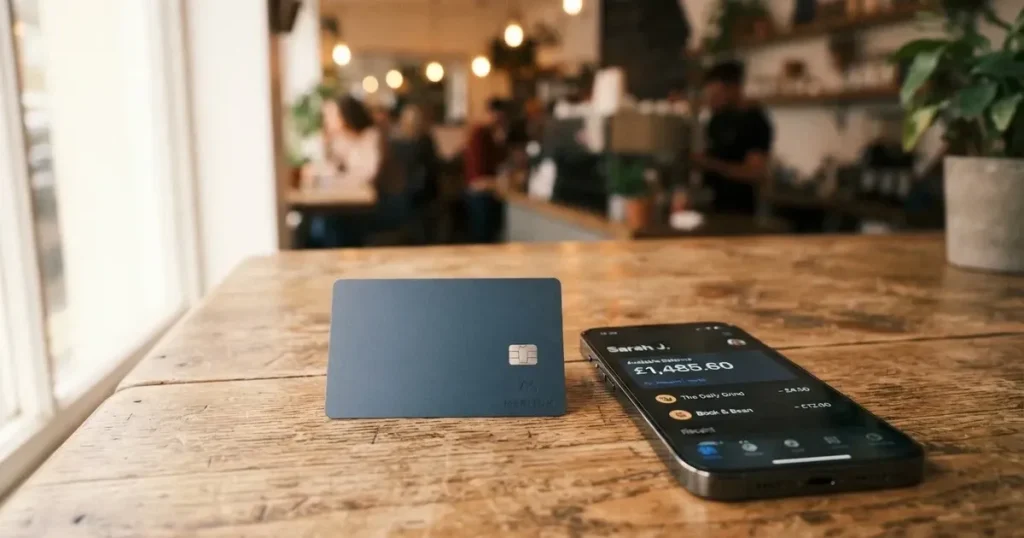
DPT is a payment card that turns a stablecoin balance into everyday spending. The card is a Visa, issued by U.S. Bank, and the brand behind it is DPT (HK) Limited, a Hong Kong company that holds a trust or company service provider licence (TCSP TC010834) under Hong Kong’s anti-money-laundering ordinance. When you pay, the system converts your USDC or USDT at the moment of the Visa transaction, so there is no pre-loaded fiat wallet to top up separately. Custody of the assets sits with BitGo, a qualified custodian, and the app lets you freeze the card instantly if it is lost or stolen.
Conditions are current as of October 28, 2026.
I spent time with the card’s public pages, terms and help-centre articles. The picture that came together is of a card aimed at a fairly specific reader: someone who already holds USDC or USDT, wants a real Visa rather than another crypto-only app, and is comfortable with the card being unavailable in the United States, Canada and a list of comprehensively sanctioned jurisdictions. If that sounds like you, the rest of this review walks through who can get the card, what it costs, how to fund it, what daily use looks like, and what to watch out for.
Verdict
DPT scores 8.5 out of 10. It is not trying to be a rewards-heavy everyday card; it is a clean way to spend a stablecoin balance through a major-bank-issued Visa, and on those terms it does its job well. The two things that hold it back from a higher mark are the everyday-use score (7 out of 10), which reflects the missing information on ATM fees, physical-card shipping, and the exact list of mobile-wallet compatibility, and the fact that several figures a reader will want (card issuance fee, monthly fee, spending limits) are not stated on the public pages and only appear inside the app after verification.
| Criterion | Mark | Why it scores there |
|---|---|---|
| Who can get it | 9 / 10 | Spending accepted in “150+ countries” wherever Visa is taken; services not offered to persons in the United States, Canada or comprehensively sanctioned jurisdictions |
| Cost | 8 / 10 | USD transactions free, other currencies 0–2.00% FX, no DPT deposit fee; issuance and monthly fee amounts are not disclosed publicly |
| Top-up options | 9 / 10 | USDC or USDT live on Ethereum, Polygon, Tron, Solana; Base, BNB and fiat deposits are on the roadmap |
| Reliability and complaints | 9 / 10 | Operator licensed in Hong Kong, card issued by U.S. Bank under Visa, custody with BitGo; no complaints found in public sources |
| Everyday use | 7 / 10 | Virtual card works with Apple Pay and Google Pay, physical card has chip and contactless; ATM fee and wallet availability on the physical card not stated |
| Total | 8.5 / 10 |
The card suits stablecoin holders who want a U.S. Bank-issued Visa, can pass KYC outside the United States and Canada, and are happy to pay foreign-currency markups in exchange for spending USDC or USDT anywhere Visa is taken. It is the wrong choice if you want cashback, if you need a card that works inside the United States or Canada, or if you want every fee stated up front before you sign up.
Who can get the card
DPT says spending works in “150+ countries”, which is an acceptance claim (wherever Visa is taken) rather than an eligibility claim. Who can actually be issued the card is narrower. The terms specify that services are not offered to persons located in, incorporated in or resident of the United States or Canada, and to persons in comprehensive-sanctions jurisdictions. If you are reading this from the United States or Canada, the card is simply not available to you regardless of citizenship details.
For everyone else, eligibility is decided in the app. DPT runs standard KYC: you must be at least 18, hold one DPT account per individual, and provide a government-issued ID plus a live selfie. The Learn guide mentions a passport or national ID plus a proof of address (a utility bill or bank statement no more than three months old); the in-app flow does not always ask for the address document at the start. The two pages do not fully agree, so be ready to provide address evidence if asked. Verification is usually minutes, but the help centre says it can take up to 24 hours. KYC is required before you can get the card, deposit at full capacity, or make payouts.
A common reason for failed KYC on this kind of card is an “unsupported jurisdiction”, which is a polite way of saying the country you are in is on DPT’s exclusion list. Blurry or expired IDs and mismatched personal information (a name that does not match your ID exactly, for example) are the other typical reasons. Spending limits are not stated publicly; they appear in the app after verification, with a higher tier unlocking larger limits.
If you are weighing DPT against a card that explicitly lists the countries it serves, the alternatives section below describes three of them.
How to get the card
The application is in the DPT app. You download it from the Apple App Store or Google Play; an Android APK is also published at download.dpt.xyz. I searched the public app stores for ratings and a store listing on 21 October 2026 and could not locate one, so the app’s star rating is not something I can quote. That is a gap, and it is worth checking yourself on your device before you commit.
Inside the app the flow is: download, create an account, complete identity verification, then choose between a virtual card or a physical card. The virtual card is provisioned for Apple Pay and Google Pay; the physical card is a chip-and-contactless Visa. Card currency is not stated outright on the public pages, but USD transactions are described as free of FX fees, which strongly implies the card is denominated in USD.
Shipping times, cost and replacement cost for the physical card are not stated on the public pages. This is a small but real gap: you may find the figure only at checkout, or only after you begin the application. If that matters to you, the app is the place to confirm.
Fees: what it really costs
The fee schedule for the card lives in the app rather than on the public website. Issuance and monthly-fee amounts are not stated publicly, and no monthly fee appears in the text I read. That makes a written review slightly awkward, because the headline numbers a reader expects are not all there to be quoted. What I can give you is the per-transaction fee structure and a few worked examples, because those are disclosed and they tell you most of what you need to know.
| Fee or limit | What it is |
|---|---|
| Card issuance | Not stated publicly (shown in the app) |
| Monthly fee | Not mentioned in the public pages |
| USD transactions | Free of FX fee |
| Foreign-currency transactions | 0% to 2.00% FX fee depending on currency |
| Small transactions ($25 or less) | $0.10 per transaction (currently waived as a limited-time promotion) |
| Declined authorisations | First 3 per calendar month free, then $0.50 each |
| DPT deposit fee | None |
| ATM withdrawal | 2% of the amount, plus 0% to 1.75% FX surcharge depending on location, plus any ATM operator fee |
| Free ATM allowance | Not stated |
| Spending limits | Not stated publicly (shown in the app after verification) |
A few everyday payments make the table easier to read.
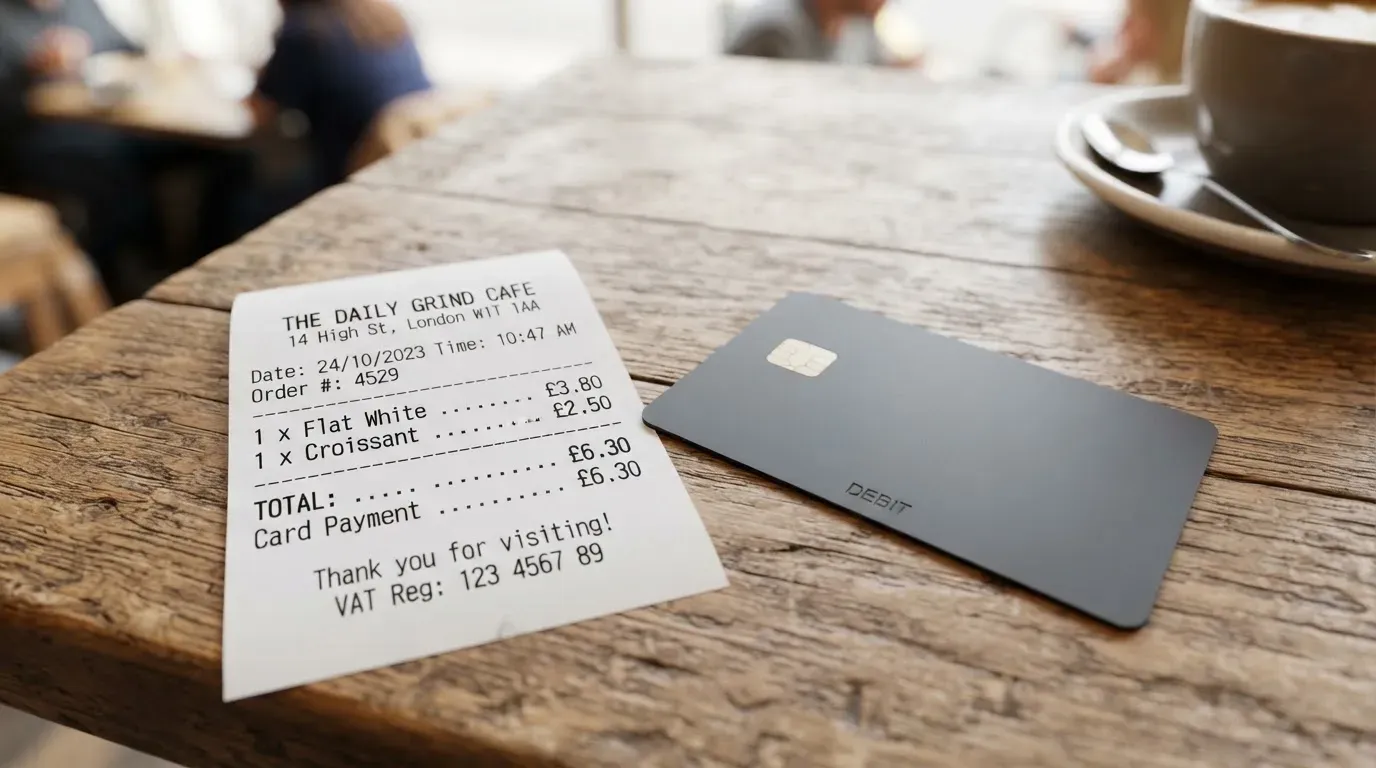
Coffee in a local café, paid in USD. You hand over a card denominated in dollars and the merchant charges in dollars, so the FX line is 0%. There is no DPT fee on a USD transaction. The small-transaction $0.10 fee applies because the coffee is under $25, but it is currently waived as a limited-time promotion, so this costs you nothing on the card side. You still pay the gas fee on the blockchain when you top up, not at the till.
A €40 restaurant bill while travelling. The Visa network converts euros to USDC (or USDT) at the transaction’s exchange rate, and DPT adds its own FX fee. The card terms put that fee at 0% to 2.00% depending on the currency; for a euro transaction the realistic case is somewhere in that range rather than 0%. If your bill is over the $25 threshold the small-transaction fee does not apply. Add the cost of the original stablecoin top-up gas on top, and that is the all-in number.
A cash withdrawal abroad. This is the most expensive everyday use case on the card. The headline ATM fee is 2% of the amount, plus a 0% to 1.75% FX surcharge depending on where you are, plus whatever the ATM operator itself charges. There is no free allowance. A $200 cash withdrawal on a trip could easily run to $7 or $8 in combined fees before the operator’s own charge. If you plan to use the card for cash regularly, this is the number to budget for.
Two small footnotes that are easy to miss. The $0.10 small-transaction fee is currently waived as a limited-time promotion, so small payments are free at the moment; it is not dated, so it could be reintroduced. And if a transaction is declined, the first three per calendar month are free, but the fourth and beyond are $0.50 each. Declined authorisations can also place a temporary hold on funds that lasts several days, which is a category-level behaviour rather than a DPT-specific one.
How to top it up
DPT runs a single-balance model. The card balance and the account balance are the same thing: you hold USDC or USDT, and when you pay the conversion happens at the moment of the Visa transaction. There is no separate fiat wallet to top up, and no second step of “load the card” before you can spend.
Live networks for both USDC and USDT are Ethereum, Polygon, Tron and Solana. The minimum is 1 USDC or USDT on Ethereum, Polygon and Solana, and 10 USDT on Tron. Funds are credited about a minute after the transfer confirms. DPT does not charge a deposit fee; you only pay the blockchain’s gas from your own wallet, and the gas figure depends on the network you choose. Circle no longer supports USDC on Tron, so if you want to send USDC you cannot use the Tron network; USDT on Tron is the alternative for that rail.
Roadmap items, not live at the time of writing, include Base and BNB support, and fiat deposits by card or bank. The roadmap is undated, so do not assume any of these are imminent. If you need to fund from a bank today, the supported route is to convert fiat to stablecoin elsewhere and transfer in.
There is also a withdrawal side. Crypto withdrawal is 0.1% commission from DPT plus gas (around $2.00 on Ethereum, $1.00 on Polygon, $1.00 on Solana, $5.00 on Tron). Bank payouts exist in 100+ currencies across 80+ corridors, each with its own provider fee: India 0.30%, Nigeria 0.80%, Vietnam 0.60%, Philippines 0.50%, Brazil 0.45%, Mexico 0.50%, Indonesia 0.55%, Thailand 0.40%, Europe SEPA Instant 0.35%, UK Faster Payments 0.35%. What happens to a remaining balance on account closure is not stated, though the terms allow DPT to delete an account on seven days’ notice.
A practical warning that applies to any card of this kind: blockchain transfers are irreversible, and sending on a network the provider does not support, or to an address of a different network, can mean lost funds or a long support recovery with no guarantee. Always send a small test amount first, and copy the deposit address rather than typing it.
Paying with it every day
Once the card is in your wallet, everyday use is straightforward. The virtual card adds to Apple Pay and Google Pay “where available”; the physical card is a chip-and-contactless Visa you tap or insert. The mobile-wallet availability for the physical card is not stated, so if adding the physical card to your phone matters, the app is the place to check.
The card comes in two tiers, and the difference matters if you travel.
| Tier | Card | Perks |
|---|---|---|
| Oxygen | Visa Platinum | Travel accident insurance up to US $500,000, instant digital cards, member prize draws |
| Obsidian | Visa Infinite, invite-only | Insurance up to US $1.5M, 24/7 concierge, dedicated lifestyle manager, Priority Pass lounge access, DPT events; top-spending Oxygen holders are auto-upgraded |
Payouts in 100+ currencies are supported, but multi-currency balances inside the app are not stated; the practical effect is that you hold USDC or USDT, and the conversion happens at the Visa side. The card does not advertise cashback. There is a Rewards and Referral Program with referral commissions, points and elite rewards, and a separate DPT Earn product that is a stablecoin yield vault; both are outside the card’s payment function.
For disputes, the Learn guide says file with support within 60 days of the statement posting date for unauthorised charges; the Terms say 90 days from the transaction date. The two pages differ, so the safer course is to act quickly and not wait until the last day. Decisions by DPT or its Service Partners are described as generally final, and the Terms specify Hong Kong courts or LCIA arbitration in London as the forum.
Support is 24/7, with a Help Center organised into 12 categories, a ticketing system, an email ([email protected]), a Telegram channel (t.me/dpt_pay) and an X account (@DptPay). Card controls include instant freeze from the app, three wrong CVV, expiry or PIN attempts locking the card for 24 hours, and 2FA, anti-phishing and spending alerts on the help-centre checklist.
What can go wrong
The first thing a careful reader will look for is complaints. I could not find a Trustpilot page or Reddit discussions for DPT Pay, nor any third-party news post with public card-volume figures. That is encouraging in one sense and unhelpful in another: a young product with a small public footprint gives you less signal, not more, on what long-term use looks like.
The second thing to weigh is the regulatory structure. DPT (HK) Limited operates under a Hong Kong TCSP licence, the card is issued by U.S. Bank, and custody is with BitGo as a “qualified custodian” with coverage stated as up to $250M, subject to terms. The Terms are also clear that “users do not deposit funds with DPT on a custodial basis”, which sounds contradictory at first; the practical reading is that DPT arranges issuance through a Service Partner, and your assets sit with the qualified custodian, not on DPT’s own balance sheet. The governing law is Hong Kong. That mix is common for crypto card programmes and is not a red flag in itself, but it does mean disputes go to Hong Kong courts or LCIA arbitration, and you should know that before you sign up.
A few more practical risks worth naming:
- Stablecoin depeg. The card spends USDC or USDT, and even though both are dollar-pegged and most of the stablecoin market sits in these two, they are not immune to market volatility. USDC briefly lost its peg during the US banking turmoil in March 2023. If a depeg happens at the moment of a transaction, the conversion is whatever the rate is at that moment.
- Sender gas and minimums. There is no DPT fee on deposits, but you pay the blockchain’s gas. Tron is the cheapest rail, USDC is not available on it, and the USDT minimum on Tron is 10 rather than 1. Picking the right network for the right coin matters.
- Wrong network, lost funds. If you send on a network DPT does not support, or to an address belonging to a different network, the funds can be lost or stuck in support. This is a class-of-product risk rather than a DPT-specific one, but the consequences are sharp.
- No public ratings. The lack of a public app-store rating I could verify, and the lack of third-party reviews, means I am leaning on the card’s own pages. Worth noting if you like to triangulate.
- Programme closure risk. The category has examples: Visa terminated its global agreements with FTX in November 2022, and the WaveCrest programme closures of 2018 wiped out a generation of crypto Visa cards in Europe overnight. A crypto card is only as good as the issuer-bank relationship and the network’s willingness to keep it.
- Identity and tax. Each card payment funded from crypto may be a taxable disposal in your jurisdiction; the card does not do this accounting for you, and you should keep your own records.
What to take instead
If DPT is the wrong fit, the most common reasons are country, fee disclosure or the missing rewards. Three alternatives to consider, each quite different in character:
| Card | Score | Best for | Watch out for |
|---|---|---|---|
| Cardex | 5.6 / 10 | A multi-network crypto debit card with cards on Verve, Visa, Mastercard and UnionPay | App Store listing is Naira-focused; conversion rate described as “AI-Powered” with no fee percentage published |
| CardFlow | 4.9 / 10 | A quick virtual USD Mastercard aimed at Nigerian users, created in 3 minutes | Naira-and-crypto focus; fee percentages and country eligibility not stated |
| HyperCard | 4.7 / 10 | A prepaid card with USD or EUR balance, accepted in 176+ countries | No public fee schedule; card network not stated on the listing I read |
None of these is a direct DPT replacement. DPT’s specific combination, a U.S. Bank-issued Visa, USDC/USDT funding on four live networks, and an exclusion list that explicitly names the US and Canada, is a narrower product than any of the alternatives. If you are choosing on a single feature, the others may win; on the overall package, that is why DPT scores higher.
Who I would recommend it to
I would recommend DPT to a stablecoin holder outside the United States and Canada who wants a clean, bank-issued Visa, is happy to pay foreign-currency markups when travelling, and does not need cashback. The fee structure is competitive for someone whose main spend is in USD or who tops up a few times a month rather than daily, and the security model (qualified custodian, instant freeze, three-strike PIN lock) is at the level I would expect for this kind of product. The two things I would want you to do before you commit are: confirm the missing figures (issuance fee, monthly fee, shipping, your spending limits) inside the app once you have an account, and check the latest status of the roadmap items, especially fiat deposits, since those would change the daily experience materially.
I would not recommend it to a US or Canada resident (the card is not available), to someone whose main goal is rewards and cashback (this card does not advertise any), to someone who needs every fee stated up front before signing up (DPT discloses most of them but keeps a few in-app), or to anyone who plans to use cash heavily, since the ATM fee is the most expensive everyday line on the schedule.
Frequently asked questions
What is the DPT card?
DPT is a payment card that lets you spend a USDC or USDT balance anywhere Visa is taken. The card is a Visa issued by U.S. Bank, and the brand behind it is DPT (HK) Limited, a Hong Kong company that operates under a TCSP licence. The conversion from stablecoin to fiat happens at the moment of the Visa transaction, so you do not pre-load a separate fiat wallet. Custody of the assets is with BitGo as a qualified custodian.
How does the DPT card work?
You hold USDC or USDT in your DPT account, and when you pay with the card the system converts the stablecoin at the Visa transaction’s exchange rate and settles with the merchant in fiat. The card balance and the account balance are the same thing. Spending is accepted in “150+ countries” wherever Visa is taken, but services are not offered to persons in the United States, Canada or comprehensive-sanctions jurisdictions. The card comes in virtual form (for Apple Pay and Google Pay) and physical form (chip and contactless).
Is DPT a bank?
No. DPT is a Hong Kong-licensed trust or company service provider (TCSP TC010834) under the AMLO. It arranges the card programme through a Service Partner, and the card is issued by U.S. Bank. The terms are clear that users do not deposit funds with DPT on a custodial basis; the assets sit with BitGo as a qualified custodian, with stated coverage of up to $250M subject to terms.
How do I get the DPT card?
You download the DPT app from the Apple App Store or Google Play, or the Android APK at download.dpt.xyz, and complete identity verification. You need to be at least 18, hold one DPT account per individual, and provide a government-issued ID plus a live selfie, sometimes a proof of address. Verification is usually minutes and can take up to 24 hours. Card issuance and shipping costs for the physical card are not stated on the public pages, so the app is the place to confirm those before you commit.
Does the DPT card require KYC?
Yes. You cannot get the card, deposit at full capacity, or make payouts without completing KYC. The flow is a government-issued ID plus a live selfie, with a proof-of-address document sometimes requested. The most common reasons for failure are an unsupported jurisdiction (a country DPT does not serve), blurry or expired IDs, and personal details that do not match the ID. Spending limits appear in the app after verification and are higher on a higher tier.
Which countries can use the DPT card?
DPT says spending is accepted in “150+ countries” wherever Visa is taken. Eligibility for being issued the card is narrower: services are not offered to persons located in, incorporated in, or resident of the United States or Canada, or in comprehensive-sanctions jurisdictions. If you are reading this from the US or Canada, the card is not available to you. For every other country, eligibility is confirmed in the app at sign-up.
How do I top up the DPT card?
You transfer USDC or USDT to your DPT deposit address on one of the four live networks: Ethereum, Polygon, Tron or Solana. The minimum is 1 USDC or USDT on Ethereum, Polygon and Solana, and 10 USDT on Tron. Funds are credited about a minute after confirmation. DPT does not charge a deposit fee; you only pay the blockchain’s gas from your own wallet. Circle no longer supports USDC on Tron, so for USDC you must use Ethereum, Polygon or Solana.
What does it cost to use the DPT card?
USD transactions are free of FX fees, and other currencies carry a 0% to 2.00% FX fee depending on the currency. A small-transaction fee of $0.10 applies to payments of $25 or less, currently waived as a limited-time promotion. The first three declined authorisations per calendar month are free, then $0.50 each. ATM withdrawals cost 2% of the amount plus a 0% to 1.75% FX surcharge depending on location, plus any ATM operator fee. The issuance fee and monthly fee are not stated publicly; they appear in the app.
Is the DPT card safe?
The card programme has the structural pieces I look for: a U.S. Bank-issued Visa, custody with BitGo as a qualified custodian with stated coverage up to $250M, instant freeze in the app, a three-strike lock on wrong PIN, CVV or expiry attempts, and 2FA, anti-phishing and spending alerts. The terms describe Hong Kong law and LCIA arbitration as the forum for disputes, which is a known feature of Hong Kong-licensed crypto programmes. I did not find independent complaints in public sources at the time of writing, but the product’s public footprint is still small.
How do I delete my DPT account?
DPT may delete an account on seven days’ notice under the terms. To do it yourself, the app’s account or settings section is the right place; the help centre covers the steps. What happens to any remaining balance on closure is not stated on the public pages, so before you close the account it is worth checking the balance and withdrawing what you need, either as crypto (0.1% commission plus gas) or as a bank payout through one of the supported corridors.
Choosing a virtual card – cryptocardadvisor
Content created by the «cryptocardadvisor» team