
Pay3 card review: a non-custodial Visa with collateral limits and quiet fee lines
 Available in US

The Pay3 card is a Visa you load from crypto or fiat and spend like an ordinary payment card, minus one thing that catches people out: the card is collateral-based. Your spending limit is the US-dollar market value of collateral you have posted, and Pay3 says it can change that limit with or without notice — including down to zero. That single design choice shapes almost everything else about the card, from why your limit moves when the market moves to why a stablecoin deposit is safer than a volatile one.
I went through the card’s own terms, its platform terms and its published pages, and here is where I landed: Pay3 scores 6.3 / 10. It is a competent, unremarkable card with a genuinely useful non-custodial model and a card spend starting from $0.15, wrapped in fee language that is hard to price in advance and a limit system that puts you at the mercy of the collateral you choose.
The conditions described on this page are current as of October 28, 2026.
The score, and who this card is actually for
The Pay3 card suits someone who wants both a virtual and a physical Visa, is comfortable with a collateral-based limit, and already holds stablecoins they are willing to post. It suits readers who value the non-custodial model — your assets stay in your own wallet — more than they value a predictable fee schedule. It suits readers who understand that “supported everywhere Visa is accepted” still runs into the usual foreign-BIN friction.
It does not suit people who want a card whose limit does not move with the market, people for whom the 3% fee ceilings matter more than the 1.15% headline conversion number, or anyone hoping for spend cashback. It also does not suit readers who want a deposit guarantee scheme: the terms say plainly that there is no insurance or guarantee.
Here is the breakdown criterion by criterion.
| Criterion | Mark | Why |
|---|---|---|
| Who can get it | 7 / 10 | Open outside “Restricted Locations”; that list is not published; a US citizen needs to decline |
| Cost | 5 / 10 | Issuance “starts at $5”, a spend from $0.15; conversion “from 1.15%”, FX and cross-border fees up to 3% |
| Top-up options | 6 / 10 | Stablecoins or fiat into a multi-currency account; top-up 0%; coins and networks not listed |
| Reliability and complaints | 6 / 10 | Pay3 Limited (Hong Kong, 2024), “not a bank”, issuer Third National; no insurance; complaints thin |
| Everyday use | 8 / 10 | Virtual and physical Visa, Apple Pay and Google Pay; ATM “may support” |
| Total | 6.3 / 10 | A usable card held back by soft cost and limit language |
Everyday use is the strongest column, and it is strong for a plain reason: virtual and physical Visa, Apple Pay and Google Pay, is what a card in this category should offer in 2026. There is nothing clever about it, but nothing missing either. The weakest column is cost, and that is where I would point a sceptical reader first — not because the fees are outrageous, but because the ceilings are wide and the card does not publish enough for you to predict a bill.
Will they give you the card
You can apply if you are outside what Pay3 calls “Restricted Locations”, which the card defines as countries under trade sanctions, export controls or crypto/fintech prohibitions. The list itself is not published and may change without notice. Users, citizens or residents of Restricted Locations are excluded.
There is a second, individual-level exclusion that catches more people than the country list does: under the card terms, you must attest that you are not a US citizen and not OFAC-blocked. So a US citizen is out even from a country that is not on any restricted list. If you are a US citizen reading this hoping the country rule is the only gate, it is not.
Age is 18 or your legal age, whichever applies. Beyond that, the card does not publish fixed income, balance or residency requirements on the pages I read.
The practical point: the eligibility test is not “which country am I in” but “which country am I in, and what is my citizenship.” Nationality is screened separately from residence because sanctions screening and issuer risk policy apply to citizenship and country of birth as well as to country of address. If your citizenship is restricted but your address is not, the address will not save the application.
How to get it
The process is short and lives entirely in the app. Identity verification runs through Sumsub once, and that single verification is reused across your card, your account and swaps — you are not re-verified per card. Then you apply for the card, then you fund it. In that order.
The one thing that can slow it down is documents. Extra documentation, such as proof of address, may be requested depending on the partner and your region. The card does not publish verification tiers, processing times or the reasons a check might be rejected. Failed KYC may lead to suspension, so if your documents do not match what you typed, that is a closed door rather than a retryable step.
On delivery: a virtual card is ready right after you apply. A physical card takes “3–5 business days”. Countries shipped to, shipping cost and replacement cost are not stated, so I cannot tell you whether it lands free in your postbox. What I can tell you is that a lost or stolen card can be replaced through your account, and a new number is possible.
Card-wise, Pay3 offers virtual, physical, and Apple Pay / Google Pay versions of a Visa. The card terms say it is issued “under license from Visa” — which is how these cards are normally structured, since Visa and Mastercard license issuers rather than issue to consumers themselves. The card currency is not stated outright; a US dollar is implied by the way the fee schedule is written, since the foreign exchange fee is described as applying to “non-USD”.
Fees: what it really costs you
Here is the honest version: you can price the bottom of Pay3’s fee schedule, but you cannot price the top of it. Issuance “starts at $5”. A card spend starts from $0.15 per transaction. Currency conversion starts from 1.15%. And then the same terms carry foreign exchange fees of up to 3% on non-USD, cross-border fees of up to 3%, and foreign transaction fees of up to 3%. Monthly and annual fees are not stated at all.

Those “up to 3%” lines are the ones to hold on to. A card whose conversion starts at 1.15% but whose foreign transaction fee runs up to 3% is telling you there is a case where fees might stack. That may be a card payment taken by a merchant who treats your card as foreign, or a cash withdrawal, or a case the terms simply reserve the right to charge. Which of the three fees applies to your payment, and how high within the range, is not published.
| Item | What Pay3 states |
|---|---|
| Issuance | “starts at $5” |
| Card spend | from $0.15 per transaction |
| Currency conversion | from 1.15% |
| Foreign exchange fee (non-USD) | up to 3% |
| Cross-border fee | up to 3% |
| Foreign transaction fee | up to 3% |
| Monthly fee | not stated |
| Annual fee | not stated |
| Cash advance / balance transfer | not available |
| ATM withdrawal | physical cards “may support”, subject to partner policies |
| ATM fee and allowance | not stated |
| Top-up fee | 0% |
| Withdrawals | available; fees not stated |
| Spending limit | USD market value of posted collateral, changeable with or without notice, including to $0 |
Fees vary by card type, currency and location, and Pay3 names two card products — the Pay3 Credit Card and Pay3 Black — without publishing what separates them on the pages I read.
Three ordinary payments, and which fees bite
Coffee in your own city, in your card’s home currency. This is the cheap case and it is genuinely cheap: a card spend from $0.15, no conversion. If you pay with the virtual card in Apple Pay, that is the same fee. You are using the model as intended.
A subscription charged in US dollars while you think in euros. Now the currency conversion applies, “from 1.15%”, and because this is non-USD the foreign exchange fee of up to 3% may sit alongside it. The range on that FX line is the difference between a reasonable subscription price and an unpleasant one.
A shop abroad, or an ATM abroad. Both the cross-border fee up to 3% and the foreign transaction fee up to 3% are in scope, and the card terms say cash advances are not available while the platform terms say physical cards “may support” ATM withdrawals subject to partner policies — with no fee and no allowance stated. If cash is what you need, you are relying on the word “may”.
Two everyday categories can be constrained without the card telling you which: cash-like transactions — foreign currency, crypto, money orders — may be limited, and blocked merchant categories are not stated. In this category, MCC 7995 (gambling) is a category many issuers block by policy rather than by law, and the blocked list varies by issuer, so I would rather you check in the app than assume.
Top up
Topping up Pay3 is either stablecoins or fiat into a multi-currency account. Adding funds is free and the top-up fee is 0%. There is no minimum published, and the card does not say whether the blockchain network fee on a crypto deposit is paid by you or by them — worth knowing before you send a small deposit, because on-chain network fees are charged by the blockchain, not by the card provider.
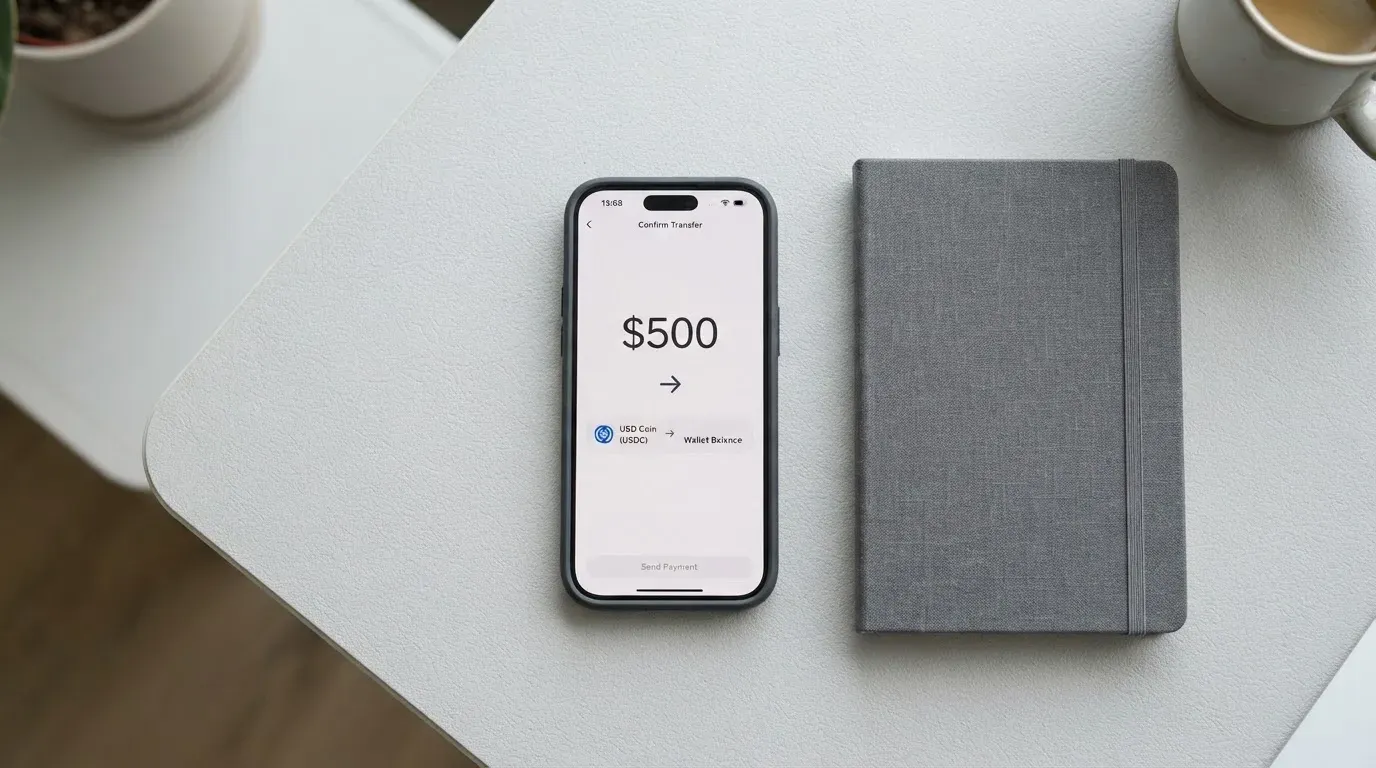
The multi-currency account shows cash, stablecoin and card balances together, so your fiat, your stablecoins and what your card has left sit in one view. Which coins and which networks are supported is not listed on the site. That is the single biggest practical unknown in the funding flow: I can tell you the top-up is free, but I cannot tell you that your coin on your chain is one of the accepted ones.
The reason this matters so much is that transfers are irreversible. A deposit sent on a network Pay3 does not support, or to an address belonging to another network, can be lost entirely or need manual support recovery with no guarantee of success. On Ethereum, a transfer of USDT also needs ETH for gas, so a wallet holding USDT with no ETH cannot send at all. Circle stopped supporting USDC on Tron in February 2024, so “USDC over TRC20” is not a native option if you were planning around it.
On the way back out, withdrawals are available but the fees are not stated. The terms describe no withdrawal process, and they warn that extra verification may be needed to retrieve residual balances after termination — so if you close the account, be aware there is a documented friction point at exactly that moment.
Paying with it every day
Daily use is where this card is at its best. Virtual and physical Visa, plus Apple Pay and Google Pay, and a virtual card that is ready immediately after application — you can be paying online before the plastic arrives.
Apple Pay and Google Pay support is worth a sentence of its own, because of how it works underneath. Apple Pay replaces the card number with a device-specific Device Account Number stored in the Secure Element, never on Apple servers, and each payment uses a one-time dynamic security code. That is a structurally stronger arrangement than handing a long-lived card number to a merchant’s website. The issuer can also restrict the tokenised number — blocking it on magnetic stripe, phone or web, for instance — which is a safety feature rather than a bug, though it can also be the reason a payment is declined.
Where friction can appear: merchants may decline prepaid or foreign BINs, because a BIN lookup reveals the card type and issuer country and some merchants treat “foreign” with extra suspicion. That is why a card issued in one country can look odd to a shop in another, and it is outside Pay3’s control entirely. Address Verification Service, which compares the numeric parts of your billing address with issuer records, is mainly offered in the US, Canada and the UK and is generally unavailable for foreign-issued cards — which can cause declines. And a declined authorisation can leave a hold on your funds for several days, typically up to seven.
Rewards are a weak point. The card does not state a rewards programme. Unofficial reporting from a third-party review site in 2026 indicates no spend cashback on the Black tier, only non-transferable P3P referral points redeemable toward card issuance. That is not confirmed by Pay3, and I would not plan around it. The site itself lists Grow as “coming soon” and Autopilot as “in development”, with no dated events.
The app is at app.pay-3.io, described as a Telegram Mini App / web app. There is no App Store or Google Play listing I could find, and no ratings.
If something goes wrong with a charge, the path is: try the merchant first, report the disputed charge within 60 days of posting, and chargebacks are started through the Pay3 account under card-network rules. Unresolved complaints after 60 days go to HKIAC arbitration. That arbitration route matters — it is a real, named escalation, which is more than many cards in this category offer.
What can go wrong
The limit can move without notice, including to zero. This is the headline risk. Your spending limit equals the US-dollar market value of your posted collateral, and Pay3 may change it with or without notice. Post a volatile asset, watch your available balance swing with the market; have a dispute with the collateral value, watch it be adjusted. There are no fixed limits to fall back on.
There is no insurance and no guarantee. The terms state there is no insurance or guarantee scheme. This is different from a bank deposit and different from an e-money account with safeguarded funds, where an EMI must segregate customer funds or insure them.
You cannot recover an irreversible transfer. Already covered, but it belongs in the risk section too: wrong network, wrong address, or an unsupported chain, and the money is gone or in a support queue.
The support channel is thin. Support runs on [email protected], Telegram at t.me/pay3io, and X at @Pay3_io. Hours are not stated. Unofficial user reports from 2026 on a third-party site describe very thin organic complaint volume — the few complaints being a card that failed to open with an error, and support reachable only via Telegram bot or help section. That is not an official finding and I am not treating it as one; I am noting that the channel structure is thin whether or not those specific reports are accurate. There is no Trustpilot page for Pay3, and the card is new enough that a complaint record would be short by default.
There is an internal inconsistency in the terms. The card terms show a returned-payment fee of $29 in the fee table and $50.00 in the terms. That is a drafting problem, not necessarily a charging problem — but if a returned payment ever lands on your statement, that is a place to slow down and ask which figure applies. Note also that crypto transfers are typically irreversible generally, so what a “returned payment” even refers to here is worth clarifying with support in advance if you expect one.
The card programme could be suspended. Visa and Mastercard license issuers and can suspend a programme; they do not issue these cards to consumers directly. WaveCrest, a Visa issuer that supplied crypto card brands, was suspended by Visa in Europe in 2018, closing all WaveCrest-issued Visa programmes. In November 2022 Visa said it had “terminated our global agreements with FTX” and the FTX US debit card was wound down by its issuer. Programme closures typically give a notice period, then stop spending and loading, then ask users to withdraw remaining balances. This is not a prediction about Pay3 — it is the shape these closures take, and it is why “withdrawals are available” matters more than the fee being unstated.
Jurisdiction and sanctions. The Restricted Locations list is unpublished and can change without notice. Sanctions can land on a stablecoin issuer too: Tether says it disables tokens in wallets on the OFAC sanctions list and has frozen funds tied to illicit activity, so stablecoins are not censorship-proof.
One thing to get right on the tax side, framed as a heads-up rather than advice: the IRS treats digital assets as property, so exchanging them for goods or services generally produces a taxable gain or loss, measured in local fiat currency at fair market value on the date of the transaction. That means each card payment funded from crypto can be a separate disposal. I am not telling you what your obligations are — that is between you and a professional who knows your jurisdiction — but if you spend regularly from a crypto balance, assume the paperwork exists.
What to take instead
Three other cards in this category, so you can see whether Pay3’s trade-offs are the ones you want.
Sponge scores 4.9 / 10, below Pay3. It is a virtual card created in-app, described on its homepage as a credit card issued by Rain, a Visa Principal Member. Funding is USDC collateral moved from the Sponge wallet with a card fund command, with base as the example chain and solana as an optional one in the SDK. Its card pages carry no country list, costs and fees are not stated, and the platform terms set only a minimum age of 13 for the service. If you want the simplest possible USDC-only virtual card and will accept writing your own fee model from scratch, that is the trade.
Nexo scores 6.3 / 10, exactly level with Pay3, and is the more established option with a much clearer rewards story. It is for residents and citizens of “selected European countries, including the EEA and the United Kingdom” — no country list on the page, excluded jurisdictions not named. Virtual and physical cards, issued by DiPocket UAB. No monthly, annual or inactivity fee. The virtual card needs at least $50 in the account to activate; the physical card is free to ship but requires a balance above $5,000 in digital assets and at least Gold tier. FX fee is 0.2% on weekdays in the EEA/UK/CH and 2% in the rest of the world, 0.7% and 2.5% at weekends. What it has that Pay3 does not is cashback: in Credit Mode, by tier, Platinum 2%/0.5% in NEXO/BTC, Gold 1%/0.3%, Silver 0.7%/0.2%, Base 0.5%/0.1%, with the tier depending on the share of NEXO tokens in your portfolio. If you are European, hold $5,000-plus, and want rewards rather than a non-custodial model, Nexo is the harder offer to walk away from. Unofficial reporting also notes a 2025-era Bulgarian police raid on Nexo’s Sofia office over alleged Russia-sanctions and AML violations, with no official Nexo statement about Russians found — not a card fact, but a company fact worth holding in mind.
Xplace scores 7.7 / 10, the highest of the four. A Visa with an instant virtual card and a physical card (Silver live; Gold and Platinum coming soon, delivery 7–14 business days), accepted in 160+ countries, though no country list and “services are not available in all jurisdictions”. The difference is structure: annual fees are Basic free, Silver $99, Gold $249, Platinum $999, but borrowing has no origination fee and Platinum gets 0% FX. You deposit BTC, ETH, SOL, JitoSOL, USDC, USDT and xStocks on Solana, in Cash mode spending your stablecoin balance and in Credit mode borrowing against your holdings. Credit-mode cashback by tier is Basic 0.5%, Silver 1%, Gold 1.5%, Platinum 2%, paid in USDC to the wallet at settlement.
The comparison, briefly:
| Card | Score | Fees you can actually price | Rewards | Main constraint |
|---|---|---|---|---|
| Pay3 | 6.3 / 10 | Conversion from 1.15%, FX/cross-border/foreign transaction up to 3% | none stated | collateral-based limit, changeable to $0 |
| Sponge | 4.9 / 10 | not stated | not stated | USDC-only virtual card, sparse disclosure |
| Nexo | 6.3 / 10 | FX 0.2%–2.5% depending on region and day | cashback in NEXO/BTC, up to 2% | $5,000 balance and Gold tier for physical card; selected European countries |
| Xplace | 7.7 / 10 | 0% FX on Platinum, no origination fee | up to 2% credit-mode cashback in USDC | annual fees from $99 on Silver up |
If your priority is a published, tiered fee and reward schedule with a large balance behind it, Xplace or Nexo. If your priority is keeping your assets in your own wallet with a card that spends against them, Pay3 is the more honest fit of these.
Who I would recommend it to
I would recommend Pay3 to someone who already holds stablecoins, has decided which chain to use, is comfortable that their spending limit floats with collateral value, and wants a virtual card today and a physical one in a few days, with Apple Pay and Google Pay in between. I would also recommend it to someone who specifically values that Pay3 does not take custody — the terms say plainly it offers no custody of digital or fiat assets, and only the amount needed to repay debt is liquidated. For a reader whose main worry is a platform disappearing with their balance, that is a real structural difference.
I would not recommend it to you if any of these are true. You want to know what a payment costs before you make it — the ceilings here are too wide. You want a limit that does not move — this one can go to zero without notice. You are a US citizen — you are excluded by attestation. You want cashback — it is not stated, and unofficial reporting says there is none on spend. You are in a country whose list membership you cannot verify — the Restricted Locations list is unpublished and can change. Or you want a deposit guarantee — there is none.
The last case is the one I want to be least vague about. There is no insurance or guarantee scheme behind this card, and there is no safeguarding either. If you read e-money regulation and hear “customer funds are safeguarded”, that is a category of regulated institution — and Pay3 describes itself as “a fintech company, not a bank”, with services delivered through licensed partner providers and the card issued by a named third party. What I would do before committing meaningful money: read the terms section on security and the section on fees end to end, put a small amount in, test a virtual-card payment and a small cash withdrawal if you need cash, and confirm which fee line your payments actually hit.
Frequently asked questions
What is Pay3 card?
Pay3 is a Visa payment card, virtual and physical, that spends a balance you load yourself from stablecoins or from fiat. It is collateral-based: your spending limit equals the US-dollar market value of collateral you post. Pay3 Limited is a Hong Kong company incorporated in 2024 and describes itself as a fintech company, not a bank, delivering services through licensed partner providers, with the card issued by a named third party.
How does Pay3 card work?
You load a balance, and the card spends that balance. Pay3 holds no custody of your digital or fiat assets — the assets stay with you — and only the amount needed to repay debt is liquidated. A multi-currency account shows cash, stablecoin and card balances together. Because it is collateral-based, your limit tracks the market value of what you have posted and can change with or without notice.
Is Pay3 a bank?
No. Pay3 describes itself as “a fintech company, not a bank”. The card is issued under licence from Visa by a partner issuer named in the terms. Services run through licensed partner providers. The terms also state there is no insurance or guarantee scheme, so funds here are not a bank deposit.
Who owns Pay3?
Pay3 Limited, incorporated in Hong Kong in 2024. The card itself is issued by a partner issuer identified in the terms as Third National, whose country is not stated. Licences held by the partners are not named on the pages I read.
Does Pay3 card require KYC?
Yes. Identity verification runs through Sumsub in the app, once, and that single verification is reused across your card, your account and swaps. You must be 18 or your legal age, and an extra document such as proof of address may be requested depending on the partner and region. If the check fails, suspension is a possible outcome.
Can I use Pay3 card in my country?
You can if you are outside “Restricted Locations” — countries under trade sanctions, export controls or crypto/fintech prohibitions — and are not a US citizen and not OFAC-blocked. The Restricted Locations list is not published and may change without notice, so the honest answer is that the card does not tell you in advance, country by country, where you stand.
How much does Pay3 card cost?
Issuance “starts at $5” and a card spend starts from $0.15 per transaction. Currency conversion starts from 1.15%. The foreign exchange fee on non-USD, the cross-border fee and the foreign transaction fee each run up to 3%. Monthly and annual fees are not stated. Top-ups are free, with a top-up fee of 0%.
How do I top up Pay3 card?
You add either stablecoins or fiat into the multi-currency account. Adding funds is free and the top-up fee is 0%. No minimum is published, and the site does not list which coins or networks are supported — so confirm your chain before sending, because transfers are irreversible and a deposit on an unsupported network or to a wrong-network address can be lost.
Is Pay3 card safe?
The model has real advantages: Pay3 does not take custody of your assets, and only the amount needed to repay a debt is liquidated. But there is no insurance or guarantee scheme, the spending limit can be changed to $0 without notice, and blockchain transfers cannot be reversed. Support is email and Telegram with unstated hours, and the terms contain an inconsistency on the returned-payment fee.
Is Pay3 card worth it?
Worth it if you already hold stablecoins, want a virtual card immediately plus a physical card in 3 to 5 business days, and prioritise non-custody over a predictable fee. Less worth it if you need a fixed limit, need to know a payment’s cost in advance, or want cashback — rewards are not stated, and unofficial third-party reporting in 2026 says there is no spend cashback on the Black tier.
Choosing a credit or cashback card – cryptocardadvisor
Content created by the «cryptocardadvisor» team