
A crypto Visa with a Asia-first pitch and thin paperwork
 Available in US
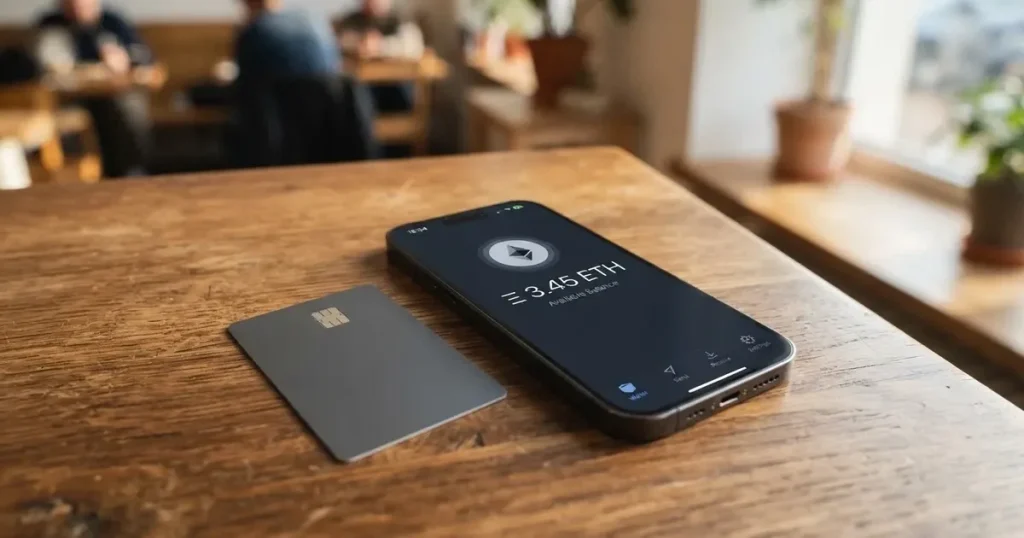
Anytap is a crypto payment card that converts and loads a balance you can spend like an ordinary Visa, online or at a terminal, with Apple Pay, Samsung Pay and Google Pay support. On paper it does what most cards in this category do. The problem is that most of the numbers you would use to decide are not on its public pages, so this review is as much a map of what is missing as a verdict on what is there. My score is 7.7 out of 10. Who can get it scores 9, top-up options 9, everyday use 9, but cost drops to 6 and reliability to 6 because the issuer and the fee schedule are not disclosed and I found no independent reviews at all.
Conditions are current as of October 28, 2026.
Conditions are current as of 2026.
Who the card suits, and who it does not
The card is built for crypto holders paying in USDT or USDC across Asia. If that is you — stablecoins in hand, spending in several Asian markets, no usable ordinary bank card — the pitch lines up: it is a Visa, it accepts the two stablecoins you are likely to hold, and the top-up side is the strongest part of the product. The launch was aimed at Asia starting with South Korea, Japan and Indonesia, though that comes from press-release titles I did not date, so treat the country rollout as directional rather than a guarantee.
The person it does not suit is the one who needs to know the price before committing. An issuance fee is charged and its amount is not disclosed, no monthly fee figure is published, and the headline percentages for cross-border payments and ATM withdrawals come from a single press release I could not date. Nobody reading this can compute what a year of ordinary spending costs from official material. That is not disqualifying on its own, plenty of new products look like this for a year, but it means you are accepting a pricing page that does not exist yet.
| Criterion | Mark | Why |
|---|---|---|
| Who can get it | 9 / 10 | Worldwide except OFAC-sanctioned countries per starting data; the application form lists United States, Singapore, UAE, United Kingdom, Vietnam, Japan, Other |
| Cost | 6 / 10 | Issuance is paid and undisclosed; unofficial figures are 1% + $0.30 cross-border, 2% with a $1 minimum at ATM, 30 USDT minimum top-up |
| Top-up options | 9 / 10 | USDT and USDC, USDT on TRC-20 described as faster and cheaper, 350+ supported coins |
| Reliability and complaints | 6 / 10 | U.S.-headquartered per starting data, issuer and licences unnamed; no reviews, Trustpilot page or Reddit threads found |
| Everyday use | 9 / 10 | Virtual or physical Visa, Apple Pay, Samsung Pay, Google Pay, ATM; wallet rollout reported as gradual by card type and market |
| Total | 7.7 / 10 | A card that does the basic job well, with the paperwork to back it still unwritten |
Note what the reliability row is really saying. A high mark there would mean an identified issuer, named licences, and a public complaint record you can read before signing up. Anytap has none of the three visible, so the 6 is generous for the product idea and stingy for the disclosure.
Will they give you the card
Eligibility is where this card looks most open, and most of that comes from starting data rather than a page I could verify. Per the starting material, the card is offered worldwide except countries sanctioned by OFAC, and the application form itself lists United States, Singapore, UAE, United Kingdom, Vietnam, Japan and an Other option. Two things are worth separating. A country appearing on a dropdown is not the same as a card being issued to residents of that country; it can mean the form is being localised. And “worldwide except sanctioned countries” is a policy statement, not a guarantee that any particular applicant in any particular country will be approved.
Your nationality is a separate matter from where you live, and the general rule across this category is that screening is applied to citizenship and country of birth as well as your address. So if you are a citizen of a sanctioned country living somewhere unremarkable, being on the eligible side of the world does not obviously help you. If that describes you, the honest answer is that nothing here resolves it, and the only real test is the application and its response.
The identity check itself is standard: passport or ID plus a selfie, and the signup material says applicants are approved in minutes. Proof of address and an age requirement are not stated on the public pages. Age matters more than it sounds, because prepaid and debit cards generally go to adults 18 and over, and this card behaves like a prepaid card. There are no published tier levels or premium tiers either, so if you are looking for a status ladder you will not find one here.
Delivery timing for a physical card is not stated either. Virtual cards obviously arrive instantly because they are generated in the app, but if you are planning around a mailed card for a trip, treat that as unknown.
How to get it
The stated flow is short and reads like a funnel: sign up on the web with an email address, your name and your address, pay the issuance fee, then activate. Approval is described as happening in minutes, so this is not a weeks-long onboarding queue. That is a real advantage over the traditional bank, and for someone whose problem is a frozen or refused ordinary account, minutes matter.
Two details deserve your attention before you start. First, the issuance fee is a precondition, not an optional extra — you pay before the card exists, and the amount is not published. Second, you are entering your name and address on a web form for a company whose issuing institution and licences the public pages do not name. That is not automatically a red flag; plenty of legitimate programmes are run through licensed issuers that do not advertise their partners. But it means you are asked to trust a company identity you cannot fully verify from the pages in front of you, and I would rather say that plainly than imply the trust is warranted.
The card you get is a Visa debit card, either virtual or physical. The card currency is not stated, which matters for pricing: if the account runs in dollars and you spend euros, the conversion cost depends on the rate you are given, and you cannot check that rate in advance from the published material. An unofficial source describes physical and virtual cards all running on the Visa network, with up to three cards per person. I could not confirm that on an official page, so treat the three-card figure as reported rather than promised.
What it really costs: fees and limits
Here is where this card is weakest, and I want to be exact about why. The official public pages state that an issuance fee is paid before activation and do not give the amount. They state no monthly fee. They do not publish a conversion rate or a conversion fee, though the starting data describes crypto being converted to fiat at the point of sale. The cross-border percentage, the ATM percentage and the minimum top-up all come from one press release carried by a site I could read but not date. Everything in the “unofficial” rows below is single-sourced and not confirmed by the card.
| Fee or limit | What the card’s own pages say | Reported elsewhere, not confirmed |
|---|---|---|
| Issuance | Paid before activation, amount not stated | — |
| Monthly fee | Not stated | — |
| Crypto-to-fiat conversion | Crypto converted to fiat at point of sale per starting data, no percentage published | — |
| Cross-border transaction | Not stated | 1% plus $0.30 per transaction |
| ATM withdrawal | ATM withdrawals available, fee and allowance not stated | 2% of the amount, minimum $1 |
| Minimum top-up | Not stated | 30 USDT |
| Daily limit | Not stated | — |
| Monthly limit | Not stated | — |
| Card currency | Not stated | — |
Let me take three ordinary payments and walk through what would apply, using only the figures above. This is an illustration of the shape of the cost, not a quotation.
A $40 lunch in a local currency, same country as your balance. If your balance is already in dollars and the card settles in dollars, the merchant may apply its own local-currency conversion and your card issuer adds its own rate; neither rate is published, so you cannot predict the effective cost. If you paid a 3% top-up fee to load the money — a figure that appears in starting data but not on the pages — that 3% is already spent before the lunch happens. Reading right to left, roughly $1.20 of a $40 lunch would go to the top-up alone, and the lunch is the cheapest kind of transaction on this list.
A $60 online purchase from an overseas merchant. This is where the reported cross-border fee bites: 1% plus $0.30 would add about $0.90. But there is a second cost that no card can avoid and that crypto cards make worse — the merchant or its payment processor may decline a card whose issuing country looks foreign, or may apply extra scrutiny, and stablecoin funding makes the billing-country mismatch more likely, not less. So the honest expected cost of this purchase is the 0.90 plus an unknown chance of a decline and a retry.
A $80 cash withdrawal at an ATM. The reported 2% with a $1 minimum would be $1.60. Add whatever the ATM operator charges on top, which is separate and outside the card’s control. And note the allowance is not stated — you do not know how much you may take out per day or per month until you try.
The top-up fee deserves a second look because it is the one cost that hits you on the way in rather than on the way out. It is charged on every load, so a frequent top-upper pays it repeatedly in a way a one-off converter does not. If the card charges 3% to load and the cross-border fee is 1% plus $0.30, then loading once and spending carefully is clearly better behaviour than loading small amounts often — not because the card penalises you, but because the arithmetic does.
Also worth separating, because it is a common confusion in this category: the on-chain network fee for sending your crypto to the card is charged by the blockchain, not by Anytap, and who pays it is not stated. If you send USDT over Tron, the cost is Tron resources; if you send it over Ethereum, the gas is paid in ETH, which means a wallet holding USDT and no ETH cannot send at all. That is a detail that will bite someone.
How to top up
Top-ups are the strongest part of this card, and it is the section where the product is most confident. The card accepts USDT and USDC directly. USDT on TRC-20 is described as faster and cheaper than other routes, and the marketing claims 350+ supported coins, with starting data naming USDT on either TRC-20 or ERC-20, or USDC, as the practical options. For a user sitting on the two largest dollar-pegged tokens, this is close to ideal: the assets you already hold are the assets the card takes.
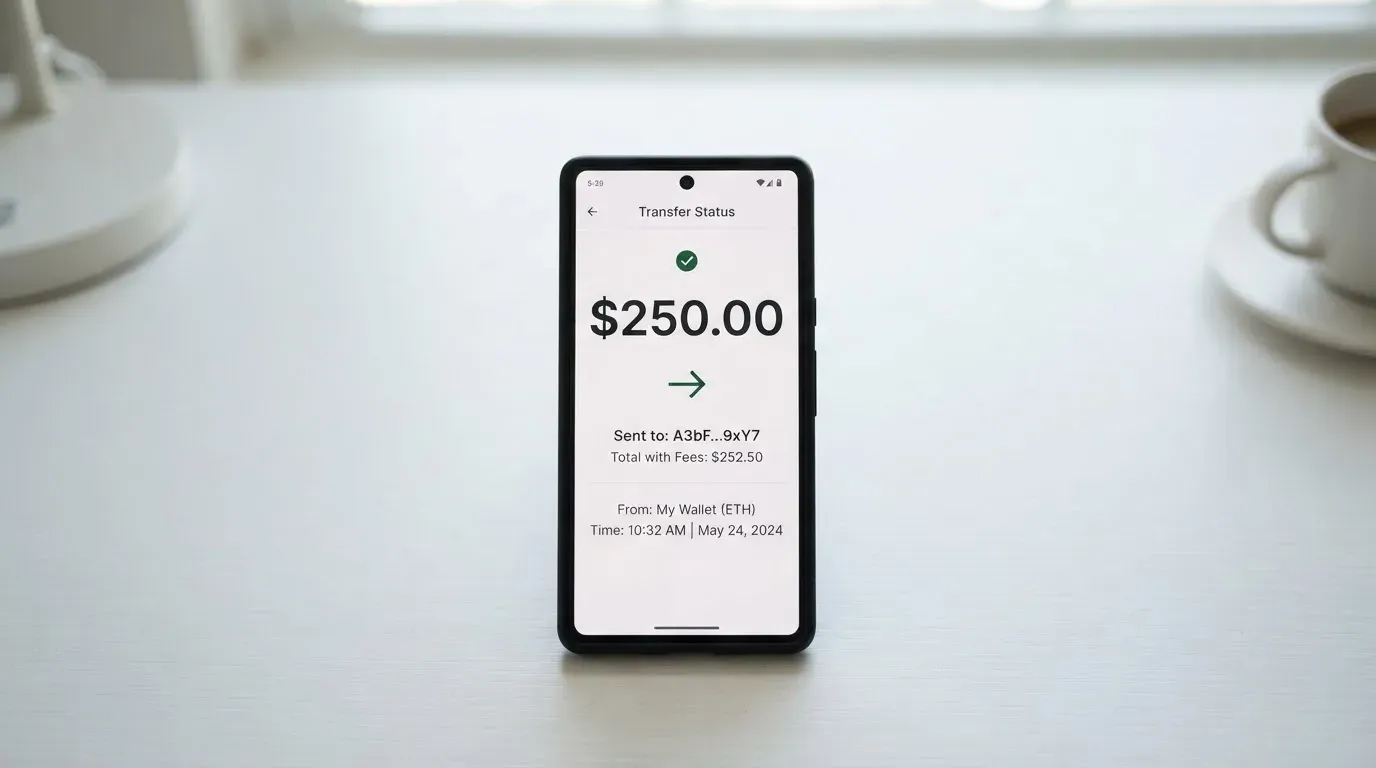
One thing to keep in your head while reading “350+ coins”: the figure counts what can be converted, not what should be converted. Stablecoins have the virtue of being dollar-pegged most of the time, and even that is not guaranteed — a stablecoin collapsed in May 2022, and USDC lost its peg briefly in March 2023 during the US banking crisis. Converting a volatile coin to load the card means a conversion rate you did not choose and cannot predict.
The choice of network matters more here than with most transfers. Blockchain transfers are irreversible, so a deposit sent on a network the provider does not support, or sent to an address belonging to a different network, can be lost or need manual support recovery with no guarantee of success. This is not a small technicality — it is the single most common way people lose money to crypto payment services. TRC-20 and ERC-20 addresses look similar and are not interchangeable. Before you send anything, match the network to the one the app tells you to use, character by character, and do not trust your memory of a familiar address.
There is a subtlety with USDC specifically: Circle stopped supporting USDC on Tron in February 2024, so “USDC over TRC20” is not a native option. If your plan is to send USDC on the cheap network, check what the card actually supports rather than assuming symmetry with USDT. Circle lists USDC as natively supported on 38 networks as of 16 September 2026, but that is Circle’s coverage, not Anytap’s.
On getting money back out, the official pages say nothing. An unofficial source describes balances moving between a user’s own cards and loaded funds being withdrawable to an external wallet. If that is accurate, it makes the card a pass-through rather than a trap. If it is not, a card you can only spend from is a much narrower tool. I would want to see this in writing before treating it as a feature.
Paying with it every day
Day to day, the card behaves like a normal Visa, which is the point. You get a virtual or physical card, you can add it to Apple Pay, Samsung Pay and Google Pay, and you can withdraw cash at ATMs. That is the full everyday toolkit, and it covers the cases people actually complain about with crypto cards: paying a terminal that will not take a phone-only wallet, and needing cash.
The phone wallets are genuinely useful in a way that the plastic is not. Apple Pay replaces your card number with a device-specific number stored in the phone’s secure hardware, never on Apple’s servers, and each payment uses a one-time dynamic code, so a leaked card number is worth much less. Samsung Pay and Google Pay work on the same tokenised principle. An unofficial source says mobile wallet support rolled out progressively depending on card type and local market conditions, which is worth taking seriously: your specific card in your specific country may not have Apple Pay on day one, and the way to find out is to try adding it.
Where the everyday experience gets bumpy is not Anytap’s fault so much as the category’s. The card’s issuing country is visible to merchants in the card number’s first six or eight digits, and a shop can look that up and apply extra scrutiny when the issuing country differs from the billing address. Some merchants decline prepaid or foreign-issued cards for exactly that reason. Address verification, which compares the numeric parts of the billing address you type against the issuer’s records, is mainly offered in the United States, Canada and the UK and is generally unavailable for foreign-issued cards — a common and quiet cause of declines. Online payments add a step: 3-D Secure asks your issuer to assess the risk, either approving frictionlessly or challenging you with a one-time code or a biometric prompt. Your bank can decline that challenge as easily as it can pass you.
One cost to know about that is not a fee at all: a declined authorisation can leave a hold on your funds for several days, typically up to seven. On a card whose balance is your money and not your bank’s money, a hold is a real freeze, not an accounting entry.
Whether the card works for gambling and similar high-risk merchants is not stated, and the blocked-category list is not published either. Merchant categories are classified by four-digit codes, with gambling sitting under one specific code that many issuers block as policy rather than by law, and the blocked list differs between issuers. If that category matters to you, ask.
Rewards are not stated. There is no published cashback, no points scheme, no fee waiver for spending. Treat the card as a payment tool at face value, not a rewards product.
What can go wrong
The largest risk here is not fraud or a collapse. It is that you cannot verify the thing you are trusting.
The issuer is not named. Per starting data this is a U.S.-headquartered fintech. The pages do not name the issuing institution or the licences. That matters because a Visa card is not issued by Visa — Visa and Mastercard license issuers and can suspend a programme. When you hold a card, your money sits with the issuer under its own regulatory regime, and if you do not know who that is, you do not know what protections apply to you or which regulator you would complain to.
There are no independent reviews. I found no reviews, no Trustpilot page and no Reddit threads for Anytap. A brand with no complaints is not the same as a brand with a good record; at this stage it usually means the card is either very new or very small. You get no crowd-sourced answer to “has anyone had a problem withdrawing” or “does support actually respond”.
Programmes close. This is the history of the category. Visa terminated its global agreements with FTX in November 2022 and the FTX US debit card was wound down by its issuer. Visa suspended WaveCrest in Europe in 2018, closing all WaveCrest-issued Visa programmes. Closures typically follow a pattern: a notice period, then loading and spending stop, then users are asked to withdraw remaining balances. One 2026 closure reported by a secondary source ended new loads on 8 July 2026 and spending on 8 August 2026 — that is a single unconfirmed source, but the shape matches the pattern. This is why holding funds on a card you cannot name the issuer for is a bet.
Custody risk. Almost every card in this category is custodial: the provider holds the credentials, so your balance depends on that provider’s security and solvency. The history here is not reassuring. Mt. Gox reported about US$350 million stolen between 2011 and 2014, Coincheck about US$400 million in 2018, and Ronin Network US$625 million in 2022. Self-custody-linked cards exist as an alternative, where the funds stay in your own wallet until the moment of payment — but there you bear the full risk of key loss, phishing, and clipboard-hijacking malware that silently swaps a copied address.
Irreversible transfers. A transfer to a wrong network or a wrong address generally cannot be undone. Neither the network nor the blockchain can freeze or return it.
Undisclosed protections. Whether funds are safeguarded in segregated accounts, whether the balance counts as a deposit, and what dispute rights you have are all unstated. In the EU, electronic money institutions must safeguard customer funds by segregating them or insuring them, and such funds are not the same as bank deposits and may not be covered by deposit guarantee schemes. In the US, debit card reversal rights come from Regulation E and credit card rights from Regulation Z, while prepaid-card coverage varies and should not be assumed. Which of those regimes applies to an unnamed issuer is exactly the thing you cannot determine.
Support and app. Support channels are not stated. More concretely, I could not find an Anytap card app in the App Store as of 22 October 2026 — the only “AnyTap” result is an unrelated accessible-camera app — and Google Play was not found either. If your plan was to manage this from a phone, check what you would actually be using before you commit. A web-only flow is workable for a card you top up occasionally and poor for one you use daily, and the missing app also means no visible track record of app-based two-factor authentication, instant freeze or spending controls, though those safeguards are typical for the category rather than confirmed here.
What to take instead
I looked at three cards that come up in the same searches. None of them is a clear upgrade, and that is itself informative: this is a thin category with thin disclosure across the board.
Cardex, which I scored 5.6. It advertises one crypto card in 200+ countries with no country list and no stated exclusions, and it runs on VERVE, Visa, Mastercard and UnionPay with virtual and physical cards. Its conversion is real-time, and the site says an “AI-Powered Conversion Rate” scans global exchange rates and picks the best one when you spend — a nice-sounding feature that comes with no published fee percentage. Its App Store listing is Naira-focused. Against Anytap it offers named networks and a real conversion story, but in exchange it commits to a currency that may not be yours.
CardFlow, which I scored 4.9. It is aimed at global users, and issues a virtual USD Mastercard. Creating a virtual card is described as completely free, which beats Anytap on the one cost Anytap refuses to publish. Its funding routes are Bitcoin, USDT, ETH or a Naira bank transfer, with networks not stated — and that omission matters more here than the headline number of coins, because network is what makes a transfer cheap, safe or lost.
HyperCard, which I scored 4.7. A prepaid card with the network not stated on its App Store page, balance in USD or EUR, funding by depositing crypto such as USDT, BTC or ETH in the app, converted to USD or EUR. The App Store says it works in more than 176 countries, but that describes acceptance, not eligibility, and conflating the two is a common trap. No fees are listed at all — which for a card whose issuer is unnamed tells you about the marketing, not the margin.
| Anytap | Cardex | CardFlow | HyperCard | |
|---|---|---|---|---|
| My score | 7.7 | 5.6 | 4.9 | 4.7 |
| Card | Visa debit, virtual or physical | VERVE, Visa, Mastercard, UnionPay | Virtual USD Mastercard | Prepaid, network not stated |
| Issuance cost | Paid, amount not stated | Not stated | Free for virtual cards | Not stated |
| Conversion fees | Not published | Not published, rate auto-picked | Not stated | Not stated |
| Funding | USDT, USDC, 350+ coins | USDT, USDC, BTC | BTC, USDT, ETH or Naira transfer | Crypto deposit, converted to USD or EUR |
| Main gap | Issuer and fees undisclosed | Currency and fee detail | Nigeria-focused, networks unstated | Eligibility vs acceptance confusion |
If Anytap’s fees turn out to be in line with the reported figures, its top-up breadth and Asia-first design make it a better fit than any of these three for someone holding USDT or USDC in Asia. If the fees are worse, CardFlow’s free virtual card is worth a look. And if what you really need is certainty about who holds your money and what happens when something goes wrong, none of the four gives you that today — which is an argument for a regulated exchange with its own card, where the issuer is named and the jurisdiction is known.
Who I would recommend it to
I would recommend this card to someone who already holds USDT or USDC, is spending across Asian markets, has a genuine problem getting an ordinary bank card, and is comfortable treating the card balance as money in someone else’s hands for a short period rather than as savings. Under those conditions, a Visa that accepts the two stablecoins you already have, tops up on cheap networks, and works with your phone’s wallet is a real answer to a real problem, and the 7.7 reflects that.
I would not recommend it to anyone whose decision hinges on the price. The card’s own pages do not publish the issuance fee, a monthly fee, a conversion rate, or any spending limit, and the figures floating around come from a press release I could not date. If you are trying to work out whether a specific card is worth it for your spending pattern, you cannot do that arithmetic from public material, and you should not sign up expecting to discover the fee structure afterwards.
I would hold off entirely if any of these apply to you: you are a citizen of a sanctioned country, because the “worldwide except sanctioned countries” line does not tell me how screening treats citizenship separately from residence and I will not guess; you plan to hold a large balance on the card for weeks, because a prepaid balance with an unnamed issuer is not where you park money; you are relying on dispute rights or chargebacks, because nothing about the applicable regime is published; or you need a phone app, because I could not find one.
My honest overall position is that Anytap is a credible product with the documentation of a pre-launch. The features line up, the score is high where features live, and the marks drop exactly where disclosure should be. If you can accept the unknown cost and the unnamed issuer, the card does the job. If you cannot, the thing to do first is not to choose a different card — it is to ask Anytap for the fee schedule and the issuing institution in writing, and see how quickly you get an answer. That single reply will tell you more than anything on this page.
Frequently asked questions
What is the Anytap card?
Anytap is a crypto payment card issued on the Visa network, available as a virtual or physical card. You load it with crypto, mainly USDT or USDC, and it converts that into a spendable balance you use like an ordinary Visa — online, at terminals, or through Apple Pay, Samsung Pay and Google Pay. It behaves more like a prepaid card than a bank debit card.
How does the Anytap card work?
You fund the card by transferring supported crypto to it, and the card converts that into a fiat balance you spend from. Payments draw down that stored balance rather than a linked bank account, so the card cannot overdraw. Cash withdrawals at ATMs are also offered. How good the conversion rate is depends on fees the card’s own pages do not publish.
Who owns Anytap?
The public pages do not say clearly, and this is the most important gap on this page. Starting data describes it as a U.S.-headquartered fintech. The issuing institution and the licences behind the card are not named, so you cannot confirm which regulator holds it to account. I would want that answered in writing before funding it.
Which countries can get an Anytap card?
Per starting data, the card is offered worldwide except OFAC-sanctioned countries, and the application form lists United States, Singapore, UAE, United Kingdom, Vietnam, Japan and an Other option. Unofficial reporting says the launch targeted Asia starting with South Korea, Japan and Indonesia. A country on a dropdown is not a guarantee of approval.
Does the Anytap card require KYC?
Yes, identity verification is part of signup: a passport or ID plus a selfie, with approval described as taking minutes. Proof of address and an age requirement are not stated. Citizenship is normally screened separately from residence in this category, which matters if you live in an eligible country but hold a nationality that is not.
How much does an Anytap card cost?
An issuance fee is charged before activation and the amount is not published, and no monthly fee figure is given. Unofficial figures, from a single undated press release, are 1% plus $0.30 per cross-border transaction, 2% of the amount with a $1 minimum for ATM withdrawals, and a 30 USDT minimum top-up. Starting data also mentions a 3% top-up fee.
How do I top up the Anytap card?
You send USDT or USDC to the card. USDT on TRC-20 is described as faster and cheaper, and the marketing claims 350+ supported coins. Networks matter enormously: transfers are irreversible, so sending on the wrong network or to an address belonging to another one can lose the money outright. Note that Circle stopped supporting USDC on Tron in February 2024.
Can I use the Anytap card in Apple Wallet?
Apple Pay, Samsung Pay and Google Pay are all listed as supported, which is the most useful everyday feature on the card, since a tokenised phone number is far safer to lose than a plastic card. Unofficial reporting says mobile wallet support was rolled out gradually depending on card type and local market. I also could not find an Anytap card app in the App Store or Google Play as of 22 October 2026.
Is Anytap a bank, and is the card safe?
Anytap is not a bank, and the pages do not name a bank partner. A Visa card is issued by a licensed issuer, not by Visa itself, and this card’s issuer is undisclosed. In this category, balances held with a provider carry counterparty risk — Mt. Gox, Coincheck and Ronin Network are the historical examples. Treat the balance as money in someone else’s hands.
Is the Anytap card worth it?
For someone holding USDT or USDC who needs a working Visa in Asia and cannot get one elsewhere, the features justify the card. Against that, the issuer is unnamed, no fee schedule is published, and there are no independent reviews, no Trustpilot page and no Reddit discussion to check. My score is 7.7 out of 10, with cost and reliability both scoring 6.
Choosing a virtual card – cryptocardadvisor
Content created by the «cryptocardadvisor» team