
A virtual Visa sold inside Telegram by a marketing brand, not a bank
 Available in US
WooCard is a brand that markets a card programme run by an unnamed provider. That is the most important thing to know before you put money into it: you are buying access to somebody else’s payment infrastructure through a middleman, and the middleman’s own legal identity is not printed anywhere on the pages. The product itself is a virtual Visa in USD or EUR, created and managed entirely inside Telegram, with a Standard tier and a pricier VIP tier that adds ATM withdrawals. Top-ups run at 2.8% plus a possible fixed 1 USDT, card creation costs 9 USDT on Standard and 85 USDT on VIP, and monthly maintenance is $0.
My score for it is 5.6 out of 10. That is not a rounding of something worse — it is a genuinely usable card with competitive top-up costs attached to a provider layer I could not identify and a public review record that does not exist yet. If you are a Telegram user who needs a virtual Visa in USD or EUR quickly, and you are comfortable treating the balance as money you could lose, this does the job it advertises. If you need to know which legal entity stands behind your money, or you want a card you can hold, or you want independent people to have used it for a year, I cannot tell you this is that card.
The conditions described here are current as of October 28, 2026.
Verdict
5.6 / 10. The card works in the narrow sense: a virtual Visa, issued fast, funded with USDT or USDC, spendable online and in Apple Pay and Google Pay, with no monthly fee. The reasons I cannot push it higher are structural rather than cosmetic. No issuer is named, no licence is named, no legal entity or registered address is given, and a search for user reviews turned up nothing at all — not bad reviews, no reviews. A card with no track record and an invisible issuer is a card I would fund in small amounts only.
Who it suits: someone already living in Telegram who wants a USD or EUR Visa number for subscriptions and online payments today, who accepts that the balance is a prepaid balance rather than bank money, and who will not be hurt by an account freeze because the money in it is money they can replace. Who it does not suit: anyone treating this as a bank account, anyone whose income depends on the card being reliably available next month, anyone who needs a physical card, and anyone who wants a documented answer to “who is my counterparty”.
| Criterion | Mark | Why |
|---|---|---|
| Who can get it | 7 / 10 | Issuing countries are not listed; the provider decides eligibility. A block list of 44 places is published, including Russia, Belarus, Serbia, Afghanistan, Iran and Cuba. |
| Cost | 4 / 10 | Standard creation 9 USDT, VIP 85 USDT, servicing $0. Top-up 2.8% plus a possible 1 USDT, crypto swap 0.1%, purchases and declines $0, balance withdrawal 3 USDT. |
| Top-up options | 8 / 10 | USDT, USDC, TRON, ETH, BTC. The wallet supports 18+ coins across 4 networks, with a swap into stablecoins. |
| Reliability and complaints | 3 / 10 | WooCard is a brand and referral partner, not an issuer. No legal entity or address given, provider and licences unnamed, and no user reviews found. |
| Everyday use | 7 / 10 | Virtual Visa, Apple Pay and Google Pay on eligible cards, ATM on VIP only. Unofficial listings mention a physical card as well. |
The spread in that table is the honest shape of this card. Where it is a mechanism — accepting crypto, converting it, handing you a Visa number — it works fine and scores well. Where it is an institution — who issued this, under what licence, with what recourse — it is silent, and that silence is the whole problem.
Will they give you the card?
They will probably not refuse you on nationality grounds unless you are in one of 44 listed places, because WooCard does not publish the countries it issues in. The site’s wording is that the card is “not available in all jurisdictions” and that the provider decides eligibility case by case. In practice that means: you cannot check your own eligibility from the public pages before you try, and the answer may come from an unnamed provider rather than from anything WooCard publishes.
The block list is unusually long and worth reading closely. It names Afghanistan, Albania, Angola, Belarus, Bosnia and Herzegovina, Myanmar, Burundi, Central African Republic, Cuba, North Korea, DR Congo, Ethiopia, Eritrea, Guinea, Guinea-Bissau, Haiti, Iran, Iraq, Ivory Coast, Kosovo, Lebanon, Liberia, Libya, Macedonia, Mali, Nicaragua, Pakistan, Russia, Somalia, South Sudan, Sudan, Syria, Serbia, Sierra Leone, Venezuela, Yemen, Zimbabwe, Abkhazia, Nagorno-Karabakh, Northern Cyprus, Sahrawi Arab Democratic Republic, Somaliland and South Ossetia.
Russia and Belarus are on it. Serbia is on it, which surprises people who assume Europe is broadly open. Albania is on it, which is another one that catches people out. Because the site does not distinguish citizenship from residence, it is unclear whether the block applies to where a user is, where they are from, or both. For an alternative, see the Azul Card entry in the comparison table below: Azul Card states plainly that its restrictions apply “regardless of the user’s nationality”, which is at least a sentence a user can reason with.
Here is the blunt version. Eligibility for this card is decided by a party WooCard does not name. You are not being told the rules; you are being told there are rules. If your situation is complicated — a sanctioned nationality, a residency in a high-risk jurisdiction, a business rather than a personal account — the honest advice is to ask the provider directly through the Telegram support channel before you assume you are in or out, and to treat the answer as provisional.
How to get it
The signup is unusually short, and the shortness is the main practical reason people are interested. You need an active Telegram account and an email address. Everything happens in the Telegram app — the card, the card number, the PIN, the freeze button, the OTP and 3-D Secure codes.
Beyond that, the public pages do not say much. Onboarding and anti-money-laundering checks are performed by the unnamed provider, and the site refers to “simplified due diligence” that may apply to low-limit prepaid tiers where the law permits it. The documents required, whether proof of address is needed, and the minimum age are not stated on those pages. KYC levels are likewise not described.
A third-party listing of crypto cards says “No KYC (level 0)” for WooCard — no ID document, no proof of address, no selfie, just Telegram and email. That is an unofficial claim from a third-party site and is not confirmed by WooCard. Treat it as a description of how the signup may start, not as a promise about what happens later. In practice, the sign-up can be quick and a limit can be imposed before any documents are asked for, which is normal in the prepaid card world; what I cannot tell you from the public pages is what would trigger a document request later.
What you get at the end is a virtual Visa card in USD or EUR. Standard comes with no ATM; VIP comes with ATM access. You can hold up to 5 active cards, and each is valid for 3 years from issuance. Physical cards and Mastercard are not mentioned on the site — the Visa network is what is described. A third-party listing also offers a physical WooCard with an unstated fee; again, unofficial, not confirmed by the card’s own pages, and not something the site describes.
Delivery is not stated, because only virtual cards are described. The documented terms of use took effect on 01/10/2026 and were last revised on 20/10/2026; the date format is not specified, so I cannot tell you which convention is intended. A third-party listing dates the card’s establishment to September 2026, which would make it only weeks old at the time of writing — unofficial, and consistent with the absence of reviews.
Fees
This is where the card is strongest, and where the headline numbers deserve a second look because they are not all the cost.
| Fee or limit | Amount |
|---|---|
| Card creation, Standard | 9 USDT |
| Card creation, VIP | 85 USDT |
| Monthly maintenance | $0 |
| Top-up | 2.8% plus a possible fixed 1 USDT |
| Crypto swap | 0.1% |
| Purchase fee | $0 |
| Decline fee | $0 |
| Cross-border fee | $0 |
| Conversion outside the card currency | at official Visa rates, no WooCard markup |
| ATM withdrawal, Standard | not available |
| ATM withdrawal, VIP | available; fee not stated |
| Withdrawal or refund of card balance | 3 USDT |
| Daily limits | not stated |
| Monthly limits | not stated |
Card creation is a one-off, and the two tiers are priced far apart: 9 USDT for Standard against 85 USDT for VIP. If you only need a card to pay for things online, VIP’s price buys you an ATM and nothing else you will use — that is a lot of money to pay for cash access you may never take. Work out which side of that line you are on before you pay.
Now the everyday cases, because fees behave differently depending on where the money already is.
Paying in the card’s own currency. If your balance is in USD and you pay a USD invoice, the purchase fee is $0, the cross-border fee is $0, and the decline fee is $0. This is the cheapest path and the one the fee list is quietly built around.
Paying in a currency your card does not hold. The balance is converted at official Visa rates with no WooCard markup. That is a genuinely good deal compared with cards that add their own spread, but the Visa rate is not necessarily the rate your bank would have given you, and it moves.
Cashing out. On Standard there is no ATM at all — not a fee, an absence. On VIP withdrawals are possible and the fee is not stated. A third-party listing claims the ATM fee is free and withdrawals unlimited; that listing contradicts itself in the same breath by noting Standard has no ATM, and in any case it is unofficial and not confirmed by the card.
Loading the card. Top-up is 2.8% of the amount plus a possible fixed 1 USDT. On a small top-up the fixed part is what hurts: the percentage is competitive, but the flat fee makes frequent small loads expensive relative to occasional larger ones. The deposit fee itself is $0.
The number I would fix in your head is the 2.8%. Everything else about WooCard’s pricing is either zero, absent, or unstated — and unstated is not the same as free, especially for ATM fees and limits.
Two limits deserve attention and get none from the marketing. Daily spend and monthly spend figures are not stated on the card’s own pages; load limits and monthly load capacity are “subject to current provider terms”. The site is careful with its wording here, and the carefulness is the message: “no limits” in a third-party listing does not mean unlimited. A third-party listing gives daily spend unlimited, monthly spend $200,000, ATM unlimited and a $20 minimum top-up. Those are unofficial figures, not confirmed by the card, and they sit oddly beside the card’s own “subject to current provider terms”.
Top up
Top-ups are the part that works best, and they are where the card’s design makes the most sense. You fund from USDT, USDC, TRON, ETH or BTC. The wallet supports 18+ coins across 4 networks, and it can swap those 18+ coins into stablecoins first — so you are not forced to hold the exact asset the card wants.
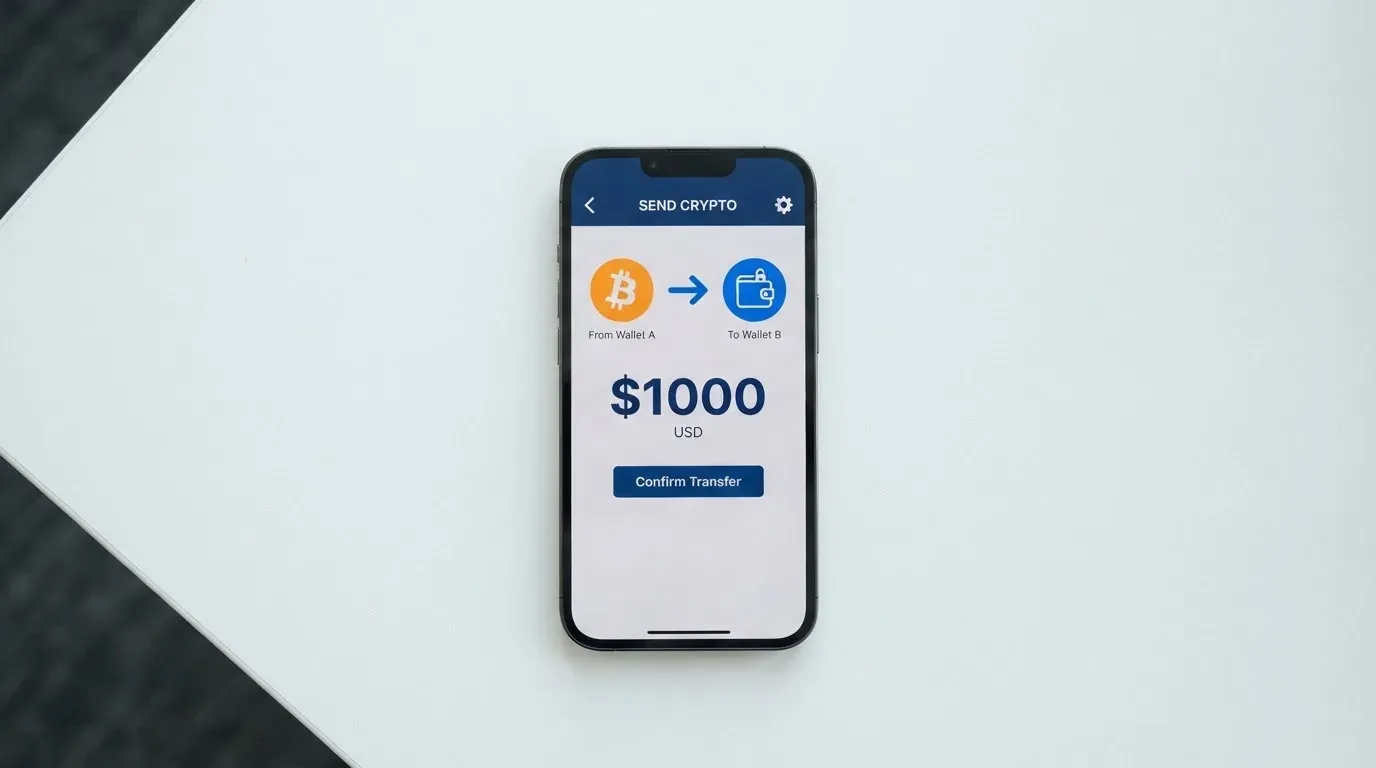
The sequence in practice: you send crypto to an address for the right network, the provider credits the card balance, and you spend. The cost is 2.8% plus a possible fixed 1 USDT, with the deposit fee at $0. Network fees may apply on top, and those are charged by the blockchain rather than by WooCard. The minimum top-up is “subject to current provider terms” — no figure is published. Fiat top-up is not stated at all; everything documented is crypto.
Two network details will make or break a first deposit, and both are worth internalising before you send anything. First, the network must match the one the card expects. Second, a transfer on the wrong network, or to an address belonging to another network, can be lost outright or need manual support recovery with no guarantee — blockchain transfers are irreversible by design, and there is no chargeback button on a crypto network. If your USDT sits on Tron and the card wants Ethereum, the difference is not a formality.
If you are coming from a card you want to close, note that withdrawing or refunding the card balance costs 3 USDT. Closure and balance terms are not described; those questions go to the provider. A 3 USDT exit fee is small, but it is the kind of thing that stops people from moving a balance out, and combined with 2.8% per top-up it means frequent in-and-out movement is the most expensive way to use this card.
Paying with it every day
Day-to-day, the card behaves like a prepaid Visa: you load a balance, the balance gets spent, and it cannot overdraw. Apple Pay and Google Pay work on eligible cards where the wallet, your region and the card programme all allow it, with no WooCard markup. Card details and PIN are viewable in the app, and 3-D Secure is supported.
This is genuinely convenient for the specific person WooCard seems built for — someone who lives in Telegram and needs to hand a Visa number to a service that does not take crypto. Adding the card to a phone wallet and paying by tap is the normal case, and it works the way you would hope.
What the pages do not say is where it will not work. Blocked merchant categories are not stated. That matters more than it sounds: gambling merchants carry a merchant category code of 7995, and many issuers block that category by policy rather than by law, with the list varying by issuer. If gambling or similar is part of why you want the card, you are in territory where the card’s own pages give you no answer. And because this is a virtual card with a foreign issuer, some merchants will treat it as foreign or prepaid on the basis of the issuer identification number at the front of the card number, and decline it or add extra scrutiny. Address verification is mainly offered in the US, Canada and the UK and is generally unavailable for foreign-issued cards, which is another reason a decline can happen at the till for reasons that have nothing to do with your balance.
Also worth knowing: a declined authorisation can leave a hold on funds that stays for several days, sometimes up to 7. On a prepaid balance, a hold is money you cannot spend elsewhere.
Three things the pages simply do not address: rewards — no cashback programme is mentioned; the app — the service runs inside Telegram and no App Store or Google Play listing is named; and disputes — how a chargeback would be handled is not stated, and that question goes to the provider’s support. That last one is not a small gap. A chargeback is the refund a card issuer orders to settle a dispute, with reason codes for fraud, duplicate billing or goods not received. If you cannot get a straight answer about who handles them before you need one, you are finding out at the worst moment.
What can go wrong
The specific risk here is not fraud or a collapse. It is opacity. WooCard does not hold customer funds — the provider does — and WooCard names neither the provider nor any licence. No legal entity, registration or address is given. So the counterparty you are trusting with your balance is a party with no public identity.
That is not a hypothetical concern for this category. Custodial platforms have a documented history of failure: Mt. Gox, with roughly US$350 million reported stolen between 2011 and 2014; Coincheck, about US$400 million in 2018; and the Ronin Network bridge, US$625 million in 2022. Card programmes specifically have closed: WaveCrest, a Visa issuer that supplied crypto card brands, was suspended by Visa in Europe in 2018 and all its Visa programmes were closed; and Visa terminated its global agreements with FTX on 13 November 2022, with the FTX US debit card wound down by its issuer. Closures typically follow a shape — notice, then spending and loading stop, then you are asked to withdraw what is left. One 2026 closure reported by a secondary source had new loads ending 8 July 2026 and spending stopping 8 August 2026; that is a single unconfirmed source, and I give it to you as the shape of a timeline rather than as a prediction.
Sanctions and screening cut both ways. Crypto funding is screened for sanctions and anti-money-laundering purposes, which is why the block list exists. But Tether says it disables tokens in wallets on the OFAC sanctions list and has frozen funds tied to illicit activity, so stablecoins are not censorship-proof — that is a feature if you are worried about blocked funds and a risk if you are worried about your account being frozen and the balance going with it.
On identity: WooCard’s own pages describe onboarding checks by the provider and simplified due diligence for low-limit tiers. A third-party listing claims no KYC at all. If the no-KYC version is accurate at the start, expect limits to start small and expect the possibility of a document request later. In the EU, customer due diligence normally covers name, address, date of birth, nationality and identity documentation, a sanctions check, the purpose of the relationship, and whether you are a politically exposed person; if it cannot be completed, the institution is required to refrain from the transaction and, where necessary, end the relationship. Prepaid and debit cards are generally for adults 18 and over, and some issuers set higher limits. None of that is WooCard-specific law, but it is the standard these things are built to, and an unnamed provider will be running inside some version of it.
Where the card does say something reassuring: crypto funding is screened for sanctions and AML, 3-D Secure is supported, card details and PIN are viewable in the app, and freeze and terminate controls plus OTP and 3-D Secure codes live inside the Telegram app. Those are the standard safeguards — app-based two-factor, instant freeze, spending limits, 3-D Secure confirmation, tokenised mobile wallets. They are sensible. They are also, in the end, controls operated by the provider on a system it owns.
And the review record is empty. A search for WooCard reviews turned up only name collisions with unrelated businesses and a listing marked “Not yet rated” — user report: none. No Trustpilot page for this card was found, and no Reddit thread. That is not evidence of anything bad. It is simply the absence of any third-party account of how this card behaves when something goes wrong, which is exactly the information you would want before loading money.
Two smaller operational gaps. Telegram support hours and languages are not stated. And the balance-exit fee of 3 USDT, plus closure terms that are not described, means getting out is not frictionless.
What to take instead
If the thing stopping you is that you cannot identify who issued this, the alternatives are not obviously better on that axis either — but they are more legible in other ways, and comparing them is more useful than declaring a winner. Here is where each one stands.
| WooCard | Azul Card | Telecard | OnCards | |
|---|---|---|---|---|
| Score | 5.6 / 10 | 5.3 / 10 | 6.1 / 10 | 4.6 / 10 |
| Card | Virtual Visa, USD or EUR; up to 5 active, 3-year validity | Virtual only; Mastercard; balance in USD | Virtual Mastercard, instant; no physical or metal card | Virtual, “Mastercard / Visa” network not fixed |
| Who can get it | Countries not listed; 44 places blocked, incl. Russia, Belarus, Serbia | Worldwide except Russia, Belarus, North Korea, Iran, Syria, Cuba, Sudan, Venezuela, Ukraine and the Crimea, Donetsk, Luhansk, Zaporizhzhia and Kherson regions; restrictions apply regardless of nationality | Over 150 countries where Mastercard is accepted; terms bar only users blocked or sanctioned by the US Government, including OFAC | Not stated; no country list |
| Setup cost | Standard 9 USDT, VIP 85 USDT | $20 one-time, refunded after $2,000 in spending | Standard $5 one-time; VIP $49 setup then $19/month; VIP reissuance $15; main page says signing up is free with no monthly fee on basic | Not stated (“no hidden charges”, no amounts) |
| Running cost | $0 maintenance; top-up 2.8% plus possible 1 USDT; swap 0.1%; ATM on VIP only | $5/month; crypto top-up 4%; $0.25 per transaction; FX fee not stated | Currency conversion 1.5% on non-USD payments; gas 0.5 USDT per successful transaction; FX and cross-border “up to 3% each”; $99 minimum deposit to activate, stated as “NOT a fee” | Not stated |
| Funding | USDT, USDC, TRON, ETH, BTC; wallet 18+ coins, 4 networks; swap to stablecoins | Crypto sent in Telegram; coins and networks not named; first top-up up to 10 minutes, later 1–5 minutes | USDT on Tron or Ethereum; USDC on Ethereum; Polygon not supported; bank transfers “coming soon” | USDT BEP20 only; bank transfers not accepted |
| Rewards | Not stated | No cashback; referral pays “up to 40% of our fees” | Fiorini per activated friend plus cashback; 1 USDT = 100 Fiorini; rate not specified | Not stated |
| ATM | VIP only; fee not stated (unofficial: free, unlimited) | Not stated | Not stated | Not stated |
Azul Card is the interesting comparison because it is the one that states its restrictions most plainly. Worldwide except a named list that includes Russia, Belarus, North Korea, Iran, Syria, Cuba, Sudan, Venezuela and Ukraine and four regions of it — and the site says the restrictions apply regardless of your nationality, so at least you know the rule before you apply. It is virtual only, on Mastercard, with the balance in USD. The economics are worse for most people: $20 to create the card, refunded after $2,000 in spending, then $5 every month, 4% to load and $0.25 per transaction. Its timing advantage is real though — first top-up up to 10 minutes, then 1 to 5. Its referral scheme pays “up to 40% of our fees from every transaction made by your referrals”, which tells you something about where the money comes from.
Telecard scores highest of the four and is the one to look at if your objection to WooCard is the reliability score rather than the anonymity. It is a virtual Mastercard with no physical or metal card at all, USD-denominated, so non-USD payments carry a 1.5% conversion fee. The pricing is more complicated than WooCard’s: $5 one-time for Standard, or $49 setup plus $19/month for VIP, $15 to reissue a VIP card, 0.5 USDT gas per successful transaction, and FX and cross-border fees of “up to 3% each”. There is also a $99 minimum deposit to activate, which the site insists is “NOT a fee” because the money stays in your wallet — a distinction that is legally meaningful and practically a hurdle. Funding is narrower than WooCard’s: USDT on Tron or Ethereum, USDC on Ethereum, no Polygon. Its terms bar only users sanctioned by the US Government including OFAC, with no country list at all, which is permissive on paper and untested in practice.
OnCards I would mention mainly as a floor. It is the thinnest of the four: no country list, no prices, no fees, no rewards, virtual only, network not even fixed (“a virtual Mastercard / Visa card directly in your Telegram”), and funding restricted to USDT on BEP20 with no bank transfers. Very little to recommend it and very little to warn you about.
Worth keeping in view as you compare: the Virtual Asset Service Providers Act. Its stablecoin rules applied from 30 June 2024 and the crypto-asset service provider rules from 30 December 2024. Under it, e-money tokens may be issued only by a credit institution or an electronic money institution, and the transitional period lets providers already operating under national law continue only until 1 July 2026 or until they receive or are refused authorisation, whichever comes first. ESMA keeps a public interim register of authorised providers — that is the one concrete thing you can do before funding any of these: look the issuer up there. And a card is regulated separately from the crypto side, which is why a crypto card can rest on two licences. If neither the brand nor the issuer appears on that register, you have learned something useful before sending anything.
Who I would recommend it to
Three profiles, in order of how comfortable I am.
Definitely worth a try if you live in Telegram all day, you need a working virtual Visa in USD or EUR for online subscriptions, you are not moving savings through it, and you are the kind of person who checks a dashboard. You will probably like it: 2.8% to load, $0 per purchase, $0 per decline, no monthly fee, Apple Pay and Google Pay on eligible cards. Fund it with an amount you would not mind setting on fire, keep it loaded, and use it for what it is good at.
Think hard if you are moving meaningful sums, if the balance would be money you miss, or if your income depends on the card being there. The missing issuer is the sticking point, not the fee list. Before you load, find out who the provider is — ask in the Telegram support group, and look for the entity on the ESMA interim register. If nobody will tell you, that is your answer.
Skip it if you need a physical card, if you need a card in a currency other than USD or EUR, if you need to be able to name your issuer in a dispute, or if you want a track record. On the physical card: unofficial listings mention one exists at an unstated fee, but the card’s own pages describe virtual cards only, and I would not plan around a third-party sentence. On the track record: no reviews, no Trustpilot page, no Reddit thread, no official incidents found — which is not the same as a clean sheet.
One last thing I would tell anyone considering it, and it is not specific to WooCard. Tax treatment follows the crypto, not the card. Digital assets are generally treated as property, so exchanging them for goods, services or dollars generally produces a taxable gain or loss, measured in local currency at fair market value on the date of the transaction — which means each card payment funded from crypto can be a separate disposal. That is a fact about how the rules work, not advice about what to do; take it to an accountant in your own jurisdiction before you turn a payments convenience into a tax question.
Frequently asked questions
What is WooCard?
WooCard is a Telegram-based service selling access to a virtual Visa card in USD or EUR, in two tiers: Standard at 9 USDT without ATM, and VIP at 85 USDT with ATM. WooCard itself describes itself as a brand, marketing and affiliate referral partner rather than an issuer — the actual provider is not named. It runs entirely inside Telegram, and the whole service lives in the app rather than a separate mobile app.
Is WooCard a bank, and who owns it?
No. WooCard states on its own site that it is “a brand, marketing, and customer-acquisition partner and affiliate referral service”, that it is not the issuer, and that it does not hold customer funds — the unnamed provider does. No legal entity, registration or address is published, and no licence is named. That is the single most important thing to know before you load money.
Do I need KYC to get the card?
Sign-up needs an active Telegram account and an email, and that is all the card’s own pages describe as requirements. Onboarding and AML checks are handled by the unnamed provider, and “simplified due diligence” may apply to low-limit prepaid tiers. A third-party listing claims no KYC at all — no document, no selfie — but that is unofficial and not confirmed by WooCard. Required documents and minimum age are not stated on the official pages.
Is WooCard available in my country?
The issuing countries are not published; WooCard only says the card is “not available in all jurisdictions” and that the provider decides. What is published is a block list of 44 places, including Russia, Belarus, Serbia, Albania, Cuba, Iran, Afghanistan and North Korea. Whether the block follows citizenship or residence is not stated. If your situation is ambiguous, ask the provider directly before you assume you are eligible.
How much does WooCard really cost?
Card creation is 9 USDT for Standard or 85 USDT for VIP, with $0 monthly maintenance. Loading costs 2.8% plus a possible fixed 1 USDT, and a crypto swap costs 0.1%. Purchases, declines and cross-border payments are $0, and currency conversion outside your card currency uses official Visa rates with no WooCard markup. Withdrawing the card balance costs 3 USDT. Network fees for the blockchain transfer may apply on top.
How do I top up, and which network do I use?
You send crypto to an address: USDT, USDC, TRON, ETH or BTC are listed, and the wallet supports 18+ coins across 4 networks with a swap into stablecoins. The deposit fee is $0, and the cost is the 2.8% plus possible 1 USDT. Get the network right — a transfer on the wrong network, or to an address belonging to another one, can be lost or need manual support recovery with no guarantee, because blockchain transfers cannot be reversed.
Can I add WooCard to Apple Pay or Google Pay?
Yes, on eligible cards, where your wallet, region and the card programme all permit it. The card number can be added to the mobile wallet and used for tap payments with no WooCard markup. Wallet services tokenise the card number into a device-specific number and use a fresh one-time code per payment. Note that the card’s own pages do not state which merchant categories are blocked.
Is WooCard safe to use with real money?
The card does not hold your money — an unnamed provider does, and that provider is not identified anywhere on the public pages. WooCard does say crypto funding is screened for sanctions and AML, 3-D Secure is supported, and freeze, terminate, OTP and 3-D Secure controls sit inside the Telegram app. Those are sensible safeguards, but the counterparty behind them is not documented, and I found no user reviews, no Trustpilot page and no Reddit thread at all.
What are WooCard’s limits on spending and ATM?
The card’s own pages publish no figures: daily and monthly spend limits are not stated, and load limits and monthly load capacity are “subject to current provider terms”. On ATM, Standard has no cash withdrawal at all, and VIP does, with the fee not stated. A third-party listing claims unlimited daily spend, $200,000 monthly, unlimited ATM and a $20 minimum top-up — unofficial, not confirmed by WooCard, and at odds with the official wording.
What should I do if I want out?
Withdrawing or refunding your card balance costs 3 USDT. Beyond that, closure and balance terms are simply not described on the public pages, so that question goes to the provider’s support — along with how disputes and chargebacks would be handled, which is also unaddressed. Telegram support hours and languages are not stated either. If those answers are important to you, ask before you load rather than after.
Choosing a virtual card – cryptocardadvisor
Content created by the «cryptocardadvisor» team