
KuCard: a Visa debit card tied to your KuCoin balance, built for EEA residents who already use the exchange
 Available in US
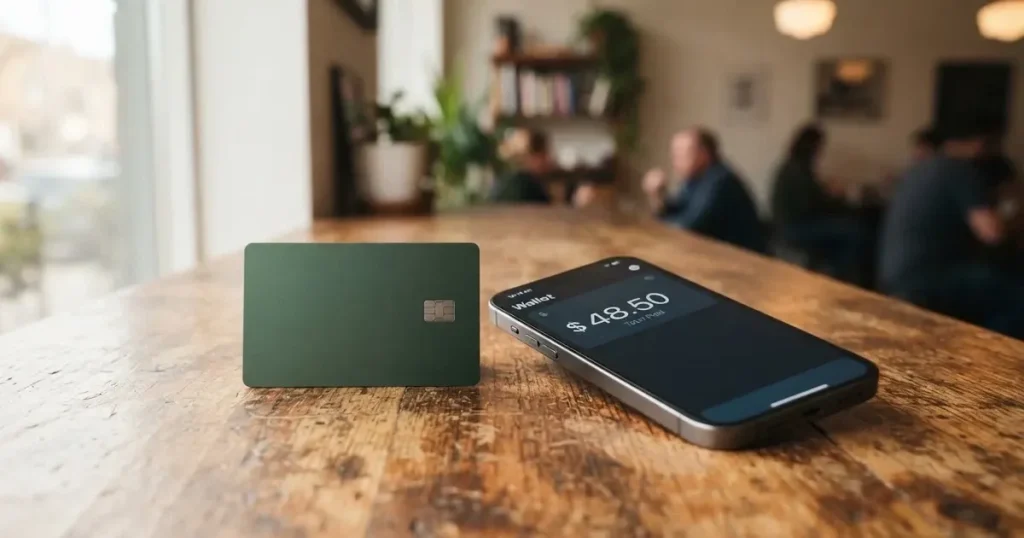
KuCard is a Visa debit card that draws on a crypto balance held inside the KuCoin EU platform. It comes in a virtual form, which is issued almost immediately, and a Chip&Pin physical card posted to your address. The default spending currency is USDT, and the card converts to euros at the moment of payment, which is why KuCard appeals to people who already keep stablecoins on KuCoin and want to spend them without an extra conversion step.
This review is written for someone who is weighing KuCard against other crypto cards and wants to know what the product actually delivers in practice, from eligibility and sign-up to fees, top-up, everyday use and the things that can go wrong. The conditions described here are current as of October 28, 2026.
Verdict
I give KuCard a score of 6.0 out of 10. It is a narrow but well-defined product: if you are an EEA resident with a verified KuCoin EU account and you already hold USDT on the platform, the card is a straightforward way to turn that balance into a Visa you can spend. If you live outside the EEA, do not already use KuCoin, or want a card you can fund from a regular bank account, KuCard is not the right fit.
| Criterion | Score | Why it matters |
|---|---|---|
| Who can get it | 5 / 10 | EEA citizens and residents only, with an EEA-issued ID; Malta is excluded |
| Cost | 6 / 10 | First virtual card is free, but extras and the physical card are paid; non-euro payments carry a 2% fee |
| Top-up options | 4 / 10 | Funded from crypto in the KuCard account only; the list of supported coins and networks is not published |
| Reliability and complaints | 7 / 10 | Issuer is Wallester AS in Estonia, supervised by the Estonian FSA; card-specific complaints are very rare, though KuCoin exchange has a troubled reputation |
| Everyday use | 8 / 10 | Visa network, virtual card issued at once, Chip&Pin physical, Apple Pay and Google Pay reportedly supported |
The audience this card is built for is EU residents who already use the KuCoin exchange. If you fall into that group, KuCard is convenient and reasonably priced. If you do not, the geographic restriction and the crypto-only top-up make it a poor match.
Who can get a KuCard
The eligibility rules are stricter than for most crypto cards, and they come from the card’s terms rather than from a marketing summary. You need to be a citizen or resident of the European Economic Area, which means the EU member states plus Iceland, Liechtenstein and Norway. The KuCoin help pages add one explicit exclusion: the card is not available in Malta. You also need an identity document issued by an EEA country, so a residence permit in an EU state backed by a non-EU passport will not be enough on its own.
If you are reading this from outside the EEA, KuCard is not a card you can apply for, and there is no indication that the issuer plans to expand the geography. The issuer, Wallester AS, is an Estonian e-money institution supervised by the Estonian Financial Supervision Authority, which is why the card programme is built around EU-style identity checks and an EU licensing footprint rather than a global rollout.
Because the rule combines citizenship or residence with the place the ID was issued, the practical effect is that KuCard is open to people who are fully embedded in the EEA: they live there, they have an EEA passport or national ID, and they can pass standard KYC. People who are still in the middle of moving to Europe, or who hold residency in a non-EEA country, will not qualify.
How to get it
The sign-up path is the same as for any KuCoin EU product, because the card is not a standalone app: it is a feature inside your existing KuCoin EU account. You start by opening or signing in to a KuCoin EU account, then complete full KYC, which means uploading a supported EEA-issued identity document and verifying your address. You must be at least 18 years old. Once the account is verified, you apply for the card directly on the platform, choosing between a virtual card and a physical one.
A few practical points are worth knowing before you start. The first virtual card is free, and you can have it in your wallet within minutes; it is meant for immediate online use. The physical card is a Chip&Pin Visa posted to the address on your account and is activated in the KuCoin app or on the website. There is no published list of countries the physical card is shipped to, but since the card programme itself is EEA-only (minus Malta), delivery is effectively limited to the same set of countries. If you want the card faster, there is an “Express Card Delivery” option for €30 per card; a replacement card costs €9.90.
The terms give a short list of reasons an application can be rejected, and they are worth reading in advance so you do not waste a verification attempt: an invalid phone number, a name or date of birth that does not match your documents, an invalid 3-D Secure password, insufficient balance to pay the card fee, and a generic “risk control” catch-all. The processing time for a new application is not stated, so it is worth treating the wait as unpredictable rather than assuming instant approval.
You can hold up to five cards under one account, mixing virtual and physical if you want, and you can cancel a card at any time without a fee. One thing to be aware of with the virtual card is its lifespan: it expires at the end of the month and you re-apply, which is fine if you are happy to manage that, but it is not a permanent card number you can leave on a streaming subscription for years.
Fees: what it really costs
The headline pricing is reasonable for a crypto card, and it is more transparent than the terms suggest once you pull together the fee schedule. The first virtual card is free, each further virtual card is €9.90, and the physical card is €9.90 for the first one (with an older support article quoting €19.90 in places; the fee schedule is the more recent and authoritative figure). A replacement card is €9.90 and a cancellation is free. Express delivery for a physical card costs €30. There is no monthly or annual fee, and the card is a single product with no tiers.
Day-to-day spending is the cheapest part. Payments in euros are free of any extra card-side fee, and payments in a non-euro currency carry a 2% charge on the transaction total. If a payment is declined for insufficient funds there is no fee. Overdrafts are not offered, which is consistent with the card being funded from a pre-loaded balance rather than from a credit line.
| Fee or limit | Amount |
|---|---|
| First virtual card | Free |
| Further virtual cards | €9.90 each |
| Physical card (first) | €9.90 (older source: €19.90) |
| Replacement card | €9.90 |
| Cancellation | Free |
| Express delivery | €30 |
| Euro payments | Free |
| Non-euro payments | 2% of transaction total |
| ATM within Europe | €2 per withdrawal |
| ATM outside Europe | 2% of transaction total + €2 |
| Daily and monthly spending limits | Not stated |
| ATM withdrawal limit | Not stated |
The terms warn that other charges can apply on top of the headline numbers: local fees, third-party fees, network fees, a conversion spread, and IOF fees. The conversion spread is the one that matters most in practice, because every purchase is effectively a crypto-to-euro conversion. The exact spread is not published; the terms say only that the rate is “solely determined by” KuCoin. For people who are used to a normal bank card, this is the equivalent of an FX margin that you can see only in the rate at the moment of payment.
Three everyday scenarios are worth walking through, because they show how the numbers behave in real life.
A €40 lunch in Berlin: no FX fee, no card fee, and the only cost is the crypto-to-euro conversion margin, which depends on the rate KuCoin gives you at that moment. This margin is not officially published and can vary (figures from third-party sites are unofficial). If USDT is at $1 and you are getting roughly one euro per USDT, the conversion cost is the spread alone.
A $50 online subscription in US dollars: the 2% non-euro fee adds $1, plus the same conversion margin. This margin is not officially published (figures from third-party sites are unofficial). On a recurring bill, that 2% plus spread compounds, and a cheaper card may work out better if the subscription is small.
A €100 ATM withdrawal in Spain: you pay €2. If the ATM is outside the EEA, you also pay 2% of the €100 (so €2 more), plus whatever the ATM operator adds. ATM operators can and do add their own fees, which is true of every Visa card and not specific to KuCard.
The daily and monthly spending limits, and the ATM withdrawal limit, are not stated in the public materials. The terms say the issuer may set daily limits, and unofficial reporting says KuCoin does not publish a single universal limit table. This is a real gap if you plan to use the card for a large one-off purchase, because you may find out the limit only when the payment is declined.
Top up: how to fund the card
Top-up is where KuCard looks most different from a regular Visa, and where you need to be clear-eyed about what is and is not supported. The primary funding source is the supported cryptocurrency sitting in your KuCard account, and the default spending currency is USDT. The card converts that crypto to euros at the moment of payment, using a rate determined by KuCoin.
The list of supported coins and the networks they can be sent on is not published. The terms say only that the card is funded from “supported cryptocurrency in the KuCard account” with USDT as the default, and the help pages do not give a fuller list. If you hold BTC, ETH or a non-stablecoin on KuCoin, it is not clear from the official materials whether the card can spend it directly or whether you need to convert to USDT first; in practice, the safer assumption is to convert to USDT before paying, because that is the documented default.
There is no top-up fee listed in the fee schedule, but the terms do reserve the right to apply “a conversion spread”, which is the same margin discussed in the fees section. The terms also do not state whether fiat top-up is possible, what the minimum top-up is, or who pays the network fee on a crypto deposit. If you move USDT in from an external wallet, the underlying blockchain fee is charged by the network itself, not by KuCoin, and that is a normal part of any on-chain transfer rather than a KuCard charge.
One practical consideration that often catches people out: stablecoin transfers are irreversible, and the card provider does not control which networks it accepts. If you send USDT on a chain KuCard does not support, or to an address belonging to a different network, the funds can be lost or stuck in manual support recovery with no guarantee. The right approach is to send a small test transaction first, on a network the platform confirms, before moving a larger amount.
Moving money the other way is also worth thinking about in advance. The terms do not state whether you can withdraw a card balance back to crypto or to a bank account, only that refunds from merchants are paid in euros and that an unactivated card may be closed after three months without refund of service charges, and a card can be terminated after four consecutive months of being closed or blocked, or after six months of non-use. The return of balance on closure is not stated, which is another reason to keep the card balance modest rather than treating it as a long-term store of value.
Paying with it every day
Once the card is in your wallet, KuCard behaves much like any other Visa debit card. The virtual card is accepted at any online merchant that takes Visa, including subscriptions, digital services and travel sites; the physical Chip&Pin card is accepted at point-of-sale terminals across the Visa network. There is no published list of merchant categories that are blocked, and the terms point only to the general rule that purchases must not be prohibited by law. Some issuers block gambling (MCC 7995) by policy, but KuCard’s terms do not state whether this category is open or closed, so it is worth testing with a small payment if it matters to you.
Unofficial reporting says Apple Pay and Google Pay are supported, which would put the card on equal footing with mainstream bank cards in countries where mobile payments are the default. The card issuer’s own pages do not confirm this. If mobile wallet support matters to you, the safest path is to add the card inside Apple Wallet or Google Pay and see whether the tokenisation goes through before relying on it day to day.
There is a separate EU rewards programme that is not in the terms but is reported by third-party trackers. According to that reporting, monthly eligible spend unlocks tiers with rising cashback paid in USDC, starting below 500 USDC of monthly spend at 1% (capped at 5 USDC) and rising through six further tiers to 8% on monthly spend above 30,000 USDC (capped at 200 USDC). Points become available 15 days after they are earned and expire after 90 days, with 1,000 points equal to 1 USDC. A monthly inactivity fee of €2 on a virtual card after 90 days without a transaction is also reported. These figures are unofficial: the card’s own terms mention only that “different benefits or rewards” may be offered from time to time, and the reward table is not on an official page. If the cashback is what draws you to the card, treat the numbers as useful background rather than a guarantee.
If something goes wrong with a payment, the terms say you must report an unauthorised transaction within 60 days of the transaction date, or it is treated as correct. Refunds from merchants are paid in euros, valued at the euro amount at the time of the original transaction, and refund processing time is not stated. Card fees are non-refundable. For online payments, 3-D Secure is the identity check that runs in the background; if your card does not prompt for a one-time code or biometric on a new device, the merchant may decline the payment for that reason, especially on foreign-issued cards where Address Verification Service is generally not available.
A practical point on holds: a declined authorisation can leave a temporary hold on the funds for a few days, which means a small balance can feel “stuck” for a few days after a failed payment. This is industry-wide rather than KuCard-specific, but it is worth knowing if you see a missing euro that you expected to be free.
What can go wrong
The risks fall into three groups: card-specific, platform-specific, and category-specific.
Card-specific risks are small but real. The fee schedule, the limits, and the supported coins are not all published in one place, so you can find out a limit only when a payment is declined. The card balance is denominated in fiat after conversion, but the source is a custodial crypto account, so a KuCoin-side event can affect your ability to spend even if the card itself is fine. The 60-day dispute window is short, and unauthorised transactions reported late are treated as correct, which means you need to check the card activity regularly rather than waiting for a statement.
Platform-specific risks are the larger concern, because the card sits on top of KuCoin EU. The exchange profile on Trustpilot has no TrustScore shown (the page is flagged as “unavailable due to a breach of our guidelines”), with 1,597 reviews and 78% one-star as of the most recent read. The themes are consistent across recent months: withdrawal and account restrictions, dormancy fees and repeated ID demands just to log in, P2P disputes, and deposits not being credited. There is only one Trustpilot review I found that is specifically about KuCard, from July 2026, describing around $120 stuck after the card on file expired; the reviewer says KuCoin asked for an old-bank PDF statement, that about €110 in fees ended up being charged, and that replies were slow. That single data point is not a verdict, but it shows what a card-specific complaint looks like in practice: the friction is on the platform side, not the card network side.
The card’s regulatory footing is on firmer ground. The issuer is Wallester AS, an Estonian e-money institution (registry code 11812882) that is a Visa principal member and supervised by the Estonian Financial Supervision Authority. UAB EURLITA in Lithuania operates the virtual currency exchange and deposit side under national law, and KuCoin operates the platform. The fee schedule is dated 29 September 2026. The 2024 EU crypto regulation (MiCA) is in force, with e-money token and stablecoin rules applied from 30 June 2024 and the broader crypto-asset service provider rules applied from 30 December 2024. There is a transitional period running until 1 July 2026 for providers already operating under national law, and an interim register of authorised CASPs is kept by ESMA, so you can look up the relevant entities yourself.
Category-specific risks apply to any crypto card and are worth holding in mind. The card is custodial in practice, which means the funds sit on the KuCoin platform until the moment of payment; you do not hold a private key, and the terms do not use the word “custodial” but the structure is custodial. Custodial platforms have a history of large failures: Mt. Gox (around US$350 million reported stolen between 2011 and 2014), Coincheck (around US$400 million in 2018), Ronin Network (US$625 million in 2022), and the FTX US debit card, which was wound down in November 2022 after Visa terminated its global agreements. A card programme can also be closed by the network, as happened to WaveCrest-issued Visa programmes in Europe in 2018. None of this is specific to KuCard, but it is the landscape you are buying into when you keep a balance with a card issuer rather than with a self-custody wallet.
On the security side, the card supports strong customer authentication (two independent elements for sensitive actions), unauthorised-use liability is capped at €50 unless fraud or gross negligence is involved, and the terms tell you to freeze your account on the platform if the card is lost or stolen. Two-factor authentication is not specifically mentioned in the terms, which is a small gap; insurance on the card balance is not stated.
What to take instead
If KuCard does not fit, the alternatives worth comparing are Young Card, MSX and Bybit Card. The three are not equivalent, and the difference starts with who can actually get them.
| Card | Score | Who can get it | How it is funded | Rewards |
|---|---|---|---|---|
| KuCard | 6.0 / 10 | EEA citizens and residents, EEA-issued ID, not Malta | Crypto in the KuCard account, default USDT | EU programme by monthly spend, unofficial: 1%–8% in USDC, points expire after 90 days |
| Young Card | 5.7 / 10 | Not stated officially | Not stated officially | Cashback paid in YNG tokens, by Club tier: Essential 0.1%, Gold 1.8%, Platinum 3.6% |
| MSX | 6.4 / 10 | Not stated officially | Not stated officially | Not stated officially |
| Bybit Card | 6.0 / 10 | Country-specific; explicitly not for EEA customers | Crypto on the Bybit platform, draws on Funding Account and Flexible Easy Earn | From 5 October 2026 only crypto-funded transactions earn; Base 2% to Infinite 10% by tier, paid in USDT |
Bybit Card is the most fully documented of the three and is worth a closer look if you are not in the EEA: it operates in Argentina, AIFC (Kazakhstan), Georgia, Kazakhstan, Australia, Mexico, Brazil, Peru and Asia Pacific, with explicit country-specific pricing. The card has no balance of its own and draws on the Funding Account (and the Flexible Easy Earn balance), spending fiat first and selling crypto only when the fiat runs out. The supported coins are BTC, ETH, XRP, USDT, USDC and GRAM, with a default order of USDT > USDC > GRAM > BTC > ETH > XRP that you can change in the Card Dashboard. The conversion fee is 0.9% on top of the One-Click Sell rate in most regions (0.5% in Argentina), and the FX fee is 2% on top of the network rate in Australia, Asia Pacific, Georgia and Mexico, 2% as an “International Fee” for Kazakhstan, 7% in Argentina, 1.5% in Brazil and 1% in Peru. The reward tiers, as of 5 October 2026, run from Base at 2% to Infinite at 10% of monthly spend, paid in USDT, with a 10% welcome cashback up to 110 USDT in the first 30 days. The Bybit Card page is explicit that “this product is not meant for European Economic Area customers”, so it is the alternative for people KuCard rules out, not for people KuCard suits.
Young Card and MSX are thinner on public information: their official pages do not state the basics that you would need to compare fees, eligibility and funding head-to-head with KuCard. The one reliable data point for Young Card is the cashback structure, which is paid in YNG tokens and ranges from 0.1% (Essential) through 1.8% (Gold) to 3.6% (Platinum), with Bronze and Silver not stated. If you are choosing between these and KuCard on the documented information alone, the comparison is incomplete and the safer move is to assume the worst about the gaps until the issuer publishes more.
Who I would recommend it to
The honest answer is that KuCard is a good card for a small, specific group of people, and a poor card for everyone else.
It is a good fit if you are an EEA resident (excluding Malta) with an EEA-issued ID, you already use the KuCoin EU platform, and you hold USDT or another supported stablecoin there. For you, the card is a way to convert that balance into a Visa without leaving the KuCoin app, the first virtual card is free, euro payments are free, and the small set of fees (€9.90 for a second virtual card, €9.90 for a physical, €2 for an EEA ATM withdrawal) is easy to budget around. The unofficial reports of Apple Pay and Google Pay support, and the unofficial EU cashback programme, are reasonable bonuses if they apply to your situation.
It is a poor fit if you live outside the EEA (the card is not available to you), if you do not already use KuCoin and have no reason to (the card is a feature of the platform rather than a standalone product), if you want a card you can fund from a bank account (fiat top-up is not stated, so the assumption is that you cannot), or if you want a card with a published, generous reward programme (the cashback is unofficial, has caps and 90-day point expiry, and a €2 monthly inactivity fee on a virtual card after 90 days is reported).
There is also a middle group: people who would qualify, who are comfortable with KuCoin, but who place a high value on transparency. If you want every fee, every limit and every reward rate on a single official page, KuCard is not yet that product. The fee schedule exists and is more complete than the terms, but the supported coins, the networks, the limits and the rewards are not all in one place, and a meaningful part of the picture is unofficial third-party reporting.
The bigger question, beyond the card, is whether the platform underneath it is the right place to keep a balance you intend to spend. KuCard inherits the strengths and weaknesses of KuCoin EU, and on the evidence available, the strengths are regulatory (Wallester as issuer, Estonian supervision, MiCA in force) while the weaknesses are operational (a large volume of recent complaints on the exchange profile about withdrawals, account restrictions and ID friction, even though card-specific complaints are rare). The card itself is a competent product. The decision is whether the platform is where you want your spending money to live.
Frequently asked questions
What is the KuCard card?
KuCard is a Visa debit card that is funded from a crypto balance held inside a KuCoin EU account. The default spending currency is USDT, which the card converts to euros at the moment of payment. It comes as a virtual card, issued almost immediately, and as a physical Chip&Pin card posted to your address.
How does KuCard work?
The card draws on the supported cryptocurrency in your KuCard account, converts it to euros at a rate set by KuCoin, and then pays merchants through the Visa network. The virtual card is meant for online use, the physical card works at point-of-sale terminals, and a separate EU rewards programme reportedly pays cashback in USDC based on monthly eligible spend.
Is KuCard a bank?
No. KuCard is a payment card issued by Wallester AS, an Estonian e-money institution supervised by the Estonian Financial Supervision Authority. Wallester issues the card under a Visa principal membership, and KuCoin operates the platform on which the card sits; the KuCard balance is not a bank deposit and is not covered by a deposit guarantee scheme.
Who owns KuCard?
The card is a KuCoin product. The issuer is Wallester AS (Estonia, registry code 11812882), and UAB EURLITA (Lithuania) operates the virtual currency exchange and deposit side. KuCoin itself operates the platform where you apply for the card and manage the balance.
Is KuCard available in my country?
The card’s terms restrict it to citizens and residents of the European Economic Area (the EU plus Iceland, Liechtenstein and Norway), with an EEA-issued identity document. The KuCoin help pages add that the card is not available in Malta. Outside this set of countries the card is not offered.
How do I apply for KuCard?
You open or sign in to a KuCoin EU account, complete full KYC with a supported EEA-issued ID and address verification, and then apply for the card on the platform. The first virtual card is free; the physical card is paid; express delivery is available for €30.
Does KuCard require KYC?
Yes. You need a verified KuCoin EU account with a supported EEA-issued identity document, address verification, and to be at least 18 years old. If you cannot complete the checks, the issuer is required to refuse the relationship rather than issue a card without verification.
Is KuCard free?
The first virtual card is free, euro payments are free, and cancellation is free. The second and subsequent virtual cards cost €9.90 each, the physical card is €9.90 for the first (with one older source quoting €19.90), a replacement card is €9.90, and express delivery is €30. Non-euro payments carry a 2% fee, and a conversion spread applies on top of the headline rate. A €2 monthly inactivity fee on a virtual card after 90 days without a transaction is reported but unofficial.
Can I add KuCard to Apple Pay or Google Pay?
Unofficial reporting says yes, both Apple Pay and Google Pay are supported. The card issuer’s own pages do not confirm this, so the practical test is to add the card inside Apple Wallet or Google Pay and see whether the tokenisation completes before relying on it day to day.
Is KuCard safe?
The card sits on a regulated base: an Estonian e-money issuer supervised by the Estonian FSA, with the broader crypto side covered by EU rules under MiCA. The balance is held on the KuCoin platform, which is custodial in practice even though the terms do not use that word, so platform-level events (withdrawal restrictions, account reviews, dormancy fees) are the main risk to budget around. The card also caps your liability for unauthorised use at €50 unless fraud or gross negligence is involved, and unauthorised transactions must be reported within 60 days.
Choosing an exchange card – cryptocardadvisor
Content created by the «cryptocardadvisor» team