
A Visa card you load with stablecoins, read closely before you trust it
 Available in US
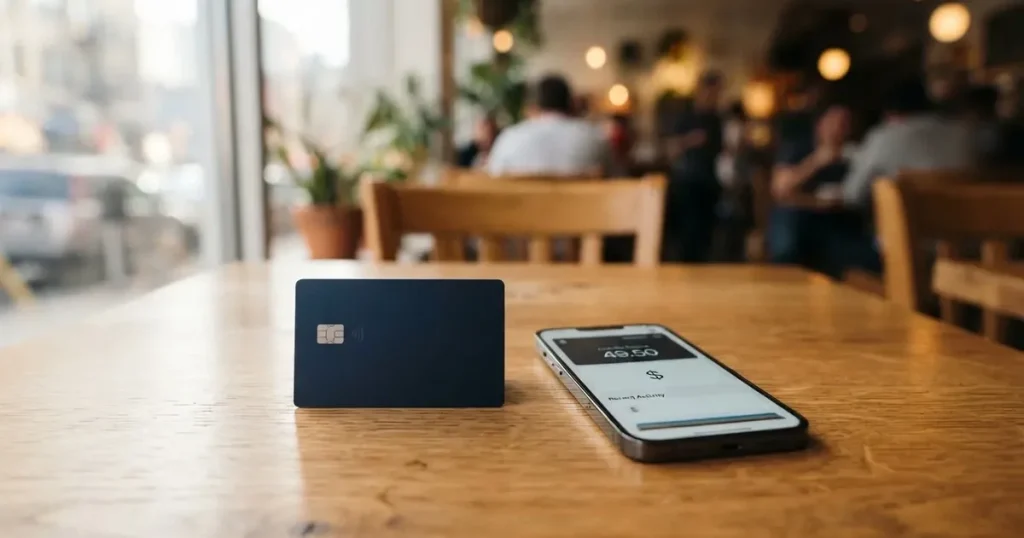
MaaarPay is a digital Visa card that you load with cryptocurrency — mostly USDT or USDC — and then spend like an ordinary payment card, in stores and online, in your local currency. On paper that solves a specific problem: getting a normal bank card when your own bank, your country or your paperwork says no. That is the reader this review is written for. The card is built for people funding a digital Visa with USDT or USDC.
The conditions described here are current as of October 28, 2026.
Before the details, the honest summary. MaaarPay scores 6.7 out of 10. It is not a bad card. It is a young card, run by a licensed technology company in Dubai that explicitly says it is not a bank, with some genuinely strong points — 150+ countries, several top-up assets, Apple Pay and Google Pay, an app freeze button — and some genuinely weak points: two percentage fees that stack on top of each other, no published list of countries, a physical card that does not exist yet, and a cross-border fee that can eat a large slice of a modest payment.
Verdict: 6.7 out of 10
| Criterion | Score | Why |
|---|---|---|
| Who can get it | 8 / 10 | “Available in 150+ countries”, but the list is not published; US citizens are excluded and the terms refer to OFAC sanctions |
| Cost | 4 / 10 | Currency fee up to 2%, Cross Border Fee up to 3%; issuance and crypto conversion fees are not disclosed |
| Top-up options | 8 / 10 | USDT, USDC and other supported crypto, with BTC also listed on the home page; card collateral held in stablecoins on Ethereum, Polygon, Optimism, Arbitrum |
| Reliability and complaints | 8 / 10 | MAAAR PAY FZCO (DMCC, Dubai, licence DMCC-981512), issuer named as Third National under a Visa licence; no complaints found |
| Everyday use | 6 / 10 | Digital card instantly, Apple Pay and Google Pay, freeze in the app; physical card and ATM marked “Coming soon” |
| Total | 6.7 / 10 | Strong on access and funding, weak on published pricing and on what does not exist yet |
Who this suits: someone who already holds USDT or USDC, cannot get a normal card, mostly spends online or in their own country, and is comfortable reading terms rather than expecting hand-holding. The instant digital card, the mobile wallets and the app freeze are real advantages over juggling crypto through an exchange.
Who this does not suit: anyone who needs a physical card next week, anyone who lives in a currency where the two percentage fees would hurt, anyone who spends in the US, and anyone who needs the crypto conversion fee to be a known, fixed number rather than an undisclosed one. If your spending profile is large amounts in a weak currency, a 2% currency fee plus a cross-border fee of up to 3% is not a rounding error — it can be a third of what you were going to pay.
I also want to be plain about what I could not find. There are no published complaints, no Trustpilot page, and no news record I could locate — that is not proof of a clean history, it is proof of a thin one. A young card with no complaints and no public track record is a different proposition from a large institution with a long one, and you should price that difference in.
Will they give you the card?
Partly. MaaarPay says it is “available in 150+ countries” and does not publish the list — and the absence of a list is itself the information. The terms require you to attest that you are “not a United States citizen” and refer to OFAC sanctions. The terms do not say whether that rule applies to citizenship, residence, or both; my research does not close that gap, and neither will any page the company publishes today.
So the practical answer is: not to US citizens, and not to anyone whose own screening catches them. If you are in a country that is subject to sanctions and you are not sure where you stand, the honest answer is that you need to ask the company directly, not to guess from a card page.
Beyond that, sign-up includes “secure identity verification”. The card’s public pages do not state which documents you need, whether proof of address is required, what the minimum age is, or what the verification tiers look like. There is an AML & KYC Policy page on the site; I did not read it, and I would not characterise what is in it.
The company side is at least legible. The operator is MAAAR PAY FZCO, licensed in the Dubai Multi Commodities Centre, Licence No. DMCC-981512, Reg. No. DMCC202616. It has a subsidiary, MAAAR CIRCLE PAYMENTS LTD. in British Columbia, Canada (BC1585437). It describes itself as a “technology service provider and does not provide banking or money transmission services”. The issuer is named as Third National, under a Visa licence, and BANEX MICROFINANCE BANK LIMITED is named for Nigerian users.
Read that structure carefully. MaaarPay runs the product; a licensed third party issues the card. That is normal for this category — networks do not issue to consumers directly, they license issuers — but it means the entity whose name is on your card statement is not the entity whose app you use, and not the company whose name is on the site.
How to get it
The path is short, and it is the digital card that matters today.
- Create the account and complete identity verification.
- Get the digital card, which is available instantly in the app.
- Add it to Apple Pay or Google Pay.
- Load it with crypto and spend.
Two details will shape what you can do afterwards. First, the physical card is marked “(Coming soon)” — not available, coming soon — so if you were planning on a plastic card in the post, that plan does not exist yet. The same applies to ATM withdrawals, which the site advertises as “ATM Withdrawals in over 150 countries” while simultaneously marking that feature as coming soon.
Second, this is a Visa card, and Visa converts foreign transactions into USD at the card association’s rate before your balance is touched. That is the mechanism behind the currency fee in the next section, and it is worth understanding before you spend, not after.
The terms say cash advances and balance transfers are not available. That is normal for a card like this, but it removes one common escape route if money ever gets tight.
Fees: what it really costs
Here is the honest picture, and it is not a complete one. Two of the most important numbers are missing.
| Fee or limit | What the card says |
|---|---|
| Issuance fee | Not stated |
| Monthly fee | Not stated |
| Foreign exchange fee (non-USD) | Up to 2% |
| Cross Border Fee | Up to 3% |
| Crypto conversion fee | Not stated |
| Late payment | Up to $40 |
| Returned payment | Up to $29 (section 6 says $00.00 — the card’s own pages conflict) |
| Interest | 0% APR for now |
| ATM fee | Not stated; ATM withdrawals marked “Coming soon” |
| Cash advances / balance transfers | Not available |
| Purchase limits | No amounts published; the issuer may cap purchases by type, number and dollar amount |
| Restricted transactions | Cash-like purchases: money orders, crypto purchases, gambling |
Three payments, worked through:
A $20 lunch in a euro country, paid from a USD balance. The merchant charges you in the local currency automatically. Visa converts the non-USD amount to USD, and on top of that the card’s foreign exchange fee of up to 2% applies. Add the cross-border fee of up to 3% and the same lunch can carry both fees on top. On a $20 purchase that is noticeable. On a $2 purchase it is still subject to these rates.
A $300 online subscription. Here you are not crossing a border in the way a holiday is, and it is not obvious which of the two fees applies or whether both do. With no crypto conversion fee published and no monthly fee published, the running total is genuinely uncertain — you could work out the cost if the card published its percentages, and it does not.
An online ticket bought with a foreign-issued card. This is where the category’s old problem bites: some merchants decline prepaid or foreign BINs because a lookup on the card number reveals the card type and the issuer country, and the billing address on file matches neither. It is not a rule, it is a shop’s risk decision, and it is more common with digital-only foreign cards like this one.
Also worth knowing: on Ethereum-based networks, gas is paid only in ETH, so a wallet holding USDT with no ETH cannot send. Network fees on your deposit are charged by the blockchain, not by the card company. And declined authorisations can leave a hold on your funds for several days, sometimes up to seven.
Then there are the restricted categories. Money orders, crypto purchases and gambling are blocked. The gambling restriction is normal — the merchant category for casinos, betting and lotteries is routinely blocked by issuers by policy, not by law — but crypto purchases being restricted may catch you out if you were planning to use the card to buy more crypto.
The two “up to” figures deserve one more sentence, because this is the section where the 4 out of 10 comes from. “Up to 2%” and “up to 3%” are ceilings, not the rate you will pay. What you actually pay depends on the currency, the route and the card’s own schedule, which is not published. A card you cannot cost in advance is a card you cannot budget with.
Top up: how to load it
Topping up means moving crypto into the MaaarPay wallet, and the card spends the fiat value of what is there. The wallet is loaded with USDT, USDC or another supported crypto, with BTC also listed on the home page. The card’s collateral is held in stablecoins on Ethereum, Polygon, Optimism and Arbitrum.
What the card’s public pages do not state is which wallet networks you can actually deposit on, and the deposit instructions themselves live in a help-centre article called “Deposit crypto” rather than on the pages I read. That matters more than it sounds. Crypto transfers are irreversible, and a deposit sent on a network the provider does not support, or to an address belonging to a different network, can be lost outright or need manual support recovery with no guarantee. There is also a stablecoin-specific trap: Circle stopped supporting USDC on Tron in February 2024, so “USDC over TRC20” is not a native option here.
The safest procedure is the boring one: read the “Deposit crypto” article in the help centre, confirm the exact network before you send anything, send a small amount first, confirm it has landed, then send the rest. Not because anything here is unusual, but because blockchain transfers do not have a customer-service undo.
On the other side of the ledger, the wallet supports withdrawing crypto to an external wallet — the help article is linked, and I did not read the fees. The terms add a real condition: the issuer may suspend or cancel the account “with or without cause”, and what happens to your balance on closure is not stated. That single sentence is worth more attention than it first appears to deserve.
Paying with it every day
This is where MaaarPay is at its most confident and its score is still only 6. The digital card is instant, works with Apple Pay and Google Pay, and can be frozen and unfrozen at any time from the app. Card details are virtual. The app is on Google Play and the Apple App Store; I did not read the ratings, which is a gap in this review.
That freeze function is worth more than it sounds. Card freeze, app-based 2FA and virtual card details are the standard safeguards of the category, though the card’s marketing language about “advanced security protections” and “institutional-grade SaaS infrastructure” is not a substitute for a specific statement about 2FA, which is not stated. Apple Pay itself is the safer way to hold the card: the number is replaced by a device-specific account number stored in the Secure Element, not on Apple’s servers, and each payment uses a one-time code.
What you cannot do yet is take cash out. The ATM feature is coming soon, cash advances are not available, and the physical card does not exist. So the realistic picture is a card for online payments, contactless taps and card-not-present transactions in your own country — not a replacement for the physical card in your wallet.
If a payment goes wrong, the process is standard and slightly unforgiving: you resolve it with the merchant first, then start a Chargeback in your account, and you must report within 60 days of the transaction posting. The terms refer to AAA arbitration and waive class actions. The arbitration piece is common in this category and it does cost you the easier route — a shared court action — when something goes wrong across many customers at once.
There is no rewards programme. Cashback is not offered, so if you are moving money to the card to earn something back, that is not the reason to do it. The reason is access.
What can go wrong
The card is digital only, for now. No plastic, no ATM. If your phone is lost or its screen is broken and you have not enabled the mobile wallets, you are describing your access to spending money in difficulty.
Two percentage fees, both with ceilings you cannot see. Up to 2% for currency conversion, up to 3% cross-border. No published schedule, no published conversion fee, no published monthly fee. Budgeting is guesswork.
It says it is not a bank and not a money transmitter. MAAAR PAY FZCO calls itself a technology service provider. That is honest, and it is the part people skip. Customer funds in this category are typically safeguarded by segregation in dedicated accounts or insurance — which is not the same as a bank deposit, and generally not covered by a deposit guarantee scheme. You are choosing a different category of protection than a bank account, whatever the marketing says.
The account can be suspended or cancelled “with or without cause”, and the balance position on closure is not stated. Read that clause before you load an amount you would mind losing access to.
Merchant declines. Foreign-issued and prepaid cards get refused at the counter. Address verification is mostly a US, Canada and UK system and is generally unavailable for foreign-issued cards, which by itself causes declines.
Holds after declines. A declined authorisation can tie up funds for days — up to seven. Your balance is not simply “what is left after spending”.
Crypto-side risks sit underneath. If the provider holds your keys, you are trusting them; the sector has a documented history of custodian failures, including Mt. Gox, Coincheck and the Ronin Network bridge. Transfers are irreversible and a stolen key has no recovery path. Stablecoins can depeg — TerraUSD collapsed in May 2022, USDC lost its peg briefly in March 2023 — and Tether says it disables tokens on OFAC-listed wallets and has frozen funds tied to illicit activity, so stablecoins are not censorship-proof.
Programme-level risk is real. Visa terminated its agreements with FTX on 13 November 2022 and the FTX US debit card was wound down. WaveCrest, a card issuer that supplied several crypto card brands, was suspended by Visa in Europe in 2018. Closures typically follow a pattern: a notice period, then loading and spending stop, then you are asked to withdraw your balance. A secondary source reported one 2026 closure ending new loads on 8 July 2026 and spending on 8 August 2026 — single source, unconfirmed, but the pattern is the point.
Compliance friction. Identity verification is part of sign-up, and if due diligence cannot be completed, the account is frozen or closed pending documents. That is not a judgement about you; it is the rule.
The regulatory picture is unsettled. MiCA took legal effect in June 2023, with its stablecoin rules applying from 30 June 2024 and crypto-asset service provider rules from 30 December 2024, and a transitional period running until 1 July 2026 or until a provider gets a MiCA authorisation, whichever comes first. Cards are regulated separately from crypto, so a product like this often depends on two licences. If you are in the EU, ESMA’s interim register of authorised providers is where to check.
What to take instead
I looked at three alternatives in this category. None of them is obviously better; they are better at different things, and comparing them is more useful than ranking them.
| MaaarPay | Cardex | CardFlow | HyperCard | |
|---|---|---|---|---|
| Score | 6.7 | 5.6 | 4.9 | 4.7 |
| Reach claimed | 150+ countries, list not published | 200+ countries, no list or exclusions | Aimed at Nigeria and “global users” | Acceptance in 176+ countries; no eligibility list |
| Card | Visa, digital now, physical “Coming soon” | Debit card on VERVE, Visa, Mastercard, UnionPay; virtual and physical | Virtual USD Mastercard, created in about 3 minutes | Prepaid, network not stated on the store page |
| Price disclosed | FX up to 2%, cross-border up to 3%, rest not stated | No percentage published; “AI-Powered Conversion Rate” claimed | Free card creation; no monthly fee stated | No fees listed |
| Funding | USDT, USDC, other supported crypto, BTC listed | USDT, USDC, BTC | Bitcoin, USDT, ETH or Naira transfer | USDT, BTC, ETH, converted to USD or EUR |
| Rewards | Not stated | Not stated | Not stated | Not stated |
The comparison worth making is not “which is best” but “which unknowns will you pay for”. Cardex claims 200+ countries and gives you virtual and physical cards, but its App Store listing is Naira-focused and it publishes no fee percentage at all — you are buying an “AI-Powered Conversion Rate” claim instead of a number. CardFlow is the clearest for a Nigerian user: it says creating a virtual card is completely free and you can have a USD Mastercard in minutes, but its fees are not stated and it is visibly built for one market. HyperCard says the card works in more than 176 countries, which is an acceptance statement rather than an eligibility one, and the pages I could read list no fees at all.
Against all three, MaaarPay’s advantage is that it at least names its two headline percentages, and its disadvantage is that it names them as ceilings without the schedule behind them. If your priority is knowing your cost to the last cent, none of these cards is fully transparent. If your priority is simply having a usable Visa loaded with stablecoins today, MaaarPay is the most complete of the four on features.
Who I would recommend it to
I would recommend MaaarPay to a reader in this position: you have USDT or USDC already, you have no workable alternative card, you spend mainly online or in your own country, you mostly want Apple Pay and Google Pay rather than plastic, and you are the kind of person who reads a fee schedule before loading money rather than after.
I would not recommend it, without hesitation, if any of these are true: you need cash from an ATM; you need a physical card this month; you are a US citizen; you spend in a currency where the total fees would be visible in your budget; or you need to know your total cost in advance down to a fixed number.
The 6.7 is not a snigger at a card that does a hard job. It is a young product with good bones — a real licensed issuer, a named Dubai company, a proper freeze control, and four networks named for collateral — held back by the simplest thing a financial product can get wrong: not publishing its prices.
One last thing, because it is not a fee and it will cost you if you ignore it. The IRS treats digital assets as property, so spending crypto generally produces a taxable gain or loss measured in local fiat currency at the date of each transaction, and each card payment funded from crypto can be a separate disposal. That is not advice — it is a reminder that every tap has a tax dimension and that keeping records of cost basis is worth more than any cashback programme this card does not have.
Frequently asked questions
What is the MaaarPay card?
MaaarPay is a digital Visa payment card that you load with cryptocurrency rather than from a bank account. You deposit USDT, USDC or another supported crypto — BTC is listed on the home page — and the card spends the fiat value of that balance in stores and online. The card is issued by a third-party licensed institution, and MaaarPay itself describes itself as a technology service provider, not a bank.
How does the MaaarPay card work?
You top up a wallet with stablecoins, and Visa converts what you spend into USD at the card association’s rate, with the card’s own fees applied on top. You then pay in your local currency at the till or online. Apple Pay and Google Pay are supported on the digital card. The physical card and ATM withdrawals are both marked “Coming soon”, so today this is primarily an online and contactless card.
Is MaaarPay a bank, and who owns it?
No. MaaarPay is operated by MAAAR PAY FZCO in the Dubai Multi Commodities Centre, Licence No. DMCC-981512, with a Canadian subsidiary, MAAAR CIRCLE PAYMENTS LTD. in British Columbia. It states plainly that it does not provide banking or money transmission services. The card itself is issued by Third National under a Visa licence, with BANEX MICROFINANCE BANK LIMITED named for Nigerian users.
Is the MaaarPay card available in my country?
The card says “available in 150+ countries” but does not publish the list, and the terms require you to attest that you are not a United States citizen while referring to OFAC sanctions. Whether the rule follows citizenship, residence or both is not stated. If sanctions screening could apply to you, the reliable answer comes from the company directly rather than from the card’s marketing pages.
Does getting the MaaarPay card require KYC, and what documents?
Sign-up includes what the card calls “secure identity verification”, and there is an AML & KYC Policy page on the site. The public pages do not state which documents you need, whether proof of address is required, what the minimum age is, or how the verification tiers work. In practice, expect identity checks in the normal way for regulated services, with the possibility of an account being frozen if documentation cannot be completed.
What does it cost to use the MaaarPay card?
The two published figures are a foreign exchange fee of up to 2% on non-USD spending and a Cross Border Fee of up to 3%. Late payment is up to $40 and a returned payment is listed as up to $29, though another section of the card’s own pages shows $00.00 — the card’s terms conflict with themselves there. Issuance, monthly and crypto conversion fees are not stated. You also pay the blockchain’s own network fee when you deposit.
How do I top up the MaaarPay card, and can I get the money back?
You send supported crypto to the MaaarPay wallet, and deposit instructions sit in a help-centre article called “Deposit crypto” rather than on the main pages. The card’s public pages do not list which networks are accepted, so read that article and confirm the network before sending, and send a small test amount first — blockchain transfers are irreversible. Withdrawing crypto to an external wallet is supported, though the fees are not published and the issuer may suspend or cancel the account.
Can I use MaaarPay card in Apple Pay and Google Pay?
Yes, both are supported on the digital card, which arrives instantly in the app. This is the practical reason to consider the card even with the physical version pending: tokenising it into a mobile wallet gives you tap-to-pay and online payments without plastic. You can also freeze and unfreeze the card from the app at any time, which is the single most useful safety control the product offers today.
Is the MaaarPay card safe?
In the ordinary sense of a prepaid, digitally issued card, it has the usual protections: instant freeze, virtual card details and mobile wallet tokenisation. But it is not a bank deposit, and customer funds in this category are safeguarded rather than insured in the way a current account is. Transfers are irreversible, stablecoins can lose their peg, and providers holding your keys carry counterparty risk. Read the clause allowing suspension “with or without cause” before you load a large balance.
How do I close or delete my MaaarPay account, and what happens to my balance?
The card’s public pages do not describe account closure in detail, and what happens to a balance if the issuer cancels the account is not stated. If that matters to you, get the answer in writing from support before you load funds — the support email is [email protected], and there is also a Telegram channel and a Reddit community linked from the site. The prudent habit is to withdraw what you will not need, rather than leaving a balance parked and hoping.
Choosing a virtual card – cryptocardadvisor
Content created by the «cryptocardadvisor» team