
A gold-backed virtual card with an unlisted issuer
 Available in US
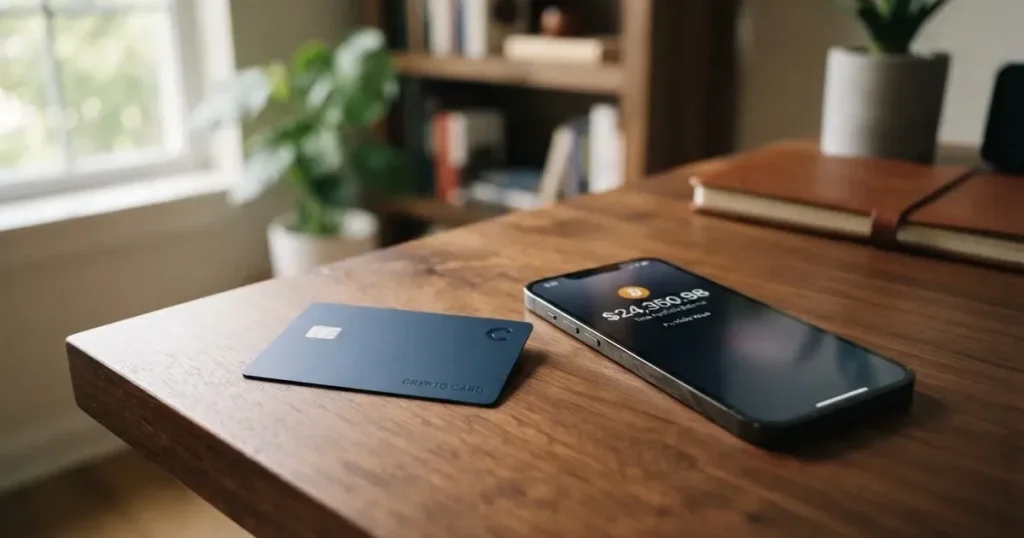
The Kinesis card is not the crypto debit card most people picture when they hear the words. There is no plastic in the post, no ATM, and no stated list of countries on the card’s own pages. What there is, on the evidence of the public pages and the sources around them, is a virtual card tied to an account that holds gold (KAU), silver (KAG), crypto and a stablecoin called C1USD, plus a cashback offer paid in gold.
That framing matters more than the headline number. I scored it 4.8 out of 10 overall, and the reason is not that the product is bad. It is that almost everything you would want to check before trusting your money to it is simply not published: who issues the card, what it costs to hold, what it costs to spend, what network it runs on, which countries can get one. The card’s own pages do not name a card issuer or a licence. That is a first question, not a detail.
The conditions described here are current as of October 28, 2026.
So who is this for? In plain terms: someone who already holds gold or silver through Kinesis, or who wants to spend metal-linked balances, and who can live with a virtual card and a support line rather than a plastic card and a branch. It also suits someone for whom a normal bank card is not available and who wants a way to spend a crypto-side balance anyway.
It does not suit someone who needs a physical card today, a cash machine, Apple Pay or Google Pay, a clear fee schedule, or a published list of eligible countries. It does not suit anyone who wants to know exactly what a payment costs before they make it, because the numbers that would tell you that come from unofficial sources that disagree with each other.
Here is how the score breaks down.
| Criterion | Mark | Why |
|---|---|---|
| Who can get it | 5 / 10 | No country list on the page read; starting data points to the United States, Latin America and the Caribbean; general availability unclear, the site shows pre-registration |
| Cost | 6 / 10 | Not disclosed officially; unofficial sources say no monthly or sign-up fee, a 1.95% transaction fee on one page, and 0.22% conversion plus 0.45% per transaction in another |
| Top-up options | 5 / 10 | Instant conversion of gold (KAU), silver (KAG), crypto and C1USD from the Kinesis account at the point of sale; networks not named |
| Reliability and complaints | 4 / 10 | Card issuer and licences not named; Trustpilot for Kinesis Money 2.4 out of 750 reviews, with withdrawal delays of around 40 days, fee complaints and liquidity worries |
| Everyday use | 3 / 10 | Virtual only; Apple Pay and Google Pay not mentioned; no ATM |
| Total | 4.8 / 10 |
One more thing belongs in the verdict, because it is the card’s genuine appeal and it is unusual: the rewards are framed around gold and silver holders, with 2% cashback paid in gold, and the cashback plan offered as six months free from launch. Paying your rewards in metal rather than dollars is the part of this card nobody else in this category is really offering, and for a person already holding metal, that is a real argument in its favour.
Will they give you the card
The honest answer is that I cannot tell you from the card’s own pages. Eligibility is not stated on the page I read. The starting data points to the United States, Latin America and the Caribbean as the initial markets. General availability is unclear, and the site is showing pre-registration for the virtual card with a six-month free cashback plan “from launch”.
Pre-registration is worth pausing on. It is a signal about maturity. A product that is pre-registered rather than open often means pieces are still being finished, and the details that separate “nearly ready” from “ready” — which countries, which documents, which currencies — tend to be the ones still moving.
If you are reading this hoping to find your own country in a list, assume for now that there is no list, and that you will find out by trying. If your situation is that you have no ordinary bank card and are looking for any way to spend a crypto balance, that changes what matters: your question stops being “is this available in my country” and becomes “will this work in the places I actually shop, and can I get money back out”. Availability is one filter among several, and I would not want you to treat a page that does not name your country as a yes.
What the page does say is that it links to a KYC verification guide. What it does not say is what KYC level the card itself requires. Those are different statements, and only the second one tells you what documents to have ready. Assume you will need to verify, and that the outcome of that verification is a decision someone else makes.
How to get it
The route the pages describe is: register on the site, complete verification, and you are issued a virtual card. That is the entire sequence as far as it is published.
Three things to be clear about before you start:
- It is virtual. The card is delivered digitally. There is no physical version described on the pages I read.
- The card network is not stated officially. Unofficial sources say it runs on Mastercard, operated by BAANX. The separate physical Visa card issued in the US in 2021 is a different product, from Brave New Coin and Substack coverage in 2026, and I would not let the two get confused in your head.
- The card currency is not stated. Nobody has published which currency this card thinks in.
That virtual-only detail is the one that decides whether this card is even a candidate for you. A virtual card lives in a phone or a browser wallet. If the thing you are missing is a card you can hand over at a shop that takes cash, or that survives a dead battery, a virtual card does not fill that hole. If the thing you are missing is a way to spend a balance you cannot get into a bank account, it might.
And activation is not described on the pages I read. That is a gap, not a red flag, but it is a gap.
Fees and what a payment really costs
Here is the thing I want to be blunt about: the card does not publish its fee schedule, so I cannot tell you what a payment costs. That is not me being cautious. That is the state of the information.

What is stated: the cost of the card is not stated. The fees are not stated. There is no ATM fee stated, no daily or monthly limit stated, no tiers (it appears to be a single card), and no card currency stated. The site links a general fees page whose contents I did not read, so I will not invent what is on it.
What is unofficial:
| Item | What unofficial sources say |
|---|---|
| Monthly fee | No monthly fee (promotional coverage, 2026) |
| Sign-up fee | No sign-up fee (promotional coverage, 2026) |
| Transaction fee | 1.95% on one promotional page; another source gives 0.45% per transaction |
| Conversion | 0.22% in another source |
| ATM | Not stated anywhere |
| Daily limit | Up to $15,000 (one source); €15,000 daily in another |
| Monthly limit | Over $400,000 (one source) |
| Card currency | Not stated |
| Tiers | Single card; no tiers described |
Read that table carefully, because the two unofficial sources do not agree. One says 1.95% per transaction. The other says 0.22% conversion plus 0.45% per transaction. Neither is confirmed by the card. I am not going to average them, and I would not plan a budget on either. What I would do is assume there is a percentage cost per payment of roughly the order of one percent, and check the card’s own terms before you commit.
Three everyday payments, and what applies to each:
- Buying something online for a stated amount in dollars. If you are spending a crypto-side balance, the conversion happens at the moment of sale from your Kinesis account balance. Which percentage applies — the 1.95% or the 0.22% + 0.45% — is exactly the thing I cannot resolve for you. Budget for a conversion cost on top of whatever the merchant charges you.
- Paying for something priced in euros or pounds while your balance is in dollars. There is no stated foreign exchange fee, and no stated card currency, so the FX behaviour of this card is genuinely unknown. This is the scenario where an unpublished fee hurts most, because you have no way to price it.
- Paying a subscription. Two unknowns stack here. Recurring payments depend on online authorisation succeeding, and authorised-but-settled declines can leave a hold on funds for several days. And a subscription paid in crypto-linked funds is, for many people, a disposal of an asset each month rather than a quiet bank debit — which is a tax question I am not going to answer for you here, only flag.
That is the honest state of it: two of the three scenarios have a number I could not verify, and one of them has a behaviour nobody has described.
How to top it up
Topping up is where this card is most clearly designed, and also where it is least clear to a newcomer. You are not transferring cash to a card account. You are converting assets you already hold.
The mechanism: instant conversion at the point of sale of gold (KAU), silver (KAG), crypto and C1USD, drawn from your Kinesis account. The page says spending converts from your account balance. In practice you top up the card by holding value in the Kinesis account and letting the sale convert it.
Two gaps you should know about:
- Networks are not stated. Which blockchains your crypto has to arrive on, and which ones Kinesis accepts, is not published on the page I read. This is not a small gap. Blockchain transfers are irreversible. A deposit sent on a network the provider does not support, or to an address belonging to a different network, can be lost or need manual support recovery with no guarantee. Before you send anything, the network has to be confirmed, not assumed.
- The page also says you can buy gold and crypto with your card or a bank transfer. Card-specific top-up fee and minimum are not stated.
So the practical picture: gold and silver holders have the cleanest path, because the conversion is between things you already hold in the same account. Anyone coming from outside with crypto has one extra question to answer first — which network — and the answer is not on the page.
Paying with it every day
Day to day, this is a virtual card that spends a converted balance, and the honest score for everyday use is the lowest of the six criteria at 3 out of 10.
The daily-use features that would normally make a card feel ordinary are simply absent from what is published. Apple Pay and Google Pay are not mentioned, so assume you are entering the card number by hand. There is no ATM. There is no statement of supported wallets. Dispute handling for a card purchase is not stated — and dispute handling is what you care about precisely when a payment goes wrong.
There is a mobile app, described for keeping track of your assets on the go. I did not read the store ratings, because the store lookups did not come back; so I am not going to tell you how people rate it.
The rewards are the interesting part of the daily picture: 2% cashback in gold, paid in gold, with access to the plan offered as six months free from launch. Paying in metal is genuinely unusual, and if metal is what you believe in, it is coherent with the rest of the product.
What I would warn you about, without needing the fees to be known: virtual cards get declined. A prepaid or foreign-issued card can be declined by merchants because the card’s issuer identification reveals what it is and where it came from, and address verification is generally unavailable for foreign-issued cards, which causes declines of its own. Online card payments increasingly add an identity step with a one-time code or biometric check, and an issuer can restrict a card number on phone or website use. None of these are Kinesis-specific, but they all land hardest on a card with no published support story.
What can go wrong
This is the section where I found the most, and where the gaps in the published information matter most.
Nobody will tell you who issues the card. The page names Kinesis Money (Kinesis Cayman per starting data) and describes KMS Labs as the issuer of the ERC-20 gold (KAU) and silver (KAG) tokens. It does not name the card issuer and does not name licences. In this category that gap is structural, not cosmetic: a card programme normally involves a licensed issuer holding the programme, with the crypto brand often acting as a front-end or programme manager. If you do not know which institution is actually behind your card, you cannot check whether that institution is on a regulator’s register.
A card programme can simply end. Visa and Mastercard do not issue crypto cards to consumers themselves; they license issuers and can suspend a programme, and that has happened. Visa terminated its agreements with FTX on 13 November 2022 and the FTX US debit card was wound down by its issuer. WaveCrest, a Visa issuer that supplied crypto card brands, was suspended by Visa in Europe in 2018, closing all WaveCrest-issued programmes. The pattern of closure is usually a notice period, then spending and loading stop, then you are asked to withdraw what is left. One closure reported by a secondary source in 2026 said new loads ended 8 July 2026 and spending stopped 8 August 2026 — that is a single unconfirmed source, but it shows how fast a closure can bite.
The complaints on the platform are about money coming out, not about the card. I found no official card incidents. What I did find is a user report on Trustpilot for Kinesis Money — the platform, not the card, and none of the sampled reviews mention the card at all: delayed or frozen withdrawals, some reported at around 40 days, template support replies, complaints about fee disclosure, liquidity concerns, and complaints involving CIMA mentioned in October 2026. The rating is 2.4 out of 5 from 750 reviews, 115 of them in the last 12 months, read on 21 October 2026. If your plan involves converting in and then out, withdrawal friction is the risk that actually shows up in the record — not card declines.
“Your assets are in safe hands” is a claim, not a custody model. The page says this and links to independent audits and monthly attestations. It does not state the custody model, whether there is two-factor authentication, or how a freeze works. Do not read audits of the metal tokens as information about how your card funds are held.
Safety is your job too. Where you hold crypto decides what happens when things go wrong. With a custodial wallet, the provider holds the credentials and you trust them completely. With a self-custody-linked card, your funds stay in your own wallet until the moment of payment, but you carry sole responsibility for key loss, phishing, and malware that swaps a copied address. Transfers are typically irreversible; a stolen private key has no recovery. This has cost real money at scale: Mt. Gox (about US$350 million reported stolen, 2011–2014), Coincheck (about US$400 million, 2018), Ronin Network (US$625 million, 2022).
Where you live changes what protects you. US debit card reversal rights come from Regulation E and credit card rights from Regulation Z, but prepaid-card coverage varies and should not be assumed. In the EU, customer due diligence covers identity documents, a sanctions check and a politically-exposed-person check, and if it cannot be completed the institution must refrain from the transaction. MiCA has applied to asset-referenced tokens and e-money tokens since 30 June 2024, and the remaining provisions including crypto-asset service provider rules since 30 December 2024; e-money tokens may be issued only by a credit institution or an electronic money institution. Providers operating under national law could continue only until 1 July 2026 or until they receive or are refused an authorisation, whichever came first. ESMA keeps an interim register of authorised providers, and checking it is something you can do yourself.
The card currency is not stated, so the currency mismatch risk when paying abroad is unquantifiable from public information.
What to take instead
I looked at three alternatives, and the comparison is as much about what they publish as what they charge.
| Kinesis | Gemini | Lava | GoMining Card | |
|---|---|---|---|---|
| Score | 4.8 / 10 | 4.9 / 10 | 7.1 / 10 | 6.6 / 10 |
| Card type | Virtual only (network not stated officially; unofficial: Mastercard, BAANX) | Mastercard World Elite credit card | “Lava Card”; network, physical/virtual not stated | Virtual now, physical “coming soon” |
| Annual / sign-up fee | Not stated; unofficial: none | No annual fee; issuance fee not stated | “No annual fees”; issuance fee not stated | Not stated; opening a card grants a free 1 TH miner |
| FX fees | Not stated | No foreign transaction fees | “No FX fees, and no FX spread” | Not stated |
| Other fees | Not stated; unofficial 1.95% or 0.22% + 0.45% | Crypto conversion not applicable (credit card) | No exchange fees or spread on Bitcoin buy/sell per page | Not stated |
| Funding | Instant conversion of KAU, KAG, crypto, C1USD from account; networks not stated | Not prepaid — credit card paid off in fiat | Local currency or stablecoins; networks not stated | BTC, USDT, GOMINING and other coins |
| Rewards | 2% cashback in gold; 6 months free from launch | Gas/EV/transit 4% on first $300/month, dining 3%, groceries 2%, other 1%, in Bitcoin or 50+ cryptos; 10% Vault Rewards at some merchants; referral $50 crypto each, $250 per 5 referrals, up to 50/year | “Up to 5% back in bitcoin on every purchase”; conditions not stated | Cashback in mining power, rate rises with VIP level; “up to 5% cashback” |
| Availability on the card page | Not stated; starting data: US, Latin America, Caribbean | Not stated | Not stated | Not stated as a list; products “may not be available in your jurisdiction” |
Three observations.
First, Gemini is a different animal. It is a credit card, not a prepaid card, so the whole balance-and-conversion problem does not apply — you pay it off in fiat, there are no foreign transaction fees, and crypto conversion is not applicable because you never convert. Its rewards are richer in the ordinary way (4% on fuel, EVs and transit for the first $300 a month, then 3% dining, 2% groceries, 1% elsewhere, paid instantly in Bitcoin or 50+ other cryptos, changeable at any time), and it carries referral terms. If your problem is that a crypto card has confusing costs, a credit card removes that entire category of problem — and adds a credit line, which is a different thing to manage.
Second, Lava publishes its fee position and Kinesis does not. “No annual fees”, “no FX fees, and no FX spread”, no exchange fees or spread on Bitcoin buy/sell — that is a short, readable promise. Kinesis’s position is silence. Kinesis does have something Lava does not: spending from gold and silver, and being paid in gold. If you are a metal holder, that is not a small thing, and the Lava card is not a substitute for it. But if you are simply someone who wants to spend crypto without mystery surcharges, Lava’s published numbers are easier to plan around.
Third, GoMining ties your spending to a machine. Opening the card grants a free 1 TH miner, and cashback is paid in mining power with a rate that rises with VIP level — “up to 5% cashback”. That is a different proposition again: the reward is tied to a mining business, and availability is explicitly conditional on your jurisdiction. It is not a swap for a metal-linked card.
Who I would recommend it to
I would recommend this card to someone who already holds gold or silver in a Kinesis account and wants to spend it, is comfortable with a virtual card, and has a clear view on where they will shop. The 2% cashback in gold is not a gimmick bolted onto a normal card — it is the same thesis as the product, paid in the same asset, and for a person who already thinks in metal that is coherent rather than clever.
I would not recommend it to you if any of these are true: you need a physical card; you need a bank; you need an ATM; you need Apple Pay or Google Pay; you are outside the United States, Latin America or the Caribbean and cannot confirm your own eligibility; you plan to withdraw the value you put in and need to know how long that takes; or you simply need the fee schedule before you commit to anything.
The largest gap is not the product, it is the disclosure. You cannot verify the issuer, the licence, the fee schedule, the network, the currency, or the limits from the card’s own public pages. Everything I was able to put a number on came from unofficial sources, and those sources disagree. For a card whose whole purpose is to hold and move metal-linked value, that is the wrong kind of silence — and it is the reason this sits at 4.8 out of 10 rather than somewhere near the top.
If you are considering it, the two things to check first are simple and free: whether the provider appears on the relevant regulator’s register, and what the card’s own current terms say about issuance, conversion fees and withdrawal times. Both are things you can do before you deposit anything, and both tell you more than any review can.
Frequently asked questions
What is the Kinesis card?
The Kinesis card is a virtual payment card linked to a Kinesis account that holds gold (KAU), silver (KAG), crypto and a stablecoin called C1USD. Spending converts from that account balance at the point of sale. It is not a bank card issued by a bank, and the card’s own pages do not name a card issuer or licence. Rewards are framed around gold and silver holders, with 2% cashback paid in gold.
Is Kinesis a bank?
No, not on the evidence available. Kinesis Money (Kinesis Cayman per starting data) is described alongside KMS Labs as issuer of the ERC-20 gold and silver tokens. The card issuer and its licences are not stated on the page I read, so I cannot tell you which institution is behind the card. In this category the card programme is normally held by a licensed issuer, with the crypto brand as front-end.
How do I get the Kinesis card?
You register on the site, complete verification, and are issued a virtual card. The card is digital only, and no physical version is described on the pages I read. The site links a KYC verification guide, but the KYC level required for the card itself is not stated, so assume documents will be needed. Activation steps are also not published.
Does the Kinesis card require KYC?
The card’s own pages do not state the KYC level for the card. The site does link a KYC verification guide, so identity verification is clearly part of the process. Under EU rules, due diligence covers identity documents, a sanctions check and a politically-exposed-person determination, and if it cannot be completed the institution must refrain from the transaction or end the relationship — which is why accounts get frozen pending documents.
What does it cost to spend on the Kinesis card?
The card does not publish its fee schedule, so I cannot give you a figure it has confirmed. Unofficial sources disagree: one promotional page gives a 1.95% transaction fee, another gives 0.22% conversion plus 0.45% per transaction. Unofficial coverage also says there is no monthly or sign-up fee. Treat the percentages as an order of magnitude, and check the card’s current terms before budgeting.
Can I use the Kinesis card in my country?
The card’s pages do not publish an eligibility list. Starting data points to the United States, Latin America and the Caribbean as initial markets, general availability is unclear, and the site showed pre-registration with a six-month free cashback plan from launch. Pre-registration rather than open enrolment suggests details were still moving. I would not treat a page that does not name your country as a yes.
How do I top up the Kinesis card?
By holding value in your Kinesis account: gold, silver, crypto and C1USD are converted instantly at the point of sale, and the page says spending converts from the account balance. The page also says you can buy gold and crypto with your card or a bank transfer. Card-specific top-up fees and minimums are not stated, and the networks your crypto must arrive on are not named.
Can I add the Kinesis card to Apple Wallet?
Not on the published information — Apple Pay and Google Pay are not mentioned anywhere on the pages I read, so assume you would be entering the card details by hand. No wallets are listed as supported, and there is no ATM. This is why everyday use scores lowest of all the criteria I assessed: 3 out of 10.
Is the Kinesis card safe?
Partly answered, partly not. The page says “your assets are in safe hands” and links independent audits and monthly attestations, but does not state the custody model, two-factor authentication or freeze controls. On the platform side, Kinesis Money has a Trustpilot score of 2.4 out of 5 from 750 reviews, with reports of delayed or frozen withdrawals of around 40 days. Those reviews concern the platform, not the card.
Is the Kinesis card worth it?
It depends entirely on whether you already hold metal. If you do, spending from gold and silver and earning 2% cashback in gold is a coherent product and the closest thing in this comparison to that idea. If you do not, you are being asked to trust a card whose issuer, fees, limits, network and currency are not stated on its own pages. On that basis I scored it 4.8 out of 10.
Choosing a credit or cashback card – cryptocardadvisor
Content created by the «cryptocardadvisor» team