
A quick virtual card funded from crypto, with the numbers kept behind the app
 Available in US
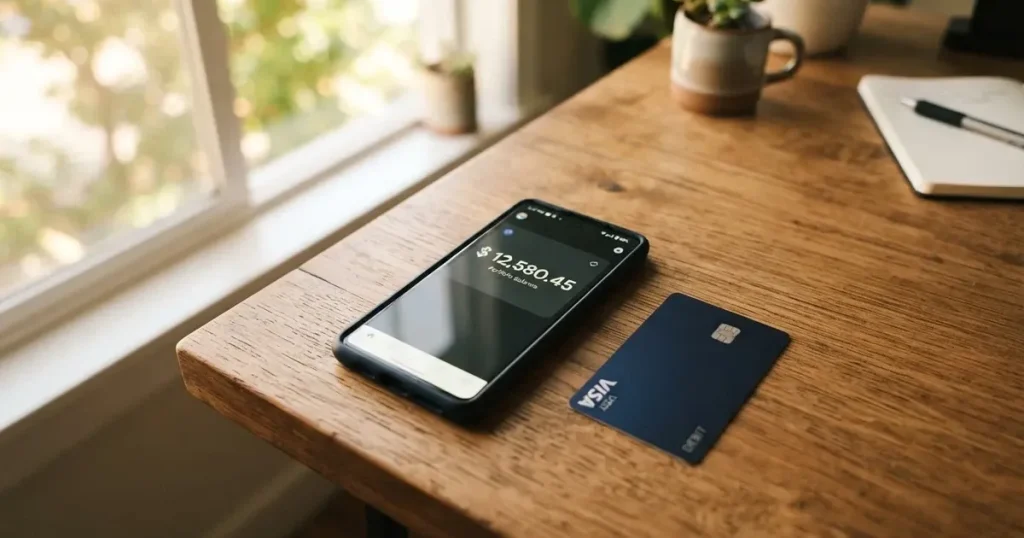
DigitalPurse is a virtual payment card funded from crypto — Bitcoin, Litecoin, Monero, Ethereum, USDT or USDC — and spent through your phone’s mobile wallet. There is no physical card, no cash machine, and almost no published numbers: what it costs, who can get it and which country issues it are all things you learn inside the app rather than on the site. I gave it 5.8 out of 10. It sits in the middle of the field, and its whole character comes from that: convenient for a specific kind of spending, frustrating to evaluate, and thinner on the things most people assume a card has.
The conditions described below are current as of October 28, 2026.
Verdict: 5.8 / 10 — convenient for online spending, thin everywhere else
The score is not a rounding of my opinion; it is a sum of six criteria, each marked separately, because “is this card good” collapses into very different questions depending on why you want one. Here is the breakdown I worked from.
| Criterion | Mark | Why |
|---|---|---|
| Who can get it | 6 / 10 | No country list and no restrictions published; nothing about citizenship or residence; issuing region not disclosed |
| Cost | 5 / 10 | Official: issuance and top-up fees appear in the app at creation, no figures on the site, undisclosed; unofficial: $3 for a virtual card and a $6 minimum balance per one App Store reviewer, while cryptocards.so lists issuance, top-up and monthly fee as free — the sources disagree |
| Top-up options | 7 / 10 | BTC, LTC, XMR, ETH, USDT, USDC; networks not disclosed; no extra fee for USDT and USDC |
| Reliability and complaints | 6 / 10 | Issuer not named, platform is not a bank; chargeback not supported; Trustpilot 4.8 out of 232 reviews, with complaints about declines at Google Cloud, Azure and DigitalOcean |
| Everyday use | 5 / 10 | Virtual only; Apple Pay, Google Pay, Samsung Pay all present; cash machines not allowed |
| Total | 5.8 / 10 | A fast virtual card funded from crypto, with the details that decide your case mostly kept in-app |
So who does that suit? The picture the card paints is a quick, anonymous-style virtual card funded from crypto: no branch, no paperwork at the counter, no plastic. If you already hold crypto and want to spend it online in dollars without waiting for a bank to open an account for you, that is a real niche and this card addresses it directly. If you want a card for the supermarket, a cash machine in a hurry, or a purchase you might want to dispute next month, it is the wrong tool — and the parts of it that would make the difference are the parts it publishes least.
Who Will Give You the Card
The card’s public pages do not say. That is the honest answer, and it matters more here than on most cards, because eligibility in this category is not a formality. DigitalPurse itself names no country list and no exclusions, and says nothing about citizenship or residence requirements, and does not disclose which region issues the card. If you are wondering whether you personally qualify, you cannot find out from the public site.
That silence is not automatically a red flag — plenty of legitimate providers are vague because their eligibility is set by a partner issuer rather than by the brand — but it does mean the question has to be answered by other means. In practice the answer arrives when you try: you register, and the app either lets you proceed or does not. That is a worse way to find out than reading a list.
One fact does apply broadly: prepaid and debit cards in this category are generally available to adults aged 18 and over, and DigitalPurse states 18+ with one account per individual. What the age floor does not tell you is whether the check at sign-up is a formality or a real identity check, which is the subject of the next section but three.
How to Get It
The short version: download the app, create an account, and the card appears. The card’s home page says only “create an account” after you download the app, and there is no application form to fill in beforehand.
What actually happens when you sign up
- Cards are created through the app or through a Telegram bot, and are described as “available instantly”.
- Orders are processed right away but “may take up to 24 hours”.
- There is no physical card — virtual only, usable in-store through mobile wallets.
What nobody tells you about identity checks
KYC documents are not stated. There are no defined verification levels. The card’s position is that KYC “may” be required for certain payments or products, which leaves the scope deliberately open: you learn what triggered it afterwards. Unverified users do have daily and monthly order caps in place — the amounts are not stated — and verified users get higher limits. Cards sold without KYC do exist, at a higher price, because the card says they “offer greater privacy and flexibility”.
So there are two ways to hold this card: verified, with higher limits and a verification step whose documents and processing time are not stated, or unverified, cheaper to open but capped, and more expensive if you want privacy. The help centre carries an article titled “Why is my KYC verification still pending?” — I did not read it, and neither should you expect it to give you a processing time, because the card does not state one, nor does it state rejection reasons.
What It Really Costs: Fees, Limits and the Number That Is Not Published
This is the section to slow down on. The card publishes no fees at all. Not the issuance fee, not the monthly fee, not the conversion rate, not the FX markup, not the cash-machine terms — the terms page says purchases “may be subject to handling fees” and that the amounts are “detailed in the specific terms” of each product. Those specific terms are inside the app. What you can say with certainty is that a cost exists and that you will meet it at the moment of creation or payment rather than in advance.
| Cost or limit | What the card publishes |
|---|---|
| Issuance fee | Not stated; shown in the card description in the app during creation |
| Monthly fee | Not stated |
| Top-up fee | Not stated; shown in the app; scales with the amount on privacy cards |
| Conversion / handling fee | Not stated; purchases “may be subject to handling fees” |
| Currency exchange on payment | Not stated; balance is in USD and non-USD payments exist, but no spread is published |
| Cash machine | Not permitted — treated as a “transfer of value” |
| Starting balance | Virtual cards offered with a “starting balance of up to $1,000 – $10,000” |
| Daily / monthly spending limits | Not stated; unverified users have caps of unstated size, verified users get higher limits |
Unofficial figures exist and they contradict each other, which is itself useful information. An App Store reviewer says the company charges an extra $3 for a virtual card and requires a minimum $6 balance. cryptocards.so, a third-party aggregator, lists issuance, top-up and monthly fee as free. Neither is confirmed by the card. If a $3 issuance charge is real, it is punitive on a $6 balance; if issuance is free, the $3 story is wrong. You cannot tell which from outside.
Now let us walk three ordinary payments through what this means, because a fee you cannot see is still a fee you pay.
A subscription in dollars, paid with USDC. The balance is in USD, and the FAQ states that “FIAT is converted to USD the moment it’s loaded to the card” — so for a stablecoin-funded purchase, the top-up conversion is the moment cost appears. For USDT and USDC the card says no extra top-up fee is charged, which makes them the quiet option. On top of that, the chain network fee for moving the token is charged by the blockchain itself, not by the card.
A purchase on a euro-priced site. Here you are spending USD at a euro merchant. The card states the balance is USD and says nothing about the spread or fee applied when paying in another currency. That silence is the whole problem: the markup exists somewhere between the USD you loaded and the euro the merchant charges, and it is not published.
Anything at a cash machine. Not available. The terms list both “Manual Cash Disbursements” and “Automated Cash Disbursements” among prohibited purchases, and state plainly that ATM withdrawals are considered a “transfer of value” and are not permitted. This is not a limit you can raise with support; it is a category the card does not do.
How to Top It Up
Top-up is the strongest part of this card, and it scores highest of all the criteria. Six assets are accepted: BTC, LTC, XMR, ETH, USDT and USDC. That is a wider list than most competitors in this category offer, and it includes two privacy-leaning coins alongside the majors.
- Reloadable cards: select the card, then “Add Funds”.
- Non-reloadable cards cannot be topped up — you buy as many as you like instead.
- Creation and top-up fees “will be displayed in the card description during creation”, and scale with the amount on privacy cards. No figures are published.
- Extra fees are possible for non-fiat methods, and BTC, ETH, LTC and XMR may cost more because of volatility and processing.
- USDT, USDC, bank transfer or mobile money are the card’s own suggestion if you want to avoid extra charges.
- Minimum top-up amount is not stated.
The one gap that will bite someone is the network. The card names the coins but not the blockchains to send them on, and it does not state a minimum. Getting that wrong is not a small mistake: a transfer sent on a network the provider does not support, or to an address belonging to a different network, can be lost or need manual support recovery with no guarantee, because blockchain transfers do not reverse. If you are funding from an exchange, check the required network and deposit address in the app before you send — that is not a trick, it is the ordinary careful step.
Getting money back out. The FAQ says yes, you can withdraw your funds and that terms and conditions apply. The help centre describes the path: select the active card, then More/Manage, then “Withdraw Funds”. Fees, minimums, timing and destination are not stated, and how a balance is treated if you close a card is not stated either.
Paying With It Every Day
Daily use is where this card is thinnest, and it scores 5 out of 10 for a reason. It is virtual only. There is no physical card in the plan, so there is nothing to slide into a terminal, hand to a waiter, or drop in a taxi. Everything goes through your phone.
What that means in practice:
- Apple Pay, Google Pay and Samsung Pay are all supported, and the card works at merchants that accept mobile wallets.
- Cash machines are not an option at all.
- Apps exist for iOS and Android. The site’s download buttons point to its own pages rather than the stores, and no official store rating is shown there. Unofficial store figures — Android around 4.6 out of 5 from roughly 170 reviews and 50,000+ installs, iOS around 4.5–4.7 from over a thousand ratings — are third-party readings, not confirmed by the card.
- Rewards are not stated. Do not assume any cashback, points or tier scheme exists.
- Prohibited purchases are listed as “not exhaustive”, and include betting and casino gambling, government-licensed online casinos, non-sport internet gaming, dating and escort services, security brokers and dealers, foreign or non-fiat currency, wires and money orders, and cash disbursements.
That prohibited list is longer than most cards in this category carry, and it is worth reading as what it is: a statement about which merchants will work with the card. Gambling and gaming categories are routinely blocked by issuers as a matter of policy rather than law, and blocking varies by issuer — but the practical effect for you is the same. If any of those categories is where you spend, this card is not for it.
There is also a structural reason for friction that is not the card’s fault. A card number carries an issuer identification number that a merchant’s system can look up to see which institution and country issued it, and shops may apply extra scrutiny when the issuer country differs from the billing address. Address verification is offered mainly in the US, Canada and the UK and is generally unavailable for foreign-issued cards, which can cause declines. That is the background behind the specific complaints in the risk section below.
What Can Go Wrong
You cannot charge back. The card says “we cannot support chargebacks”, and gives its reasons: unsustainable fraud, the finality of blockchain transactions, and privacy. It says this applies to sub-issuers too. Refunds of returned items go “to the card originally used”. There are help-centre articles on refunds not yet arrived, double charges, and merchants that declined a payment but took the money anyway — none of which is a chargeback scheme. No dispute time frames are given. Gift-code orders, once processed, are neither returnable nor refundable.
You do not need to take my word for how thin that is. A chargeback is a refund ordered by the issuer to settle a dispute, with reason codes for fraud, duplicate billing or goods not received; rights of this kind come from specific consumer-credit regulation in some countries and prepaid-card coverage varies by jurisdiction and should not be assumed. When an issuer states up front that it cannot support them, you should price your purchases with that in mind: anything you cannot afford to lose should go on a card with a dispute process.
Funds sit with the platform. The card describes itself as “a technology platform, not a bank”, and says services “may be facilitated by third-party licensed financial institutions”. The issuer is not named, and neither are the registration country or the licences. The site says it uses “secure encryption, minimal data collection, and strict access controls”, and notes you can cap the amount loaded onto a card to limit spending — but an in-app freeze, two-factor authentication, spending controls and insurance are not stated. Custodial by nature, the funds are held with the platform and its sub-issuers.
This is where the category’s history is relevant rather than decorative. Custodial platforms have failed before — Mt. Gox, Coincheck, Ronin Network are the standard references — and a card’s licence position is also fragile in a specific way: the networks themselves do not issue crypto cards to consumers; they license issuers and can suspend a programme. Visa terminated its agreements with FTX in November 2022, and WaveCrest, a card issuer that supplied several crypto brands, was suspended by Visa in Europe in 2018, closing its programmes.
Declines at specific merchants. The strongest recurring complaint, from a third-party aggregator and corroborated by an App Store reviewer, is that cards get declined at Google Cloud, Azure and DigitalOcean — the pattern of prepaid card numbers being blocked by those providers. The aggregator also reports a minority of older reviews calling the service a scam over declined cards, slow support and high fees, and cites Reddit threads from r/Ghana and r/Nigeria that I could not verify. No official incident was found.
The rating picture is better than the complaint picture. Trustpilot shows 4.8 out of 5 from 232 reviews, 60 in the last 12 months, the latest on 19 October 2026, with the visible reviews largely positive and the company reported as not having recently invited customers. An earlier reading of 4.5 from 192 came via a different Trustpilot domain, so treat any single number as a snapshot. Support is praised and criticised in about equal measure.
No news, in either direction. The official site and help centre contain no dated licence, issuer or programme events. Help articles from 2025–2026 about non-reloadable cards and chargebacks are undated. So there is no regulatory milestone to point at in either direction — which is a fact about the disclosure, not an accusation.
What to Take Instead
If any of the above is a dealbreaker, the field has comparable options. All three below are also virtual-first, so none of them solves the “I need cash” problem either; they differ in how much they publish.
| Card | Score | Card form | Stated cost | Top-up assets |
|---|---|---|---|---|
| DigitalPurse | 5.8 / 10 | Virtual, mobile wallets | Not stated; shown in-app; unofficial $3 and $6 minimum claims | BTC, LTC, XMR, ETH, USDT, USDC |
| Cardex | 5.6 / 10 | Virtual and physical, on VERVE, VISA, Mastercard, UnionPay; currency Naira per its listing | Not stated | USDT, USDC, BTC |
| CardFlow | 4.9 / 10 | Virtual USD Mastercard, created in about 3 minutes | “Creating a virtual card is completely free” (site FAQ); monthly fee not stated | Bitcoin, USDT, ETH, Naira bank transfer |
| HyperCard | 4.7 / 10 | Prepaid, balance in USD or EUR | Not stated; App Store page lists no fees | USDT, BTC, ETH |
Where they differ is worth spelling out, because the differences are about disclosure rather than capability.
Cardex positions itself as “one crypto card, 200+ countries” — again no country list and no exclusions, though its App Store listing is Naira-focused. It is the only one of the four offering a physical card, which matters if contactless terminals are your main route. It runs on four networks including VISA and Mastercard rather than an unnamed one, and its conversion story is the most elaborated: real-time conversion at the moment of payment with what it calls an “AI-Powered Conversion Rate” that scans global exchange rates. No fee percentage is stated, so the marketing is loud where the number would be.
CardFlow is aimed at Nigeria (“Nigeria’s smartest fintech card platform”) and also “global users”, again without a country list. Its one clear advantage is transparency on a single point: creating a virtual card is free, per its own FAQ. The catch is that a free card in a Naira-first product may not be the product you need.
HyperCard states no country list on its official pages, and its App Store page says the card works in “more than 176 countries” — which is a statement about acceptance, not about eligibility, and the difference matters. Its balance is available in USD or EUR, which no other card here offers, and it lists no fees at all.
If you need a physical card, Cardex is the only one of these. If you need an answer to “what will this cost me” before you start, none of them gives you a complete one. If your priority is avoiding the app entirely, you are in the wrong category.
Who I Would Recommend It To
I would recommend DigitalPurse to someone in a fairly specific position: you already hold crypto, you mostly buy things online, you are comfortable managing an app and a Telegram bot, and you want to spend without a traditional bank card in your name. For that person the six accepted assets, the reloadable model and the mobile-wallet support make this one of the more flexible options in the category, and the absence of a physical card is a feature rather than a flaw.
I would not recommend it as your only card. Three things decide that, and none of them are fixable by support: no chargeback, no cash machine, and no published price. You are spending real money through a system the operator describes as a technology platform rather than a bank, with an unnamed issuer, on a card that cannot be disputed and cannot be used where physical cards are expected.
Before you commit anything, do three things. Open the app and read the fee shown on the card description at creation — that is the number that matters, and it exists even though the website will not tell you. Check that the network required for your top-up asset is one the app accepts, because a wrong-network transfer does not reverse. And keep a balance on the card that you could lose, because the refund position is exactly as stated: back to the card, no chargeback.
Frequently asked questions
What is the DigitalPurse card?
It is a virtual payment card funded from crypto. You load BTC, LTC, XMR, ETH, USDT or USDC, the balance sits in USD, and you spend it at merchants that accept mobile wallets such as Apple Pay, Google Pay or Samsung Pay. There is no physical card — virtual only — and no cash-machine use, which the card treats as a prohibited “transfer of value”.
Is DigitalPurse a bank?
No, and it does not claim to be. The site says it is “a technology platform, not a bank”, and that services “may be facilitated by third-party licensed financial institutions”. The issuer is not named, and neither the registration country nor any licence is stated. The company behind it is listed as DECLASSIC TECHNOLOGIES LLC 2026.
Does the DigitalPurse card require KYC?
Sometimes, and the card will not tell you in advance. It says KYC “may” be required for certain payments or products, defines no verification levels, and does not state which documents are needed or how long verification takes. Unverified users carry daily and monthly order caps of unstated size; verified users get higher limits. Non-KYC cards exist at a higher price.
How much does the DigitalPurse card cost?
The card publishes no figures. Issuance and top-up fees appear in the card description inside the app during creation, and scale with the amount on privacy cards. Terms say purchases “may be subject to handling fees”, detailed in each product’s specific terms. Unofficial claims conflict: $3 for a virtual card plus a $6 minimum balance from one App Store reviewer, and free issuance, top-up and monthly fee from cryptocards.so.
How do I top up the DigitalPurse card?
Select the card and choose “Add Funds”. Six assets are accepted — BTC, LTC, XMR, ETH, USDT, USDC — and extra fees are possible for non-fiat methods, with BTC, ETH, LTC and XMR potentially costing more because of volatility and processing. The card suggests USDT, USDC, bank transfer or mobile money to avoid extra charges. The blockchain networks are not stated.
Can I use the DigitalPurse card in my country?
Nobody can tell you from the public pages. No country list and no exclusions are published, and nothing is said about citizenship or residence. The blockchain network accepted for a top-up is also not stated, which matters more than eligibility: a transfer on an unsupported network, or to an address from another network, can be lost, because blockchain transfers do not reverse.
Is the DigitalPurse card safe?
It depends on what you mean. The site claims “secure encryption, minimal data collection, and strict access controls” and lets you cap how much you load, but an in-app freeze, two-factor authentication, spending controls and insurance are not stated. Funds are held with the platform and its sub-issuers by nature. The issuer is unnamed, and Visa has terminated crypto card programmes before, in 2022 with FTX and in 2018 with WaveCrest in Europe.
Why do payments get declined at Google Cloud, Azure and DigitalOcean?
That pattern comes from prepaid card numbers being blocked by those providers, and it is the most frequently reported complaint about this card from third-party sources. It is not a confirmed official incident — no such statement appears on the card’s own pages. The general reason is structural: merchants can look up the issuer identification number on a card and treat foreign-issued or prepaid numbers with extra caution.
Does DigitalPurse support chargebacks or refunds?
No. The card states “we cannot support chargebacks”, citing unsustainable fraud, blockchain finality and privacy, and says this also applies to sub-issuers. Returned items are refunded “to the card originally used”. There are no dispute time frames, and gift-code orders cannot be returned or refunded once processed. Treat anything you load as money you may not get back.
Is it worth it?
Worth it if you already hold crypto, buy mainly online, and want to spend without a traditional bank card — the six accepted assets and mobile-wallet support are genuinely flexible. Not worth it as your only card, because you get no chargeback, no cash machine and no published price, with an unnamed issuer behind it. On the score I worked from, it lands at 5.8 out of 10: a fast virtual card funded from crypto, with the details kept in-app.
Choosing a virtual card – cryptocardadvisor
Content created by the «cryptocardadvisor» team