
Decaf card review: a non-custodial Visa with gaps in the fine print
 Available in US
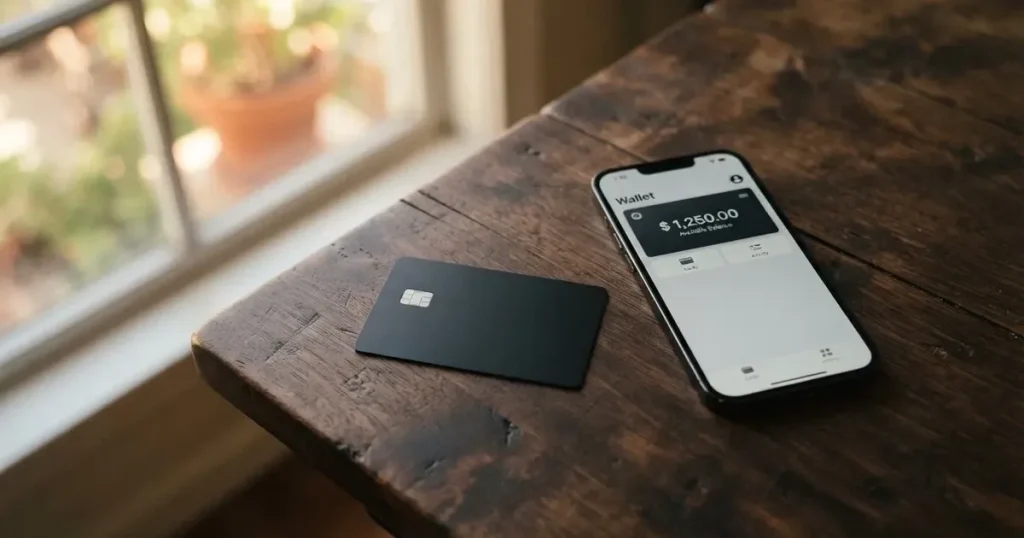
Decaf is a Visa debit card built to spend from a crypto balance, wrapped in a self-custody app. On paper it does something many cards in this category still don’t: it lets the user keep their own keys while paying at any Visa-accepting merchant. In practice, the card is live, the app works, and a great deal of the fine print is simply missing from the public pages. That gap is the story of this review.
The conditions described here are current as of October 28, 2026.
Verdict
Decaf earns 6.2 / 10 in my scoring, which places it in the middle of the crypto-card field rather than at the top. The card suits a narrow profile: freelancers or remote workers paid in USDC who want a non-custodial wallet, a Visa number and nothing else. If you also want a transparent fee table, named issuer and licence, support for Apple Pay and Google Pay, or even a clear statement of which coins fund the card, you will not find them.
The score breaks down across the criteria I weigh most heavily:
| Criterion | Score | Reason |
|---|---|---|
| Who can get it | 8 / 10 | Wide reach, but 19 countries and 12 US states are blocked |
| Cost | 7 / 10 | No monthly or annual fee, but a steep $90 activation outside the US |
| Top-up options | 5 / 10 | USDC shown, but the coins and networks that fund the card are not named |
| Reliability and complaints | 4 / 10 | Issuer, licences and a public complaints history are all thin |
| Everyday use | 6 / 10 | Virtual and physical Visa, no mobile wallet support listed |
The audience I have in mind throughout this review is the freelancer paid in dollars who holds their own keys. Decaf is built for that person; everyone else will feel the gaps sooner.
Who Decaf will issue a card to
Decaf is available in a long list of countries, but the list of restricted countries is the one to read first if your situation is unusual. Decaf will not issue cards in the following 19 countries: Belarus, China, North Korea (DPRK), India, Iran, Iraq, Israel, Myanmar, Nepal, Russia, Syria, Turkey, Cuba, Ukraine, Venezuela, Vietnam, Nicaragua, Puerto Rico and Nigeria. The restricted list also covers 12 US states: Arizona, Delaware, Georgia, Idaho, Louisiana, Maryland, Montana, Ohio, Oregon, Rhode Island, Washington and Wisconsin.
Russia and Belarus both appear on the restricted list. Whether the rule is applied by citizenship or by residence is not stated on the public page, so if you hold a passport from one of these countries but live somewhere else, the answer depends on the KYC process rather than on the marketing.
For US residents, the state restrictions cut the country roughly in half. For European users, the absence of major European economies from the restricted list is positive, though the card’s own pages do not name which EU states are actively served. The safest interpretation is that Decaf serves most countries outside the restricted list, but you will only know for certain once KYC is attempted.
Age and minimum documentation requirements are not stated. The card’s public description simply says “sign up and verify your identity once,” without listing the documents, proof of address or minimum age that the verification process requires. The phrasing of the rule on restricted US states also leaves ambiguity, so a borderline case is worth raising with support before committing time to the sign-up flow.
How to get a Decaf card
The sign-up flow has three steps: download the app, verify your identity, and choose between a virtual and a physical card. The virtual card is the cheaper option and is available worldwide; the physical card is delivered with tracking and is the only form that can be used at an ATM.
Documents needed for KYC and the minimum age are not stated. In practice this means the public marketing offers no checklist; you find out what is required when the app asks. Card currency is not stated, though the page’s headline “Earn in dollars” and the sample balance shown in USDC both point to a US-dollar-denominated card.
Delivery time and the cost of replacing a lost or damaged physical card are not stated. The activation cost of the physical card is the part that is clearly listed: $10 if your address is in the US, $90 if it is anywhere else. For a non-US user, the physical card is a $90 commitment before you have spent a cent.
Fees: what Decaf really costs
Decaf’s fee structure is one of the simpler ones in the category, with the caveat that several important numbers are not stated on the public page.
| Fee or limit | Amount |
|---|---|
| Virtual card activation | $5 (worldwide) |
| Physical card activation (US) | $10 |
| Physical card activation (rest of world) | $90 |
| Monthly fee | None |
| Annual fee | None |
| FX markup | None (Visa rate) |
| ATM fee added by Decaf | None |
| ATM limit per transaction | $250 |
| ATM frequency | Up to 3 times per day |
| Free ATM allowance | Not stated |
The headline numbers worth holding onto are these: no monthly or no annual fee, no Decaf FX markup (the rate is Visa’s), and a one-time activation cost that ranges from $5 (virtual, anywhere) to $90 (physical, outside the US). The crypto conversion fee that is normally the biggest cost on a card like this is not stated.
What that gap means in practice: if you top up in USDC and spend in USDC, you will see only Visa’s FX rate. If you top up in another token, the cost of the conversion step is hidden in the app rather than published, so you should check it on a test transaction before committing a meaningful balance.
A few everyday payments show where the cost lands:
- Buying a small purchase in US dollars from a US merchant: only Visa’s rate, which on a same-currency transaction is 1:1. The cost is the activation fee already paid.
- Buying coffee in euros while your card balance is in USDC: Visa’s FX rate, no Decaf markup. Whether you also pay a crypto-to-fiat conversion fee depends on what is loaded onto the card.
- Withdrawing local currency from an ATM abroad: no Decaf fee, but the ATM operator will set its own fee. The $250-per-transaction and three-times-a-day limits from Decaf apply on top.
The activation fee for the physical card outside the US is the single most important number on this page. At $90, the card is not a casual purchase; for a frequent traveller it can be worth it, for occasional use it is steep. Sunk-cost thinking should be resisted: if the card is not right for your situation, the $90 is the price of learning that, not a reason to keep using it.
Top up: how to fund the card
Topping up starts with a transfer to Decaf. Clients can pay a Decaf payment link or account details by card, bank transfer or USDC; the sample balance on the page is shown in USDC. The app itself runs on Solana and Stellar, which is unusual: most non-custodial cards name a single chain. Which coins and which networks top up the card itself is not stated on the public page.
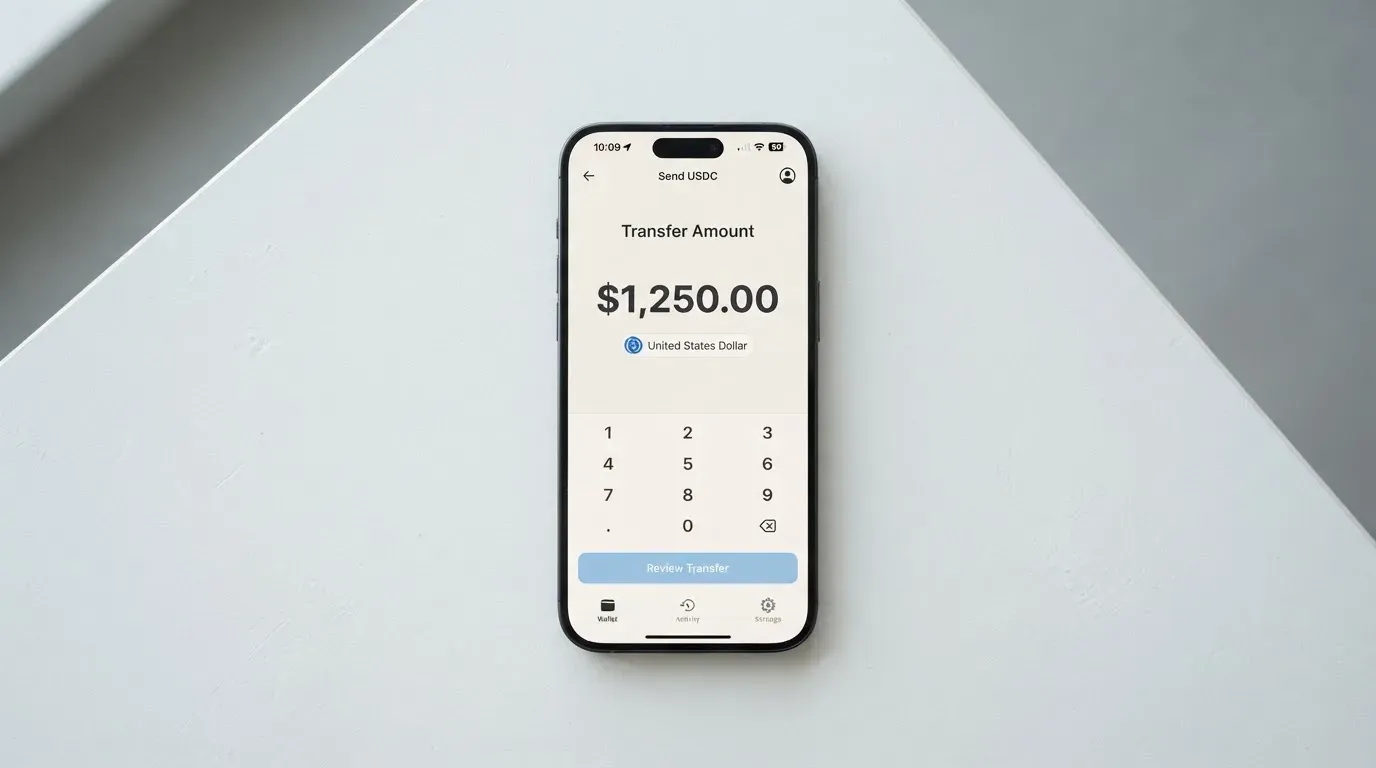
What this means in everyday use: the deposit step is described in principle (you send funds to a Decaf address, they arrive as USDC, you move them from the Decaf balance to the card balance in-app), but the details that matter for cost and risk are missing. The deposit fee, the minimum top-up amount and who pays the network fee for the on-chain transfer are all not stated. A wallet holding only the receiving token and no native gas token cannot send on the relevant chain, so this is the kind of detail that turns a small transfer into a support ticket.
For withdrawals, Decaf states that bank withdrawals to accounts in “85+ markets” are supported, and cash pickup is offered through MoneyGram in “180+ countries.” Moving the card balance back into crypto and what happens to any leftover balance on account closure are not stated.
The honest summary: funding the card is described well enough to get started, but the cost and timing of each leg of the trip are hidden in the app. A small first deposit is the right way to confirm what the round trip actually costs and how long it takes.
Paying with the card every day
Decaf is a Visa, so it works at any merchant that takes Visa. That is the main story for everyday use. The card exists in two forms, virtual and physical, both issued as Visa, with the physical card supporting ATM withdrawals up to $250 per transaction, three times a day.
What is not stated is also important. Apple Pay and Google Pay support is not listed. Blocked merchant categories (for example gambling, often restricted by policy rather than by law) are not listed. The dispute process and the cashback or rewards structure are also not stated. Spending limits are set by the user in the card screen, which is the right design for self-custody but only useful if the user actively sets them.
The Decaf app is available on iPhone, iPad and Apple Vision, with an App Store rating of 4.4 out of 5 from 113 ratings as of 2026-10-21. Google Play was not read for this review, so Android users should check the listing themselves before relying on the figures here. The App Store listing is in English only, with Russian not supported, which limits the app’s usefulness in several of the regions the card does serve.
For a freelancer being paid in USDC and spending in dollars, the everyday experience should be smooth: the app balance is in USDC, the card is funded in dollars, and Visa handles the merchant. For users in non-USD countries who top up in a non-stablecoin token, the missing conversion fee and the missing Apple Pay and Google Pay support will be the two frictions they feel first.
Risks: what can go wrong
The honest list of risks for Decaf comes from three places: what is stated on the public pages, what is missing from them, and what the public complaint record shows.
What is stated. Decaf, Inc. is a “financial technology company registered in Delaware, USA,” and the company states that it is “not a bank, exchange, or asset custodian.” Payment services are provided through licensed partners in each jurisdiction. The app is described as non-custodial in its App Store listing (“only you control your private keys”), and Decaf states it does not hold user assets. The Help Center runs on Intercom, with collections on Business Accounts, the Decaf wallet, DecafPay and guidelines; no other support channels or hours are listed.
What is missing. The card issuer is not named, and no licences are listed. Without those two facts it is hard to assess which regulator oversees the card programme, what recourse is available in a dispute, and what happens to the card if a partner’s licence changes. In-app freeze, two-factor authentication, the dispute process and the supported wallet connection methods are all not stated on the public pages.
What the complaint record shows. A search for Decaf card reviews on third-party sites found one Trustpilot review dated 23 September 2026 with a one-star rating, titled “Scammers 2” and alleging fake support. The Trustpilot profile (decaf.so) is unclaimed, with a TrustScore of 3.2 out of 5 from that single review. There are no Reddit threads or card-specific reviews to draw a recurring pattern from, and one user report is not a pattern. The honest reading is: nothing has surfaced publicly that I would call a confirmed incident, but the public record is also too thin to clear the company by reputation alone.
The structural risks that apply to any card in this category. Card programmes can be suspended by the network. In November 2022, Visa terminated its global agreements with FTX, and the FTX US debit card programme was wound down by its issuer. WaveCrest, a Visa card issuer that supplied several crypto card programmes, was suspended in Europe in 2018, closing all WaveCrest-issued Visa programmes. Programme closures typically follow a notice period, then stop loading, then stop spending, and ask users to withdraw their remaining balances. The non-custodial design of Decaf is a real protection here: if the card programme closes, the user’s crypto stays in their own wallet, and the practical question becomes only how to extract the residual fiat balance from the card.
For self-custody users specifically. With a self-custody-linked card, funds stay in the user’s own wallet until the moment of payment, but the user bears full responsibility for key loss, phishing and clipboard-hijacking malware that swaps copied addresses. Transfers on the wrong network, or to the address of a different network, can be lost or need manual support recovery with no guarantee. A small test transfer before any meaningful amount is the standard safeguard.
Alternatives
Three cards are worth comparing to Decaf for the reader who wants a non-custodial or dollar-denominated option. Each one scores a little differently in the criteria I weigh most heavily, and the choice between them is largely about which trade-offs you can live with.
TokenPocket (TP Card), 5.8 / 10. TP Card is a Visa or Mastercard debit card (the network depends on the country) that runs on Arbitrum. Coverage is regional: Visa debit is available in a list of European countries and territories (Germany, France, Spain, Switzerland among them), and Mastercard debit is available in Australia, Canada, Hong Kong, Japan, Taiwan, New Zealand, Singapore, South Korea and the UK, with the Americas listed as “planned for Q2 2025.” Balances are in EUR24 and USD24 (Fiat24’s own stablecoins), and only virtual cards are mentioned. The NFT creation fee for issuing the card is partly covered by TokenPocket, with the user paying a small portion of an undisclosed amount. The page states that “apart from these, TP Card does not charge any additional fees.” A 1% fee is charged on crypto deposits to the card, intended to be refunded later through rewards or reduced transaction fees. FX fees are not stated.
MetaMask Card, 7.1 / 10. MetaMask’s card is a Mastercard, with the virtual card issued first (instant) and a Metal tier available to pre-order in the app after virtual approval. The issuer is Monovate and the card provider is Crypto Life; one card per user. Sign-up is open in 45 listed countries and territories (Andorra, Argentina, Brazil, Canada, Mexico, Germany, France, Spain, Uruguay among them), with other regions on a waitlist. Proof of residency is required, and the page notes that “ineligible regions limit sign-ups, not spending,” which is a useful distinction. US and UK sign-ups were temporarily closed per the FAQ at the time of writing. Citizenship rules are not stated. The virtual card has no issuance fee, no annual fee and no maintenance fee. The Metal tier costs $199 per year. There is “no additional MetaMask fees” and “no foreign transaction fee,” with the Mastercard rate used. Rewards are paid in mUSD into the Money Account: 1% on the Virtual card; 3% headline on Metal, footnote-limited to the first $10,000 then 1%; plus a $FLY bonus of 5X (Virtual) or 7X (Metal) via the Blackbird dining app. The card spends directly from the connected wallet, with named networks (Linea, Base, Monad, Solana) and named tokens (mUSD, wETH, EURe, GBPe, USDC, USDT, plus a few more), though Solana-only wallets cannot withdraw credit.
KAST, 6.1 / 10. KAST supports up to 10 cards per user in three programmes: Visa Platinum (Standard), Visa Infinite metal (Premium) and Visa Infinite gold plated (Private), with additional designs (Pengu, Solana, Bitcoin) on top. The account balance is in USD, with stablecoin deposits converted 1:1 at 0% spread. Country availability is residence-based at KYC (“if your country isn’t listed, it means KAST is not available there”), with the actual list not published, only a referenced Restricted Locations list; citizenship and ID matter too, with the rule “if you currently live in a supported country but only hold an ID from a restricted region, you may still be ineligible to pass KYC,” while dual citizens with an ID from a supported country may pass. Only the account holder’s own ID is accepted, and VPN does not bypass. Annual membership is the main cost: $0 for Standard, $1,000 for Premium, $10,000 for Private, billed annually upfront with no monthly option. Extra virtual cards are $2 in some regions, the Standard physical card has a $0 card fee plus a $40 delivery fee (Premium and Private physical cards are included), and there is a $1/month inactivity fee after 12 months. Funding is in stablecoins (USDT, USDC, PYUSD, RLUSD, with the Terms noting “currently USDT and USDC” as the only acceptable tokens), on Ethereum, Solana, Polygon, Arbitrum or TRON. Spending fees are 0% for stablecoin top-ups, USD card spend, transaction fees, and Apple and Google Pay; non-USD FX is 0.5%–1.75% depending on residence, transaction country and programme; non-USD transactions under $25 incur a $0.10 fee; and declined transactions (insufficient balance) cost $0.50. Cashback is paid in USD: Standard 1.5% on the first $2,000 per month, Premium 2% on the first $10,000, Private 3% on the first $40,000, plus KAST Points of +1% on Premium and +2% on Private of eligible spend.
The honest comparison: MetaMask is the strongest of the three on transparency (named issuer, named networks, named tokens, named cashback), KAST is the strongest on rewards and on the breadth of the card programme, and TP Card is the most regional and the least transparent on the numbers. Decaf sits in the middle on every axis, with the only edge being the self-custody framing and the lack of a monthly fee.
Who I would recommend this card to
The recommendation is narrow on purpose, because the gaps in the public material matter more for some users than for others.
A good fit. A freelancer or remote worker paid in USDC, who already runs a self-custody wallet on Solana or Stellar, who spends mostly in US dollars, and who is comfortable setting their own spending limits and using a virtual card where possible. For this person the $5 virtual activation is the only meaningful cost, the FX rate is Visa’s, and the self-custody design protects the underlying crypto from a card-programme shutdown.
A poor fit. A user outside the US who wants a physical card and will not use the $90 activation cost as a sunk cost. A user who needs Apple Pay or Google Pay, or who needs cashback. A user in one of the 19 restricted countries or 12 restricted US states. A user in the EU who needs the comfort of an EU-licensed issuer with named regulation: the card’s own pages do not provide that, and the user is left to discover it through KYC.
A borderline fit. A user in the US who wants a physical card for ATM access and is willing to pay $10 for activation. The $250-per-transaction, three-times-a-day limit is a real constraint for a heavy user, but it is also the rule on the public page rather than something to be discovered.
The single most useful thing to do before signing up is to test the funding path with a small amount. The public page describes the path in principle but does not state the deposit fee, the minimum top-up, or who pays the network fee; the only way to find out is to make a small transfer and read what the app tells you. If the round-trip cost and timing are acceptable, the rest of the card is straightforward. If they are not, the $5 virtual activation is the cheap way to learn that.
Frequently asked questions
What is the Decaf card?
Decaf is a Visa debit card that spends from a crypto balance, paired with a non-custodial app. The app holds the user’s private keys, and the card balance is funded from USDC held inside the app. It exists in virtual and physical forms, with the physical card supporting ATM withdrawals.
How does the Decaf card work?
You add funds to your Decaf balance (typically in USDC), then move funds from that balance to the card balance inside the app. The card then spends like any Visa, drawing on the loaded balance, with FX handled at Visa’s rate. Because the wallet is non-custodial, the underlying crypto stays under the user’s control until it is converted for the card.
Is Decaf a bank?
No. Decaf, Inc. is a financial technology company registered in Delaware, USA, and the company’s own page states that it is “not a bank, exchange, or asset custodian.” Payment services are provided through licensed partners in each jurisdiction; the card issuer and the specific licences are not named on the public pages.
Who owns Decaf?
The owner of the company is not stated on the public pages. Decaf, Inc. is a financial technology company registered in Delaware, USA; the parent company, investors and the management team are not disclosed in the materials read for this review, so the reader should look for that information outside the marketing site.
Is the Decaf card available in my country?
Decaf will not issue cards in 19 countries (Belarus, China, North Korea, India, Iran, Iraq, Israel, Myanmar, Nepal, Russia, Syria, Turkey, Cuba, Ukraine, Venezuela, Vietnam, Nicaragua, Puerto Rico and Nigeria) or in 12 US states (Arizona, Delaware, Georgia, Idaho, Louisiana, Maryland, Montana, Ohio, Oregon, Rhode Island, Washington and Wisconsin). Outside that list, availability is governed by KYC, and the rule for citizenship versus residence is not stated.
How do I top up the Decaf card?
The public page describes paying a Decaf payment link or account details by card, bank transfer or USDC, with the app running on Solana and Stellar. Funds arrive as USDC into the Decaf balance and are moved to the card balance in-app. The coins and networks that top up the card itself, the deposit fee, the minimum top-up and who pays the network fee are all not stated on the public page.
Is the Decaf card free?
There is no monthly or annual fee. Activation is $5 for a virtual card (worldwide) and either $10 (US) or $90 (rest of world) for a physical card. The FX rate is Visa’s with no Decaf markup; the crypto conversion fee is not stated and should be checked in-app.
Does the Decaf card require KYC?
Yes. The sign-up flow says “sign up and verify your identity once,” though the specific documents, proof of address and minimum age are not stated on the public pages. The restricted-country and restricted-US-state lists are the only specific KYC rules disclosed before sign-up.
How do I add the Decaf card to Apple Wallet or Google Pay?
Apple Pay and Google Pay support is not stated on Decaf’s public pages, so the safest answer is that this is not currently listed as a feature. Check the most recent app update notes or contact support before assuming either wallet will accept the card.
Is the Decaf card safe?
The wallet is non-custodial (you hold the keys) and Decaf states it is not an asset custodian, which removes one major category of counterparty risk. The card issuer and the licences behind the programme are not named on the public pages, which limits what can be said about the regulatory protection of the fiat balance. Treat any card programme as capable of being suspended by the network, and do not leave more on the card than you can afford to have frozen during a programme change.
Choosing a wallet card – cryptocardadvisor
Content created by the «cryptocardadvisor» team