
Collective Memory card: a creator-focused card built on ATTN token earnings
 Available in US

The Collective Memory card is a debit card tied to the Collective Memory social platform, where creators earn ATTN tokens for staked content. When a cardholder pays, the platform converts Liquid ATTN into USDC and the card settles the purchase in fiat. Wirex powers the card through its Banking-as-a-Service platform, and the card is rolling out across the United States, most of Europe, parts of Asia and Latin America, and a long list of countries in the Middle East, Africa and the former Soviet space.
In this review I walk through who can get one, what the signup looks like, what the card costs day to day, how funding actually works, what daily spending looks like, and the risks that aren’t obvious from the marketing. The card is interesting because it’s built for a specific audience (creators spending their earned tokens) and that focus shows up in both its strengths and its gaps.
Conditions are current as of October 28, 2026.
Verdict
The Collective Memory card lands at 6.1 out of 10 in my scoring. That’s a middle-of-the-pack result that reflects a card that does some things well (broad country coverage, mobile-wallet support, an interesting funding model) and leaves a lot of basic information undisclosed (no published fees, no stated limits, no clear KYC requirements). The card suits a particular reader: someone who already earns ATTN on the Collective Memory platform and wants a frictionless way to spend those earnings in the real world. It does not suit a general reader who wants a clear-cost crypto debit card, because too many of the everyday figures are missing from the public materials.
The scoring breaks down as follows.
| Criterion | Mark | Why |
|---|---|---|
| Who can get it | 7 / 10 | Long list of countries across the US, Europe, Asia, Latin America, the Middle East, Africa and the former Soviet space; Russia and Belarus are excluded; citizenship vs. residence basis not stated |
| Cost | 5 / 10 | Issuance and monthly fees not published; the release talks about “transparent pricing and competitive FX rates” but no numbers are given |
| Top-up options | 4 / 10 | Only Liquid ATTN is converted and spent; no external wallet deposits and no general crypto top-up path |
| Reliability and complaints | 7 / 10 | Card runs on Wirex Banking-as-a-Service, which describes itself as a principal Visa and Mastercard member; the actual issuing entity and licences aren’t disclosed; I found no complaints in one search |
| Everyday use | 7 / 10 | Virtual and physical cards, Apple Pay and Google Pay, ATM details not stated |
The “creators spending ATTN earnings” angle is worth flagging. If you’re not a Collective Memory creator, the card’s funding model is a hard constraint rather than a feature, and you’d be paying for a tool built around someone else’s product. The card’s score reflects that: it loses points on top-up flexibility because the design intentionally narrows the funding path.
If you want a debit card that spends directly from a self-custody wallet you control, with published fees and a long list of supported networks, the Collective Memory card isn’t trying to be that. If you do want a card that turns a specific token into everyday spending, and the card is available where you live, the model is coherent and Wirex’s banking infrastructure reduces some of the operational risk.
Who can get the Collective Memory card
The card’s eligibility list is one of its stronger points. The release material names the United States, most of the European Union and the wider European Economic Area, the United Kingdom, Switzerland and several Balkan and micro-jurisdiction territories; in Asia, Australia, Hong Kong, Indonesia, Malaysia, the Philippines, Singapore, Taiwan, Thailand and Vietnam; in Latin America, Argentina, Brazil, Chile, Colombia, Ecuador, Mexico and Peru; and a long list across the Middle East, Africa and the former Soviet space that includes Azerbaijan, Bahrain, El Salvador, Georgia, Ghana, Guernsey, the Isle of Man, Israel, Japan, Jersey, Kazakhstan, Kenya, Macao, Moldova, Nigeria, Oman, Panama, Saudi Arabia, South Africa, South Korea, Turkey, Uganda, Ukraine, the United Arab Emirates and Uzbekistan.
Russia and Belarus are not on the list. The card’s documentation doesn’t say whether the rule is based on citizenship, on country of residence, or on both. That ambiguity matters if you have a passport from one of the excluded countries but live in a supported one, or the other way around. The card doesn’t publish a Restricted Locations policy in the materials I read, and it doesn’t say what happens if you apply from a country not on the list.
The card’s positioning also implies that you’re a Collective Memory user with ATTN earnings. The funding model (Liquid ATTN converted to USDC and spent through the card) only makes sense if you have a balance to convert. People who don’t already hold ATTN will struggle to find a clear “deposit crypto, spend fiat” workflow.
A note on minimum age: the public materials don’t state a minimum. As a rule in this category, prepaid and debit cards are usually restricted to adults (18 and over), and some issuers set higher limits. Treat that as the working assumption until Collective Memory states otherwise.
How to sign up for the Collective Memory card
The card is offered in both virtual and physical debit form, per a release from February 2026. The card network (Visa or Mastercard) and the settlement currency aren’t stated in the public materials. The card is delivered through the Collective Memory app, which is available at collectivememory.ai/get-app.
What the card’s documentation doesn’t say is more important than what it does. There’s no published list of identity documents the card requires, no description of the KYC steps, no statement of the KYC levels (basic vs. enhanced), and no stated delivery time for the physical card. Compared to mainstream crypto cards, which usually publish at least a KYC overview and a delivery window, the Collective Memory card is unusually quiet on the operational details.
What I do know is that the card is rolling out in waves. The Wirex partnership was announced on 11 February 2026, with EU and UK access from March 2026 via a waitlist. By May 2026 the card was rolling out in eligible countries, and the withdrawal terms changed on 18 May 2026. If you’re in a supported country and the card isn’t visible in your app yet, joining the waitlist is the documented path.
Two practical things to check before you sign up. First, whether the card is in your country, because the app and the eligibility list are the only sources of truth right now. Second, whether the issuer’s KYC will accept your documents, because the materials don’t tell you in advance which IDs and which proof of address are accepted.
Collective Memory card fees and costs
This is where the Collective Memory card is most frustrating. The release language promises “transparent pricing and competitive FX rates”, but the public materials don’t publish a fee schedule, don’t state the issuance cost, don’t state any monthly or annual maintenance fee, don’t state the ATM fee, and don’t state the daily, monthly or per-transaction limits. The card currency itself isn’t stated either, although the platform mentions EUR and USD IBAN accounts and a unified balance.

That leaves a reader unable to compare the card to anything on a fee basis. I can tell you what the card doesn’t charge based on its design: there’s no prefunding step where you top up a stablecoin balance and then have that balance debited (the conversion happens at the point of sale), so the card’s “loading” line item doesn’t exist in the usual sense. But the standard costs of a debit card (foreign exchange, ATM withdrawal, declined transactions, inactivity) are not stated.
Here’s the published facts at a glance, with the gaps called out.
| Fee or limit | Published value |
|---|---|
| Card issuance (virtual) | Not stated |
| Card issuance (physical) | Not stated |
| Monthly / annual fee | Not stated |
| Crypto-to-fiat conversion fee | Not stated (release: “transparent pricing”) |
| Foreign exchange (FX) fee | Not stated (release: “competitive FX rates”) |
| ATM withdrawal fee | Not stated |
| Daily spending limit | Not stated |
| Monthly spending limit | Not stated |
The cost score of 5 out of 10 reflects this gap, not a known-high fee. A reader should treat the card’s cost as “unknown until first statement” until Collective Memory publishes a fee schedule.
In practice, the everyday costs that matter for a card like this are:
- Paying in the same currency the card settles in. If the card settles in USD and you pay in USD, there’s no FX layer. The exact settlement currency isn’t stated, so this is an open question.
- Paying in a different currency at home or abroad. The card applies an FX rate on top of the network’s wholesale rate; the markup isn’t stated. With a Visa or Mastercard debit, the wholesale rate is usually near spot, and the issuer markup is what makes a card cheap or expensive.
- ATM withdrawals. Crypto debit cards in this category often charge a flat fee plus a percentage. The Collective Memory card doesn’t publish either.
If you’re price-sensitive, hold off until the issuer publishes a fee schedule or you can test with a small balance. The card’s funding model (no prefunding, conversion at the point of sale) means your cost of holding a balance is zero, but the cost of an individual transaction is still unknown.
How to top up the Collective Memory card
The card doesn’t work the way most crypto debit cards work. You don’t move USDC from an external wallet onto a card balance; you hold ATTN on the Collective Memory platform, and when you pay, the card converts your Liquid ATTN into USDC and settles the purchase in fiat. The release describes this as conversion at the point of sale with no prefunding step.
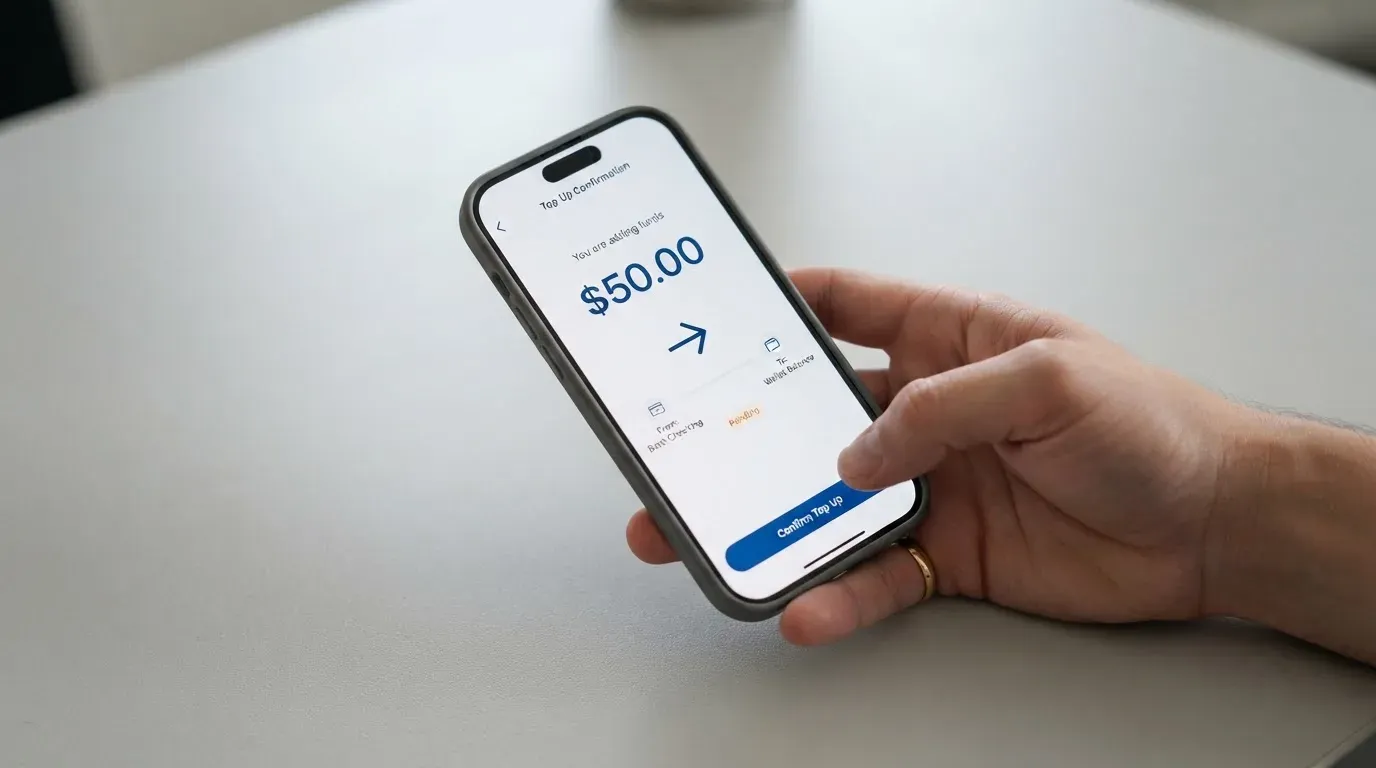
The platform splits ATTN into Liquid and Savings. Withdrawals are split 50/50 between the two, and only the Liquid half is usable for card spending. The Savings half sits in the platform.
This has practical consequences. If you’re a creator being paid in ATTN for staked content, the card is a clean way to turn that earning into a coffee or a bill payment. If you’re an outside user, the only way to “fund” the card is to acquire ATTN on the platform first, which the documentation doesn’t describe in detail. There’s no documented path to deposit USDC or USDT from a self-custody wallet.
The card does mention EUR and USD IBAN accounts as part of the unified balance release, which suggests there’s a way to receive traditional currency into the platform. The fees for receiving into those accounts aren’t stated.
The withdrawal path is clearer than the top-up path. ATTN is swapped to USDC in the app wallet and sent to an external provider for local currency. An in-app off-ramp is described as “coming soon” in the materials I read, and the withdrawal cycle shortened from 30 to 14 days starting 18 May 2026. So if you want to convert ATTN to spendable cash outside the card, that’s a 14-day cycle today.
For a reader who wants a “deposit from my own wallet” workflow, this isn’t it. For a reader who is already inside the Collective Memory ecosystem, the workflow is intentional and clean.
Paying with the Collective Memory card day to day
The card is offered in virtual and physical form, and the release explicitly mentions Apple Pay and Google Pay support. Tokenised mobile wallets work by replacing the card number with a device-specific number stored in the Secure Element of the phone, so even if the merchant or terminal only accepts contactless, the card can be used.
What’s not stated is the list of merchant categories the card blocks, the dispute process, and the cashback or rewards structure for spending. The release describes creator earnings from stakes on content, but doesn’t mention a card cashback programme. So the everyday economics are: you spend ATTN, the card converts it to USDC, the merchant receives fiat, and you don’t appear to earn anything back on the spend.
The app is the operational centre. Card management, the IBAN accounts, conversion, and (when it ships) the in-app off-ramp all sit in the same place. Store ratings weren’t checked in the materials I read, so I can’t tell you whether the app is well-reviewed.
The card does not, on the public materials, support a “spend from your own non-custodial wallet” flow. If you hold USDC in MetaMask, Phantom, or another self-custody wallet, this card is not a path to spend that balance. You’d need to move the USDC to an exchange, convert to fiat, and deposit into a bank, then spend through a normal card. The Collective Memory card only spends from inside the platform.
What can go wrong with the Collective Memory card
The risk picture for a card like this has three layers: the platform, the card programme, and the wider category. I’ll take them in order.
On the platform side, Collective Memory is described as a decentralised social platform where creators earn ATTN for staked content. The card’s documentation says the user retains non-custodial control, but the conversion-to-USDC and the IBAN accounts run inside the platform, so in practice you’re trusting Collective Memory to handle the conversion and the payout correctly. The 2FA options and the ability to freeze the card are not detailed in the public documentation.
On the card programme side, the card is powered by Wirex Banking-as-a-Service. Wirex describes itself as a principal member of both Visa and Mastercard, which is a meaningful claim: a principal member can issue cards directly under the network’s licence, rather than sponsoring through another bank. That said, the actual issuing entity for the Collective Memory card is not stated, and the licences that govern the card programme are not stated either. You’re trusting a sponsorship chain that the public materials don’t fully describe.
Complaints data is thin. I didn’t find a Trustpilot page for the card, didn’t find Reddit threads about the card, and didn’t find official incident notices in one search. That can mean the card is too new to have generated complaints, or it can mean the card is too small for complaints to surface. It is not, by itself, evidence of safety.
On the category side, the historical record for crypto cards is mixed. Visa terminated its global agreements with FTX in November 2022, and the FTX US debit card was wound down by its issuer. WaveCrest, a Visa card issuer that supplied several crypto brands, was suspended by Visa in Europe in 2018, closing every WaveCrest-issued Visa programme. Programme closures typically follow a pattern: a notice period, then loading stops, then spending stops, then users are asked to withdraw remaining balances. None of this is unique to the Collective Memory card, but a reader who is putting meaningful value onto the card should know that card programmes can be suspended and balances can become hard to reach for a time.
Stablecoin risk is part of the funding model here, even though the card converts at the point of sale. The card’s release mentions USDC, which is redeemable 1:1 for US dollars and is backed, per Circle, by cash and cash equivalents with monthly reserve attestations. That backing has held through prior stress events, including the USDC depeg in March 2023 during the US banking crisis. The wider stablecoin market is dominated by USDC and USDT, which together hold about 90% of stablecoin market capitalisation per a BIS estimate from July 2025. The good news: if you hold USDC, the underlying is one of the most-reserved stablecoins in the market. The bad news: “stablecoin” is a category name, not a guarantee; past pegs have broken, and a temporary depeg at the moment of conversion would affect the amount of fiat the merchant receives.
The card’s support contact is [email protected] for technical questions. Languages and hours aren’t stated. If your card is declined at a critical moment, the resolution path is one email address and the app.
What to take instead of the Collective Memory card
The right alternative depends on what you’re trying to do. If you want a card that spends from a self-custody wallet with a published fee schedule, three cards are worth comparing. None of them is the Collective Memory card; each takes a different angle.
TokenPocket (TP Card). A crypto card from the TokenPocket wallet. The Visa debit variant is available across a list of European countries (Germany, France, Spain, Switzerland among them); the Mastercard debit variant is available in Australia, Canada, Hong Kong, Japan, Taiwan, New Zealand, Singapore, South Korea and the UK, with the Americas described as planned for Q2 2025. The card runs on Arbitrum. Fiat24-issued cards are virtual, and balances are held in EUR24 and USD24. The cost model is unusual: a small portion of an NFT creation fee is partly covered by TokenPocket, and the documentation says “apart from these, TP Card does not charge any additional fees”. On funding, a 1% fee is charged when depositing cryptocurrency into the TP Card, to be refunded later via rewards or reduced transaction fees; the FX fee is not stated, and extra fees can come from inter-institution settlement. No card cashback is stated. TokenPocket scores 5.8 out of 10 in my comparison set. Compared to the Collective Memory card, it offers a more general “deposit from your wallet” flow on a specific network, but its card coverage is more limited geographically.
MetaMask Card. A Mastercard debit issued by Monovate, with Crypto Life as the card provider. Sign-ups are open in 45 listed countries and territories, including parts of Europe, Latin America and Canada; other regions join a waitlist. US and UK sign-ups were temporarily closed per the FAQ at the time the materials were collected. Proof of residency is required; the rule is that “ineligible regions limit sign-ups, not spending”, so the geography applies to getting the card, not to using it once issued. The Virtual card is free, with no annual or maintenance fee; the Metal card is $199 a year. A minimal fee per transaction is mentioned but not stated; the documentation says “no additional MetaMask fees” and that the Mastercard rate is used for FX. The card spends directly from the connected wallet, and the supported networks are Linea, Base, Monad and Solana. The named tokens are mUSD, wETH, EURe, GBPe, USDC and USDT, with the page saying nine. Cashback is paid in mUSD into the Money Account: 1% on Virtual; 3% on Metal for the first $10,000 of spend, then 1%. There’s also a $FLY bonus via the Blackbird dining app. MetaMask scores 7.1 out of 10, the highest of the three alternatives here. Compared to the Collective Memory card, it offers a self-custody spending flow, a published fee structure, and an explicit rewards programme, at the cost of a more limited country list and a temporary closure of US/UK sign-ups.
KAST. A Visa card programme with Standard (Visa Platinum), Premium (Visa Infinite metal) and Private (Visa Infinite gold plated) tiers, plus other designs (Pengu, Solana, Bitcoin). Up to 10 cards per user. Available in residence-based countries listed at KYC, with a Restricted Locations list referenced but no countries named. Citizenship and ID matter: a person living in a supported country but holding an ID from a restricted region may still be unable to pass KYC, while dual citizens with an ID from a supported country may pass. Only the account holder’s own ID is accepted, and a VPN does not bypass the check. Annual membership is 0 USD for Standard, 1,000 USD for Premium and 10,000 USD for Private, billed annually upfront with no monthly option. An extra virtual card is 2 USD, with regional variation. Inactivity is 1 USD a month after 12 months. The fee schedule is more detailed than most: stablecoin top-up 0%, card spend in USD 0%, transaction fee 0%, Apple/Google Pay 0%, non-USD FX fee 0.5% to 1.75% depending on residence country, transaction country and card programme, non-USD transactions under 25 USD 0.10 USD, declined transactions 0.50 USD. Non-stablecoin tokens may be auto-converted at a fee shown in the app. Cashback is paid in USD: 1.5% on first 2,000 USD a month for Standard, 2% on first 10,000 USD a month for Premium, 3% on first 40,000 USD a month for Private; Premium and Private also earn KAST Points. KAST scores 6.1 out of 10, identical to the Collective Memory card. Compared to the Collective Memory card, it offers a much more detailed fee schedule and a tiered rewards programme, at the cost of a paid membership at the higher tiers and a less clearly published country list.
A short comparison:
| Card | Score | Best for | Key trade-off |
|---|---|---|---|
| Collective Memory | 6.1 / 10 | Creators spending ATTN earnings | Fees and limits not published; funding only from platform balance |
| TokenPocket | 5.8 / 10 | TokenPocket wallet users on Arbitrum | Limited geography; FX fee not stated |
| MetaMask Card | 7.1 / 10 | Self-custody spending across multiple networks | US/UK sign-ups temporarily closed; residency required |
| KAST | 6.1 / 10 | Detailed fee schedule and tiered rewards | Paid membership at higher tiers; country list not published |
If you’re a Collective Memory creator, the Collective Memory card is the natural fit and the alternatives won’t replicate the funding flow. If you want a general-purpose crypto debit card, MetaMask Card is the strongest of the three on published fees and rewards, KAST is the most transparent on per-transaction costs, and TokenPocket is the right answer if you’re already on Arbitrum. None of the three replicates the Collective Memory card’s exact model.
Who I’d recommend the Collective Memory card to
The short version: this card is for a specific reader, and if you are not that reader, you’ll be paying a “creator product” premium in the form of an opaque fee schedule and a constrained funding model.
The card is a good fit if you are a creator on Collective Memory earning ATTN for staked content, you live in one of the listed eligible countries, you want to spend those earnings in the real world without an off-ramp, and you are comfortable with the card’s mobile-wallet support and Wirex-powered banking infrastructure. The unified balance, the EUR and USD IBAN accounts, the Apple Pay and Google Pay support, and the 14-day withdrawal cycle (down from 30 days) are all reasonable features for that reader.
The card is a poor fit if you want a published fee schedule before you sign up, if you want to fund the card from an external self-custody wallet, if you want a card cashback programme, if you want clear KYC and dispute procedures in writing, or if you want a card that supports a wide range of cryptocurrencies and networks. The card’s design is to convert Liquid ATTN at the point of sale; if that’s not the spend flow you want, this is the wrong card.
There’s also a category-level caveat. A crypto debit card in 2026 sits at the intersection of three regulated things: payments, electronic money, and cryptoasset services. In the EU, MiCA’s rules on asset-referenced tokens and e-money tokens applied from 30 June 2024, and the remaining provisions (including crypto-asset service provider rules) applied from 30 December 2024. The MiCA transitional period runs until 1 July 2026, or until a provider receives or is refused a MiCA authorisation. In the US, FinCEN guidance treats administrators and exchangers of convertible virtual currency as money transmitters. None of that means the Collective Memory card is or isn’t compliant; it means that the regulatory picture for any crypto card in 2026 is a moving target, and the issuer and the licence chain matter. The card’s public materials don’t state who the issuer is or which licences apply, so a reader who cares about that question will have to wait for more disclosure.
A final note on safety. I want to be careful here, because the limits of what I can say are real. A new card with a thin public footprint and no complaints I can find is not the same as a card with a proven track record. The card’s strongest structural feature is that it runs on Wirex Banking-as-a-Service, and Wirex’s principal membership in Visa and Mastercard reduces some of the operational risk around programme suspension. The card’s weakest structural feature is that the issuing entity and the licences aren’t named. Treat the card as a usable product for its intended audience, with the caveat that “intended audience” matters: the more you depend on the card for everyday spending outside the Collective Memory ecosystem, the more you should want a published fee schedule, a published dispute process, and a published licence chain before you load meaningful value.
Frequently asked questions
What is the Collective Memory card?
The Collective Memory card is a debit card that settles purchases by converting the platform’s Liquid ATTN token into USDC at the point of sale. The card is offered in virtual and physical form, supports Apple Pay and Google Pay, and is rolled out across a long list of countries. It’s intended for creators earning ATTN through the Collective Memory platform who want to spend those earnings without a separate off-ramp.
How does the Collective Memory card work?
When you pay, the platform converts your Liquid ATTN into USDC, which is then settled as fiat with the merchant. There is no prefunding step where you load a balance in advance; the conversion happens at the moment of purchase. Withdrawals from the platform split 50/50 into Liquid and Savings ATTN, and only the Liquid half is usable for card spending.
Is Collective Memory a bank?
Collective Memory is not a bank. It’s a decentralised social platform that issues the card through a third-party banking partner. The card is powered by Wirex Banking-as-a-Service, and Wirex describes itself as a principal member of Visa and Mastercard. The specific issuing entity and the licences that govern the card programme are not stated in the public materials I read.
Who owns Collective Memory?
The card’s documentation doesn’t disclose ownership of Collective Memory. It’s described as a decentralised social platform. The card programme is run through Wirex Banking-as-a-Service, which is a separate company. For ownership details, the platform’s own materials are the source of truth.
Is the Collective Memory card available in my country?
The card’s eligibility list names the United States, most of the European Union and EEA countries, the United Kingdom, Switzerland, several Balkan and micro-jurisdiction territories, Australia and a number of Asian and Latin American countries, and a long list across the Middle East, Africa and the former Soviet space. Russia and Belarus are not on the list. The documentation doesn’t say whether the rule is based on citizenship, residence, or both. Check the current list in the app before signing up, because the app and the eligibility list are the only sources of truth.
How do I get the Collective Memory card?
You sign up through the Collective Memory app, available at collectivememory.ai/get-app. The card is offered in virtual and physical form. The card’s documentation doesn’t state the KYC steps, the documents required, or the delivery time for the physical card, and that lack of disclosure is worth treating as a known gap rather than a hidden step.
Does the Collective Memory card require KYC?
The card’s documentation doesn’t describe the KYC process. As a regulated debit product, the card will require identity verification before it can be used; what isn’t published is the specific set of documents, the KYC levels (basic vs. enhanced), and what happens if your documents are from a country not on the eligibility list. Plan on having a government-issued ID and a proof of address ready.
How do I add the Collective Memory card to Apple Wallet or Google Pay?
The release explicitly mentions Apple Pay and Google Pay support. The standard flow in the app is to open card management, choose “Add to Apple Wallet” or “Add to Google Pay”, and follow the tokenisation steps. The card number is replaced by a device-specific number stored in the phone’s Secure Element, which is how tokenised mobile wallets keep the underlying card number private.
How do I withdraw money from Collective Memory?
ATTN is swapped to USDC in the app wallet and sent to an external provider for local currency. An in-app off-ramp is described as “coming soon” in the materials I read. The withdrawal cycle shortened from 30 to 14 days starting 18 May 2026, and withdrawals are split 50/50 into Liquid and Savings ATTN, with only the Liquid half usable through the card.
Is the Collective Memory card safe?
The card’s strongest structural feature is that it runs on Wirex Banking-as-a-Service, and Wirex’s principal membership in Visa and Mastercard reduces some of the operational risk around programme suspension. The card’s documentation says users retain non-custodial control of their crypto, but the conversion and payout are run by the platform. The issuing entity, the licences, the 2FA options, and the freeze functionality are not stated in the public materials, which is a real gap rather than a sign of trouble. Treat the card as a usable product for its intended audience, with the caveat that “intended audience” matters: the more you depend on it outside the Collective Memory ecosystem, the more you should want more disclosure before you load meaningful value.
Choosing a wallet card – cryptocardadvisor
Content created by the «cryptocardadvisor» team