
A 7.6 look at a Visa crypto card built for stablecoin spending
 Available in US
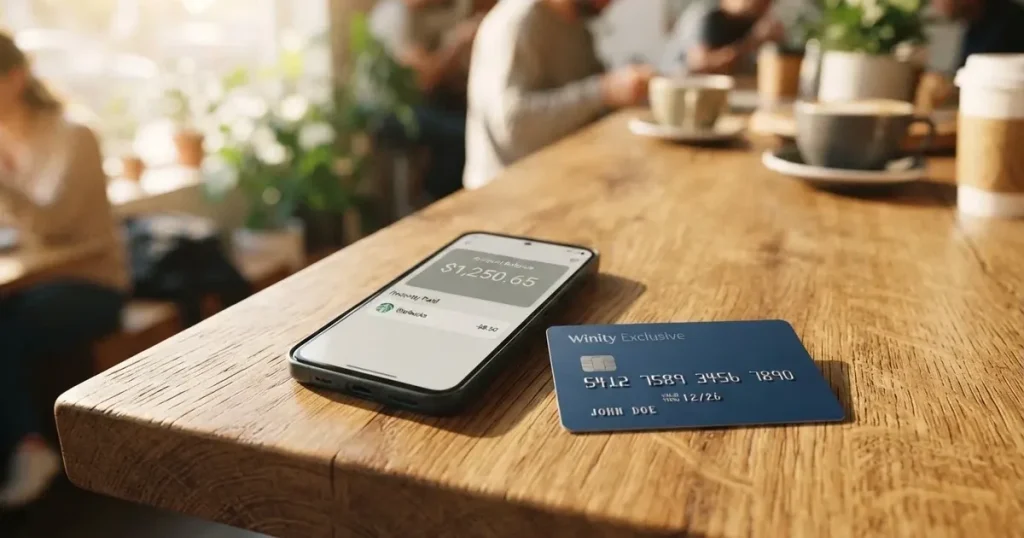
The Winity Exclusive line is a pair of Visa cards (one virtual, one physical) that draw on a balance funded by crypto. Spend happens in USD, the card itself is a familiar Visa, and the design choice behind the product is straightforward: hold USDT or USDC, top up the card, and pay anywhere Visa is taken. That core idea, plus unusually broad geographic reach, is what makes the Exclusive cards worth a close look. It is also what makes them worth some caution: stablecoin top-ups, a Hong Kong-based programme manager, and unnamed issuing partners each add a layer a reader should understand before signing up.
Conditions are current as of October 28, 2026.
Verdict
Winity Exclusive scores 7.6 out of 10 in my reading. The breakdown below shows where the marks come from. The card suits someone who already holds USDT or USDC, wants to convert to USD at no percentage fee, and values a Visa that works in 180-plus countries. It does not suit someone who needs a card that is plainly issued by a named bank, who wants to spend in a currency other than USD, or who is unwilling to keep a USD 25 minimum balance on the card at all times.
| Criterion | Mark | Why |
|---|---|---|
| Who can get it | 9 / 10 | 187+ countries named in the FAQ, 180+ in the footer, restricted jurisdictions excluded but not listed |
| Cost | 7 / 10 | Physical card USD 20 a year with the first six months waived, USDT and USDC top-up at 0%, USD 0.10 minimum on payments under USD 25, virtual issuance and FX fees not stated |
| Top-up options | 9 / 10 | USDT and USDC at 0% across six networks, plus ETH, SOL, POL, TRX, WCO and BNB at 5%, USD 25 minimum balance |
| Reliability and complaints | 5 / 10 | Winity Life is a Hong Kong technology company that says it is not a bank, cards are issued by unnamed licensed partners, the only public Trustpilot review is a single positive one |
| Everyday use | 8 / 10 | A virtual and a physical Visa, Google Pay ready on the virtual card, USD 3 per ATM withdrawal on the physical, no Apple Pay mentioned |
| Total | 7.6 / 10 |
The headline the card is built around, in my reading, is “spending USDT or USDC with a virtual and physical Visa.” If that is what you want, the Exclusive pair delivers a clean and unusually wide version of it. If you want anything else, the design choices of the product start working against you.
Who can get the Winity Exclusive card
The first thing to know is that the Winity Exclusive cards are positioned for reach. The FAQ says they are available in 187+ countries, and the website footer says 180+. Both numbers are large; both are also imprecise, because restricted countries are excluded from those totals and the company does not publish the exclusion list. The terms simply require residence in a supported non-restricted country. Citizenship is not mentioned as a separate criterion, so the practical question for a reader is whether their country of residence is on the inside of the line.
There is no tiered eligibility, no holding period, and no proof of address in the published checks. The age requirement is 18+. The supporting documents are a passport, a driving licence or a national ID. Identity verification usually takes minutes, with a manual review window of one to two business days if the automated check needs a second pair of eyes. The cards are only issued after that check succeeds, so the KYC step is the gate. None of this is unusual for a regulated card product, but the lack of a published restricted-country list is unusual and worth checking before you start the application: if your country of residence is on whatever the company treats as restricted, the rest of the process simply will not run.
If you are weighing Winity against an ordinary bank card and your main frustration is being turned down by a bank, the broad reach is genuinely meaningful. If you are weighing it against a different crypto card and you live in a country where most products are not offered, it is also meaningful. The flip side is that “187+ countries” is not the same as a licensing story: the company behind it is a Hong Kong technology business that is not a bank, and the cards are issued by unnamed licensed partners. That is the next section, but it is worth flagging here, because the breadth of the offer is what makes the corporate structure matter.
How to get the Winity Exclusive card
The application path is a standard KYC-then-issue flow. You complete identity verification through the Winity app, and the cards are issued once that check is successful. There is no second tier of verification, no VIP pathway that skips the checks, and no published reason list for rejection, so if the system declines you the only practical step is contact through support.
There are two cards in the Exclusive line, plus a higher-end Executive Metal that sits above them. Both Exclusive cards are Visa-branded, and transactions are denominated in USD. The Exclusive Virtual is the always-on card that can be added to a mobile wallet; the Exclusive Physical is the plastic card that arrives by post. The Executive Metal adds a faster earn rate, a concierge and a 24/7 relationship manager. Loyalty levels run Silver, Gold and Platinum, with Platinum at USD 5,000 and above.
A few practical points from the published terms, worth knowing before you tap through the screens:
- Physical card shipping charges may apply, and the company does not publish the cost, the time, or the replacement fee.
- Issuance of the physical card is “limited” in its free form, and the physical card requires USD 25 of spend on the virtual card before it is issued for free; the standard physical card fee is USD 20 a year.
- The virtual card is deactivated if the account does not receive at least USD 25 within 14 days of activation, so a half-completed onboarding has a real cost.
For most readers the onboarding is short, the verification is fast, and the card is in the app within minutes. The friction is the parts the company does not say out loud: what the physical card actually costs to ship, what happens to a virtual card that does not get funded, and what the corporate structure looks like behind the Visa mark.
What it really costs: Winity Exclusive fees
The cost picture is one of the more important parts of this review, and it is also one of the more uneven parts of the published information. Some numbers are stated clearly, others are simply not stated. Where the company has not said, I will say so rather than guess.
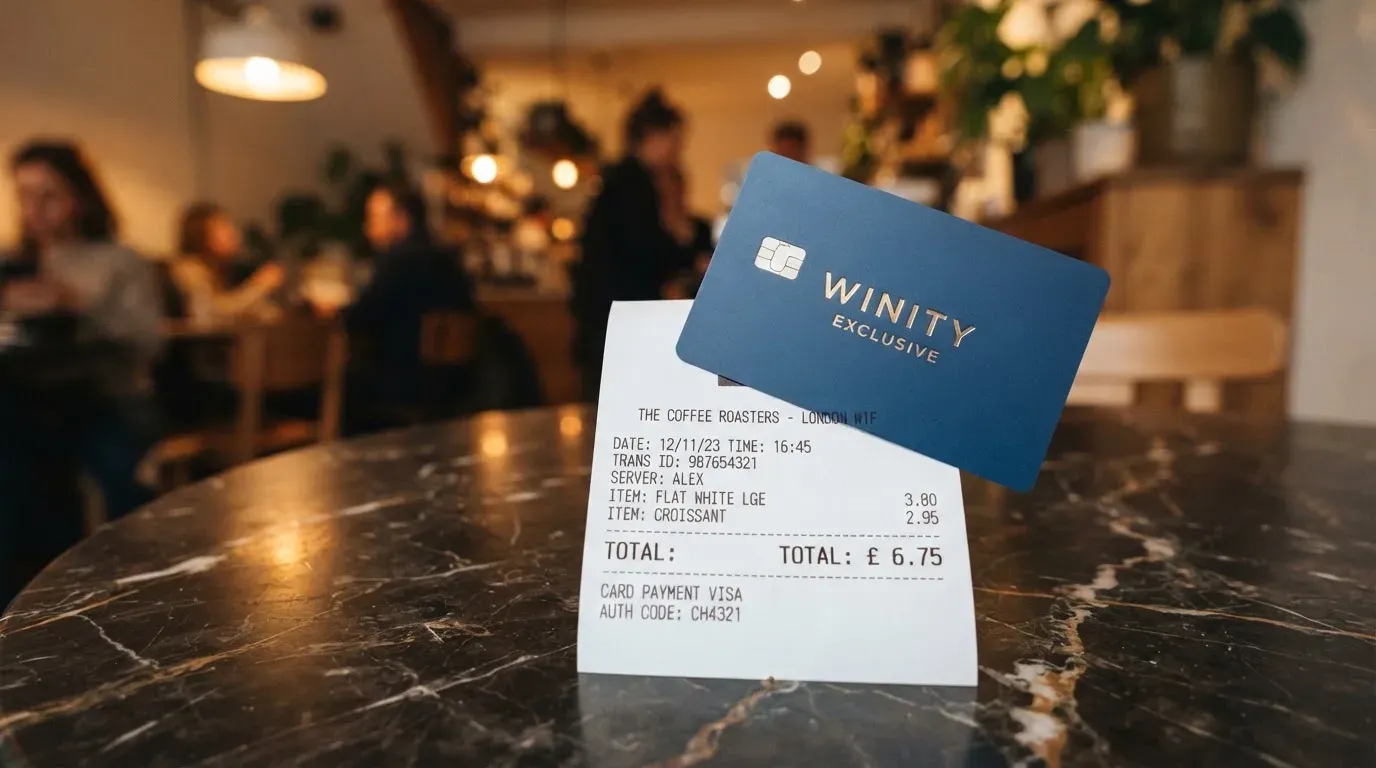
| Fee or limit | Amount |
|---|---|
| Physical card annual fee | USD 20 (first 6 months waived on new activations) |
| Virtual card issuance | Not stated |
| Top-up fee, USDT and USDC | 0% |
| Top-up fee, other crypto (WCO, ETH, SOL, POL, TRX, BNB) | 5% |
| Minimum spend fee | USD 0.10 for payments under USD 25 |
| FX fee | Not stated |
| ATM withdrawal | USD 3 per withdrawal (physical card only) |
| PIN change | USD 5 |
| Minimum balance for card transactions | USD 25 |
| Daily and monthly spend caps | Not published (vary by user, tier and jurisdiction) |
| Statement request | USD 5 |
| Chargeback fee | USD 100 |
Two everyday payments will give a sense of how the costs line up.
A USD 30 coffee in a US shop, paid with the virtual card funded by USDT: the deposit conversion is 0%, the payment is over the USD 25 threshold so the USD 0.10 minimum spend fee does not apply, and there is no FX because the merchant charges in USD. The only network cost is the gas fee on whatever blockchain you sent the USDT from, which the card provider does not charge. Total fee: zero, plus the gas on your deposit.
A EUR 20 dinner in Berlin, paid with the physical card funded by USDC on Polygon: the top-up is 0%, but the merchant charges in EUR and the card settles in USD, so an FX conversion runs at the card’s published rate. The fee on that conversion is not stated, which is the practical gap. The USD 0.10 minimum spend fee does not apply, because the payment is over USD 25 in USD-equivalent terms. The on-chain network fee on the USDC deposit is paid in POL (the gas token on Polygon) and is not a Winity charge. Total fee: FX rate (unstated), plus the gas on your deposit.
That second example is the honest one. The cost story is clear for the stablecoin-to-USD path, and that path is the one the company is built around. Once you cross into another currency, the published information stops, and you have to rely on the in-app rate. If your spending is going to be in EUR, GBP or any other non-USD currency, that is the first thing to check in the app before you commit.
How to top up the Winity Exclusive card
Top-up is the part the company is most explicit about, and it is also the part most likely to lose a careless deposit. The funding path runs from your crypto wallet, through a partner custody wallet, into the card’s USD balance. The card itself only ever spends in USD; the crypto top-up is converted at deposit time, and the resulting USD sits on the card until you spend or withdraw it.
The supported assets and networks are:
- USDT and USDC at 0% conversion: Ethereum, Solana, Tron, Polygon, BNB Chain and W Chain.
- ETH, SOL, POL, TRX, WCO and BNB at 5% conversion: the same six networks, with the asset being the network’s own gas token in most cases.
The 0% line on USDT and USDC is the headline. In practice that means you can move a dollar-pegged token from your own wallet, pay the network’s gas fee, and end up with a dollar on the card minus only that gas fee. The 5% line on the other assets is what makes the card unattractive for spending ETH or SOL directly: the conversion is large enough to be worth thinking about.
A few rules from the terms that are easy to miss:
- Network gas is paid by the user, in the gas token of the chosen network, and is not a Winity charge. A wallet with USDT but no ETH cannot send USDT on Ethereum.
- The card needs a USD 25 minimum balance to make a transaction, and a virtual card is deactivated if it has not received USD 25 within 14 days of activation.
- Withdrawals back to crypto are not supported in the app. Cash comes out only through Visa ATMs on the physical card, not as a crypto transfer.
- Refunds are reviewed only for the most recent deposit, and only if you request the refund immediately with no card transactions after it. Once a payment has been made, the deposit window for refunds is closed.
Two practical reading notes. First, the network choice matters: USDT on Tron and USDC on Polygon are typically the cheapest combinations, while USDT on Ethereum is typically the most expensive. Circle stopped supporting USDC on Tron in February 2024, so “USDC on TRC20” is not a native option and any token sent that way is likely to be lost or stranded. Second, blockchain transfers are irreversible: a deposit sent on a network the card provider does not support, or to an address for a different network, can be lost or require a manual support recovery with no guarantee. Always send a small test transaction first if you are changing networks.
Paying with the Winity Exclusive card every day
The day-to-day experience of the Winity Exclusive cards is the part most likely to feel familiar. You have a Visa number, the card works at any merchant that takes Visa, the virtual card is Google Pay ready, and the physical card is a piece of plastic that goes in a wallet. The Apple Pay question is open: the company’s published pages do not mention it, and the only confirmed tokenised wallet at the time of writing is Google Pay on the Exclusive Virtual. If Apple Pay is the wallet you actually use, that is the first thing to verify in the app before you depend on it.
There is no cashback. The reward mechanic is Winity Points, awarded at one point per USD 10 of eligible spend on the Exclusive cards, with an Executive earn rate that is not specified. The redemption portal is described as “coming soon”, so points are accumulating but cannot be spent in the product at the time of writing. That is a real but limited gap: the earn rate is published, the redemption is not yet open.
The mobile app is published for iOS and Android, though the app-store ratings were not found in the search I ran. The dispute path for an unauthorised transaction runs through support: report the transaction, block the card, and Winity will review and raise the case with Visa. The chargeback fee is USD 100 regardless of outcome, and the company’s published terms describe the decisions as “final and binding”. Unresolved cases after 60 days go to arbitration under the terms of service. This is broadly standard for the category, but the USD 100 fee is on the higher end and worth knowing before you file a dispute that may not succeed.
The blocked merchant list is not published. That is typical for the category, but it means a gambling transaction, a crypto purchase, or another restricted category may decline without a clear reason at the till. The standard friction of foreign-issued Visa cards can also apply: a merchant that runs an address-verification check or a BIN lookup may treat the card as foreign-issued and decline. That is a Visa-network behaviour, not a Winity policy, but it is part of what a reader in a non-US country will see in practice.
What can go wrong with the Winity Exclusive card
The risks fall into four buckets, in order of how much weight I would put on each.
The issuing structure. Winity Life is a Hong Kong technology company (the parent company is WTY Technology Hong Kong Limited, though no registration number is published), and it is explicit that it is “not a bank”. The cards are issued by unnamed licensed partners, with services issued in Hong Kong. The terms apply Hong Kong law and route disputes to HKIAC arbitration. This is not a red flag on its own: a lot of crypto cards sit on a similar stack. It is, however, a reason to read the corporate structure as a single risk rather than as background, because the recourse path on a problem is not through a named bank regulator you can complain to.
Custody during the top-up window. The funding flow moves your crypto from your wallet into a partner custody wallet, where it is converted to USD and loaded on the card. That custody step is a temporary one, but it is a custody step: between the moment your transaction is confirmed and the moment the USD appears on the card, your funds are held by a third party. The published material describes a safeguarding arrangement that is not stated, which I would read as “the safety claim is in the marketing, the legal safeguarding is in the terms”. A self-custody wallet you control entirely has the opposite profile: your funds are yours until the moment of payment, and the cost of that is sole responsibility for keys, phishing and clipboard-hijacking malware.
Operational track record. The public footprint of the Winity brand is thin. The Trustpilot profile is claimed from October 2025 and the only review I could find at the time of writing is a single five-star review posted on 26 December 2025 (read on 21 October 2026). TrustScore is 3.7 (labelled 3.5 stars) on that single review. There are no complaint themes, simply because there are not enough reviews to draw a theme from. That is not a negative signal, but it is a thin one, and a thin signal is itself a signal. The product has not been through a market cycle that would produce a real body of user reports, and there is no licence, issuer or programme news in the search results beyond the brand claim.
Programme risk in the category. Visa can suspend a card programme, and it has done so in the past. The most cited case is FTX, where Visa terminated its global agreements on 13 November 2022 and the FTX US debit card was wound down by its issuer. The WaveCrest suspension in 2018 closed every WaveCrest-issued Visa programme in Europe in one move. Neither of those events involved Winity, and neither is a forecast; both are reminders that the Visa mark on the card is licensed to an issuer, and that the licence can be revoked. A programme closure typically gives a notice period, then stops spending, then asks users to withdraw remaining balances. The most recent public example is a 2026 closure reported by a single secondary source, with new loads ending on 8 July 2026 and spending ending on 8 August 2026; that report is unconfirmed, and I am flagging it as a single data point rather than a trend.
Two small things that are easy to miss. The virtual card is deactivated if it does not receive USD 25 within 14 days of activation, so a partial onboarding has a concrete cost. And the dispute path charges USD 100 regardless of outcome, with the published decisions described as “final and binding”, which is a meaningful cost to weigh before opening a chargeback on a small amount.
What to take instead of the Winity Exclusive card
The Winity Exclusive is one of several Visa-or-network cards aimed at spending crypto. Three alternatives in the same rough space:
Cardex. Score 5.6 out of 10. Marketed as “one crypto card, 200+ countries”, with no published country list or exclusions. The card is a debit crypto card on the VERVE, Visa, Mastercard and UnionPay networks, available as virtual and physical, and the App Store listing describes a Naira currency. Top-up is from USDT, USDC and BTC wallets, with networks not stated. The standout claim is an “AI-Powered Conversion Rate” that picks a rate at the moment of payment; the fee on that conversion is not stated. The published information is thinner than Winity’s, particularly on cost and fees, and the score reflects that thinness.
CardFlow. Score 4.9 out of 10. Aimed at Nigeria and “Nigerians and global users”, with a virtual USD Mastercard created in minutes. The site FAQ says creating a virtual card is free, but the monthly fee is not stated and fees are not stated. Top-up is from Bitcoin, USDT, ETH or a Naira bank transfer, with networks not stated. CardFlow is faster to spin up than Winity Exclusive but has less published information on the parts of the cost story that matter for a long-term card.
HyperCard. Score 4.7 out of 10. Official pages do not state a country list, and the App Store says the card is accepted in more than 176 countries, which is acceptance geography rather than eligibility geography. The card is a prepaid “HyperCard” with a balance in USD or EUR, networks not stated on the App Store page. Top-up is by depositing crypto such as USDT, BTC or ETH in the app, converted to USD or EUR. Cost, fees and rewards are not stated on the pages I could read.
The honest read is that the Winity Exclusive pair is the most clearly priced of these three on the parts of the cost story it chooses to publish, and the most clearly restricted on the parts it does not. If your priority is a published fee schedule on a stablecoin-funded card, Winity is in front. If your priority is a wider currency choice or a different jurisdiction of incorporation, the trade-off is visible in the comparison.
Who I would recommend the Winity Exclusive card to
The Winity Exclusive pair fits a specific reader. It fits someone who already holds USDT or USDC, who wants to convert at no percentage fee to a USD balance on a Visa, and who values a single number for the bulk of their spending. It fits someone who travels or lives across borders and is happy to be told that the card works in 180+ countries without an exclusion list to compare against. It fits someone who is comfortable with the corporate structure: a Hong Kong technology company that is not a bank, with cards issued by unnamed licensed partners, and who treats the published 0% on USDT and USDC as the headline rather than the rest of the stack.
It does not fit someone who needs a card that is plainly issued by a named bank, or who needs the protection of a domestic regulator they can name. It does not fit someone whose spending is in EUR, GBP, JPY or any other non-USD currency, because the FX fee is not stated and the in-app rate is the only number you will have. It does not fit someone who wants to redeem a rewards programme today, because the Winity Points portal is described as “coming soon” rather than live. It does not fit someone who is unwilling to keep a USD 25 minimum balance on the card at all times, including the USD 25 receipt window for the virtual card in its first 14 days. And it does not fit someone who needs to send funds back to a crypto wallet: withdrawals to crypto are not supported in the app.
For the reader in the sweet spot, the Winity Exclusive is a clean product: top up with USDT or USDC, pay at any Visa-accepting merchant, pay no percentage on the conversion, accept the network gas as the cost of the top-up. For the reader outside that sweet spot, the gaps in the published information are the same gaps you will hit in the app.
Frequently asked questions
What is the Winity Exclusive card?
The Winity Exclusive is a pair of Visa cards, one virtual and one physical, that spend from a USD balance funded by crypto. The company behind the product is Winity Life, a Hong Kong technology company, and the cards are issued by unnamed licensed partners.
How does the Winity Exclusive card work?
You top up the card from a crypto wallet by sending USDT, USDC or one of the other supported assets on a supported network. The deposit is converted to USD in a partner custody wallet, the USD sits on the card, and you spend it anywhere Visa is taken. The virtual card is Google Pay ready, and the physical card works at Visa ATMs.
Is Winity Exclusive a bank?
No. Winity Life is a Hong Kong technology company that says it is not a bank, and the cards are issued by unnamed licensed partners. The terms apply Hong Kong law and route disputes to HKIAC arbitration.
Who owns Winity Exclusive?
Winity Life is the brand, and WTY Technology Hong Kong Limited is named as the parent. No company registration number is published. Cards are issued by unnamed licensed partners, with services issued in Hong Kong.
Is the Winity Exclusive card available in my country?
The FAQ says 187+ countries and the footer says 180+, with restricted countries excluded but not listed. Residence in a supported non-restricted country is required, so the practical answer is to start the application and see whether the system accepts your country of residence.
How do I get a Winity Exclusive card?
Complete KYC in the Winity app with a passport, driving licence or national ID, and the card is issued after verification succeeds. Verification usually takes minutes, with a manual review window of one to two business days when needed.
Does the Winity Exclusive card require KYC?
Yes. The card is issued only after identity verification succeeds, and the supporting documents are a passport, driving licence or national ID. There is no tiered verification and no VIP pathway that skips the checks.
How do I top up the Winity Exclusive card?
Send USDT or USDC at 0% conversion, or ETH, SOL, POL, TRX, WCO or BNB at 5%, on Ethereum, Solana, Tron, Polygon, BNB Chain or W Chain. Network gas is paid by the user in the network’s own gas token, and the card needs a USD 25 minimum balance to make a transaction.
How do I add the Winity Exclusive card to Apple Wallet?
The published pages do not mention Apple Pay. The only confirmed tokenised wallet at the time of writing is Google Pay on the Exclusive Virtual. Check the app for the current wallet support before you depend on a particular one.
Is the Winity Exclusive card safe?
The published safeguards include biometrics-based 3D Secure without one-time passcodes, an instant card-freeze in the app, a PIN, and optional biometrics. The card is a Visa, the company is explicit that it is not a bank, the funds are held in a partner custody wallet during the top-up window, and the safeguarding arrangement is not stated in the published material. The Trustpilot profile is too thin to draw a signal from.
Choosing a virtual card – cryptocardadvisor
Content created by the «cryptocardadvisor» team