
A multicurrency Mastercard with rewards up to 3% — but the public page leaves many of the basics unsaid
 Available in US

The UNi card is a multicurrency Mastercard tied to a UNi.Global account, and on the surface it looks like the kind of card that ought to appeal to anyone who wants to spend crypto without the friction of selling it on an exchange first. The company behind it, UNI.Global, describes itself as an AUSTRAC-regulated service provider with offices in Sydney, Auckland, Hong Kong and Taipei, and it markets the card with promises of no annual fee, no foreign-transaction fee, and Spend-to-Earn rewards of up to 3%. The card itself can be added to Apple Pay and Google Pay, and a freeze toggle in the app gives a familiar level of day-to-day control.
What I kept running into, though, is how much of the basic information a person would normally expect to find before signing up is simply not stated on the public pages. The list of supported countries is not stated. The supported top-up methods are not stated. The issuance fee, ATM terms, daily and monthly limits, the card form factor and the issuing bank all go unstated. So my job here is to walk through what is on offer, what is genuinely useful, and where you would have to contact support before you can really know whether the card fits your situation.
Conditions are current as of October 28, 2026.
Verdict: 6.1 out of 10
The score is the card’s overall mark; the breakdown below it tells you where the marks come from. In one line: a multicurrency Mastercard with no annual or FX fees and rewards up to 3%, but with too much of the operational detail left unstated to give a high mark to access, top-up or reliability.
| Criterion | Mark | Why |
|---|---|---|
| Who can get it | 5 / 10 | Supported countries not stated; the terms only refer to “jurisdictional limitations” |
| Cost | 8 / 10 | No annual fee, no foreign-transaction fee; conversion at live OTC rates; issuance fee not stated |
| Top-up options | 5 / 10 | Top-up methods not stated; multicurrency wallet with 12+ currencies is mentioned, but no networks or coins are listed publicly |
| Reliability and complaints | 6 / 10 | UNI.Global is described as AUSTRAC-regulated with offices in Sydney, Auckland, Hong Kong and Taipei; the issuing bank is not named and no independent complaint footprint was found |
| Everyday use | 6 / 10 | Multicurrency Mastercard, Apple Pay and Google Pay, in-app card freeze; card form factor, ATM terms and dispute path are not stated |
| Total | 6.1 / 10 |
The card is best suited to multi-currency spenders who want rewards of up to 3% and are comfortable contacting support to fill in the gaps before they commit. It is not well suited to anyone who needs a fully disclosed set of fees and country rules before they sign up, or to anyone who relies on cash from an ATM in places where a specific fee schedule matters.
Who they will give the card to
The honest answer is that the card’s public pages do not state who the card is for. The only thing the published terms say about geography is that service is “subject to jurisdictional limitations”, and the company does not list which jurisdictions those are.
For everyday use and KYC, the rules that are stated are familiar and reasonable. You must be 18 or older, complete a single verification that covers both the fiat side of the service and the card, and the steps are the usual ones: personal information, a scan of an identity document, a selfie, and a proof of address (a bank statement or a utility bill). UNI.Global says verification takes 1-2 business days.
The empty space around the country list is the part that should give a prospective applicant pause. If your situation depends on residency in a specific place, on having a particular citizenship, or on travelling through a list of countries where some of the card’s features would be restricted, you will not find a clean public answer. The terms also do not name the issuing bank, which is a routine detail on a card product page and a useful clue for understanding which regulator actually stands behind the card.
So: who will they give the card to? Anyone who is at least 18, can complete the KYC, and falls inside whatever jurisdictional rules UNI.Global applies in practice. The first check, before anything else, is to ask support whether your country is on the list.
How to get it
The signup flow itself is the part UNI.Global describes clearly, and it is the part that is not unusual for a regulated crypto card. You create an account, finish the single verification for fiat services and the card together, and then you should be able to add a card to your UNi.Global account. The card is a multicurrency Mastercard that spends from the UNi.Global account balance.
The KYC step is the part that deserves attention. You will need to provide personal information, a scan of an identity document, a selfie, and a proof of address — a bank statement or a utility bill is what UNI.Global’s pages call out. The whole process is described as taking 1-2 business days. You do this once, and the same verification unlocks the fiat side of the service and the card together.
What the public pages do not say is just as important here. The card is described as a multicurrency Mastercard, but the form factor — physical, virtual, or both — is not stated. The card delivery time is not stated. So you should expect that, if a physical card is offered in your jurisdiction, support will tell you the delivery estimate; if a virtual card is the only form on offer in your jurisdiction, that is also something to confirm up front.
A practical sequence to follow:
- Open the app, start account creation, and have your ID, selfie and proof of address ready.
- Expect verification to take 1-2 business days; have a backup card in case it takes longer.
- Ask support before you commit, in writing, what form factor is offered in your country and how long delivery or instant issuance will take.
Fees and what a UNi payment really costs
This is the section where the card looks strongest, but the cost picture still has holes. The stated fees are unusually friendly: no annual fee, no foreign-transaction fee, no hidden exchange fees, and assets converted at “live OTC (Over-the-Counter) rates”. A wallet that supports 12+ currencies means the card can be switched among currencies to pay.
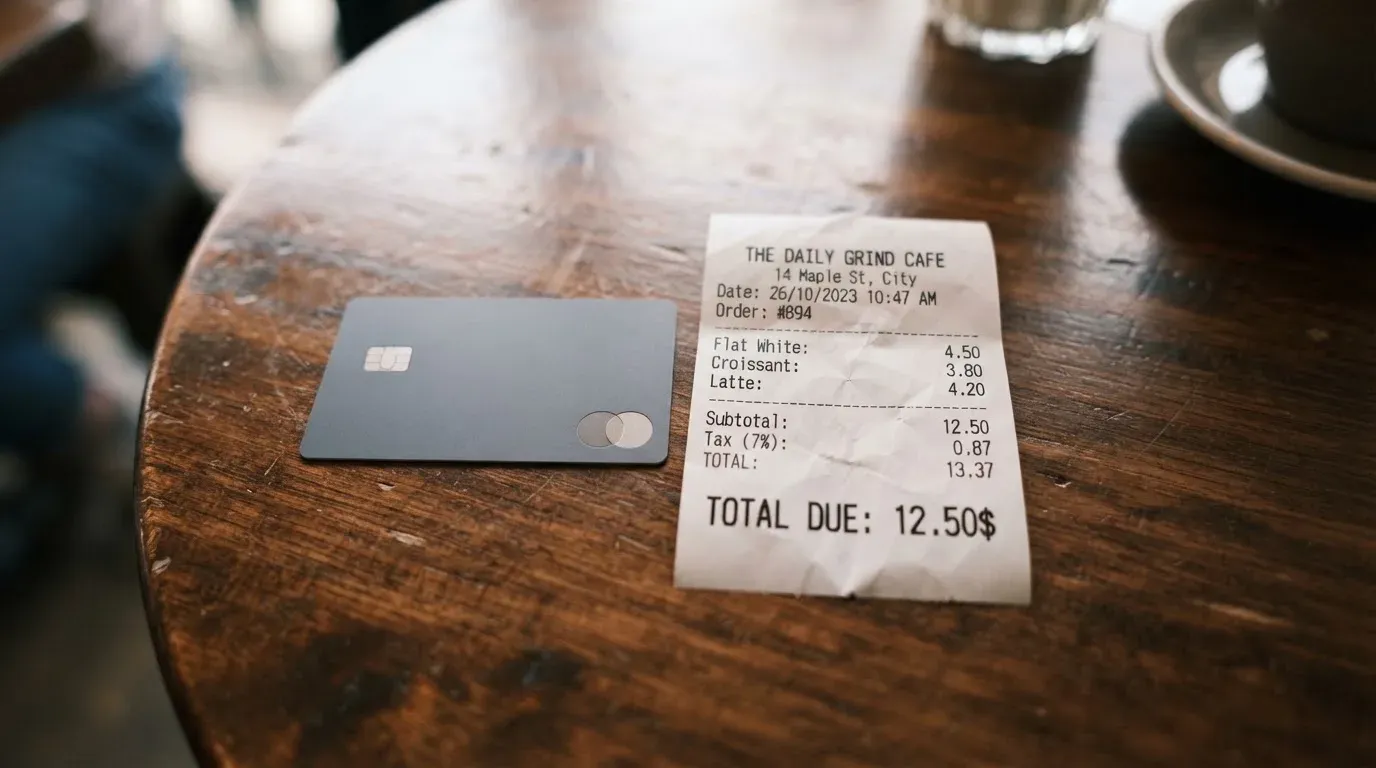
The table below lists what the public material says — and what it leaves out. Treat the “not stated” lines as a reason to ask, not as a reason to assume.
| Fee or limit | What the public pages say |
|---|---|
| Issuance fee | Not stated |
| Annual or monthly fee | None stated (“No annual fee”) |
| Foreign-transaction fee | None stated (“No annual fee or foreign transaction fee”) |
| Conversion (crypto to fiat) | At “live OTC rates”; “No hidden exchange fees” |
| ATM | Not stated |
| Daily spend limit | Not stated |
| Monthly spend limit | Not stated |
| Membership tiers | Levels exist; what each gives is not stated |
To turn the rules into something you can feel, here is how the cost story plays out for three everyday payments. I am not adding numbers that the public material does not give; the point of each case is to show which fees apply and which do not.
A coffee paid in your home currency. The merchant sees a Mastercard, the issuer settles in the card’s currency, the UNi.Global balance is debited in that same currency, and no FX or conversion is involved. None of the listed fees apply to this payment.
A meal in another country, paid from your home currency balance. The card converts the home-currency balance into the local currency at the live OTC rate that UNI.Global publishes. The “no foreign-transaction fee” rule means there is no separate Mastercard cross-border markup on top of the OTC rate, and the “no hidden exchange fees” wording suggests the OTC rate is the all-in rate. The only cost on top of the rate itself is the spread baked into the rate — which is exactly what an OTC desk charges — and the size of that spread is not stated.
A flight booked online in US dollars from a euro balance. The balance is converted at the live OTC rate, the card is charged in dollars, and the airline or travel agent gets a Mastercard authorisation. Again, the published rules do not add an FX fee on top of the OTC rate. The thing to check is whether the merchant adds its own currency-conversion markup at checkout (DCC), which is the merchant’s choice and not the card’s, and which is best refused.
There is one cost that the public material does mention but does not price: the membership levels. UNI.Global’s pages say that membership levels exist, but the perks and thresholds of each level are not stated. The 3% Spend-to-Earn reward is described as the card-level figure, so the membership tiers may add on top of it — but the public material does not say that either. If the cashback is a meaningful part of the value for you, this is a question for support before you decide.
The honest summary of the cost story is that the card’s headline fees are competitive and clear, but the cost of getting cash from an ATM, the cost of an issuance fee, the cost of monthly caps, and the cost baked into the OTC spread are all details that the public material does not state. If any of those matter to you, ask.
Top up
The funding side of the card is the part of the public material that is most under-described. With the card spending from the account balance, the wallet supports 12+ currencies, and the marketing copy talks about spending crypto through the card — but the actual top-up methods, the coins and networks that UNI.Global supports for deposit, and any limits on loading or withdrawing are not stated on the public pages.
A few general rules from the wider category are worth keeping in mind, because they will be true whatever UNI.Global’s policy turns out to be. Deposits go through a blockchain, and the network fee for that transfer is set by the network, not by the card provider. The deposit is irreversible, so sending on a network the card provider does not support, or to an address of another network, can mean the funds are lost or stuck in support. USDC and USDT are the two stablecoins that dominate the market, but they exist on many chains, and not every chain is supported by every provider — for example, Circle stopped supporting USDC on Tron in February 2024, so “USDC over TRC20” is not a native option.
What this means for the practical steps:
- Before you send anything, ask support which coins and networks UNI.Global accepts, and ask for a deposit address on the exact chain you intend to use.
- Send a small test amount first, then the rest, and never copy a deposit address from a clipboard if your device has a clipboard-hijacker.
- If you are funding in a currency the wallet supports, the conversion into the card’s spend currency happens at the live OTC rate the card already advertises.
The top-up story is, in plain terms, the largest of the holes. The card can be funded, the wallet can hold 12+ currencies, and the card spends from that balance — but the chain, coin, and method are not in the public material. That is a check to do before you transfer anything significant.
Paying with it every day
The card is a multicurrency Mastercard, and UNI.Global markets it with the features that matter most in daily use. The card works in Apple Pay and Google Pay. There is an in-app freeze and unfreeze toggle for the card with no stated limit on how many times you can use it. Real-time alerts fire for each transaction. The Spend-to-Earn rewards go up to 3% with the UNi Card, which is a competitive headline for a multicurrency Mastercard.
The mobile app is the operational front door. UNI.Global lists the app on the App Store as “UNi.Global: Invest & Spend BTC” (in the Estonian store) and on Google Play as uni.global.mcdc_client_app. The app is the place where live chat support is offered, where the FAQ lives, and where the freeze toggle sits. Support is reachable inside the app for registered customers, and by email at [email protected].
A few day-to-day things the public pages do not state, and that you will run into:
- The card form factor. Physical, virtual, or both is not stated. If you rely on contactless or a specific tap-to-pay experience, ask which form factor is offered in your jurisdiction.
- Disputes and chargebacks. The public material does not describe a chargeback path. The category rule is that the issuer handles disputes, not the programme manager; with the issuer not named here, you should ask support how a chargeback is started and how long it typically takes.
- Merchant category blocks. Gambling, adult content and similar categories are often blocked on prepaid-style cards; the public pages do not list which MCCs are blocked on UNi.
- 3-D Secure. Online payments may be challenged with a one-time code or biometric; the public pages do not say whether UNI.Global enforces 3-D Secure for every transaction or only for high-risk ones, and the network’s brand for this check on a Mastercard is Identity Check.
The day-to-day experience will be familiar to anyone who has used a multicurrency prepaid card, and the missing pieces are the routine ones that the public pages simply do not list. None of them are deal-breakers on their own, but they are reasons to confirm before you rely on the card for a specific transaction type.
What can go wrong
The honest risks here sit in two places: the things UNI.Global does tell you, and the things it does not.
The first risk is the country and citizenship rule. The terms are clear that service is “subject to jurisdictional limitations”, but the public list of supported and unsupported jurisdictions is not stated. If you are in a country that turns out to be excluded, the practical effect is that the card can be refused at the application stage or later. The right time to find that out is before you sign up, not after you have moved money in.
The second risk is the standard counterparty risk that comes with a custodial account. The card uses funds held in the account balance, so until the moment of payment the funds sit with UNI.Global, not with you. The provider, based in Sydney, Auckland, Hong Kong and Taipei, is AUSTRAC-regulated, and the card runs on the Mastercard network. The issuing bank, however, is not named, and the public material does not describe how customer funds are safeguarded. Custodial platforms have a record of failures, including Mt. Gox (about US$350 million reported stolen between 2011 and 2014), Coincheck (about US$400 million in 2018), and the Ronin Network (US$625 million in 2022). The history is not a comment on UNI.Global specifically; it is a reminder that holding funds with a custodian carries counterparty and hack risk that does not exist in self-custody.
The third risk is the top-up risk. The chain, coin and address are not stated on the public pages, and a transfer sent on the wrong network or to the wrong address is usually unrecoverable. Stablecoins themselves can depeg, as TerraUSD did in May 2022 and as USDC did briefly in March 2023 during the US banking crisis, and stablecoins are not censorship-proof: Tether has frozen funds tied to illicit activity and disabled tokens in OFAC-sanctioned wallets. None of this is a comment on UNI.Global’s choice of network, but it is the kind of thing that the public material does not walk you through.
The fourth risk is the programme-level risk. Visa and Mastercard do not issue crypto cards to consumers; they license issuers and can suspend a programme. Visa’s termination of its global agreements with FTX on 13 November 2022 and the wind-down of the FTX US debit card by its issuer is the most-cited example. WaveCrest, a Visa card issuer that supplied several crypto card brands, was suspended by Visa in Europe in 2018, closing all WaveCrest-issued programmes. Programmes do close, and a closure typically runs through a notice period, then stops spending, then asks users to withdraw remaining balances.
The fifth risk is the operational risk from the gaps in the public material. An unstated ATM fee, an unstated daily limit, an unstated dispute process — each one of these is a small thing until you need it, at which point it becomes a large thing. The freeze toggle and the real-time alerts are genuine safety features, and UNI.Global’s description of those is the part of the safety story that the company does tell you.
The complaint picture from independent sources is thin, and I want to be honest about that. One search of “UNi Global UNi Card reviews trustpilot reddit” returned no UNi card reviews of substance; the results were dominated by the unrelated Indian Uni Cards and UnCard. There is no Trustpilot page for uni.global. That does not mean the card is unsafe; it means there is not enough independent feedback to lean on, and the public material is doing a lot of the work.
What to take instead
If the UNi card is missing the feature that matters most to you, three alternatives are worth a look, and I have put them in a table so the trade-offs are easy to compare. The scores and details are taken from the alternatives’ own research; I have not adjusted them.
| Card | Score | Best fit | Key limits |
|---|---|---|---|
| International Visa Card | 6.7 / 10 | US-dollar spending with USDC/USDT deposit at 1:1 | Not available to residents of a long list of countries (Belarus, China, North Korea, Cuba, India, Iraq, Iran, Israel, Myanmar, Nepal, Nicaragua, Russia, Syria, Turkey, Ukraine, Venezuela, Vietnam); 2% FX fee on non-USD |
| Whop Cards | 5.2 / 10 | US consumers (31 states) and businesses (41 states) with 5% cashback at select merchants | Limited consumer geography; 5% cashback currently only at Uber; virtual/physical and FX fee not stated |
| Stella | 6.5 / 10 | Users who want a VISA card (virtual and physical) backed by a custodial in-app wallet | Country list not stated officially; fees not stated officially |
The International Visa Card is the closest to UNi in spirit, with a virtual card priced at a $5 one-time issuance and a free Classic plan (Pro at $9/month, Max at $19/month). USDC and USDT deposit free at 1:1 into the USD account, and there is no fee on USD spending. The FX cost is the trade-off: a 2% FX fee on top of the Visa exchange rate, which is the kind of detail UNi does not have, and the country list is explicitly long.
Whop Cards is the most geographically narrow of the three. Consumers are limited to 31 US states, and the cashback is generous (5%) but currently only at Uber. The funding model spends from a Whop balance, backed by stablecoin collateral from a linked wallet, and the coins and networks are not stated.
Stella is the most under-described of the three. The country list is not stated officially, and the fee schedule is not stated officially. What it has is a virtual and physical VISA, an in-app custodial wallet that tops up the card automatically, and a separate Earn product that is a yield feature, not cashback on the card.
The point of putting these three next to UNi is not to crown a winner; it is to show that the trade-offs in this corner of the market are mostly about disclosure. UNi discloses its headline fees but not its country list; the International Visa Card discloses its country list and its FX fee but not its top-up coins; Whop discloses its geography and its cashback but not its cashback currency or FX fee; Stella discloses almost nothing officially. Pick the card whose disclosed details matter most to you, and ask support about the rest.
Who I would recommend it to
I would recommend the UNi card to a person who is already comfortable holding funds with a regulated crypto provider, who lives in or moves through a country where the card actually works, and who wants a multicurrency Mastercard with no annual or foreign-transaction fee and rewards of up to 3%. The card fits the multi-currency spender the marketing copy describes: someone who pays in several currencies, who has a UNi.Global balance in the right currency, and who does not need to draw cash from an ATM in places where a specific fee schedule matters.
I would not recommend it to a person who needs a complete public cost picture before they sign up, who relies on a known set of country rules to decide, or who wants the issuing bank’s name on the product page. The headline fees are competitive, but the gaps in the public material are real, and the right way to close them is to ask support — not to assume.
The one-line summary: a multicurrency Mastercard with clear headline fees and rewards, that asks the prospective applicant to fill in a lot of the operational detail themselves.
Frequently asked questions
What is the UNi card?
The UNi card is a multicurrency Mastercard from UNI.Global. It spends directly from the account balance, the wallet supports 12+ currencies, and the card can be added to Apple Pay and Google Pay. It is an AUSTRAC-regulated service provider with offices in Sydney, Auckland, Hong Kong and Taipei.
Is UNi a bank?
UNI.Global is not described as a bank. It is described as an AUSTRAC-regulated service provider in Australia. The card’s issuing bank is not named in the public material, and the standard category rule is that the issuing institution, not the crypto brand, holds the card programme and the relevant licence.
How does the UNi card work?
You hold a balance in a UNi.Global account, in one of 12+ supported currencies. When you pay, the balance is converted at a live OTC rate into the currency the merchant charges, and the card settles through Mastercard. The card can be added to Apple Pay or Google Pay, and the app offers a freeze toggle and real-time transaction alerts.
Is the UNi card available in my country?
The public pages do not state which countries are supported. The terms say service is “subject to jurisdictional limitations”, and the practical answer is to ask UNI.Global support at [email protected] before you start the application, in writing, and to keep a record of the reply.
How do I get the UNi card?
You create an account in the UNi.Global app, complete the single KYC verification for fiat services and the card, and then add the card. The KYC steps are personal information, an ID document scan, a selfie, and a proof of address (a bank statement or a utility bill). Verification is described as taking 1-2 business days. The card form factor (physical, virtual, or both) is not stated on the public pages.
Does the UNi card require KYC?
Yes. The card is part of the same verification as the fiat side of the service, and the steps are the standard ones: personal information, an ID document scan, a selfie, and a proof of address. The published timeline is 1-2 business days.
How do I top up the UNi card?
The public pages do not state the top-up methods, the supported coins, or the supported networks. Since it uses the account balance, the wallet supports 12+ currencies, and the right next step is to ask support which coins and chains UNI.Global accepts and to send a small test amount before any larger transfer.
How do I add the UNi card to Apple Wallet or Google Pay?
UNI.Global’s pages say the card works with Apple Pay and Google Pay. The standard flow is to open the UNi.Global app, choose the card, and follow the prompt to add it to the wallet. If the option does not appear, that is a question for support, because the card form factor available in your jurisdiction is not stated publicly.
Is the UNi card free?
The card has no annual fee and no foreign-transaction fee on the public material. The issuance fee is not stated, ATM fees are not stated, daily and monthly limits are not stated, and the size of the spread baked into the live OTC conversion rate is not stated. Ask support for those numbers before you commit.
Is the UNi card safe?
This AUSTRAC-regulated firm lists freeze, unfreeze and real-time alerts as card features. The card runs on the Mastercard network. The issuing bank is not named publicly, the public material does not describe how customer funds are safeguarded, and there is not enough independent feedback (no Trustpilot page for uni.global, and a public search returned unrelated results) to lean on. Treat the safety story as a combination of the stated features, the regulatory framing, and the gaps the public material does not close.
Choosing an app or neobank card – cryptocardadvisor
Content created by the «cryptocardadvisor» team