
An honest look at the TXBFI crypto Visa — from a $25 virtual card to a $10,000 gold tier
 Available in US

The TXBFI card is one of those products that arrives with a striking price ladder and very little public track record. The cheapest virtual card costs $25 on launch promo, and the top physical tier costs $10,000. In between sits a Visa-branded payment card that draws on a crypto balance, supports a handful of major coins and stablecoins, and comes from a company registered in Prague. On paper it looks flexible. In practice, after reading every page the company publishes, several important questions stay unanswered, and that is where the value of a careful review lies.
This page walks through the card as it stands today: who can actually get one, what the application looks like, what it really costs to run day to day, how you top it up, how it behaves in your wallet, and where the risks sit. The conditions are current as of October 28, 2026.
Verdict
TXBFI scores 5.8 out of 10. That is a middling number, and middling for a reason. The card is cheap to enter, accepts a sensible set of cryptocurrencies, supports Apple Pay and Google Pay on its virtual tier, and ships with a tier system that lets you move up to a gold concierge product. The fundamentals are reasonable. The reason the score is not higher is the company itself: no list of eligible countries, no named card issuer, no VASP licence number, an app still in beta, and effectively no public customer feedback to anchor expectations. The card may be perfectly fine to use. The information needed to be sure of that is simply not available.
This card suits crypto holders who want a Visa, are comfortable with a self-custody-style flow, and are happy to start at the virtual tier while a company proves itself. It does not suit anyone who needs certainty about which countries are supported, anyone who values a deep public reputation, or anyone who wants a single, clearly licensed issuer on the other side of their swipe.
| Criterion | Mark | Why it lands there |
|---|---|---|
| Who can get it | 7 / 10 | No country list is published, and Russia and Belarus are not mentioned; the company only states that service depends on jurisdiction, eligibility and provider requirements. |
| Cost | 3 / 10 | Entry at $25 looks attractive, but the top-up fee starts at 2.6% on the virtual card and the forex fee is 0.6%; paying in another currency is meaningfully more expensive than several competitors. |
| Top-up options | 7 / 10 | BTC, SOL, SUI, XRP, XLM, USDT and USDC are listed, but the networks those coins travel on are not, which is a real practical gap. |
| Reliability and complaints | 5 / 10 | The company is TheXBanky s.r.o. in Prague, but the card issuer is not named, the VASP licence number is missing, the app is in beta, and no public reviews were found. |
| Everyday use | 8 / 10 | The card is a Visa, with virtual, plastic, metal and gold tiers; Apple Pay and Google Pay work on the virtual card and Google Pay works on the physical ones. |
Who will they give you the card
This is the section to read first, because everything else depends on whether the answer is yes for you. TXBFI does not publish a list of countries it serves, nor a list of countries it excludes. Its terms and conditions say only that “Service availability is subject to jurisdiction, eligibility, applicable law and provider requirements.” That is the company keeping the door flexible rather than committing either way. For someone in a country the company is happy to serve, this is a small annoyance. For someone in a country the company is not happy to serve, that sentence is the entire problem.
The company behind the card is TheXBanky s.r.o., registered in Prague at Děčínská 552/1, Střížkov, 180 00 Prague 8, Czech Republic, with company number 21932506. The site calls TXBFI a technology platform rather than a bank or card issuer. The FAQ says the company holds a VASP licence and complies with EU and Czech anti-money-laundering rules, but the licence number is not shown anywhere on the public pages. The home page carries an “Offshore Banking Sublicense” badge without further detail. None of this is necessarily a red flag, but it is a level of opacity that makes it harder for a prospective customer to verify what is on the other side of the card.
The card itself is a Visa. There are four tiers: a virtual card that exists only in app, and three physical tiers named Plastic, Metal and Gold. The card currency is not stated on the public pages. If you live somewhere the company is willing to onboard, and you are an adult with a government photo ID, you can in principle proceed; the page does not state a minimum age, which is a small oddity on its own.
The plain English version: you can almost certainly register, but whether your specific country is on the quiet internal list, and how your residence interacts with sanctions screening, are things only the company can answer. If your situation is straightforward, you will likely get through; if it is not, you will only know after you try.
How to get the card
The signup path is described in a single sentence on the company’s pages, and it is a familiar one for this category. You register on the web platform, pass KYC, choose a tier, pay the one-time price for that tier, and top up. From a process perspective there is nothing surprising. The interesting bits are what KYC actually asks for and how long it takes.
The KYC step requires a government photo ID, which can be a passport, national ID card or driver’s licence, plus a proof of address dated within the last three months, such as a utility bill or a bank statement. There is a biometric or liveness check, a sanctions and politically-exposed-person screening, and wallet screening done as part of the terms. The company says most accounts are approved within 24 hours. There is one account per person, which is the standard line for this kind of product.
Because there is only one KYC path described, the experience does not differ between tiers. There is no “light” signup for the virtual card and a “full” signup for the gold tier. That keeps things simple, but it also means the price you pay is the only thing that changes as you climb the ladder.
What is not stated is just as important as what is. The page does not name the card issuer, does not publish the VASP licence number, and does not say what happens if KYC is refused or what the appeal path looks like. For most applicants those gaps will not matter. For a small number they will, and there is no public way to predict which group you are in.
What the TXBFI card really costs: fees, top-up charges and ATM withdrawals
This is the section where TXBFI’s pricing stops looking simple. The headline price for the entry-level virtual card is $25, which is striking. The headline price for the gold card is $10,000, which is also striking. The cost of actually using the card is where the picture gets more ordinary.

The card is sold with a one-time price and no monthly or annual fee, so you are not paying rent on it. The tiers and their prices, with the launch promotion noted, are:
| Fee or limit | Virtual | Plastic | Metal | Gold |
|---|---|---|---|---|
| One-time price | $25 (promo, from $200) | $300 (promo, from $500) | $1,000 | $10,000 |
| Top-up fee | 2.6% | 2.6% | 2.4% | 1.8% |
| Forex fee | 0.6% | 0.6% | 0.6% | 0.6% |
| Internal crypto exchange | 0.2% | 0.2% | 0.2% | 0.2% |
| Cross-chain swap | 0.2% | 0.2% | 0.2% | 0.2% |
| ATM daily limit | None | $1,000 | $1,500 | $3,000 |
| Single tap limit | $15,000 | $15,000 | $40,000 | $100,000 |
| ATM fee (domestic) | — | $2.50 | $2.50 | $2.50 |
| ATM fee (international) | — | $3.50 | $3.50 | $3.50 |
A few things to notice in that table. The first is that the top-up fee is charged on the amount you load, not on what you spend. Loading $1,000 onto the virtual card costs you $26 in fees before you have bought anything. That is the kind of figure you want to keep in mind when comparing to competitors.
The second is that the forex fee of 0.6% applies to every international transaction, described as a “fixed spread over mid-market.” That is in addition to whatever the top-up fee already took from you, and it sits on top of any conversion the merchant’s bank applies. If you regularly pay in a currency different from the card’s base, the cumulative cost adds up.
The third is that the FAQ and the card-tiers page disagree on ATM fees. The FAQ says $2.50 domestic and $3.50 international; the card-tiers page says “from 2%”. The 2% figure, applied to a $200 ATM withdrawal, would be $4, which is in the same neighbourhood as $3.50 but not identical. If the ATM cost matters to you, it is worth checking which number is current at the time you sign up.
A fourth thing to notice is that the home page shows a heading reading “Why 2.7% upfront” alongside a “3%” header for top-up, while the FAQ quotes 2.6%. These small inconsistencies in the marketing pages matter, because they make it harder to know which number will appear on your receipt.
A few everyday examples make the structure of the cost easier to feel. Buying a coffee for €4 with a virtual card funded by USDT: you paid 2.6% when you loaded the card, then 0.6% on the euro transaction, and a small internal exchange fee if USDT had to be converted inside the app. The coffee itself is not expensive, but the cost of paying for it is several times what a regular debit card would have charged. Buying $300 of groceries in a foreign currency: same top-up fee, same forex fee, no further surprises. Withdrawing $200 from an ATM abroad on the Plastic tier: 2.6% on the way in, 0.6% if the ATM is in a different currency, and $3.50 for the withdrawal itself.
The card currency is not stated on the public pages, and a free allowance for ATM withdrawals is also not stated, so there is no way to know how many free withdrawals you get before fees apply. Monthly limits, in the same way, are not stated at all.
How to top up the TXBFI card
The list of accepted cryptocurrencies is short and sensible. You can top up with Bitcoin, Solana, Sui, XRP, Stellar, USDT and USDC. That covers the two largest coins by market cap and the two largest stablecoins, with three extra chains thrown in. It is a smaller list than some competitors, but a more curated one.
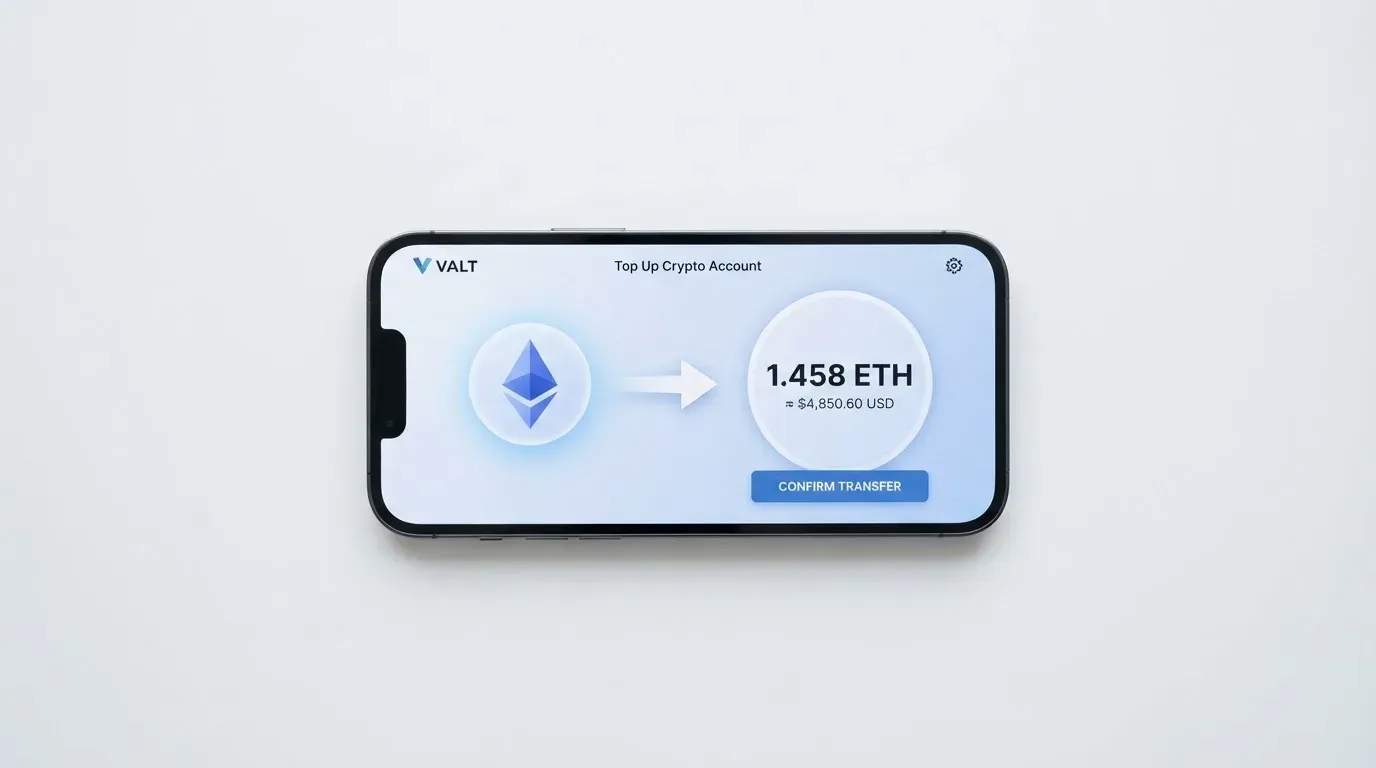
What is not stated, and this is the practical gap, is which networks those coins travel on. USDT exists on Ethereum, Tron, Solana and several other chains. USDC is on 38 networks as of mid-2026, including Ethereum, Solana, Base, Polygon, Avalanche, Arbitrum and Stellar. Sending USDC on the wrong network is one of the most common ways people lose money in this category, and the company does not tell you, on the public page at least, which network it expects to receive. That is the kind of detail that should be obvious from the moment you open the top-up screen, and the fact that it is missing from the marketing pages is a small warning sign.
The home page also mentions local bank transfers and SEPA for fiat top-ups, but the fees on those are not stated. The deposit fee for crypto top-ups runs from 2.6% on the virtual and plastic tiers down to 1.8% on the gold tier; the cost of exchanging one supported cryptocurrency for another inside the app is 0.2%; a cross-chain swap is also 0.2%. The minimum top-up is not stated, and it is not stated who pays the network fee on a crypto deposit. In practice, the network fee for a stablecoin transfer is usually small, but on Ethereum it can spike high enough to be worth knowing about in advance.
There is no information on the public pages about withdrawing crypto from the card back to an external wallet, or about withdrawing fiat to a bank account. The page does say you can delete your account from the app, by going to Profile then Delete Account, or by emailing the company, and that the balance on closure is not stated.
Paying with the card every day
The card is a Visa, which means it works wherever Visa is accepted, and that is the part of the proposition that is genuinely strong. The virtual card supports both Apple Pay and Google Pay, which is the most useful combination for someone paying from a phone. The plastic, metal and gold physical cards support Google Pay only according to the FAQ; the home page has a trust badge that says both wallets work on all tiers, which is a contradiction worth flagging.
The spending limits depend on the tier. A single tap with the virtual or plastic card can be up to $15,000; on the metal card it is $40,000; on the gold card it is $100,000. ATM daily limits start at $1,000 on the plastic card and rise to $3,000 on gold. There is no ATM access on the virtual card at all. The virtual card is the one you would use for online and wallet spending, and the physical cards are the ones you would take to a shop or a cash machine.
Cashback is paid in BTC. The rates are 0.05% on the virtual card, 0.1% on plastic, 0.2% on metal and 0.4% on gold, with no cap, credited within 24 hours. On top of that, brand discounts of 1%, 2%, 4% and 7-9% are advertised, with the higher band reserved for the gold tier. The cashback is small at the lower end and not generous by category standards, but it is uncapped, which is more than some competitors offer.
The app is the part of the everyday experience that is the least finished. It is on iOS TestFlight and Google Play testing, the company says “V2 launching soon,” and there is no published store rating. A beta app is fine for early adopters, but it is also a place where bugs and rough edges live.
The card terms point at Czech law and Czech courts for any dispute, and a Complaints Policy is linked, although the text of the policy was not available when the public pages were checked. No chargeback process is described, and that is a real gap. Blocked merchant categories are not listed either, so there is no way to know in advance whether, say, gambling transactions will be declined.
What can go wrong
The risk picture for TXBFI is less about any single dramatic failure and more about a set of smaller things that, taken together, make it hard to know what you are signing up for.
The first is the company. TheXBanky s.r.o. is a real registered entity in Prague. The card issuer is not named anywhere on the public pages. The FAQ says the company has a VASP licence, but the licence number is not given. The home page shows an “Offshore Banking Sublicense” badge without any further detail. Each of those facts is small. Together they make it hard for a customer to verify the licensing, the issuer, and the regulatory standing of the product.
The second is the absence of public feedback. A search for TXBFI card reviews on Trustpilot and Reddit did not turn up a Trustpilot page or any meaningful threads. That is not proof of anything: it could simply be that the card is too new. It is also the case that a card with no public reputation is, by definition, a card whose risks have not yet been told by other users.
The third is the app. A beta app on TestFlight and a beta channel on Google Play means you are running pre-release software. The company says “V2 launching soon,” which suggests a more polished version is on the way, but the current build is the one you would be using today. The lack of a published store rating means the usual early-warning system of customer reviews is also not in place.
The fourth is the asset-handling model. The FAQ says the card is “non-custodial” and that “TXBFI does not take custody of your assets or control your private keys,” with assets held by third-party providers. That is a meaningful claim in principle. In practice, the third-party providers are not named, the precise legal structure is not described, and the difference between a true non-custodial flow and a custodial flow dressed in non-custodial language is something only a careful reading of the underlying terms can confirm. Two-factor authentication, an in-app freeze and spending controls are not stated as features.
The fifth is the historical context of the category. WaveCrest, a Visa card issuer that supplied several crypto card brands, was suspended by Visa in Europe in 2018, and every WaveCrest-issued Visa programme closed overnight. In November 2022, Visa said it had terminated its global agreements with FTX, and the FTX US debit card was wound down by its issuer. Those are reminders that a card programme is only as durable as the relationship between the network, the issuer and the brand, and that a customer can lose access to a card through no fault of their own.
The sixth is the standard risk of the asset class itself. Cryptocurrency transfers are typically irreversible. Sending USDT on a network the company does not support, or to an address belonging to a different network, can mean the funds are lost or stuck in a manual recovery process that has no guarantee. Stablecoins can depeg; the TerraUSD collapse in May 2022 and the USDC depeg in March 2023 are reminders that “stable” is a description of intent rather than a guarantee.
What to take instead
TXBFI is not the only game in town, and the alternatives below are the ones a careful shopper would at least glance at. None of them is the same product, and the differences matter, but the comparison is the point.
| Card | Score | Best for | Card | Top-up | Fees |
|---|---|---|---|---|---|
| TXBFI | 5.8 / 10 | A Visa with a tier ladder from virtual to gold | Visa (Virtual, Plastic, Metal, Gold) | BTC, SOL, SUI, XRP, XLM, USDT, USDC | 2.6% top-up, 0.6% FX, 0.05–0.4% BTC cashback |
| Cardex | 5.6 / 10 | A multi-network card aimed at broad country reach | Debit crypto card on VERVE, Visa, Mastercard, UnionPay; virtual and physical | USDT, USDC, BTC | Real-time conversion; site says an “AI-Powered Conversion Rate” picks the best rate at payment; no fee percentage stated |
| CardFlow | 4.9 / 10 | A free virtual USD Mastercard, mainly for Nigeria | Virtual USD Mastercard | BTC, USDT, ETH or Naira bank transfer | Card creation is free; fees not stated |
| HyperCard | 4.7 / 10 | A prepaid card in USD or EUR across many countries | Prepaid HyperCard in USD or EUR; network not stated | USDT, BTC, ETH in the app | No fees listed on the App Store page; fees not stated elsewhere |
Cardex is the closest in spirit to a multi-network card. It supports a wider list of networks, and it advertises a real-time conversion that scans global exchange rates when you spend, although the page does not give a fee percentage to compare against TXBFI’s 2.6% top-up plus 0.6% forex. Cardex is also aimed at a broader country base (“200+ countries”) and at Nigerians in particular, with a Naira-priced card on the App Store listing. If your priority is the number of countries the card is willing to serve, Cardex is worth a look; if your priority is the depth of the company behind it, neither card gives you much to go on.
CardFlow is a virtual USD Mastercard that the company says can be created in about 3 minutes, with no card-creation fee, and funding by Bitcoin, USDT, ETH or a Naira bank transfer. The score is the lowest of the three alternatives, and the public pages do not state a fee structure, so it is the card you would only consider if the free virtual card and the Nigerian focus match your situation. Like the others, it does not publish the card issuer.
HyperCard is a prepaid card in USD or EUR that the company says works in more than 176 countries, although the figure is about acceptance, not eligibility. The App Store page lists no fees, and the public pages do not fill in the gap. Funding is in USDT, BTC or ETH, converted to USD or EUR on the card. It is the card you would consider if “many countries” and a USD or EUR balance are the deciding factors, and you are willing to take the published absence of fees at face value.
None of these alternatives is clearly better than TXBFI on every dimension, and none of them is clearly worse. What they share is the same problem: a thin public footprint on the company, the issuer and the licence, and fees that are not always published.
Who I would recommend the TXBFI card to
The honest answer is that TXBFI is a reasonable card for a specific kind of reader, and a poor fit for a different kind of reader. The card suits someone who already holds crypto in BTC, SOL, SUI, XRP, XLM, USDT or USDC, who wants a Visa to spend that balance online or in shops, and who is comfortable starting at the $25 virtual tier. It suits someone who is happy with a self-custody-style flow as described in the FAQ, even if the practical implementation is not fully transparent, and who is willing to use a beta app while the company rolls out a V2. It suits someone for whom the top-up fee of 2.6% and the forex fee of 0.6% are an acceptable price for the convenience.
The card does not suit someone who needs to know, before signing up, whether their country is on the eligibility list. It does not suit someone who places a high value on a deep public reputation and a long track record of customer feedback. It does not suit someone who needs a clearly licensed card issuer and a VASP licence number they can verify against a public register. It does not suit someone who wants a generous cashback rate at the entry tier, because 0.05% on the virtual card is small by category standards.
If the gaps in the public information bother you more than the price attracts you, look at Cardex for a multi-network card with a broader country footprint, or at HyperCard if a USD or EUR balance and a wide acceptance footprint matter more to you. If the gaps do not bother you, and the price and the supported coins are what you came for, the TXBFI virtual card is a sensible way to test the product before deciding whether the gold tier is worth its $10,000 price.
Frequently asked questions
What is the TXBFI card?
The TXBFI card is a Visa payment card issued through a platform run by TheXBanky s.r.o., a company registered in Prague. It comes in four tiers — Virtual, Plastic, Metal and Gold — and is funded by a crypto balance. The company describes itself as a technology platform rather than a bank, and the public pages do not name the licensed card issuer behind the Visa programme.
How does the TXBFI card work?
You register on the web platform, pass a KYC check with a government photo ID and a recent proof of address, choose a tier, pay the one-time price and top up the card with one of the supported cryptocurrencies. At payment, the card draws on the loaded balance; the company charges a top-up fee when the funds arrive and a forex fee if the merchant settles in a foreign currency.
Is TXBFI a bank?
No. The company calls itself a technology platform, and the public pages do not name a bank or licensed card issuer on the other side. The FAQ claims a VASP licence and EU and Czech AML compliance, but the licence number itself is not shown on the site, so it is not something a reader can independently verify from the public pages.
Who owns TXBFI?
TXBFI is operated by TheXBanky s.r.o., registered in Prague at Děčínská 552/1, Střížkov, 180 00 Prague 8, Czech Republic, with company number 21932506. The ownership of that company is not described on the public pages, and the licensed card issuer behind the Visa programme is not named.
Is the TXBFI card available in my country?
The public pages do not publish a list of eligible or excluded countries, and the terms only say that service depends on jurisdiction, eligibility and provider requirements. The only way to know whether the card is available where you live is to start the registration and KYC process, and even then the answer may not be obvious until the screening step is complete.
How do I apply for the TXBFI card?
You register on the web platform, complete KYC with a government photo ID and a proof of address dated within the last three months, pass a biometric or liveness check, choose a tier, pay the one-time price for that tier, and then top up. The company says most accounts are approved within 24 hours, and there is one account per person.
Does the TXBFI card require KYC?
Yes. KYC requires a government photo ID (passport, national ID or driver’s licence), a proof of address dated within the last three months, a biometric or liveness check, and a sanctions, politically-exposed-person and wallet screening done under the terms. There is a single KYC path; it does not differ by tier.
How do I top up the TXBFI card?
You can top up with Bitcoin, Solana, Sui, XRP, Stellar, USDT or USDC. The public pages do not state which network each coin should be sent on, which is a real practical gap, and the deposit fee ranges from 2.6% on the virtual and plastic tiers down to 1.8% on the gold tier. Fiat top-ups via local bank transfer and SEPA are mentioned on the home page, but the fees are not stated.
How do I add the TXBFI card to Apple Wallet or Google Pay?
The FAQ says the virtual card supports both Apple Pay and Google Pay, and that the physical cards support Google Pay only. The home page has a trust badge suggesting both wallets work on every tier, which contradicts the FAQ; if the wallet you want to use is a deal-breaker, the safe move is to confirm with support before paying for a tier.
Is the TXBFI card safe?
The FAQ says the platform is non-custodial and that TXBFI does not hold private keys, with assets held by third-party providers. The third-party providers are not named, two-factor authentication and an in-app freeze are not stated as features, and no chargeback process is described. The card is a Visa, so the network’s rules apply, but the company-level details a careful reader would want are partly missing from the public pages.
Choosing a virtual card – cryptocardadvisor
Content created by the «cryptocardadvisor» team