
Stella card: a crypto Visa with ATM access and a thin safety margin
 Available in US

If you have heard of Stella, you have probably heard it in a single breath with crypto Visa cards generally: a card number that pays in a shop or at an ATM, funded from a crypto balance, without the ritual of a bank application. That is a real product and it does something useful. What it does not do, in the version I checked, is explain its costs before you commit, name the institution that issues it, or give you much reason to believe the account will still be there next year. My score is 6.5 out of 10, and the number is less dramatic than the gap between the card’s ambition and its paperwork.
Conditions are current as of October 28, 2026.
So who is it for? Someone who already holds BTC, ETH, USDT or USDC, spends in currencies they cannot easily get a normal Visa for, and values being able to draw cash at an ATM or pay through Alipay and WeChat Pay more than they value a named bank, a published fee schedule or a public complaint record. Who is it not for? Someone whose income needs to arrive reliably, whose savings need a legal claim on a segregated account, or who is uneasy being identified as a crypto user to the people who run the payment networks and the app stores that keep the product reachable. This is a tool for spending what you already decided to spend, not an account to build a life around.
The score, criterion by criterion
| Criterion | Mark | Why |
|---|---|---|
| Who can get it | 7 / 10 | Official site names no countries; unofficial reports put availability in 57 countries including the US, UK, Singapore and India, with 49 restricted |
| Cost | 5 / 10 | No fees disclosed officially; unofficially no annual fee, 0% crypto top-up, but a virtual card application fee that a user complaint puts at USD 30 and a physical card free only after a USD 20,000 top-up |
| Top-up options | 9 / 10 | Unofficially BTC, ETH, USDT and USDC across ERC-20, TRON, BNB Smart Chain, Polygon, Arbitrum One and Optimism; officially, a crypto deposit tops the card up automatically |
| Reliability and complaints | 4 / 10 | Stella Global Services Limited in the BVI, issuer unnamed, no licences named; complaints of account freezes with funds not returned; unofficial Trustpilot 3.2 from a single rating |
| Everyday use | 9 / 10 | Virtual and physical Visa, ATMs, Google Pay, Alipay and WeChat Pay; unofficially Apple Pay as well |
| Total | 6.5 / 10 | Strong on reach and payment options, weak on disclosure and on what happens when something goes wrong |
The shape of that table is the review in miniature. Two of the five marks are the highest available, and both are about convenience. The lowest mark is the one about trusting the arrangement, and it is low because of what is missing rather than what is wrong: no named issuer, no named licence, no published fee table, and a handful of user reports that all point at the same failure mode, money going in and not coming out.
Will they give you the card
The honest answer is: the card’s own site does not say. Stella states no list of eligible countries anywhere in the pages I read. What the terms do say is that users under economic sanctions programmes are excluded, and that US and European users are routed through affiliates rather than served directly. That routing detail is the one to hold on to, because it means the entity you actually contract with in those two regions is not the same entity named on the terms elsewhere.
An unofficial account, published by a third-party card directory and last confirmed against Stella documents dated 6 September 2024, says the card is available in 57 countries including the United States, the United Kingdom, Singapore and India, and restricted in 49, among them Russia, Belarus, Ukraine, Iran, Iraq, Syria, North Korea, Cuba, Venezuela and South Africa. Take that as orientation, not as the current rule: it is two years old at the confirmation point and it comes from someone who was not on the inside. If your country matters to you, the only reliable answer comes from trying the application and reading the response, not from any list, including mine.
Two things follow from that gap. First, if you live somewhere with a sanctions relationship or a history of frozen international accounts, assume the answer may be no and assume it may change. Second, note the age requirement of 18 and prepare for a full document check before you get to the nice part.
How to get it
The signup promise on the card’s own page is a quick verification process with immediate card use after approval. The User Agreement is more specific about what you hand over: name, address, date of birth, tax ID, government ID and bank details, with biometric data also possible to request. That is the standard list for a regulated payment relationship, and if you are uneasy about any item on it, that unease is a legitimate reason not to proceed rather than a small objection.
Unofficially, the process is a full electronic KYC that typically resolves in one to two business days, with many applications approved in minutes. I did not find official confirmation of the identity tiers or of what triggers an enhanced check — that is simply not stated on the pages I read, and you should expect to find out by experiencing it.
On delivery, the same silence. Official pages do not state how or when a physical card arrives. Unofficially the physical card is free once you have topped up USD 20,000, and otherwise carries a delivery fee. Unpack that: on the virtual card you can spend from the first dollar, and the physical one is treated as a benefit for large balances. If your plan is to start small, the practical unit is the virtual card in the app, and it is worth deciding deliberately whether the USD 30 application fee that one user complaint cites is a price worth paying for something you will use twice.
Fees: what it really costs
Here is the least comfortable section of this review, and the discomfort is about disclosure rather than price. Stella’s own material does not publish fees; it says they are described under the User Agreement and in the app. So the table below separates what the card states from what third parties report, and I would rather show you a short official table than a long unofficial one dressed up as fact.
| Fee or limit | Official statement | Unofficial figure (per CryptoCardHub, Aug 2026) |
|---|---|---|
| Annual fee | not stated | none |
| Virtual card issuance | fee shown in-app only | pay-as-you-go application fee; one user complaint cites USD 30 |
| Physical card | delivery terms not stated | free after a USD 20,000 top-up, otherwise a delivery fee |
| Crypto deposit | not itemised | 0%, blockchain gas only |
| Card purchases | not stated | not itemised |
| Conversion | “interbank rates”, shown in-app | purchase fees and FX/top-up spreads not itemised |
| ATM withdrawal | available worldwide; fee and allowance not stated | daily limit USD 2,000, monthly USD 10,000, up to 3 withdrawals per day and 30 per month; fees in-app only |
| Currency | not stated officially | USD only base currency |
| Daily spending limit | set by your risk preference; amounts not stated; further limits may apply under underwriting | USD 100,000 for regular accounts |
| Loyalty tiers | none listed | — |
Now let three everyday payments go through, because that is where fee design actually bites.
A coffee. If your balance is already in dollars, this is the easy case: the card is a Visa and the coffee is a coffee. Whether anything is deducted on top is the part the card does not publish. That is not a scandal; it is a reason to check the app’s fee line once before you start using it as your everyday card, because a per-purchase charge repeated a hundred times a month is a different thing from a one-off.
A train ticket, EUR 32, bought in Rome. This is where the currency line bites. Unofficially the base currency is USD only, so a euro purchase has to be converted, and the card’s own words point to interbank rates plus something it does not publish. Card networks also apply their own rate. Depending on the provider, you may be paying the network rate, a marked-up rate, or a marked-up rate plus a stated spread. Three numbers, one of which you can see.
Cash, USD 200, from a Bangkok ATM. The card says you can withdraw cash from ATMs around the world that accept Visa. It does not state the fee or the allowance. Unofficially you have USD 2,000 a day and USD 10,000 a month, three withdrawals a day and thirty a month, with the fee visible only in the app. So the withdrawal limit is generous on paper and the cost is invisible until you are standing at the machine with your card out. Check the in-app fee and the local ATM surcharge before you rely on this abroad, and if your plan involves regular cash, check the per-withdrawal allowance too, because three a day is not unlimited.
One structural point worth carrying into all three. A prepaid-style card draws on a stored balance, so the card cannot overdraw — that is a genuine comfort. The corollary is that the balance has to be there when you want to spend, and the rate at which crypto turns into spendable balance is the number that determines your true cost. Nobody publishes it.
How to top up
This is the card’s best argument, and on the evidence it is a good one. Officially, you deposit crypto into the account and that automatically tops up the card — the in-app wallet is custodial, and the design is that funding and spending are one motion rather than two. Unofficially, the supported assets are BTC, ETH, USDT and USDC, on ERC-20, TRON, BNB Smart Chain, Polygon, Arbitrum One and Optimism. Unofficially the deposit fee is 0% and the blockchain gas is yours.
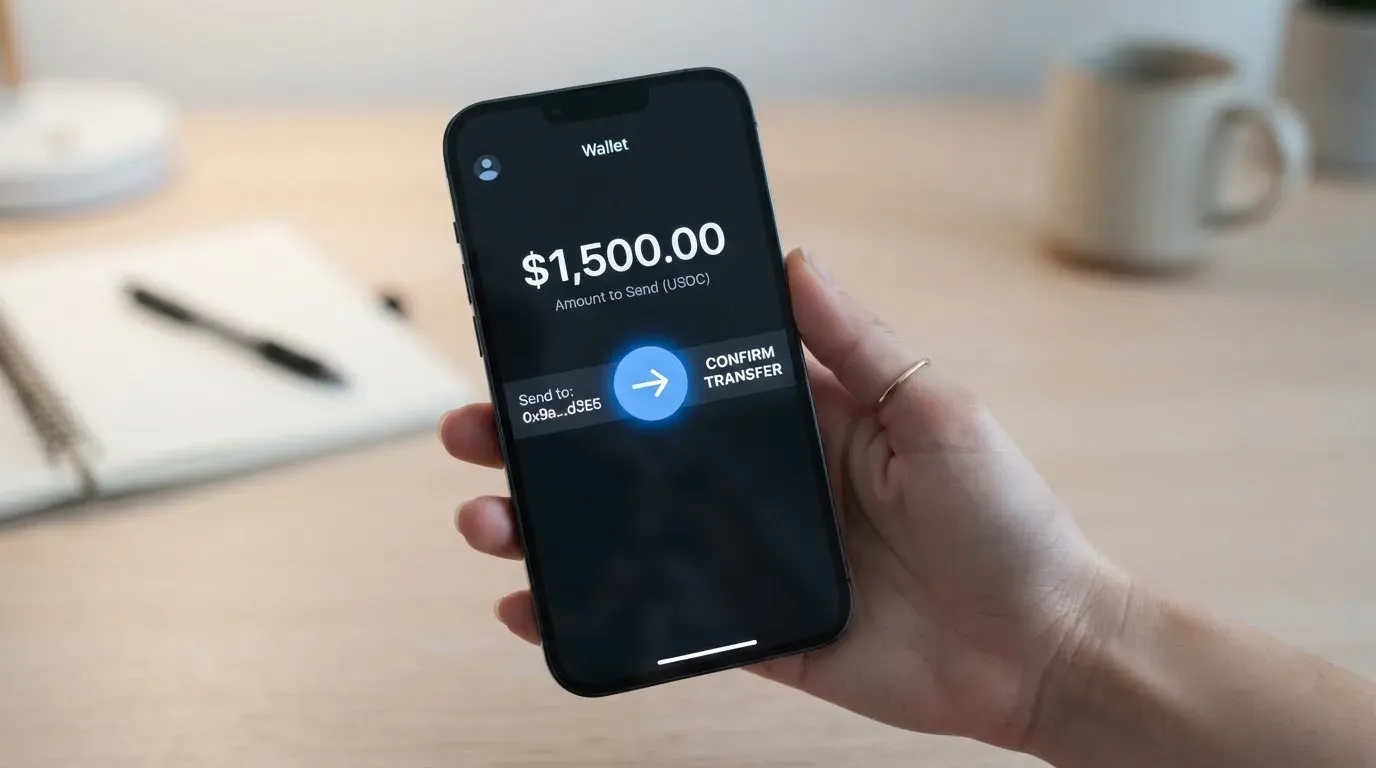
That network list is where the care is needed, and the care is not about Stella. ERC-20 is the Ethereum standard, and gas is paid only in ETH — a wallet holding USDT and nothing else cannot send it. On Tron, fees are paid through bandwidth and energy and often burn TRX, so a USDT balance on its own may not be enough. And USDC over TRC20 is not a native option: Circle stopped supporting USDC on Tron in February 2024, so if you hold that particular combination, you are holding something this card cannot natively receive. Blockchain transfers are irreversible, and a deposit sent on an unsupported network, or to an address belonging to a different network, can be lost or need manual recovery with no guarantee of success. Before your first transfer, check that the coin, the network and the address all match what the app shows for that specific deposit.
On the way out, official terms say that after account closure users may transfer digital assets out within a reasonable period unless legally prohibited, after paying amounts owed. Unofficially, crypto withdrawal fees start at USD 1 with exact amounts in the app. Read the closure clause closely, because “unless legally prohibited” is a real and open-ended exception, and “within a reasonable period” is not a date.
Paying with it every day
Both card types link to Google Pay, Alipay and WeChat Pay, and unofficially Apple Pay is supported too. That combination is unusual — Alipay and WeChat Pay are exactly where a Western card often fails at the moment you most want it to work, and their presence is why I scored everyday use at 9. Add ATM access and the picture is coherent: this is a card built for spending in places where ordinary plastic is awkward.
What is not stated: blocked merchant categories. I found no official list of what the card refuses, and for a card issued through an unnamed partner that omission is worth holding in mind if you expect it to work everywhere. The official card page states no cashback on the card itself; the Earn product is separate and is about yield, not spending. Unofficially there is no cashback on the main card and a referral scheme paying up to 40% of card fees — worth noting only because it tells you where the economics sit: the revenue is in fees and in your balances, not in rewards to you.
The app has a download page and a Google Play button; platforms and store ratings are not stated on the pages I read. Unofficially it runs on iOS, Android and a Telegram Mini App, with an App Store rating of 5.0 out of 5 from five ratings — a number that should be read for what it is, which is almost nothing. If you plan to use this card heavily, the app is the product, because the app is where the fees are, the rate is, the limits are and the freeze button would be.
What can go wrong
I am going to be blunt here rather than reassuring. The card publishes no incident record, which is worth something, and it has no published fee schedule, which cuts the other way.
The freeze. The most serious user report I found is from August 2026: an account frozen with funds not returned after transfer proof was provided. When a card freezes an account, crypto transfers stop and the balance is effectively immobilised. Official terms do not state a timeframe for handling withdrawals or unfreezing. If your instinct on reading that is to imagine it will be resolved quickly, notice that the report itself is the evidence of how it can go.
The issuer you cannot name. Stella Global Services Limited is incorporated in the British Virgin Islands. The card is issued by an unnamed licensed “Partner Issuer”, and the Apple App Store developer is shown as Flashwire Inc with starting data. No licences are named. This is not automatically a problem — many legitimate programmes are structured this way — but it means that when you want to know who stands behind the balance, or who to complain to beyond the app, the answer is not on the page. Note also that you cannot check a BVI-incorporated company against the EU’s interim register of authorised providers.
The counterparty. The wallet is custodial: assets in the app wallet are held for your benefit, pooled in omnibus accounts, with title staying with you. That is a real arrangement with real protections attached in some jurisdictions, and it also means the keys are not yours. This is where custodial carries a history: Mt. Gox at about US$350 million reported stolen between 2011 and 2014, Coincheck at about US$400 million in 2018, Ronin Network at US$625 million in 2022. Your funds are not exposed to those specific failures, but the model that produced them is the model you are choosing.
The rules you cannot see. No two-factor authentication or instant freeze is stated. No official complaint figures exist; the unofficial Trustpilot figure is 3.2 out of 5 from one rating, which is too small to judge and I will not pretend otherwise. The themes in those few reports are consistent: the virtual card cost, limited crypto support, occasional failed transactions, and the freeze.
Where you stand if something goes wrong. Unauthorized transactions and errors go to [email protected]. Partner disputes are settled directly with the partner. Disputes go to the courts of the Republic of Seychelles under Seychelles law, and no time frames are stated. If you think of this as a practical matter rather than a legal one: a dispute with a merchant thousands of kilometres away, in a jurisdiction you have never been to, under a law you do not read, is not a process you will enjoy. Card-network chargeback rights — which in the US come from Regulation E for debit cards and Regulation Z for credit cards, with prepaid coverage varying and not to be assumed — exist in principle and may not reach you cleanly through this structure.
Support. There is a Help Center, a Contact Us page and a Telegram channel at t.me/CS_StellaPay. Hours are not stated, and the language selector shows only English, so a Russian-only reader should expect to work in English. Unofficially, support runs on Zendesk tickets with no live chat reported.
The wider category sharpens two of these. Some merchants decline prepaid or foreign-issued cards because the BIN lookup shows the card type and issuer country — a card issued in one country can look foreign to a shop in another, which may mean extra scrutiny or a decline at the till. And a declined authorisation can leave a hold on funds that stays for several days, typically up to seven.
What to take instead
If Stella’s weakness is disclosure, then the alternatives worth comparing are the ones that publish. Here is how the four sit against each other on what I could verify, with their own scores shown for scale rather than as a ranking against Stella’s 6.5.
| Stella | International Visa Card | UNi Card | Whop Cards | |
|---|---|---|---|---|
| Score | 6.5 / 10 | 6.7 / 10 | 6.1 / 10 | 5.2 / 10 |
| Network and type | Visa, virtual and physical | US-issued Platinum Visa, virtual; physical “coming soon” | Mastercard, multicurrency; physical/virtual not stated | Visa; virtual/physical not stated |
| Base currency | USD only (unofficial) | Pays in USD | Multicurrency account balance | Not stated |
| Annual fee | None (unofficial) | None on Classic; Pro $9.00/mo, Max $19.00/mo | “No annual fee” | “No extra fees”, no amounts listed |
| Issuance | Virtual fee in-app; one complaint cites USD 30 | $5 one-time, virtual | Not stated | Not stated |
| Foreign currency | Conversion at interbank rates, spreads not itemised | “Visa exchange rate + 2% FX fee” | “No foreign transaction fee”, converted at live OTC rates, “no hidden exchange fees” | Not stated |
| Funding | BTC, ETH, USDT, USDC across six networks (unofficial) | USDC or USDT free at 1:1 into the USD account, plus USD, EUR, SEPA, SWIFT, FedNow | Not stated | Whop balance, stablecoin-backed (starting data) |
| Cashback | None on the main card (unofficial) | None stated | Spend-to-Earn up to 3% | 5% at select merchants, currently Uber |
| Eligibility | Not stated officially; 57 countries and 49 restricted (unofficial) | Not available to residents or registrants of a named list incl. Belarus, mainland China, India, Israel, Russia, Turkey, Ukraine, Vietnam; FATF grey-list reviewed case by case | Not stated | 31 US states for consumers, 41 for businesses; a named unsupported-country list |
| Virtual card cost | In-app, complaint cites USD 30 | $5 | — | — |
| Physical card | Free after USD 20,000 top-up (unofficial) | “Coming soon” | Not stated | Not stated |
Three comparisons are worth walking through.
Against the International Visa Card, the trade is disclosure for flexibility. Its fee structure is the clearest of the four: $5 to get the virtual card, no maintenance fee, free card use in USD on every plan, and a plainly stated 2% FX fee on top of the Visa exchange rate. What you give up is the reach: US and European users are served through affiliates, its blocked-country list is long and includes India, Turkey and Ukraine, and the physical card does not exist yet. If your spending is mostly online in dollars and predictability matters more than Alipay, this is the more sober product.
Against UNi Card, the trade is network and honesty about rates. UNi is on Mastercard rather than Visa, states no annual fee and no foreign transaction fee, converts at live OTC rates and claims no hidden exchange fees, and pays up to 3% back. What I could not establish is who qualifies, or how you fund it — both not stated. That is the same silence in a different place, so it is not obviously the safer choice; it is the one whose fee promises are cleaner.
Against Whop Cards, the trade is rewards against scope. Whop pays 5% cashback at select merchants, currently Uber, and spends from a Whop balance backed by stablecoin collateral from a linked wallet. But it is geographically the narrowest: 31 US states for consumers and 41 for businesses, with a long unsupported-country list, and the card type and currency are not stated. Rewards are worth having when your spending is concentrated; geography ends the question otherwise.
The pattern across all four: eligibility is the thing nobody publishes plainly, and fees are the thing that decides your actual cost. Ask both, in writing, before you commit.
Who I would recommend it to
I would recommend Stella to you if you are already holding BTC, ETH, USDT or USDC, you spend regularly in places where a Western card is awkward — Alipay, WeChat Pay, a cash machine abroad — you are comfortable with a custodial wallet and with the card company being the party you deal with when something breaks, and you treat the balance as spending money rather than savings.
I would not, if any of the following is true of you. Your income or your savings depend on this account being dependable. You need to know who the issuer is and which licence protects you, and the answer being unavailable ends the conversation. You are in a country whose eligibility you cannot confirm. You intend to hold a large balance for a long time — a custodial omnibus account is not where you park money you intend to keep. You have no way to read English when something needs explaining. Or you have had an account frozen by a financial institution before and know how it feels to be one of the unnamed cases in someone else’s terms.
Between those two lists is a person who should read the app’s fee screen carefully, start with the virtual card and a small balance, keep enough elsewhere that a freeze would be an inconvenience rather than a crisis, and set aside the USD 20,000 threshold as a genuine question — because on the unofficial figures that is the difference between a free physical card and a paid one, and it tells you what kind of customer the card is designed around.
Frequently asked questions
What is Stella card?
Stella is a Visa payment card that draws on a crypto balance rather than a bank account. You load crypto into a custodial in-app wallet, it is converted into spendable fiat balance, and that balance pays for purchases and ATM withdrawals through a virtual card in the app and, above a high threshold, a physical card. It is a spending tool for crypto holders, not a bank account, and it is not one.
Does Stella card require KYC?
Yes. The User Agreement lists name, address, date of birth, tax ID, government ID and bank details as required, and says biometric data may be requested. The minimum age is 18. These are standard items for a regulated payment relationship, and the card’s own promise is immediate use once approved — but the agreement also gives the company grounds to ask for more.
How long does Stella card approval take?
The official page promises a quick verification process with card use immediately after approval, without giving a timeframe. Third-party reports say a full electronic KYC typically takes one to two business days, with many applications auto-approved in minutes. Treat both as estimates and plan on at least a day, especially if your documents need manual review.
Is Stella card free?
No official answer exists — the fees are described under the User Agreement and in the app rather than published. Unofficially there is no annual fee, crypto deposits are 0% with only the blockchain gas charged, and the virtual card carries a pay-as-you-go application fee that one user complaint puts at USD 30. The physical card is reported free only after a USD 20,000 top-up.
How do I top up the Stella card?
You send crypto to the wallet, and that automatically credits the card. Unofficially the supported coins are BTC, ETH, USDT and USDC, on ERC-20, TRON, BNB Smart Chain, Polygon, Arbitrum One and Optimism. Before your first transfer, confirm that coin, network and address all match what the app shows, because a wrong-network transfer is irreversible.
Can I use Stella card at ATMs and with Apple Pay?
At ATMs, yes — the card says you can withdraw cash from ATMs around the world that accept Visa, and unofficially the limits are USD 2,000 a day and USD 10,000 a month, with up to three withdrawals a day. Google Pay, Alipay and WeChat Pay are officially supported; Apple Pay is listed unofficially. ATM fees are in-app only, which is the number to check before you rely on cash abroad.
Is Stella card safe to use?
It is as safe as a custodial provider you have not been able to fully vet. The wallet is custodial and pooled, the issuing institution is not named, no licences are stated, and there is an August 2026 user report of an account freeze with funds not returned after proof was provided. Those are reasons to keep only spending money in it, not reasons to dismiss it.
Who owns Stella card?
The operator is Stella Global Services Limited, incorporated in the British Virgin Islands. The card itself is issued by an unnamed licensed “Partner Issuer”, and the Apple App Store developer appears as Flashwire Inc with starting data. No licences are named anywhere on the pages I read, which means there is no register to check the operator against.
Is Stella card available in my country?
Officially, the card names no countries at all — it only excludes users under economic sanctions programmes and routes US and European users through affiliates. A third-party source says 57 countries are supported and 49 restricted, last confirmed against documents dated 6 September 2024. Treat that as orientation only and confirm with the company, since eligibility can change and the list is stale.
What should I check before depositing money?
Check the in-app fee and conversion rate first, since neither is published. Then check the withdrawal terms and how a freeze would be handled, because neither has a stated timeframe. Keep a balance you could afford to lose access to for a while, and remember that disputes go to the courts of the Republic of Seychelles under Seychelles law.
Choosing an app or neobank card – cryptocardadvisor
Content created by the «cryptocardadvisor» team