
What I found when I read through the Renegade card's terms and pages
 Available in US

The Renegade card is an interesting proposition on paper: a European app that promises you a euro IBAN, a virtual Visa card you can use straight away, and a bridge between a crypto balance and everyday spending. The idea is genuinely appealing, especially if an ordinary bank card is hard for you to get. But the more pages I read, the more the picture is defined by what is missing rather than what is stated. I scored it 4.1 out of 10 overall, and I want to be straight with you about that number before we go into detail.
One line before we start: the conditions are current as of October 28, 2026.
Verdict: 4.1 out of 10, and the gap between idea and evidence
The card suits a narrow but real group: residents of the European Economic Area who want a euro IBAN alongside a virtual card and are willing to live with a provider that publishes very little detail about how it operates. It does not suit anyone who needs to know exactly what their money is protected by, what the foreign-exchange costs will be, or whether the promises on the site will be delivered this year. The score below is the whole picture at a glance, and I go criterion by criterion afterwards.
| Criterion | Mark | Why |
|---|---|---|
| Who can get it | 5 / 10 | The card page lists no supported or excluded countries; the euro virtual IBAN is restricted to customers in the European Economic Area (terms 1.2) |
| Cost | 4 / 10 | Monthly: Pioneer 9.90 EUR, Voyager 19.90 EUR, Vanguard 29.90 EUR; crypto/fiat exchange 1.6%; “No other fees are collected by Renegade” |
| Top-up options | 5 / 10 | Crypto vIBAN via Striga and an IBAN account; coins and networks are not named (an earlier check showed a non-custodial wallet with USDC, BTC, ETH) |
| Reliability and complaints | 3 / 10 | No licences held; the company states it is “NOT a bank”; the issuer is named inconsistently; Trustpilot 3.2 on 1 review, reporting undelivered promises and no refund |
| Everyday use | 3 / 10 | Virtual only, “No plastic”; Google Pay appears only in a site testimonial; Apple Pay and ATM are not addressed |
| Total | 4.1 / 10 | A promising structure held up by thin disclosure and unresolved questions about status |
The single most important thing I can tell you is what kind of entity you would be dealing with. Renegade’s own terms say it is “NOT a bank”, that it does not yet provide regulated services, and that it will apply for licences first. That is an honest statement, and it is also a statement about what you do not yet have. A payment card is a regulated service; you are being offered one by a company that tells you it has not yet received the permissions to offer it.
Who gets the card
The short answer: the card’s public pages do not say. There is no list of supported countries and no list of excluded countries on the card page. The one clear geographic rule is in the terms: only customers in the European Economic Area can use the virtual IBAN for euro deposits and withdrawals (terms 1.2). So the euro account side has a defined audience, and the card side of the product does not.
This is worth pausing on, because it is unusual. Most providers in this category publish at least a rough map. When the answer is missing, the practical effect falls on you: if you are outside the EEA and apply, you cannot tell in advance whether you are eligible, and if you are inside the EEA you still cannot tell which other countries are open. The one thing you can do is ask support directly, and I would want that answer in writing before you hand over any documents.
What you do to get it
The signup path is short, and that is a genuine plus. You download the app, enter personal information, and verify identity through a secure in-app chat, which the card says “only takes a few minutes”. The virtual card is issued instantly inside the app, under the heading “No plastic. No waiting.” The page also refers to a “VISA integration”, though the exact network wording is not entirely clear, and the card’s own currency is not stated.
What is not stated is almost as interesting as what is. The materials do not say which documents you need, whether proof of address is required, or what age you must be. General category rules say prepaid and debit cards are generally available to adults aged 18 and up, and some issuers set higher limits, but that is background about this whole product type, not a Renegade rule. The KYC level, in other words, is not stated.
Two practical notes. First, there is no physical card and no delivery to wait for, which simplifies your life if you are happy with a card number in a phone. Second, since everything happens in a chat inside the app, keep your own record of what you submitted and when. When a provider tells you it is “not a bank” and has no licences yet, a clear paper trail of your own application is not paranoia; it is basic hygiene.
Fees: the monthly price is clear, everything else is not
Here is what the card actually publishes, and what it leaves out. The monthly fees are set out, and the crypto/fiat exchange rate is given. The FX fee, the ATM costs, the issuance fee and all spending limits are not stated, and the page’s flat claim that no other fees are collected does not survive contact with a reader’s questions about foreign currency.

| Fee or limit | What is published |
|---|---|
| Monthly fee | Pioneer 9.90 EUR, Voyager 19.90 EUR, Vanguard 29.90 EUR |
| Monthly fee if paid in RNG | Pioneer 4,90 EUR, Voyager 14,90 EUR, Vanguard 24,90 EUR |
| Issuance fee | not stated |
| Crypto/FIAT exchange | 1.6% |
| FX fee | not stated |
| ATM withdrawal | not stated |
| Deposit fee, minimum deposit | not stated |
| Daily and monthly limits | No figures published; Voyager is described as “Higher limits”, Vanguard as “maximum limits” |
Three everyday payments make this concrete, and I want to walk through them with you because the missing numbers matter more than the ones that are given.
Paying for a coffee in euros in a euro country. This is the easy case. You swap crypto into your balance at 1.6%, and the card spends euros from the euro IBAN account. No FX fee is added because there is no currency conversion. The monthly fee is the number to weigh, and whether that is worth it depends entirely on how often you use it.
Paying for something priced in dollars while your balance is in euros. Here the picture breaks down. The FX fee is not stated. The general practice in this category is that you pay the network’s exchange rate plus a markup on top of the 1.6% conversion fee, but I am not going to give you a number the card has not published. What I can tell you is that this is the payment to test before you commit. Buy something small in a foreign currency and read what actually leaves your balance.
Paying for something online in crypto directly, or at an ATM. Neither is documented. There is no stated ATM cost, so a cash withdrawal abroad is the payment where I would expect the largest surprise. And a spend straight from crypto, bypassing the balance entirely, may not be a feature this card has at all — the site’s framing is about converting and spending, not about card-funded crypto payments.
One point in the card’s favour on pricing: the terms say any new fees come with at least 30 days’ notice. That is a real commitment, and it is worth more than it sounds, because a fee change that must be announced a month ahead is a fee change you can react to.
Top up: two routes, and neither tells you the important part
Renegade says you can fund the account in two ways: through a crypto virtual IBAN via Striga, and through an IBAN account. The coins and networks you can use are not listed on the card page. An earlier check of the product showed a non-custodial wallet with USDC, BTC and ETH, which tells you something about the direction of travel but is not a current commitment.
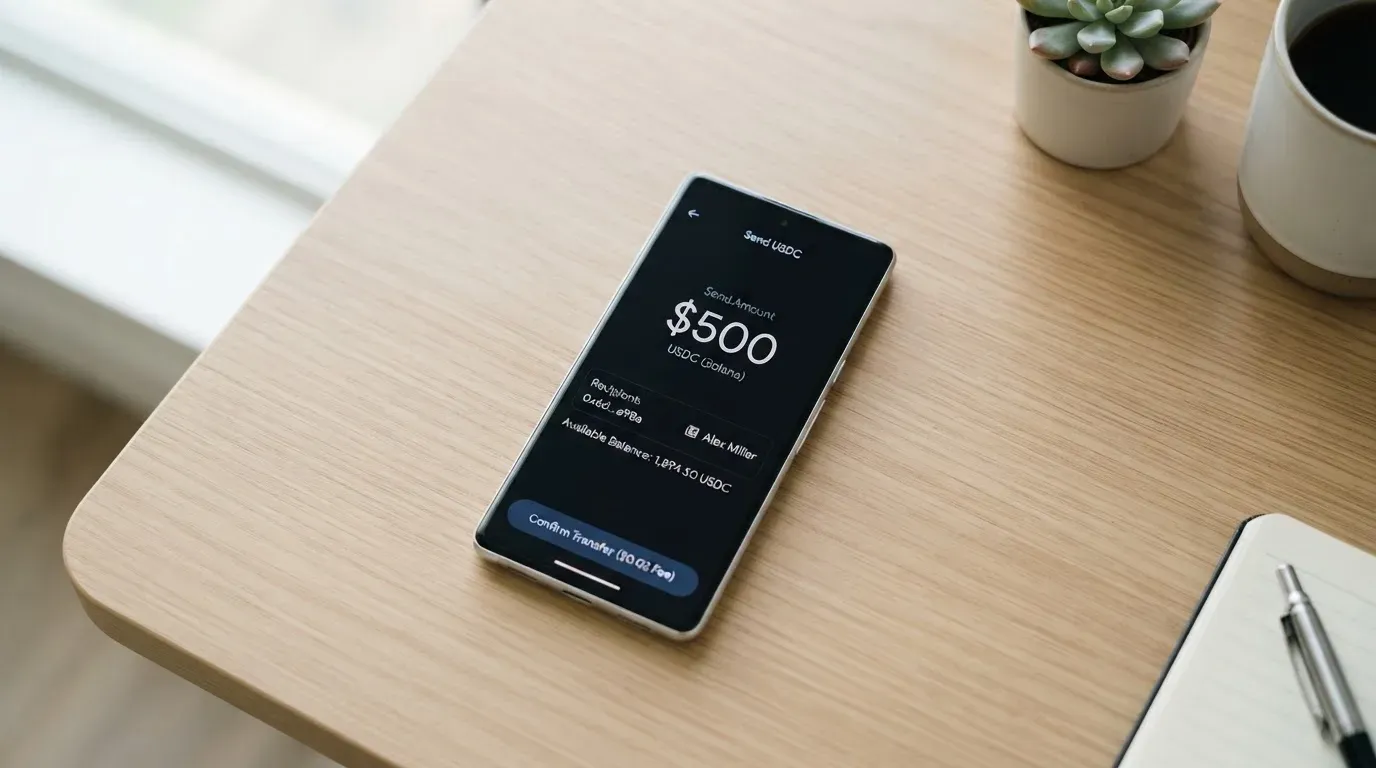
That omission is the one to dwell on, because network choice is not a technicality. Blockchain transfers are irreversible, so a deposit sent on a network the provider does not support, or to an address belonging to a different network, can be lost or need manual support recovery with no guarantee. If the card’s page will not tell you which networks to use, you are being asked to guess with money on the line.
A few category points that bear on the same question. If you send USDT on Ethereum, the gas fee is paid in ETH, so a wallet holding USDT but no ETH cannot send at all. Tether’s token has been issued on networks including Ethereum, Tron, Solana, Polygon and Avalanche. Circle stopped supporting USDC on Tron in February 2024, so “USDC over TRC20” is not a native option. And on-chain network fees for your deposit are charged by the blockchain, not by the card provider — so they are outside the 1.6% and outside anything the card would refund.
Withdrawals work one way: euros leave through the virtual IBAN. There are no other terms published, so you do not know the fee, the timing, or the minimum. On the account itself, you may terminate at any time free of charge; Renegade may close an account with two months’ notice; and accounts inactive for over six months may be closed.
Paying with it day to day
Virtual only. That is the whole card. If your reader of this page needs a physical card for a shop that takes contactless or reads a stripe, this is not it.
The wallet picture is thin and oddly framed. Apple Pay is not mentioned anywhere. Google Pay appears only inside a testimonial on the site’s own pages, describing a Web3card being added to Google Pay — which is the site’s marketing talking, not a specification. Blocked merchant categories are not stated, and this one can bite. A merchant category code is a four-digit number classifying a business by goods or services; gambling sits under 7995, and issuers block such categories by policy rather than by law, with the blocked list varying from issuer to issuer.
Then there are the rewards, which are the most concrete number on the card. Three percent back, paid in RNG coin, on all three tiers; the page calls it cashback. The monthly reward cap is listed but the Pioneer figure is garbled on the page, so the numbers as published are 2,500 EUR for Pioneer, 25,00 EUR for Voyager and 35****000 EUR for Vanguard. Read those with care. They do not look like a coherent ladder, and I would not build a spending plan on them until support explains what they mean.
The app itself: an App Store listing named “Renegade” from Renegade GmbH showed no rating, described as “hasn’t received enough ratings” when I read it on 2026-10-21, and the Google Play listing under the package name net.myrenegade.main had a rating I could not read. An app with no public rating history is not a bad sign on its own, but it does mean you have no track record to look at before you commit.
What can go wrong
I went looking for official incidents and found none. That is worth saying plainly, because it would be easy to imply otherwise. What I did find is more telling.
The company’s own terms state it is “NOT a bank” and does not yet provide regulated services, and that it will apply for licences first. No licences are held. Behind the app sits MYRENEGADE, UNIPESSOAL LDA in Lisbon, Portugal (company no. 517780801); the app developer on the App Store is Renegade GmbH; the vIBAN partner is Striga Technology OÜ of Tallinn, Estonia. The terms name Zypto as the card service provider in one section, while another says the licensed card issuer is unnamed and operates on Striga’s infrastructure. Two different answers to a basic question: who actually issues the card. If that matters to you — and for a card it should — it is a question to put in writing.
On Trustpilot, read 2026-10-21, the score is 3.2 with a single one-star review. One review proves nothing about reliability, but it is a specific and checkable account: on 7 April 2026 a user reported that roadmap items promised for Q1 2026 — the app, the crypto wallet, the card — had not been delivered, and that support refused a refund, describing the money as a “startup investment”. Refusing a refund on that reasoning tells you something about how the company treats a customer who changes their mind.
There is useful context in the wider category, and it is not reassuring. WaveCrest, a Visa card issuer that supplied crypto card brands, was suspended by Visa in Europe in 2018, closing all its Visa programmes. The FTX card is the obvious precedent: Visa said in November 2022 it had “terminated our global agreements with FTX”, and the US debit card programme was wound down. Programme closures typically follow a pattern — a notice period, then spending and loading stop, then users are asked to withdraw remaining balances. I found a 2026 closure reported by a secondary source where new loads ended 8 July 2026 and spending stopped 8 August 2026; that is a single unconfirmed report, so treat it as a pattern rather than a fact about any particular provider.
On custody and security, the site describes itself as “user-interface only” and says Striga helps keep money “in a safe manner”. The terms do not clearly address custody. Multi-factor authentication is mentioned (terms 9.1). “User-interface only” is a description of architecture, not a description of protection — it tells you the brand does not hold your money itself, without telling you who does.
Support is 24/7 live chat in the app, plus a contact form and [email protected], with Customer Support in German and English per the terms. If you take one practical thing from this review: use the chat, and keep the transcript.
Two more things you should not assume. On disputes, chargebacks are not mentioned; the terms say the seller is liable for faulty goods (2.3), complaints go to Customer Support and formally in writing (7.14), and there is a reference to the EU online dispute resolution platform (7.15) — that route exists but is slow. And the sponsored article on btc-echo.de (30 Jan 2024, updated 31 Jul 2025) described the app as live with an IBAN waitlist and crypto features still being integrated; that is paid placement, not independent coverage.
What to take instead
I compared Renegade against three other options in this category. The comparison table holds each card’s real constraints side by side, because the differences show up mostly in what is prohibited rather than what is offered.
| Renegade | International Visa Card | UNi Card | Whop Cards | |
|---|---|---|---|---|
| Score | 4.1 / 10 | 6.7 / 10 | 6.1 / 10 | 5.2 / 10 |
| Card | Virtual, “VISA integration”, currency not stated | US-issued Platinum Visa, virtual, pays in USD; physical “Coming soon” | Multicurrency, Mastercard network, spends from UNi.Global balance; virtual/physical not stated | Visa, works anywhere Visa is accepted online and in stores; type not stated |
| Monthly / issuance | 9.90 / 19.90 / 29.90 EUR monthly; issuance not stated | $5 one-time virtual issuance, no maintenance fee; Classic free, Pro $9.00, Max $19.00 per month | “No annual fee”; issuance not stated | “No extra fees”; no amounts listed |
| FX / conversion | 1.6% crypto/fiat; FX fee not stated | “Visa exchange rate + 2% FX fee”; USD use free; deposits free | No foreign transaction fee; “live OTC rates”; “No hidden exchange fees” | not stated |
| Where / who | Country list not published; euro vIBAN limited to EEA customers | Residents and registrants of Belarus, mainland China, North Korea, Cuba, India, Iraq, Iran, Israel, Myanmar, Nepal, Nicaragua, Russia, Syria, Turkey, Ukraine, Venezuela, Vietnam excluded | not stated | 31 US states for consumers, 41 for businesses; consumer exclusions include Belarus, China (Mainland), Cuba, Hong Kong, India, Iran, Iraq, Israel, Myanmar, Nepal, Nicaragua, North Korea, Russia, Syria, Turkey, Ukraine, Venezuela, Vietnam |
| Rewards | 3% in RNG, all tiers, caps as published | No cashback stated | Up to 3% “Spend-to-Earn” | 5% cashback at select merchants, currently Uber |
| Funding | Crypto vIBAN via Striga plus IBAN account; coins and networks not listed | USDC or USDT into the USD account free at 1:1; also USD, EUR, SEPA, SWIFT, FedNow; networks not stated | not stated | Whop balance; backed by stablecoin collateral from a linked wallet |
Reading that table, two things stand out. The International Visa Card is the one that publishes its own numbers most completely — $5 issuance, a named 2% FX fee, a full exclusion list — and its physical card is still “Coming soon”, which is its own version of “No plastic”. UNi Card has the cleanest fee statement of the four: no annual fee, no foreign transaction fee, live OTC rates. Whop Cards sits somewhere else entirely, limited to specific US states for consumers.
None of them is free of structural risk, and none of them fixes the underlying question you have as a reader: whether a licensed, solvent institution stands behind your money. What they do differently is tell you more about who they are and what they charge.
Who I would recommend it to
I would recommend this card to a resident of the European Economic Area who has a specific reason to want a euro IBAN and a virtual card in one app, who is comfortable holding a small balance rather than a salary, and who has read the terms and can see the licence position for themselves. For that person it is a reasonable experiment, priced from 9.90 EUR a month, with the discount for paying in RNG if you want to cut that further.
I would not recommend it as the card your money depends on, and I would not recommend it to anyone who cannot afford to lose the balance they put on it. The reasons are the ones above rather than a single dramatic problem: no licences held yet, an unclear answer about who issues the card, no published limits, no FX or ATM costs, an app with no rating history, and one dated refund refusal on file.
If a bank card is hard for you to get — which is why you are reading this — then the honest framing is that Renegade is one of the few options that exist at all, and scarcity should not lower your standards. The checks I would run before depositing anything are simple and quick: ask support, in writing, which networks are supported; ask who the licensed issuer is; ask what happens to your balance if the programme closes; and make one small foreign-currency purchase to see the real FX cost. Then decide.
Frequently asked questions
What is Renegade card?
The Renegade card is a European app offering a euro virtual IBAN, a virtual Visa card issued instantly in the app, and a bridge between crypto and a spendable balance. It is not a plastic card — the card page says “No plastic. No waiting.” The company behind it is MYRENEGADE, UNIPESSOAL LDA in Lisbon, Portugal, and its own terms state it is “NOT a bank” and does not yet provide regulated services.
Is Renegade a bank or a regulated company?
No, it is not a bank, and it says so itself. The terms state that it does not yet provide regulated services and that it will apply for licences first, and no licences are held. The euro virtual IBAN is provided through a partner, Striga Technology OÜ of Tallinn, Estonia. A payment card is a regulated service, so you are being offered one by a company that has not yet obtained the permissions.
Who owns Renegade?
The app is built by MYRENEGADE, UNIPESSOAL LDA, based in Lisbon, Portugal, with company number 517780801. The developer named on the App Store listing is Renegade GmbH. Card issuance is described inconsistently: the terms name Zypto as the card service provider in one section, while another refers to an unnamed licensed issuer running on Striga’s infrastructure.
Which countries can use the Renegade card?
The card page publishes no list of supported or excluded countries. The one clear rule is in the terms: only customers in the European Economic Area can use the virtual IBAN for euro deposits and withdrawals. If you are outside that area, the only way to find out is to ask support directly, and worth getting the answer in writing.
Does the Renegade card require KYC?
Yes, in the sense that the app asks you to enter personal information and verify identity through a secure in-app chat, which the card says takes only a few minutes. What is not stated is which documents you need, whether proof of address is required, or what age threshold applies. As background, prepaid and debit cards in this category are generally available to adults aged 18 and over, with some issuers setting higher limits.
How do I top up the Renegade card?
Through a crypto virtual IBAN via Striga, or through the IBAN account. The coins and networks you can use are not listed on the current card page; an earlier check showed a non-custodial wallet with USDC, BTC and ETH. Because blockchain transfers are irreversible, sending on an unsupported network or to a wrong-network address can lose the funds, so confirm the network with support before your first deposit.
How much does the Renegade card cost?
Monthly fees are Pioneer 9.90 EUR, Voyager 19.90 EUR and Vanguard 29.90 EUR, or 4,90, 14,90 and 24,90 EUR if paid in RNG. Crypto-to-fiat exchange is 1.6%. The card states “No other fees are collected by Renegade”, but the FX fee, ATM costs, issuance fee and all spending limits are not stated, and new fees require at least 30 days’ notice.
Can I add the Renegade card to Apple Wallet or Google Pay?
Apple Pay is not mentioned anywhere in the card’s materials. Google Pay appears only inside a testimonial on the site’s own pages, which is marketing rather than a specification. Merchant category blocks are also not stated, so you cannot tell from the public pages whether spending in categories such as gambling will be declined.
Is the Renegade card safe?
Nobody can promise safety for a card like this, and the honest answer is that the protections are not yet in place. The company holds no licences, describes itself as “user-interface only”, and does not clearly address custody in its terms, though multi-factor authentication is mentioned. Its Trustpilot score is 3.2 from a single one-star review dated April 2026, reporting undelivered roadmap items and a refused refund.
Is the Renegade card worth it?
Only if the euro IBAN solves a specific problem for you and you keep the balance small. It is worth considering if you are an EEA resident who wants a euro account with a virtual card in one app, and not worth relying on if you need deposit protection, published spending limits, or clarity about who issues the card and what it costs. Compare it against providers that publish their fees before you decide.
Choosing an app or neobank card – cryptocardadvisor
Content created by the «cryptocardadvisor» team