
A wallet with a card attached — and a lot of numbers missing
 Available in US
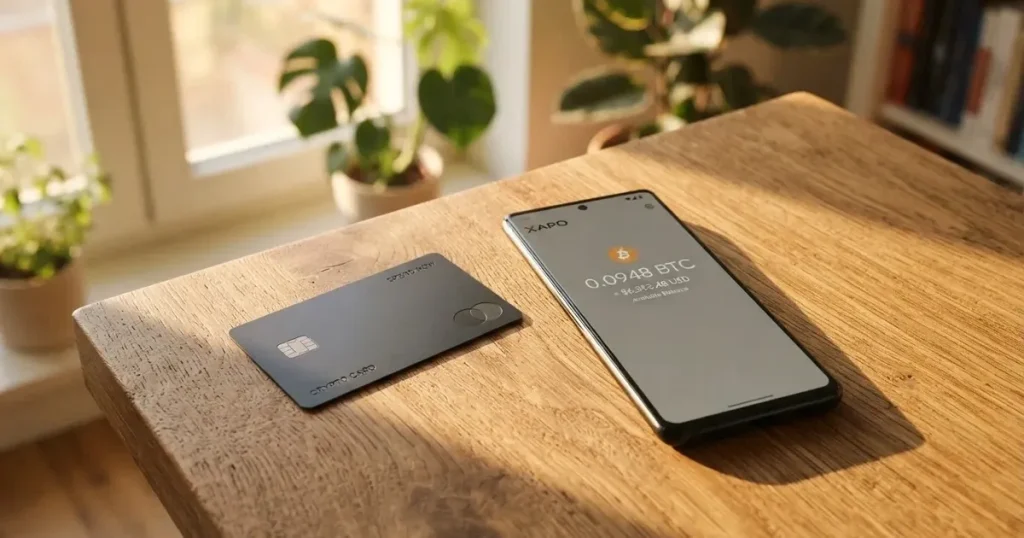
PPAY promises a crypto wallet with a USD virtual card for online shopping and a physical Mastercard alongside it. That is the pitch, and on paper it sounds like the standard crypto-card proposition: hold crypto, spend it like an ordinary bank card. The problem is that when I go looking for the details a person actually needs — what the card costs, which coins and networks top it up, who issues it, what protection your money has — the public pages come back with “not stated” almost every time.
That gap is the whole review. A card can be perfectly good and still be impossible to judge on paper, and you should know which side of that line you are on before you deposit anything. I scored it 4.5 out of 10, and I want to walk you through where that number comes from, section by section, so you can decide for yourself whether the missing information is a dealbreaker for your situation.
Conditions are current as of October 28, 2026
Verdict: 4.5 out of 10
Here is the score, criterion by criterion, with the reasoning attached to each mark.
| Criterion | Mark | Why |
|---|---|---|
| Who can get it | 3 / 10 | Residence in Nigeria or an “eligible country”; the site says “10+” countries but names none |
| Cost | 5 / 10 | No issuance or monthly fee published, no fee amounts disclosed; peer-to-peer sends carry zero fees |
| Top-up options | 4 / 10 | The wallet holds crypto and swaps run through a WhatsApp bot; coins and networks for funding the card are not disclosed |
| Reliability and complaints | 5 / 10 | Owned by PROSPER DIGITAL SYSTEMS LTD, “not a bank”, issuer and licences not named; no complaints or reviews found |
| Everyday use | 6 / 10 | A USD virtual card and a physical Mastercard; Apple Pay, Google Pay and ATM use not disclosed |
| Total | 4.5 / 10 | — |
Read that table as five questions rather than one verdict. Who can get it is the weakest link at 3 — eligibility is residence-based, centred on Nigeria, with a list that isn’t published. Cost sits at 5: there is nothing damning in what *is* said (peer-to-peer sends are fee-free, there is a built-in converter), but there is also no price list, so 5 is a score for absence of evidence rather than evidence of fairness. Top-up at 4 is the practical problem — you cannot plan a funding routine around coins and networks you haven’t been told. Reliability at 5 reflects a company that tells you plainly it is “a technology company, not a bank” and then does not name the bank. Everyday use at 6 is the strongest, because a USD virtual card plus a physical Mastercard is a genuinely usable pair.
Who does that suit? In the card’s own terms, Nigerian residents — and people in those unnamed eligible countries — who want a crypto wallet with both a virtual card for online purchases and a physical Mastercard. The audience this product is clearly built for is people who want a card attached to a crypto balance without opening a full banking relationship first.
Who it does not suit, from where I sit: anyone who needs to know the exact cost of spending before they spend it; anyone who wants to know which coins and networks they can send; anyone who needs a named, licensed issuer behind their money; and anyone outside the eligible-country footprint, who may simply find they cannot open an account at all. If your decision hinges on any of those four things, the honest answer is that this card cannot give them to you today, at least not from its published pages.
Will they give you the card?
The eligibility rule is residence-based, not citizenship-based, and that distinction matters. The terms say you must be “a resident of Nigeria or an eligible country where PPAY operates.” The home page advertises “10+” countries supported — but names none of them. So the short answer to “is PPAY card available in my country?” is: Nigeria, yes; the others, you have to ask. The site gives you no list to check yourself against.
Two further wrinkles. The rule is anchored to where you live, not what you hold, so a citizen of an eligible country resident elsewhere, or a resident of an eligible country with another passport, are different cases and the card does not say which it resolves to. And the AML policy, in setting out its risk approach, mentions only “high-risk jurisdictions” — again without a published list of which ones those are. In practice this means the published rules tell you the shape of the gate but not where its edges are.
Here is the practical summary:
- Residence, not citizenship — the terms tie eligibility to being a resident of Nigeria or an eligible country.
- “10+” countries — the home page’s figure, with no names attached.
- “High-risk jurisdictions” — referenced in the AML policy, none listed.
- Uncertainty is the cost — if you are outside Nigeria, you are relying on the site having counted your country, not on anything you can verify.
For a reader in the general case, that is enough to make a decision about whether to keep reading, but not enough to promise yourself an account.
How to get it
Getting started is a three-step shape: create an account in the app, verify your identity, then start using features. What you hand over at the verification step is the part to read twice.
PPAY’s anti-money-laundering policy lists, for onboarding: your full legal name, residential address, date of birth, phone, email, a government-issued ID and a selfie or biometric verification, proof of address, and “BVN, NIN, or equivalent verification data where applicable.” The BVN and NIN are Nigerian identity numbers, which tells you the compliance picture is built around the Nigerian market; the “or equivalent” clause is doing quiet work for everyone else. The policy is unambiguous on one point: “identity verification is mandatory before account activation.” The terms add that KYC applies for certain features “in compliance with CBN regulations” — the CBN being Nigeria’s central bank.
So the honest sequence is: you cannot use the product before verification, verification is document-heavy, and there is no stated route around any of it. (That is also why I’d push back on any suggestion that these checks can be skipped — they can’t, and the card says so.)
On the card itself: you get a USD virtual card aimed at online shopping, plus a physical Mastercard “accepted everywhere Mastercard is.” The virtual card’s card network is not stated — it is USD-denominated, but the rail behind it isn’t published. How the physical card arrives — delivery time, cost, countries — is not stated either.
One more thing to know up front: “PPay operates tiered verification limits.” That sentence is doing a lot of quiet work. It tells you there are levels, and nothing else — not what the levels are, not what limits each one carries, how long verification takes, or why a review might be refused. The one rejection detail that is published: failing to respond to verification or enhanced due diligence (EDD) requests may lead to suspension or termination. That is the failure mode to watch, because it turns on your inbox, not on the card.
Fees: what it really costs
This is the section where PPAY is quietest, and quietness here is expensive for you as a reader, because cost is the one thing you cannot work out later and still un-pay.

Not one fee figure is published. No issuance fee. No monthly or maintenance fee. No conversion spread. No foreign-exchange fee. No ATM terms. The terms say only that fees “may apply to bank transfers, card funding, and certain third-party services” — without a single amount attached to any of those three.
Here is the costs table, and note how many cells say the same thing:
| Fee or limit | What PPAY publishes |
|---|---|
| Issuance | not stated |
| Monthly / maintenance fee | not stated |
| Conversion (crypto to card balance) | not stated |
| Foreign exchange fee | not stated |
| ATM / cash withdrawal | not stated |
| Daily spending limit | not stated |
| Monthly spending limit | not stated |
| Peer-to-peer sends | zero peer-to-peer fees |
Two positives do appear on the home page. There is a “built-in converter” showing “Live Rates: crypto and fiat rates,” and peer-to-peer sends carry “zero peer-to-peer fees” — that last one clearly scoped to P2P transfers only, not to card spending. Those are genuine features, but a converter with no published spread and a fee-free P2P channel tell you nothing about what it costs to actually buy something with the card.
To make this concrete, here are three ordinary payments and what we can and cannot say about each:
- Buying a coffee from a local shop in Nigeria with the physical Mastercard. Whether the local terminal accepts it at all is not stated; acceptance rests on “everywhere Mastercard is.” No ATM or cash-withdrawal terms are published, so I can’t tell you the fee on a cash-out, or whether one is permitted.
- A subscription paid online with the USD virtual card. Spending in USD should avoid a conversion on its face, but the card’s own conversion and FX fees are not stated, and there’s no multi-currency information at all — the virtual card is USD, and nothing describes holding or spending anything else.
- Paying a merchant in another currency while holding only crypto. Whether the balance is converted at the quoted live rate, at what spread, and whether a further FX fee applies — none of that is published. This is the payment most likely to surprise you.
Card tiering exists too, in the sense that the cards are listed as virtual and physical with no tier pricing attached — no premium tier, no fee difference stated between them.
The pattern to take away: PPAY has told you what it wants you to know about the wallet (live rates, free P2P) and hasn’t told you what a purchase costs. If your spending is mostly small and domestic, the unknown spread may barely register. If you spend abroad, hold larger balances, or draw cash, this is exactly the card where an unstated fee would bite hardest.
Top up: how the money gets in
Short answer: the card’s own pages don’t say. The wallet side is described — it holds crypto and offers swaps, including OTC trades and crypto swaps run through a WhatsApp bot — but the coins and networks you can send to fund the card are not listed, and the specific method of topping up the card is not stated.

That’s a bigger gap than it sounds. Funding a card is not the same as funding a wallet balance: it involves a transfer to a specific address on a specific network. And the mechanics of crypto transfers make a wrong guess costly. Blockchain transfers are irreversible, so a deposit sent on a network the provider doesn’t support, or to an address belonging to a different network, can be lost outright or need manual support recovery with no guarantee of success. That is why an unstated network list is a real risk, not a documentation quibble.
The category background sharpens the point. Stablecoins are the usual fuel here — USDT and USDC together account for about 90% of stablecoin market capitalisation per the BIS in July 2025 — and they exist on multiple networks with different transfer costs. USDT, for instance, has been issued on Ethereum, Tron, Solana, Polygon, Avalanche and others. Fees for the transfer are charged by the blockchain, not by the card provider, so the network you pick changes the cost of getting money in. And the networks aren’t interchangeable: gas on Ethereum must be paid in ETH, so a wallet holding USDT but no ETH cannot send; Tron prices fees through bandwidth and energy resources; and Circle stopped supporting USDC on Tron in February 2024, so “USDC over TRC20” isn’t a native option.
In other words: the practical cost of topping up PPAY depends on a chain of facts — which coin, which network, whether you hold the gas token — that PPAY’s pages do not give you. Ask support before your first transfer, and treat the answer as provisional until you see it work.
On the way out: the terms say you can close your account at any time through the app settings, and any outstanding balance will be settled before closure. How settlement happens, and any fees on it, are not stated.
Paying with it every day
This is where PPAY scores best, and where the product is most conventional. A USD virtual card for online shopping plus a physical Mastercard for everything Mastercard is accepted. Wallets exist for both iOS and Android — though the app-store buttons on the home page are placeholder links, so no store listing was found and no user ratings were read.
Some things you’ll look for and not find: whether Apple Pay or Google Pay is supported (not disclosed), how cash withdrawals at ATMs work (not disclosed), and which network runs the virtual card (not stated). There is no cashback on spending (none stated). There is a savings feature advertised at “up to 8.5% APY,” but that belongs to the savings account, not to the card — don’t read it as a reward for spending.
How transactions and disputes work is at least documented, and worth reading twice. The terms say transactions are final once confirmed, and that refunds are decided case by case. Chargebacks aren’t mentioned at all. In practice, a dispute is something you take to support first — so before you ever need it, it’s worth knowing which channel to use (see below).
A few category notes that bear on daily use. Card payments involve several parties: the network (Visa or Mastercard) routes the messages and sets the rules, the issuer holds the actual card programme, and the crypto brand is often just the front end or programme manager. That structure is why “who issued your card” is a fair question and why “PPAY is a technology company, not a bank” isn’t the end of the conversation. Three-D Secure — Visa Secure or Mastercard Identity Check — adds a step to online payments. And a declined authorisation can leave a hold on your funds for several days, typically up to seven, which is worth remembering when a subscription retries after a card block.
What can go wrong
Let me split this into the risks PPAY itself discloses, and the ones you should be holding in mind because they’re not addressed.
On PPAY’s own disclosures, the picture is one of an operationally careful company that still hasn’t said the essentials:
- The company. Owner is PROSPER DIGITAL SYSTEMS LTD. PPAY states it is “a technology company, not a bank.” Registration country, issuing bank and licences are not stated. The terms are governed by the laws of the Federal Republic of Nigeria, with disputes to Lagos State courts.
- Custody and safeguarding. The custody model is not stated — who holds your crypto and your balance, and how. Safeguarding is not stated. This is the single biggest thing I’d want answered.
- Security. Every account and every sensitive action within it is “protected by biometric and two-factor verification,” and transactions are screened for fraud and sanctions. Good language — but a help page that lists the question “Can I freeze my card?” without an answer suggests the self-service controls aren’t finished.
- Verification friction. Tiered verification limits exist but are undefined; failing to answer verification or EDD requests can mean suspension or termination.
- No complaints record. No official incidents were found, and no user reviews or complaints were found either. Searches for PPAY card reviews on Trustpilot and Reddit returned only Perpay, a different company, and nothing for the PPAY website. A clean search result is not the same as a good track record — it may just mean the card is new or small. Treat the absence of complaints as no information, not as reassurance.
Now the risks that sit behind the gaps, from the world of crypto cards generally. Custody is the big one. With a custodial wallet, the provider holds the credentials, so you’re trusting them completely; and the sector has a record of exactly that failing — Mt. Gox (about US$350 million reported stolen, 2011–2014), Coincheck (about US$400 million, 2018) and Ronin Network (US$625 million, 2022). Self-custody trades that counterparty risk for your own key-management risk: a seed phrase is typically 12 to 24 words in plain form, anyone who gets it can restore the wallet and spend it, and a stolen key has no built-in recovery because the network can’t freeze or return funds. Transfers are irreversible. And stablecoins carry their own risks — they can and have lost their peg (TerraUSD in May 2022, USDC briefly in March 2023) — and they aren’t censorship-proof, since issuers have frozen funds tied to illicit activity.
Two more things you should know. First, card programmes do close. Visa terminated its agreements with FTX in November 2022 and the FTX US debit card was wound down; WaveCrest, a card issuer that supplied crypto brands, was suspended by Visa in Europe in 2018. Closures typically mean a notice period, then loading and spending stop, then you’re asked to withdraw what’s left. So the ability to get your money out matters as much as the ability to spend — and PPAY’s exit terms are thin (balance settled before closure, method and fees unstated). Second, don’t assume deposit protection or bank-style chargeback rights apply to a card like this. E-money funds are safeguarded by segregation or insurance, not by a deposit guarantee scheme, and prepaid-card chargeback coverage varies by jurisdiction and should not be taken for granted.
Finally, a housekeeping note: if you spend from crypto holdings, tax treatment can be involved, and the rules differ by country. The US IRS, for example, treats digital assets as property, so each payment funded from crypto can be a separate taxable disposal. I’m not able to advise you on tax — check what applies where you live.
What to take instead
If the missing numbers decide it for you, these are the alternatives I weighed, and where PPAY sits against them.
| Option | Score | Card | Fees | Who it’s for |
|---|---|---|---|---|
| PPAY | 4.5 / 10 | USD virtual + physical Mastercard | not stated | Nigerian residents wanting a wallet with both cards |
| International Visa Card | 6.7 / 10 | US-issued Platinum Visa, virtual; physical “coming soon” | $5 issuance, no maintenance; USD use free; FX = Visa rate + 2% | People outside a long exclusion list who want a named, priced product |
| UNi Card | 6.1 / 10 | Multicurrency Mastercard network, spends from UNi.Global balance | “No annual fee or foreign transaction fee”; live OTC rates | People who want multicurrency and no FX fee |
| Whop Cards | 5.2 / 10 | Visa, works wherever Visa is accepted | “No extra fees” (no amounts listed) | US consumers in 31 states; spends from a Whop balance |
International Visa Card is the one that publishes most: a $5 one-time issuance fee, no maintenance fee, free card use in USD on all plans, and a clearly stated 2% foreign-exchange fee on top of the Visa rate. It also excludes residents of a long list of countries — Belarus, mainland China, North Korea, Cuba, India, Iraq, Iran, Israel, Myanmar, Nepal, Nicaragua, Russia, Syria, Turkey, Ukraine, Venezuela, Vietnam — with FATF grey-list countries handled case by case, and it blocks purchases in a subset of those same countries. Its physical card is “coming soon.”
UNi Card is a multicurrency Mastercard-network card spending from your UNi.Global balance, with “no annual fee or foreign transaction fee,” conversion at live OTC rates, and “no hidden exchange fees.” Spend-to-Earn rewards go up to 3%. It says less about who can sign up than the Visa card does.
Whop Cards are Visa cards for US consumers in 31 named states (and businesses in 41), unsupported in a similar exclusion list. The page says “No extra fees” but lists no amounts, and the cards spend from a Whop balance rather than straight from your crypto. There’s 5% cashback at select merchants, currently Uber.
The honest comparison: PPAY’s weakness isn’t that it’s worse than these on any published number — it’s that it publishes almost no numbers. Whop, at 5.2, has the same kind of vagueness about fees; UNi at 6.1 and the Visa card at 6.7 both give you more to hold onto. If your priority is a card for a Nigerian wallet and you’re comfortable with the specifics being settled in-app, PPAY has a place. If your priority is knowing what you’re paying, the alternatives state it and PPAY does not.
Who I would recommend it to
I’d point PPAY at a specific person: a Nigerian resident who wants one app to hold crypto and spend it, who is content to open the app, clear the identity checks with BVN/NIN or the local equivalent, and then discover the specifics — networks, limits, fees — inside the app rather than on the website, and who has a plan B for getting funds out if the service changes. Under those conditions it’s a usable pairing of a USD virtual card and a physical Mastercard, and the peer-to-peer sends being fee-free is a real perk for anyone moving money between people.
I’d steer away from it if: you’re outside the eligible countries and can’t confirm yours is on the list; you need a published fee schedule before committing; you intend to send funds on a specific network and need to know in advance it’s supported; you’re holding a meaningful balance and want to know who’s custodying it and under what licence; or you’re moving cash at ATMs or spending across currencies, where the unstated terms are most likely to cost you. And I would never move a balance you couldn’t afford to lose onto a card where the custody model isn’t published — that’s the one gap I’d want closed before trusting it with money, not merely before trusting it with money.
Frequently asked questions
What is PPAY card?
PPAY is a crypto wallet that issues a USD virtual card for online shopping and a physical Mastercard for in-person spending. The company describes itself as “a technology company, not a bank,” owned by PROSPER DIGITAL SYSTEMS LTD. It’s aimed at Nigerian residents, and the site mentions “10+” supported countries without naming them. The wallet holds crypto and offers swaps and OTC trades.
How does PPAY card work?
You create an account in the app, verify your identity, then use a virtual USD card online or a physical Mastercard in person. The card draws on your crypto-backed balance, much like a prepaid card, so it can’t overdraw what’s loaded. PPAY says every account and sensitive action is protected by biometric and two-factor verification. It also operates “tiered verification limits,” though the tiers themselves aren’t described publicly.
Is PPAY a bank?
No — and PPAY says so itself, describing itself as “a technology company, not a bank.” The owner named in the footer is PROSPER DIGITAL SYSTEMS LTD, and the terms are governed by the laws of the Federal Republic of Nigeria. What’s not stated is the registration country, the issuing bank behind the card, and any licences. That last point matters if you want to know who stands behind your funds.
Who owns PPAY?
The footer names PROSPER DIGITAL SYSTEMS LTD as the owner. The card’s terms are governed by Nigerian law and send disputes to Lagos State courts. Beyond the company name, PPAY’s public pages don’t state where it’s registered or what licences it holds — so if ownership detail beyond the name matters to you, that’s a question to put to support directly.
Is PPAY card available in my country?
Nigerian residents can apply — the terms require residence in Nigeria or an “eligible country where PPAY operates.” The site advertises “10+” countries but names none, and the AML policy refers to “high-risk jurisdictions” without listing them. Because eligibility is by residence, not citizenship, and the country list isn’t published, you’d need to confirm your own country with PPAY rather than assume you’re covered.
Does PPAY card require KYC?
Yes. PPAY’s anti-money-laundering policy states that “identity verification is mandatory before account activation.” Onboarding collects your full legal name, residential address, date of birth, phone, email, government-issued ID, a selfie or biometric check, proof of address, and “BVN, NIN, or equivalent verification data where applicable.” Certain features also need KYC “in compliance with CBN regulations.”
How to top up PPAY card?
The public pages don’t specify the coins or networks accepted for funding the card — that’s the honest answer. The wallet is described as holding crypto with swaps and OTC trades available via a WhatsApp bot, but no coin or network list is published. Since crypto transfers are irreversible, sending on an unsupported network can lose the funds. Confirm the exact coin, network, and deposit address with support before your first transfer.
Is PPAY card free?
Nobody can tell from the published pages. No issuance fee, no monthly fee, no conversion or foreign-exchange fee is stated; the terms say only that fees “may apply to bank transfers, card funding, and certain third-party services,” with no amounts. The one confirmed zero is peer-to-peer sends — “zero peer-to-peer fees” — which covers P2P transfers only, not card spending. There are also no published daily or monthly limits.
Is PPAY card safe?
There’s no evidence of a problem — no official incidents and no user complaints were found — but no track record either, and no complaints found is not the same as a good history. PPAY says accounts and sensitive actions use biometric and two-factor verification, and transactions are screened for fraud and sanctions. What’s not stated: the custody model, whether funds are safeguarded, and whether you can freeze the card yourself — the help page even lists that question without answering it.
How do I delete or close my PPAY account?
The terms say you can close your account at any time through the app settings, and that “any outstanding balance will be settled before closure.” How the settlement actually reaches you — method, timing, and any fees — isn’t stated. If keeping access to your balance matters to you, ask support for the withdrawal mechanics before you ever need them.
Choosing an app or neobank card – cryptocardadvisor
Content created by the «cryptocardadvisor» team