
Pay It Now — a New Zealand- and Australia-only virtual Mastercard funded from crypto, scored 5.6 out of 10
 Available in US

Pay It Now is a virtual Mastercard issued by Immersve, distributed by Takeoff Media, and marketed to people who already use the PIN Network app. You fund it from a PIN wallet by converting one of 50-plus crypto assets into USDC, which the card then spends as a USD balance. The card is virtual only, sits inside Google Pay, and, since 11 May 2026, can no longer be added to Apple Pay as a new card. It is available to PIN users in New Zealand and Australia, and the company has said it is working on expansion into the United States and Europe.
Conditions on this page are current as of October 28, 2026.
Verdict
I went through the card’s terms, the supporting pages, and user reports, and I landed on a score of 5.6 out of 10. The reason is not that Pay It Now is a bad product in isolation; the reason is that it solves a fairly narrow problem (a crypto-funded USD card for residents of two countries) and that, within that narrow problem, a few details are not stated publicly and a few user reports are not flattering.
The breakdown looks like this:
| Criterion | Score | Why I marked it this way |
|---|---|---|
| Who can get it | 2 / 10 | Only New Zealand and Australia residents with a PIN account; US and Europe are described as upcoming, not available. |
| Cost | 7 / 10 | No annual fee, the issuance fee is currently waived, and the only stated percentage fee is 1.5% on non-USD purchases. |
| Top-up options | 9 / 10 | 50+ digital assets through PIN (FAQ says 40+), with BTC, ETH, SOL, USDT, TRX, and BNB named. |
| Reliability and complaints | 6 / 10 | The companies behind it are licensed in NZ and Australia, but Trustpilot reviews include unresponsive support and reports of unexplained crypto losses. |
| Everyday use | 5 / 10 | Virtual only, Google Pay works, Apple Pay additions are paused, and there is no ATM access. |
The audience this card genuinely fits is small: a New Zealand or Australia resident who already has a PIN account, who wants a virtual Mastercard denominated in USD, and who is comfortable converting crypto into a USDC balance before spending. If you are outside those two countries, you can stop reading here. If you are inside them and you mainly need a card for online subscriptions or Google Pay, Pay It Now does the job, but the daily cap, the conversion spread, and the lack of an Apple Pay path for new cards make it less appealing as a primary card.
Who they will give the card to
The card is available to PIN users in New Zealand and Australia. The company says it is working on expansion “into other regions, including the U.S. and Europe,” but those are stated as plans, not as live availability. If you are reading this from the United States, the United Kingdom, Canada, the EU, or anywhere else, you cannot get the card today, regardless of how much crypto you have.
Two companies sit behind the product. Pay It Now NZ LTD holds a Financial Service Provider registration in New Zealand (FSP 1002374), and Pay It Now AUS PTY LTD holds an Australian Financial Services Licence (AFSL 700050) and is registered with AUSTRAC (DCE100820697-002). The card itself is issued by Immersve, which holds its own AFSL (545925), and is distributed by Takeoff Media Limited, an Authorised Representative (1313795). The balance you load sits with Takeoff Media, in USDC.
What this means for you in practice is that the gate to the card is geography and an existing PIN account. Citizenship is not the only factor, because the card uses the address you give to PIN, but the card issuer’s own policies and sanctions screening will also look at your nationality, your country of birth, and the documents you submit. The country list the company publishes is two countries; everything else is on the roadmap.
How to get it
The path runs through the PIN app and adds a second KYC step on top.
- Install the PIN Network app (iOS or Android) and complete the PIN account and ID verification.
- Open the Cards section and apply for a Pay It Now card.
- Complete the card provider’s own KYC, which the company describes as taking “just a few minutes.” This is separate from the PIN KYC, even if you have already done that.
- Top up the card, after which the virtual card is delivered “in 10 minutes.”
There is no physical card to wait for. The card you get is a virtual, reloadable prepaid Mastercard, denominated in USD, with the underlying balance held in USDC. You can create multiple virtual cards from the same PIN account.
The list of documents, the address proof, and the minimum age are not stated on the pages I could read. The level of KYC (the difference between a basic and an enhanced tier) is also not stated beyond “platform KYC plus provider KYC.” That is a meaningful gap, and it is one of the reasons I marked “Who can get it” as low even within the two supported countries: a reader in Auckland or Sydney who is unsure whether they will pass needs to find that out from the app, not from the marketing pages.
Fees
The headline number is friendly: issuing costs 5.00 USDC, but the company is currently running that as “FREE for a limited time”, and there is no annual fee. Cancellation is free. The charges that actually apply are on use, not on holding the card.

Here is what the published fees and limits look like:
| Fee or limit | Amount |
|---|---|
| Card issuance | 5.00 USDC, currently free for a limited time |
| Annual fee | None |
| Cancellation | Free |
| Conversion to USDC | Spread only (the rate is shown in the app before you confirm) |
| Non-USD purchases | 1.5% transaction fee |
| FX fee | None separately stated |
| ATM | Not stated (the card is virtual only) |
| Daily spending limit | USD 20,000 |
| Yearly spending limit | USD 100,000 |
| Daily load limit | USD 5,000 |
| Yearly load limit | USD 100,000 |
| Withdrawal to PIN Wallet | 0.2 USDC per withdrawal |
A few things on that table are worth pausing on, because they show up in everyday use and they are easy to miss.
Buying something in USD online. You fund the card in USDC, the balance is shown in USD, and the merchant charges in USD. The 1.5% non-USD fee does not apply, and the only cost is whatever spread sits between the market rate and the rate shown in the app at the moment you top up. There is no card-level FX fee on top of that. This is the cheapest path.
Buying something in EUR or GBP. The same 1.5% transaction fee now applies, on top of the spread you already paid when loading. So a EUR 100 purchase from a USDC balance could cost you roughly EUR 1.50 in the stated fee, plus whatever difference between the mid-market rate and the rate the app showed you. Whether that is competitive depends on what your bank or a multi-currency account would charge for the same payment; for many debit cards, it is not.
Converting crypto to USDC inside PIN. The fee is described as a spread only. Spreads are easy to underestimate because the app shows you a number, not a percentage. Two reviews on Trustpilot (April 2026) explicitly call out the spread as unclear, which is a fair criticism: a “spread” without an advertised percentage gives you less to compare against. If you load frequently, this is the line to watch.
What is not stated: ATM fees, an inactivity fee, a card-replacement fee, and any per-transaction fee on USD purchases. The fact that the card is virtual means the absence of an ATM fee is structural rather than waived, and it is one of the trade-offs you accept by using a virtual-only product.
Top up
The card is funded from your PIN wallet. The marketing pages say 50+ digital assets; the FAQ on the same site says 40+. Either way, the named ones include BTC, ETH, SOL, USDT, TRX, and BNB. The conversion to USDC happens inside PIN, at the rate displayed in the app, and the USDC is what the card actually holds.
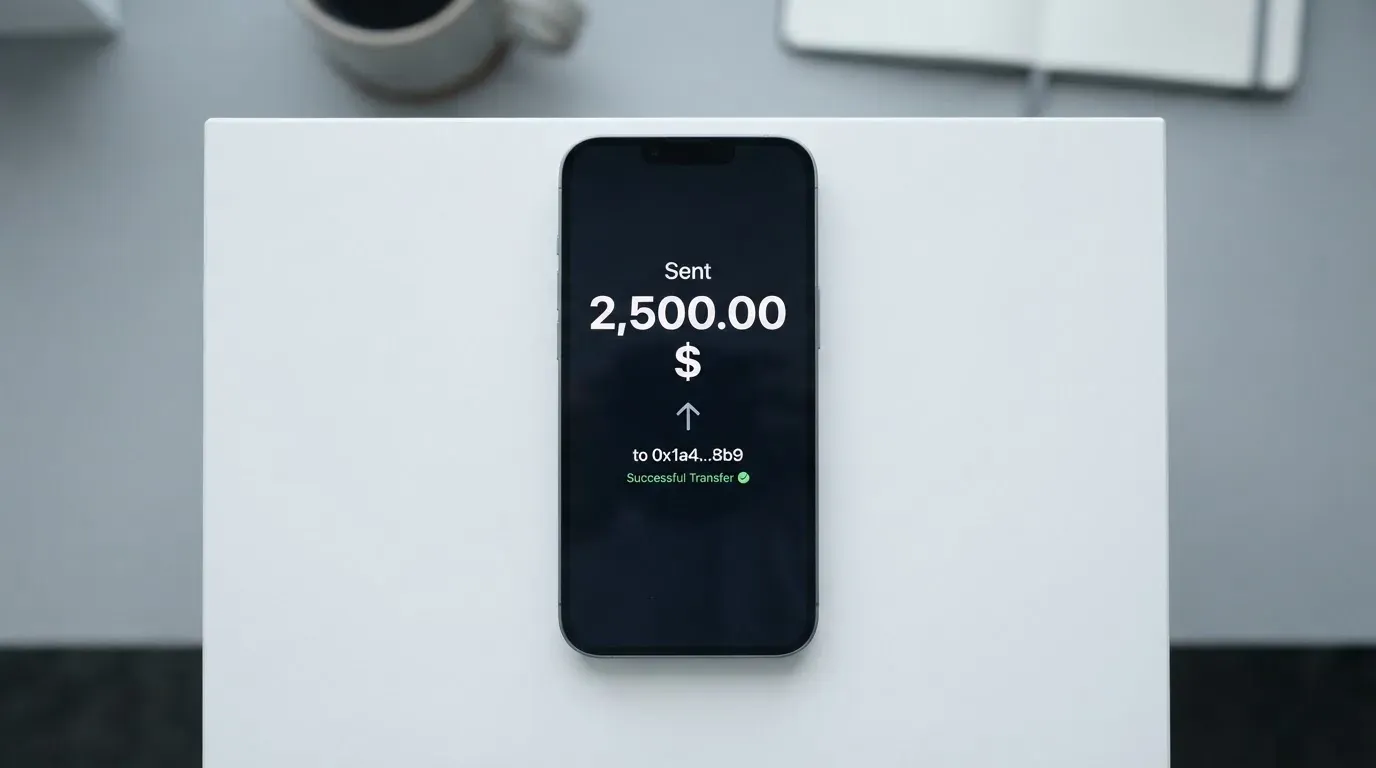
Deposits that go through a Web3 smart contract can take up to 10 minutes. There is no separate deposit fee charged by Pay It Now, but the spread between the rate you see and the rate you get still applies, and you also pay the network fee (gas, bandwidth) on the blockchain, not on the card. The card’s daily load cap is USD 5,000, with a yearly load cap of USD 100,000, and these are the same numbers whether you load once or in many small transfers.
A few practical points worth knowing before you fund the card for the first time:
- The minimum top-up amount is not stated, so check inside the app before sending a small test transfer.
- Fiat top-up (a regular bank transfer directly to the card) is not stated. The published path is crypto-to-USDC inside PIN.
- The card balance is denominated in USD; the underlying value is USDC. This matters if USDC ever lost its peg, and it is also why the card avoids the volatility of holding BTC or ETH on it directly.
- If you want to move value back, you can withdraw to the PIN wallet (fixed 0.2 USDC fee) or to a bank account. The bank account path is not detailed on the pages I read, so the practical step is to pull value back to the PIN wallet first and then off-ramp from there.
For someone whose main worry is “which coin can I load?”, the answer is essentially any major one PIN supports, and the only friction is the spread and the network fee on the deposit itself.
Paying with it every day
The card is a virtual Mastercard, so the only physical artefact is the card number in the app. From there, you have two real-world paths.
Google Pay. The card is compatible with Google Pay, so on Android you can tokenise the number and tap to pay anywhere contactless is accepted. This works today.
Apple Pay. From 11 May 2026, adding new Pay It Now cards to Apple Pay is paused “until further notice.” Existing cards that are already in Apple Pay continue to work, but if you get a new virtual card or rotate the number, you will not be able to push it to your iPhone. For someone whose main phone is an iPhone and who relies on Apple Pay, this is the most consequential line in the card’s terms right now, because it removes the smoothest way to spend from the card in a shop.
Online. The card behaves like any other Mastercard online. It supports 3-D Secure (Mastercard’s “Identity Check” brand), which means some merchants will send a one-time code or a biometric prompt in the PIN app to confirm the payment. The exact behaviour of the PIN app’s 3-D Secure flow is not described in the support pages I could read.
Where it does not work:
- No ATM withdrawals. A virtual card has no magstripe, no EMV chip, and no card reader slot, so cash access is not a feature. ATM fees are not stated because the path does not exist.
- Blocked categories are not stated. Some issuers block gambling (MCC 7995) or specific merchant types; Pay It Now does not publish a list, so you only find out by trying.
- Rewards and cashback are not stated. There is no published points, staking-yield, or cashback programme tied to spending.
Two more details on the everyday experience: the PIN app’s store ratings were not retrievable on 2026-10-21 (the store pages did not load for me), and dispute handling is done through a “Report” button under the transaction in the app, which opens a support ticket. The chargeback process, the timeframes, and the eligibility of any given transaction are not described in detail on the public pages.
What can go wrong
A crypto-funded prepaid card sits in two risk stacks at once: the card-payment stack and the crypto-custody stack. Pay It Now’s published safeguards cover some of each, but not all.
On the card side. You can cancel the card from inside the app, set a PIN, and view transactions as they happen. The company publishes a Security Guide at /securitycentre on its site. The standard 3-D Secure path applies for online payments. The card is prepaid, so it cannot overdraw. What the pages do not say is how customer funds are safeguarded (whether the USDC balance is segregated, insured, or held in a different legal entity from the operating company) — that detail is not stated.
On the support and reliability side. Trustpilot shows 4.0 out of 5 across 13 reviews as of 2026-10-21, with 77% of those at five stars and the company not having replied to negative reviews. The themes that show up in the negative ones are worth treating as warnings rather than outliers:
- Unresponsive support and an unexplained loss of crypto (July 2026 review).
- Unclear spread and an unanswered enquiry (April 2026 review).
- Delays and held transactions (February 2026 review).
If you keep meaningful funds on the card, or if you load crypto and immediately need to spend it, the response-time risk is real and it is the part of the product the official pages do not address.
On the operational side. The single most concrete recent event is the 11 May 2026 change: the addition of new Pay It Now cards to Apple Pay is paused. That is a real, dated, official fact, and it is the kind of change that a card programme can make with little notice. It is also a reminder that tokenisation into a mobile wallet is something the card issuer controls and can revoke; the card still works online, but the contactless path on iPhone is now narrower.
On the company side. The licensing picture is reassuring on paper: NZ FSP, AFSL, AUSTRAC registration, and an AFSL for the card issuer Immersve. What the licensing does not do is make the balance deposit-insured, and what the licensing cannot do is prevent the kind of programme-level changes that have hit other crypto cards in the past (Visa suspending WaveCrest-issued programmes in Europe in 2018, and Visa terminating its global agreement with FTX in November 2022). Pay It Now is on Mastercard, not Visa, so the FTX precedent is a category warning rather than a Pay It Now one, but the pattern — network or issuer changes that affect cardholders overnight — is real.
A separate, smaller risk: because the balance is held by Takeoff Media in USDC, the cardholder is exposed to whoever controls that USDC wallet. Stablecoins are not insured deposits, and although USDC has historically held its peg, it briefly lost it in March 2023 during the US banking crisis, and Tether’s USDT has had its own depeg episodes.
What to take instead
The alternatives below are all crypto-funded cards with virtual options, and they are useful comparisons if Pay It Now’s two-country restriction or its Apple Pay pause rules it out for you. None of them is a perfect substitute; each one solves a slightly different problem.
| Card | Score | Who it suits | Funding | Card form | Notable |
|---|---|---|---|---|---|
| Cardex | 5.6 / 10 | Marketed to 200+ countries; App Store listing is Naira-focused | USDT, USDC, BTC | Virtual and physical, on Verve, Visa, Mastercard, UnionPay | Conversion at the moment of payment using an “AI-Powered Conversion Rate”; no fee percentage published |
| CardFlow | 4.9 / 10 | Aimed at Nigerians and “global users” | BTC, USDT, ETH, or Naira bank transfer | Virtual USD Mastercard, created in about three minutes | Card creation is free; no monthly fee or fee schedule published |
| HyperCard | 4.7 / 10 | Acceptance advertised in 176+ countries (not eligibility) | USDT, BTC, ETH | Prepaid card, balance in USD or EUR | Network not stated; no fees listed on the App Store page |
A few honest caveats. Cardex’s “200+ countries” line is the marketing page, and the App Store listing is anchored to a Naira experience, so the actual eligibility story is less clear than it first looks. CardFlow’s site is light on fees and conditions, which is fine for transparency about the absence of fees and unhelpful if you want to plan a budget. HyperCard’s card network is not stated on the App Store page I read, which makes it hard to know what will and will not work at a given merchant.
If your priority is a card that is clearly available in your country and clearly states its fees, the right move is to treat the table above as a starting point and read the live terms on each card’s own site before committing. If your priority is a card for use in New Zealand or Australia specifically, Pay It Now is one of the few crypto-funded Mastercards in that market, and the alternatives in the table are mostly oriented to other regions.
Who I would recommend it to
I would recommend Pay It Now to a fairly specific reader: a New Zealand or Australia resident who is already on PIN, who already holds crypto and would rather not sell it for fiat first, who wants a USD-denominated virtual Mastercard for online payments, and who is happy using Google Pay on Android for in-store contactless. For that reader, the card does the job at a reasonable cost, and the published fees (no annual fee, 1.5% on non-USD purchases, spread on conversion) are clear enough to budget against.
I would not recommend it to:
- Anyone outside New Zealand and Australia. The card is not available to you, regardless of your crypto holdings or your immigration status.
- An iPhone-first user who relies on Apple Pay. New cards cannot be added to Apple Pay from 11 May 2026 onward, and that is a real loss of convenience.
- A user who needs cash access. The card is virtual only and has no ATM path.
- A user who plans to keep a large balance on the card for a long time. The published safeguards do not include anything that resembles deposit insurance, the company has not replied to negative Trustpilot reviews, and the support response-time risk shows up in user reports.
- A user who needs clear, itemised fees in writing. The spread is shown in the app but not as a published percentage, and that is the kind of detail that matters if you compare cards seriously.
If you fall into the first group, the card is worth trying with a small load. If you fall into the second, the card is best left alone until the Apple Pay path reopens and the published safeguards catch up to the support experience.
Frequently asked questions
What is Pay It Now card?
Pay It Now is a virtual, reloadable prepaid Mastercard issued by Immersve and distributed through the PIN Network app. The card’s balance is held in USDC and shown as USD, and the cardholder funds it by converting one of 50-plus crypto assets from a PIN wallet into USDC.
How does Pay It Now card work?
You apply inside the PIN app, complete a second KYC step with the card provider, top up the card from your PIN wallet, and then spend the USD balance online or through Google Pay. The crypto-to-USDC conversion happens inside PIN at a rate shown in the app, and the card’s daily spending limit is USD 20,000.
Is Pay It Now a bank?
No. Pay It Now is a financial-services brand, not a bank. The NZ and AU entities are licensed as a Financial Service Provider and an Australian Financial Services Licence holder respectively, and the card itself is issued by Immersve, which holds its own AFSL.
Who owns Pay It Now?
The brand is operated by Pay It Now NZ LTD (NZ FSP 1002374) and Pay It Now AUS PTY LTD (AFSL 700050, AUSTRAC DCE100820697-002). The card is distributed by Takeoff Media Limited (Authorised Representative 1313795), and the card programme is run by Immersve (AFSL 545925).
Is Pay It Now card available in my country?
It is available in New Zealand and Australia to PIN users. The company has said it is working on expansion into the United States and Europe, but those regions are not live on the public pages.
How do I apply for the card?
You apply inside the PIN app: open the Cards section, apply for a Pay It Now card, complete the card provider’s KYC, and top up. The virtual card is delivered in about 10 minutes after approval.
Does Pay It Now require KYC?
Yes. There are two KYC steps: the PIN account KYC and a separate KYC done by the card provider. The exact documents required, the address proof, and the minimum age are not stated on the public pages I read.
How do I top up the card?
You top up from your PIN wallet by converting one of 50-plus supported digital assets into USDC. Web3 deposits via smart contract can take up to 10 minutes, and the daily load limit is USD 5,000.
How do I withdraw money from Pay It Now?
You can withdraw value back to your PIN wallet (a fixed 0.2 USDC fee applies) or to a bank account. Withdrawal to a bank account is supported but the steps are not detailed on the public pages.
Is Pay It Now card worth it?
For a New Zealand or Australia resident who already uses PIN, it is a reasonable USD-denominated virtual Mastercard with no annual fee and a published 1.5% non-USD transaction fee. For anyone else, the two-country restriction, the paused Apple Pay additions, and the absence of a deposit-insurance-style safeguard make it harder to recommend as a primary card.
Choosing a virtual card – cryptocardadvisor
Content created by the «cryptocardadvisor» team