
The Nebeus card is cheap to open and easy to fund with crypto, but the card pages leave too much unsaid — and a 2026 stablecoin change closed one funding route.
 Available in US
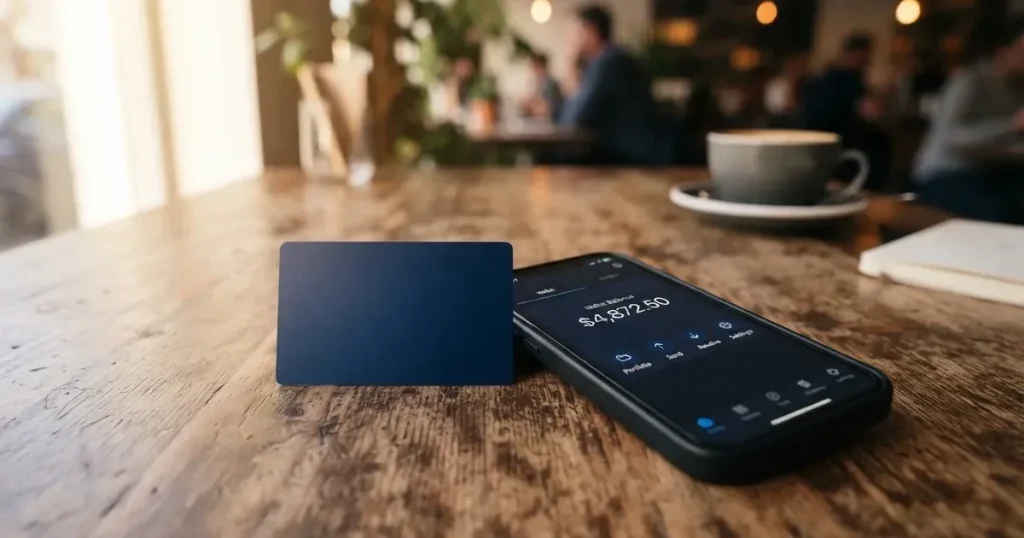
The Nebeus card is a Mastercard debit card that spends from a Nebeus account holding both crypto and fiat balances. You load it with crypto or with a SEPA bank transfer, the balance converts at the point of sale, and you spend it like an ordinary card. That is the whole idea, and on paper it is a clean one: no branch, no payroll, no bank account in your own name required — the account comes with an IBAN-style arrangement rather than a plain savings account.
That is also where the difficulty sits. The Nebeus public pages are unusually quiet on the details that decide whether a card is useful to you: the monthly fee, the conversion spread, the foreign-exchange fee, the spending limits, and what happens to a card application that is turned down. Third-party reviewers fill in some of the blanks, but they are third-party reviewers, not the company. My score is 6.2 out of 10, which is a card I would describe as promising for one specific person and a poor fit for anyone shopping on price.
The conditions described here are current as of October 28, 2026.
Verdict: 6.2 out of 10
| Criterion | Mark | Why |
|---|---|---|
| Who can get it | 5 / 10 | 128 restricted countries; the United States, United Kingdom, Netherlands, Israel and Hungary are among them, and access depends on where you live |
| Cost | 8 / 10 | Issuance is “free of charge”; unofficial sources say 0% FX and 0% crypto loading, but no monthly fee is published |
| Top-up options | 6 / 10 | BTC, ETH, USDT, USDC, LTC, BCH, XRP over Bitcoin, Ethereum, Tron and Litecoin networks, plus free SEPA — but USDT and USDC deposits stopped for personal accounts on 5 April 2026 |
| Reliability and complaints | 4 / 10 | MiCA licence from CNMV, issuer Quicko Sp. z o.o.; Trustpilot complaints about unexplained card rejections and silent support, Google Play 3.5 |
| Everyday use | 8 / 10 | Virtual and physical Mastercard, ATM up to 2,000 EUR/USD/GBP a month; unofficial sources report Apple Pay and Google Pay |
Total: 6.2 / 10.
So who is this for? In my reading, a resident of Europe who already holds crypto, wants a card and an IBAN-style account, and would rather not pay a monthly subscription to have them. That person gets a genuinely free way in, a real Mastercard number, and SEPA transfers that cost nothing.
Who it does not suit: anyone who needs published spending limits, a stated cash-back rate, a named monthly fee, or a support desk that answers. It also does not suit a US, UK, Dutch, Israeli or Hungarian resident, because those countries are on the restricted list — a restriction that follows residence, not citizenship.
The score is not lower because the card is unsafe. It is licensed, safeguarded, and insured. The score is held down by transparency and by the complaints.
Will they give you the card
Nebeus lists 128 restricted countries, and among them Belarus, the Russian Federation, Ukraine, the United States, the United Kingdom, the Netherlands, Israel and Hungary. That is a long list, and it removes a lot of people who might otherwise have been good customers.
The important detail is *how* the restriction is applied. The card’s own wording is that access is permitted only to natural persons or legal entities “residing in jurisdictions not subject to international sanctions”. So the test is where you live, not what is in your passport. A British citizen living in Spain is in a different position from a British citizen living in London — and if you are one of the two, you should read that sentence twice before anything else on this page.
There is a second rule that catches people out. The KYC article states: “If you are a resident or citizen outside Europe, the only accepted identity document for KYC verification is a valid passport.” A national ID card is not enough if either your residence or your citizenship is outside Europe. That is stricter than most, and it is worth knowing before you upload anything.
One KYC level, not several. There is no tiered verification here — no faster unverified tier and no higher tier for large balances. You submit a document, a proof of address and a video selfie, and the review either passes or does not. Minimum age is 18.
The company states four rejection reasons: appearance on international sanctions lists, a high-risk classification under its internal compliance rules, incomplete or inconsistent documentation, and failure to provide updated information. That third one is the ordinary, boring reason most people hit. The second one is the one you cannot see coming.
Behind the brand sits a real structure: Nebeus is owned by Rintral Trading SLU, incorporated in Spain at C/ de la Llacuna 11, 08005 Barcelona. The card issuer is Quicko Sp. z o.o., a licensed financial institution registered in Poland, REGON 142004870. Nebeus is authorised under the EU’s MiCA framework by Spain’s CNMV, also licensed as an EMI in the UK by the FCA, registered as an SRO in Switzerland, and authorised as a VASP and PI in Argentina. It is registered with the Bank of Spain under registration number D664.
So Nebeus is not a bank and not an anonymous offshore operation. But it is also not your bank, and it is not the issuer — Quicko is. That distinction matters when something goes wrong.
How to get it
The route is short: register on the platform, complete KYC, then order either a virtual or a physical card in the app. There is no branch, no paper application and no waiting for a postal invitation.
The KYC package is a valid passport or national ID card, proof of address, and a video selfie. Minimum age 18. As noted in ‘Will they give you the card’, anyone resident or holding citizenship outside Europe must use a passport.
Both card forms are Mastercard debit cards — virtual and physical. No metal card is mentioned anywhere. Card currencies are EUR, GBP and USD, so you pick the currency your account is denominated in rather than a currency you change later.
What the public pages do not say is where the physical card is delivered to, how long it takes, whether it costs anything, or what a replacement costs if you lose it. That is not stated. It is the kind of information that matters a great deal if you are outside Europe and depend on the plastic, and I would not sign up expecting the answer to be obvious from the site.
There is an article titled “How Long Does Verification Take?” — the content of it was not available to me, so I will not invent a number for you. Assume for planning purposes that you do not know, and find out before you rely on the card for anything time-sensitive.
Fees: what it really costs
The costs table is where a lot of card reviews go quiet. Here is everything the card actually publishes, and everything it does not.
| Item | What is stated |
|---|---|
| Issuance | “free of charge” (Nebeus website) |
| Monthly or annual fee | not published on the consumer site |
| Crypto conversion fee or spread | not stated |
| FX fee when paying in another currency than the card’s | not stated; the page mentions “automatic foreign currency exchange” without a percentage |
| ATM fee beyond the free limit | not stated |
| ATM withdrawal limit | 2,000 EUR, USD or GBP per month |
| Daily and monthly spending limits | not stated |
Read that table again and you will notice what it is. Issuance is free and that is genuinely free. Everything that would tell you what a payment actually costs you is blank.
Third-party reviews fill some of it in. One July 2026 comparison, which is unofficial and not confirmed by Nebeus, reports an FX fee of 0% and a crypto loading fee of 0%. Another, also July 2026, says that issuance and monthly fees are not transparently published and advises verifying in the app. I am showing you these because they are the best available picture, not because the company stands behind them.
That “free of charge” in the FX row should make you cautious rather than happy. A 0% figure usually means the margin moved somewhere — into the conversion rate, into the network rate, or into a spread you are not shown. The card page does not publish a conversion spread, and a spread is the most common way a card charges you without appearing to.
So what does a real payment cost? Take three ordinary days.
- A coffee in a euro country, paying in EUR from a EUR balance. No conversion, no FX. Whatever the card charges you here is whatever it charges you, and on the published page that is nothing at all. This is the cleanest case.
- The same coffee in a country where the card is denominated in USD. The card applies “automatic foreign currency exchange” and the page names no fee. You are told there is an exchange happening and not told what it costs. This is where the unnamed spread lives.
- A subscription priced in USD paid for from crypto. Your crypto has to become fiat first, and the conversion fee or spread for that step is not stated. A euro-to-dollar payment already had one unknown; this one stacks a second on top.
There is no paid tier structure published on the consumer site either — virtual and physical are options, not rungs on a ladder. That means no Pro plan to unlock better rates later.
The one limit that *is* published is the ATM: 2,000 EUR, USD or GBP a month, physical card only. A fee beyond that limit is not stated. What is not stated at all, and one third-party review flags explicitly, is any spending limit at all — daily or monthly. If the card has no spending cap, that is convenient until the moment the card is cloned, and if it does have one, you would want to know its number before you need it.
How to Top up
The card spends from the Nebeus account balance, so topping up is the only decision that matters.
There are two routes, and only two routes.
By crypto. Confirmed assets: BTC, ETH, USDT, USDC, LTC, BCH, XRP. Confirmed networks: Bitcoin, Ethereum, Tron, Litecoin. No deposit fee is stated, but you pay the blockchain’s own network or gas fee on your deposit — that is the chain’s charge, not Nebeus’s.
By SEPA bank transfer in EUR. The deposit fee is free. You can use your personal IBAN or a reference-based deposit.
Card-to-card top-up is not stated. Minimum top-up is not stated. Those are small gaps, but they are gaps.
Now the part that matters most, and it is recent. On 5 April 2026, USDT and USDC deposits and withdrawals were halted for personal accounts as part of MiCA-driven changes. EURC still works. Business accounts were unaffected. So of the two stablecoins most people would have reached for first — USDT and USDC, which together account for about 90% of stablecoin market capitalisation according to the BIS in July 2025 — one route into a personal Nebeus account is closed as of that date, and the other is your EUR bank transfer.
If you were planning to fund this card with stablecoins, that is the single fact to check before anything else. If you were planning to fund it from a bank account, the change does not touch you.
The pattern of this is worth understanding before you move money. Stablecoins are not censorship-proof, and the example is not theoretical: Circle stopped supporting USDC on Tron in February 2024, Tether says it disables tokens in wallets on the OFAC sanctions list and has frozen funds tied to illicit activity, and in this case a compliance change shut a deposit route for personal accounts overnight. Rules in this category move, and the way to protect yourself is to know which routes you actually have before you need them.
Getting money back out follows the same shape. Crypto withdrawals go to an external wallet over Bitcoin, Ethereum, Tron or Litecoin. Fiat goes out via SEPA from your IBAN account. Closing the account means contacting support; the site references a closure policy, but the fee and how the balance is handled are not publicly displayed.
Paying with it every day
Both card types are Mastercard. You can hold crypto and fiat balances in the same account and the card switches currency at the point of sale, converting automatically.
Apple Pay and Google Pay are not mentioned on the official site. A third-party source from July 2026 says both are supported — again, unofficial and not confirmed by the card, but it is the sort of thing that decides whether a card becomes your main one or a card for the things your phone wallet does not cover.
No cash-back is mentioned anywhere, on the official site or in any source I looked at. No blocked merchant categories are listed. That second point is not a bonus: MCC 7995 covers gambling, and many issuers block it on specific cards by policy rather than by law, with the list varying by issuer. Nebeus does not publish one, so you do not know whether gambling, adult content, or fuel stations will decline.
The app is on iOS and Android. Google Play shows 3.5 stars across 448 reviews, 100K+ downloads, last updated 11 February 2026.
Two everyday mechanics are worth understanding regardless of who issues your card. Declined authorisations can leave a hold on your balance that stays for several days, typically up to seven — so a failed hotel deposit can quietly tie up money. And a merchant can look up your card’s issuing country from the first digits and, if it differs from your billing address, apply extra scrutiny. That is why a card issued in one country can look foreign to a shop in another, and it is a real cause of declines that has nothing to do with you.
Disputes follow Nebeus’s Chargeback Policy and card network rules. You must try to resolve the problem with Nebeus first. Valid grounds are unauthorised charges, technical errors and confirmed fraud. An unjustified chargeback can cost you: processing fees, acquirer penalties and investigation costs may be recovered from you. And refunds are effectively final — “operations are considered final once confirmed and are not eligible for a refund”, except at Nebeus’s sole discretion where a technical error is demonstrated to be theirs.
That last sentence is the one to sit with. Once a payment is confirmed, your remedy is narrow and discretionary. Choose the card for what you want to spend, not for what you might need to argue about.
What can go wrong
I found no official incidents — no hacks, no shutdowns — in the period I looked at. What I found instead is a consistent stream of user reports.
The Trustpilot score and review count were not accessible to me, so I cannot give you a rating. The themes below are individual user reports, and I am presenting them as reports rather than as established fact.
- Card applications rejected without explanation, August 2025: “They deny the cards with no reason and without asking for information.”
- Slow or unresponsive support, August to December 2025: “They doesn’t answer the mails anymore” and “support will give you the run around forever and you wont get your funds back. TOTAL SCAM SITE”.
- Platform bugs, December 2025: “Their system is full of bugs and nothing works.”
Read those together and a pattern emerges: the complaints are less about lost money than about being left in the dark. A rejection you cannot query, a support queue that goes silent, an app that does not do its job. For someone whose plan is “hold a card as a backup”, a card you cannot activate or a support desk that does not reply is not a backup at all.
On the positive side, the safety architecture is conventional and reasonable. Crypto assets are held by Nebeus in segregated accounts under MiCA Article 75, custody is through BitGo with Lloyd’s of London insurance coverage of $250M, and fiat funds are “held in segregated safeguarding accounts in accordance with applicable regulation”. Two-factor authentication is strongly recommended and may be required in certain cases. Accounts can be “preventively blocked” on detection of suspicious activity.
Understand what that safeguarding does and does not mean. E-money funds are segregated or insured; they are not bank deposits and may not be covered by a deposit guarantee scheme. If you are reading this because a normal bank card is not available to you, the honest summary is that this is a different category of risk, not a lower one.
A few structural notes. Deposits on a network the provider does not support, or to an address belonging to another network, can be lost or need manual recovery with no guarantee — transfers are irreversible. On Ethereum, gas must be paid in ETH, so a wallet holding USDT with no ETH behind it cannot send. And Nebeus can refuse you: under EU due-diligence rules, if the checks cannot be completed the institution must refrain from the transaction or end the relationship, which is why accounts close or freeze pending documents.
The company news explains a lot of this. On 5 April 2026, MiCA-driven changes halted USDT and USDC for personal accounts. On 10 June 2025 Nebeus published Tax Reporting FAQs. On 31 March 2025 it removed Dash from the platform. And it holds MiCA authorisation from Spain’s CNMV, stated on the current site though the date is not published as a separate news item.
One note on support: the channels are 24/7 live chat with an average reply of two minutes, and email at [email protected]. The website is available in English and Spanish. The two-minute average and the reports of silence are not necessarily contradictory — a chat that answers quickly and an email queue that does not are very different experiences — but it is worth knowing which one you are relying on before you need it.
What to take instead
Three alternatives came up in my comparison, and the honest summary is that all three of them publish more than Nebeus does. That is not nothing.
| Nebeus | International Visa Card | UNi Card | Whop Cards | |
|---|---|---|---|---|
| Score | 6.2 | 6.7 | 6.1 | 5.2 |
| Network | Mastercard | Visa | Mastercard | Visa |
| Card | Virtual + physical | Virtual (physical “coming soon”) | not stated | not stated |
| Issuance | free of charge | $5 one-time | not stated | no extra fees |
| Monthly | not published | none; plans Classic free, Pro $9.00/month, Max $19.00/month | “No annual fee” | no extra fees |
| FX / conversion | not stated (unofficial: FX 0%) | Visa exchange rate + 2% FX fee | “No foreign transaction fee”, live OTC rates, “no hidden exchange fees” | not stated |
| Top-up | crypto (BTC, ETH, USDT, USDC, LTC, BCH, XRP) or free SEPA EUR | USDC or USDT free at 1:1; also USD, EUR, SEPA, SWIFT, FedNow | not stated | Whop balance |
| Rewards | none mentioned | none stated | spend-to-Earn up to 3% | 5% cashback at select merchants, currently Uber |
| Availability | 128 restricted countries, residence-based | excludes residents of Belarus, mainland China, North Korea, Cuba, India, Iraq, Iran, Israel, Myanmar, Nepal, Nicaragua, Russia, Syria, Turkey, Ukraine, Venezuela, Vietnam | not stated | 31 US states for consumers, 41 for businesses |
International Visa Card scores highest of the four at 6.7. It publishes what Nebeus does not: $5 issuance, plans at Classic free / Pro $9.00/month / Max $19.00/month, and a plainly stated “Visa exchange rate + 2% FX fee”. It is a US-issued Platinum Visa, virtual, paying in USD, with physical “coming soon” — so if you need plastic, it is not there yet. Deposits of USDC or USDT are free at 1:1, and it also takes USD, EUR, SEPA, SWIFT and FedNow. Its country list is narrower and different: no Israel, no Netherlands, no United Kingdom, no United States, but no Hungary either. For someone who wants the fee printed on the page, this is the easier product to understand.
UNi Card scores 6.1 — just under Nebeus. A multicurrency Mastercard spending from the UNi.Global account, with “no annual fee or foreign transaction fee”, assets converted at “live OTC rates” and “no hidden exchange fees”, plus spend-to-Earn rewards up to 3%. But the pages do not state who can get it, how you fund it, or whether a physical card exists, and the annual fee line leaves issuance unstated. The fee promise is attractive and unusually specific; the missing basics are the same ones Nebeus has.
Whop Cards scores 5.2. It is the narrowest of the four: Visa, working anywhere Visa is accepted, spending from a Whop balance, with 5% cashback at select merchants (currently Uber) and a page saying “no extra fees”. But conversion and FX amounts are not stated, coins and networks are not stated, the balance itself is backed by stablecoin collateral from a linked wallet, and it is limited to 31 US states for consumers. If you are reading this from outside the US, it is not an option.
The pattern across all four is worth stating plainly: every one of these cards has information it does not publish. Nebeus’s silence is the most consequential, because it is the one whose whole appeal is that the card is free.
Who I would recommend it to
I would recommend the Nebeus card to a resident of an eligible European country who already holds crypto, wants a Mastercard in EUR, GBP or USD plus an IBAN-style account, and is not planning to lean on it as their only card. Under those conditions it is a good deal: issuance free, SEPA free, several networks supported, a real licensed structure behind it.
I would not recommend it if your normal bank card works. There is no cash-back, no published spending limits, no named conversion fee, and reports of rejections with no explanation. If the card is your only route to spending, the things you are least able to find out — what a payment costs, why you were refused — are exactly the things that matter.
And I would think hard before applying if you are resident in the United States, United Kingdom, Netherlands, Israel or Hungary, if you are relying on a national ID card while living outside Europe, or if you plan to fund it with USDT or USDC — that deposit route stopped for personal accounts on 5 April 2026. EURC still works, and SEPA still works.
Two things to check before you commit: what the app shows you for the conversion rate and any monthly fee, since the website does not; and whether the physical card is delivered to your country, at what cost, and what a replacement costs. Neither is stated.
Frequently asked questions
What is the Nebeus card?
The Nebeus card is a Mastercard debit card that spends from a Nebeus account, which holds both crypto and fiat balances. You load it with crypto or a SEPA bank transfer and the balance converts at the point of sale. Both a virtual and a physical version exist, in EUR, GBP or USD. Nebeus is owned by Rintral Trading SLU in Spain; the card itself is issued by Quicko Sp. z o.o. in Poland.
How do I get a Nebeus card?
Register on the Nebeus platform, complete KYC with a passport or national ID card, proof of address and a video selfie, then order a virtual or physical card in the app. Minimum age is 18. Issuance is free of charge. Residents and citizens outside Europe must use a passport rather than a national ID. Delivery countries, time and cost are not stated on the public pages.
Is Nebeus a bank?
Not exactly. Nebeus is a crypto platform authorised under the EU’s MiCA framework by Spain’s CNMV and also licensed as an EMI in the UK by the FCA. It is registered with the Bank of Spain under number D664, and the card is issued by Quicko Sp. z o.o., a licensed Polish institution. It is a regulated provider, but it is not the same thing as holding money at a retail bank.
Is the Nebeus card free?
Issuance is free of charge, and SEPA EUR deposits are free. A monthly or annual subscription fee is not published, and the conversion fee or spread is not stated either. A third-party source from July 2026 reports 0% FX and 0% crypto loading fees, but that is unofficial and not confirmed by Nebeus. Check the app before relying on it.
Can I still deposit USDT or USDC?
For personal accounts, no. On 5 April 2026 Nebeus halted USDT and USDC deposits and withdrawals as part of MiCA-driven changes. EURC still works, and business accounts were unaffected. BTC, ETH, LTC, BCH and XRP remain supported, over Bitcoin, Ethereum, Tron and Litecoin networks, and SEPA EUR bank transfers still work.
Where can I use the Nebeus card?
Anywhere Mastercard is accepted, online and in shops, in EUR, GBP or USD depending on the card currency. ATM withdrawals work with the physical card up to 2,000 EUR, USD or GBP per month. Apple Pay and Google Pay are not stated on the official site, though a third-party source from July 2026 says both are supported. No blocked merchant categories are published.
Does Nebeus card require KYC?
Yes. There is a single KYC level: a government ID, proof of address and a video selfie, with a minimum age of 18. Residents or citizens outside Europe may only use a valid passport. Nebeus states four rejection reasons: sanctions-list appearance, internal high-risk classification, incomplete or inconsistent documents, and failure to provide updated information.
Is the Nebeus card safe?
The structure is conventional: crypto held in segregated accounts under MiCA Article 75, custody through BitGo with $250M of Lloyd’s of London insurance, and fiat held in segregated safeguarding accounts. Two-factor authentication is recommended and sometimes required. But e-money funds are not bank deposits and may not fall under a deposit guarantee scheme, and users report unexplained card rejections and unresponsive support on Trustpilot.
What are the Nebeus card’s limits?
The published limit is 2,000 EUR, USD or GBP per month for ATM withdrawals, physical card only. Daily and monthly spending limits are not stated, and one third-party review says the card publishes no spending limits at all. A declined payment can also leave a hold on your balance for several days, typically up to seven.
How do I withdraw money or close my account?
Crypto goes out to an external wallet over Bitcoin, Ethereum, Tron or Litecoin networks; fiat goes out by SEPA from your IBAN account. Blockchain transfers are irreversible, and you pay the network’s own fee on the way in. Closing the account means contacting support — a closure policy is referenced, but the fee and how the balance is handled are not publicly displayed.
Choosing an app or neobank card – cryptocardadvisor
Content created by the «cryptocardadvisor» team